Google AI Agents Dominate I/O 2026: 5 Breakthroughs That Change Everything
Google AI agents are no longer a future promise — at Google I/O 2026, they became the centrepiece of the company’s most ambitious product event in years. Across Gemini, search, Android, and next-generation hardware, Google made one thing unmistakably clear: it intends to control the AI-powered entry point to the internet.
Table of Contents
What Google AI Agents Mean for Everyday Users
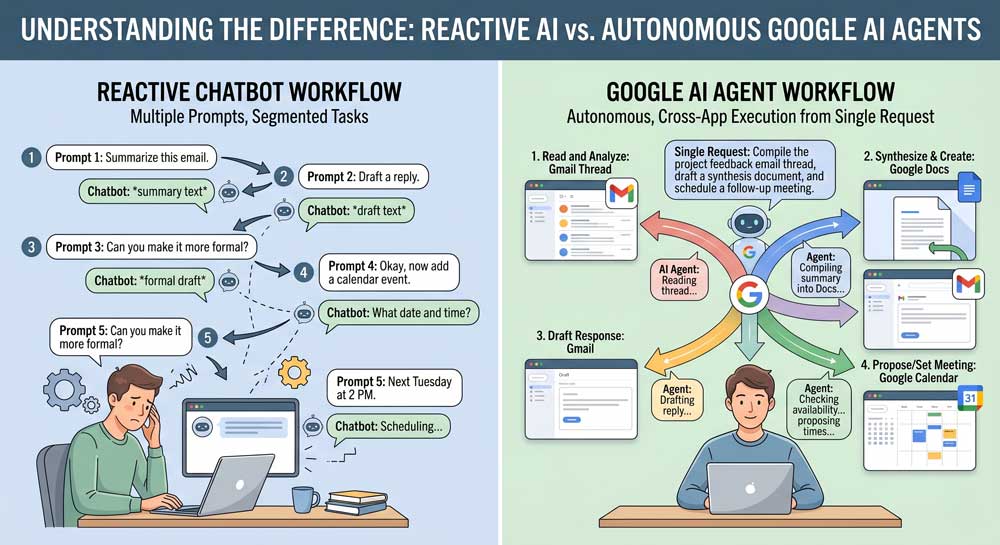
Before diving into specific announcements, it is worth defining what separates an AI agent from a standard chatbot. A chatbot responds to prompts. A Google AI agent understands a goal, breaks it into steps, executes those steps across multiple tools and services, and returns a completed outcome — often without further input from you.
That distinction is the thread running through every major announcement at this year’s event.
The 4 Core Tracks of Google I/O 2026
Track 1: Gemini 3.5 and the Speed Advantage
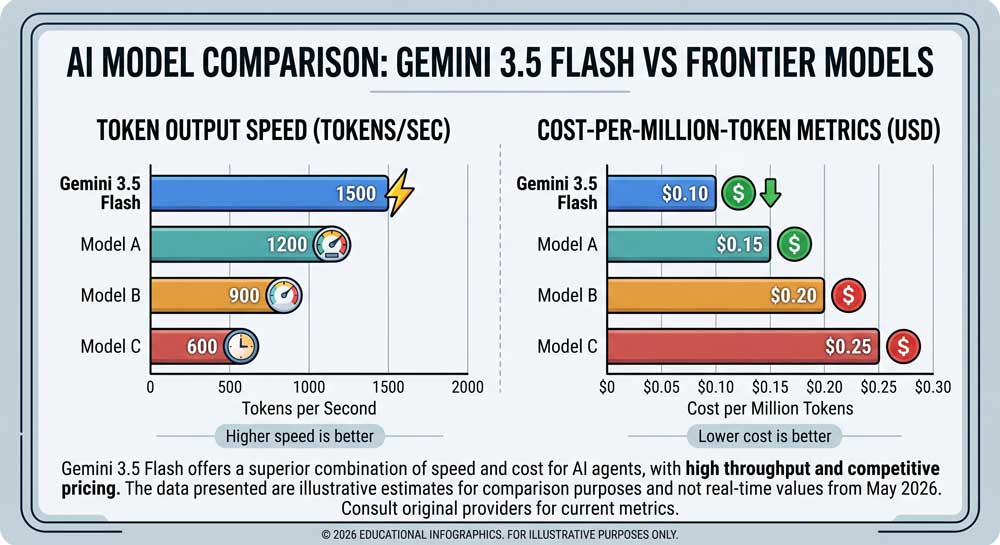
The Gemini 3.5 Flash model leads Google’s updated model lineup — a leaner, faster variant engineered for the high-frequency workloads that Google AI agents depend on: continuous background execution, bulk information processing, real-time retrieval, and sustained multi-step task chains.
At four times the output speed of comparable frontier models — and twelve times faster in the optimised version embedded within Project Antigravity 2.0 — Gemini 3.5 Flash delivers this performance at less than half the cost of equivalent-tier alternatives. That price-to-performance ratio is not incidental. It is precisely what makes large-scale agentic deployment economically viable for both developers and end users.
The Pro variant is scheduled for a follow-up release, targeting more complex reasoning tasks where raw speed is secondary to depth of analysis.
Track 2: Gemini Spark — Google AI Agents for Personal Productivity
Gemini Spark is the most direct consumer expression of Google’s agentic ambitions. It functions as a 24/7 personal assistant that operates continuously in the background — integrated with Gmail, Google Docs, Sheets, Slides, and Calendar — organising information, drafting content, generating daily summaries, and advancing tasks even when you are not actively at your screen.
What sets Spark apart from earlier AI assistant products is its approach to trust and transparency. The agent’s reasoning process is surfaced to users wherever possible, and sensitive or irreversible actions require explicit confirmation at defined checkpoints rather than executing autonomously from end to end. This design reflects a broader principle: Google AI agents only become genuinely useful when users feel confident they remain in control.
Track 3: Antigravity 2.0 — Multi-Agent Collaboration at Scale
Project Antigravity 2.0 marks the most significant architectural shift in Google’s developer tooling. The first version was, in practical terms, a capable coding assistant. The 2.0 release is a multi-agent coordination platform — multiple specialised agents working in parallel, each assigned a distinct function: task decomposition, code generation, content synthesis, quality review, and result integration.
This is Google AI agents working as a team rather than a single assistant. Combined with Gemini 3.5 Flash, the system handles complex, multi-step development projects with a responsiveness that earlier AI toolchains could not approach. For developers, the repetitive cycle of manually switching contexts, reformatting outputs, and re-prompting across tools begins to give way to an automated, coherent workflow.
Track 4: Search, Android, and Smart Glasses
Search is being repositioned from a link-distribution engine into a direct-answer workstation — one that pre-organises information, surfaces relevant context, and delivers responses you can interrogate further without opening multiple browser tabs. The Google AI agents layer sits beneath this experience, doing the retrieval and synthesis work that previously fell to the user.
On Android, Gemini integration at the system level means AI can now coordinate cross-app workflows — chaining actions that previously required manual navigation across multiple applications. The implications run considerably deeper than any individual feature update.
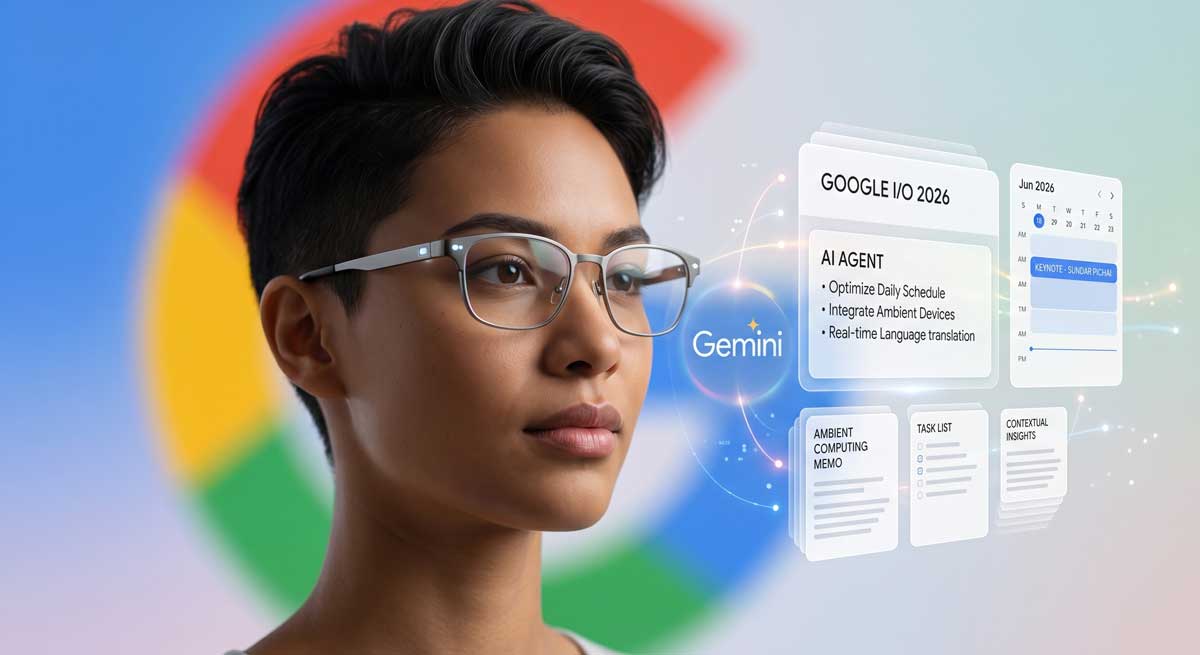
Hardware-wise, Android XR smart glasses attracted the most attention, particularly partnerships with Samsung, Warby Parker, and Gentle Monster. These devices target practical everyday utility — real-time translation, heads-up notifications, voice assistance, and navigation prompts — with an explicit goal of moving Google AI agents from the smartphone screen into ambient, wearable presence.
Comparing Google’s AI Evolution
| Dimension | Before I/O 2026 | After I/O 2026 |
|---|---|---|
| Search | User queries → list of links | AI-synthesised answer + contextual follow-up |
| Android | User manually opens apps | User states goal → AI coordinates apps |
| Productivity | Manual editing in Docs/Sheets | Gemini Spark drafts, organises, and summarises |
| Development | Step-by-step coding with AI suggestions | Antigravity 2.0 multi-agent full-workflow pipeline |
| Hardware interface | Smartphone screen | Smart glasses as ambient AI entry point |
Google AI Agents vs. Reactive AI: A Critical Distinction
Understanding why Google AI agents represent a genuine shift — rather than incremental improvement — requires distinguishing them clearly from earlier AI systems.
| Feature | Reactive AI | Google AI Agents |
|---|---|---|
| Trigger | User prompt each time | User-defined goal, once |
| Execution scope | Single response | Multi-step task chain |
| Duration | Session-based | Continuous / background |
| Tool access | Limited to chat interface | Cross-service: Gmail, Docs, Android apps |
| Output | Text answer | Completed task or deliverable |
| User confirmation | Every step | Key checkpoints only |
Three converging forces are driving Google in this direction. User behaviour has shifted — people increasingly expect systems to handle first-pass filtering and organisation rather than returning raw results for manual review. Competitive pressure has intensified — raw model capability is no longer a reliable moat, and habitual daily utility is. And structurally, Google holds advantages no challenger can quickly replicate: search, Android, Gmail, Docs, and Calendar form a high-frequency ecosystem that Google AI agents can plug into immediately.
The Business Tension at the Heart of This Strategy
The transition to Google AI agents does not just reshape user experience — it rewrites the economic logic of the web, including Google’s own revenue model.
Google’s most successful historical formula — users search, click links, generate traffic, trigger advertising — begins to erode when an AI agent answers the question directly and no click ever occurs. Publishers built content businesses on search-driven referral traffic. Advertisers built campaigns on click-through rates. Both assumptions weaken in a world where AI handles the first layer of every information interaction.
Google is navigating this tension deliberately. It is simultaneously defending and disrupting its own business model — a calculated bet that adapting now is preferable to ceding the entry point to a competitor. New advertising formats embedded within AI-generated answers, revised publisher partnership structures, and AI-driven visibility pricing are all likely responses, though none has been fully resolved publicly.
The Next Interface Era: Smart Glasses and Ambient AI
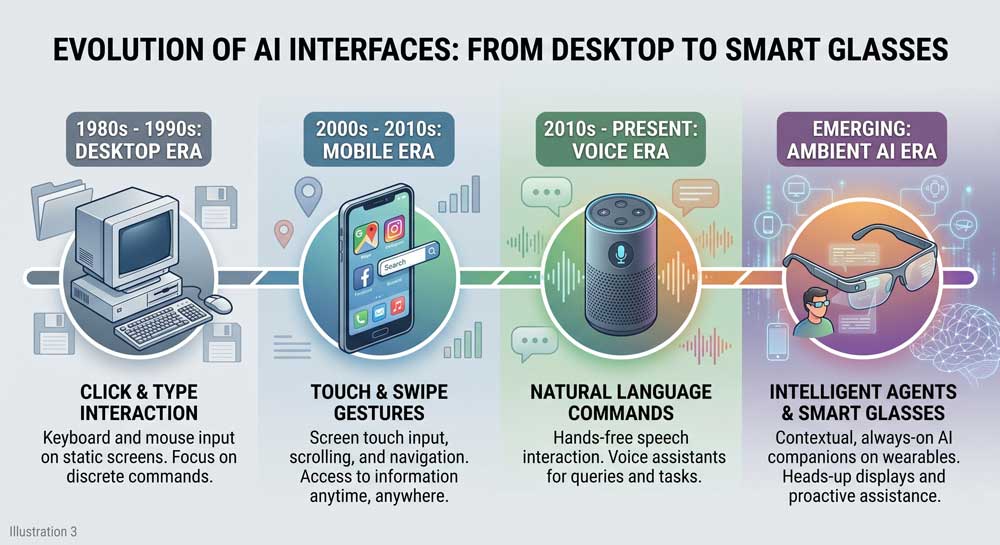
Every major platform transition in the past thirty years arrived alongside a new physical interface. The desktop browser, the mobile touchscreen, the voice-activated speaker — each redefined what an “entry point” meant. Smart glasses, if they achieve meaningful adoption, represent a potential fourth layer.
| Interface Era | Primary Device | Primary Interaction Mode |
|---|---|---|
| Desktop internet | PC | Mouse and keyboard |
| Mobile internet | Smartphone | Touchscreen and apps |
| Voice computing | Smart speaker / phone | Voice commands |
| Ambient AI (emerging) | Smart glasses / XR headset | Passive overlay and voice |
Google’s partnerships with consumer eyewear brands signal a clear understanding that hardware adoption is as much a lifestyle problem as a technology one. A wearable people are willing to put on every morning becomes an entry point by default. Google AI agents embedded in glasses — offering real-time translation, navigation, and contextual awareness — represent the most direct path toward ambient computing that the company has announced to date.
Why This Moment Is Bigger Than Any Single Product
Google has spent two decades controlling two pivotal entry points: search defined how people entered the web, and Android defined how people used mobile devices. The argument made at I/O 2026 — through products rather than statements — is that Google AI agents, powered by Gemini, should define how people interact with the AI-era internet.
This is a credible thesis. The infrastructure is in place, the model performance is competitive, and the ecosystem depth exceeds what any near-term challenger can replicate. The harder questions — how advertising evolves, how independent publishers survive, how users navigate privacy within always-on agents — remain genuinely open and will define the next chapter of this story.
What is not open is the direction. Google is building for a world where the first interface you encounter is not a search box or an app icon, but a Google AI agent that already understands what you are trying to accomplish.
Google I/O 2026 was not just another product showcase — it was a declaration of intent. With sweeping upgrades across Gemini, agentic AI, search, Android, and next-generation hardware, Google made its clearest statement yet about who it believes should control the AI-powered future of the internet.
Google I/O 2026: What Was Actually Announced
To understand why this event matters, it helps to organise the announcements across four distinct tracks. Each one signals a different dimension of Google’s strategy.
1. The Gemini 3.5 Series
The Gemini 3.5 Flash model leads the charge — a leaner, faster variant built for high-frequency workloads. While the Pro version is slated for a follow-up release, Flash targets the scenarios where speed and cost efficiency matter most: continuous agent tasks, bulk processing, real-time information retrieval, and sustained background execution.
At four times the output speed of comparable frontier models — and twelve times faster in the optimised version embedded within Project Antigravity 2.0 — Gemini 3.5 Flash delivers competitive performance at less than half the price of equivalent-tier models. That price-to-performance ratio is not incidental. It is the foundation on which scalable agent deployment becomes economically viable.
2. Gemini Spark: Your Always-On Personal Agent
Gemini Spark is Google’s answer to the personal agent category. Think of it as a 24/7 assistant that operates continuously in the background — connected to Gmail, Google Docs, Sheets, Slides, and Calendar — organising information, drafting content, generating daily briefs, and advancing tasks even when you are not actively at your screen.
Critically, Google has built transparency and user control into the design. Spark’s reasoning process is surfaced where possible, and sensitive actions require explicit confirmation at key checkpoints rather than executing autonomously end-to-end. This reflects a broader understanding that user trust is not optional — it is the product.
3. Project Antigravity 2.0: From Code Editor to Multi-Agent Platform
Project Antigravity 2.0 marks a significant architectural shift. The previous version was, in essence, a smart coding assistant. The 2.0 release is a multi-agent coordination platform — multiple AI agents working in parallel, each assigned a distinct role: task decomposition, code generation, content synthesis, quality review, and result integration.
When combined with Gemini 3.5 Flash’s speed, the system handles complex, multi-step projects with a responsiveness that earlier AI toolchains could not approach. For developers, this means that the repetitive cycle of manually switching contexts, reformatting outputs, and re-prompting across tasks begins to give way to a more fluid, automated workflow.
4. Search, Android, and New Hardware
Search is being repositioned from a link-distribution engine into a direct-answer workstation — one that pre-organises information, surfaces context, and delivers responses you can interrogate further without opening multiple tabs.
On Android, the integration of Gemini at the system level means AI can now participate in cross-app workflows — chaining tasks that previously required manual navigation across multiple applications. The implications here run deeper than any single feature update.
Hardware-wise, Android XR smart glasses drew the most attention, particularly partnerships with Samsung, Warby Parker, and Gentle Monster. These glasses target practical everyday utility: real-time translation, heads-up notifications, voice assistance, and navigation prompts. The design goal is explicit — move AI from the phone screen one step closer to ambient, always-available presence.
Google’s Core Strategy: Owning the Middle Layer
The real story of Google I/O 2026 is not any individual product. It is the consistent, deliberate effort to insert an AI layer between users and everything they do online.
| Dimension | Previous Model | Google’s AI-Era Model |
|---|---|---|
| Search | User queries → list of links | Query → AI-synthesised answer + context |
| Android | User opens apps manually | User states goal → AI coordinates apps |
| Productivity | Manual editing in Docs/Sheets | Gemini Spark drafts, organises, and summarises |
| Development | Developer writes code step-by-step | Antigravity 2.0 multi-agent pipeline handles full workflow |
| Hardware | Smartphone as primary interface | Smart glasses as ambient AI entry point |
This “middle layer” concept is straightforward: rather than users facing web pages, apps, and system menus directly, they increasingly interact with an AI intermediary that then retrieves, executes, and organises everything behind it. Whoever controls that intermediary controls the new internet entry point.
For Google, this is both an opportunity and a tension. Its most successful historical model — users search, click links, generate traffic, trigger ads — begins to erode when AI answers the question directly and the click never happens. Google is simultaneously defending and cannibalising its own business model. The fact that it is doing so deliberately suggests a calculated bet: adapt now or cede the entry point to a competitor.
Why AI Agents Are the Real Headline
If I had to distil Google I/O 2026 into a single theme, it would be the move from reactive AI to proactive AI — from systems that answer questions to systems that complete objectives.
The distinction matters enormously. A reactive AI waits for your input. A proactive agent understands your goal, breaks it into steps, executes them across multiple tools and services, and delivers an outcome. Gemini Spark and Antigravity 2.0 are both expressions of this shift.
| Feature | Reactive AI | Agentic AI (Google’s Direction) |
|---|---|---|
| Trigger | User prompt | User-defined goal |
| Execution | Single response | Multi-step task chain |
| Duration | Session-based | Continuous / background |
| Tool use | Limited | Cross-service (Gmail, Docs, Android apps) |
| Output | Text answer | Completed task or deliverable |
Three forces are driving Google in this direction. First, user behaviour has genuinely shifted — people increasingly expect systems to handle initial filtering and organisation, not just return raw results. Second, the competitive landscape has compressed — raw model capability is no longer a reliable moat, and habitual daily utility is. Third, Google holds structural advantages no competitor can easily replicate: search, Android, Gmail, Docs, and Calendar form a high-frequency ecosystem that agents can plug into immediately.
The Business Implications
The transition to agentic AI does not just reshape user experience — it rewrites the economic logic of the web.
Content publishers built their revenue models on search-driven traffic. If AI summaries satisfy queries before a single click is made, referral traffic drops. Advertising inventory changes in form and placement. The open web’s traditional discovery mechanism — write good content, rank well, attract visitors — becomes structurally weaker.
Google is navigating this carefully. Its challenge is to retain advertiser revenue and publisher relationships while deploying AI that inherently reduces click-through rates. The answer likely involves new ad formats embedded within AI-generated answers, new pricing models for AI-driven visibility, and new publisher partnership structures. None of this has been fully resolved, and that ambiguity represents both risk and opportunity for anyone operating in the digital content or advertising space.
Smart Glasses and the Next Entry Point
The Android XR smart glasses announcement deserves separate attention, not because the product is ready today, but because of what it represents strategically.
Every major platform shift in the past thirty years has come with a new physical interface: desktop browser, mobile touchscreen, voice assistant. Smart glasses — if they reach sufficient adoption — represent a potential fourth interface layer. The key word is ambient: AI assistance that does not require you to reach for a device, unlock a screen, or open an app.
| Interface Era | Primary Device | Primary Interaction |
|---|---|---|
| Desktop internet | PC | Mouse + keyboard |
| Mobile internet | Smartphone | Touch + apps |
| Voice computing | Smart speaker / phone | Voice commands |
| Ambient AI (emerging) | Smart glasses / XR | Passive overlay + voice |
Google’s partnerships with consumer eyewear brands signal an understanding that hardware adoption is as much a fashion and lifestyle problem as a technology problem. A device people are willing to wear every day is a device that becomes an entry point.
What This Means Going Forward
Google has spent the past two decades controlling two pivotal entry points: search defined how people entered the web, and Android defined how people used mobile devices. The argument Google made at I/O 2026 — through products rather than words — is that Gemini should define how people interact with the AI-powered internet.
This is a credible thesis. The infrastructure is in place. The model capability is competitive. The ecosystem integration is deeper than any challenger can replicate quickly. The harder questions — how advertising evolves, how publishers survive, how users navigate privacy and control — remain genuinely open. But the direction is unmistakable: Google is building for a world where the first interface you encounter is not a search box or an app icon, but an AI that already knows what you are trying to do.
Reference URLs
- Google Blog — 100 things we announced at Google I/O 2025
- Google Cloud — Google I/O 2025: Top updates from Google Cloud AI
- MindStudio — What Is Gemini Spark? Google’s 24/7 Agent That Learns From Your Behaviour
- Mashable — Everything we learned from Google I/O 2025
- CNET — Google I/O 2025 Liveblog: Gemini AI Updates, Android XR and More
- Google Developers Blog — Google I/O 2025 Developer Keynote Recap
- ELevenLab — Google Gemini Comeback: 1,000 Days of Incredible Triumph in the AI War
- ELevenLab — AlphaGenome Breakthrough: 5 Ways Google DeepMind’s AI Decodes 98% of DNA “Dark Matter”
- ELevenLab — Beyond the Model: How Google’s Ecosystem Strategy is Outmaneuvering OpenAI