Why Oil Prices Haven’t Skyrocketed After 100 Days of War — And Why That Could Change Fast
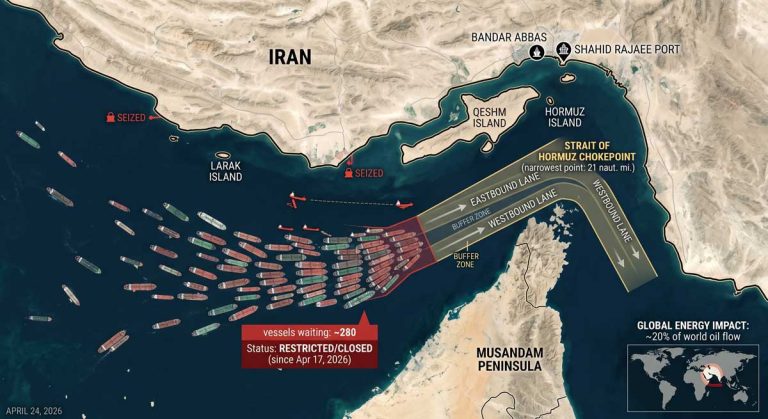
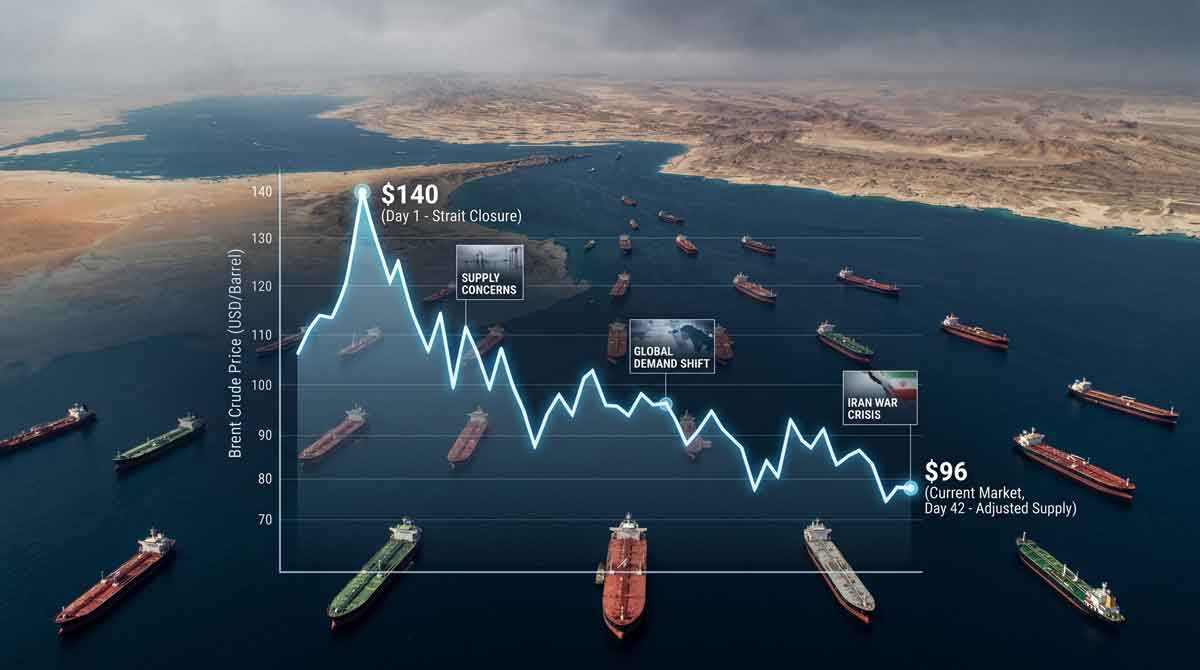
The Strait of Hormuz has been effectively closed for over three months. More than 10 million barrels per day of Middle Eastern oil supply have been severed — the most severe supply shock in modern history. Yet Brent crude, after briefly spiking above $140 per barrel in the early days of the Iran-US conflict, has since pulled back below $100. The apocalyptic $200-per-barrel forecasts that circulated at the outset simply haven’t materialised.
That gap between expectation and reality deserves a serious explanation — because the forces that held oil prices down are now running out of runway.
Table of Contents
What the Iran War Oil Price Shock Actually Looks Like
The conflict crossed its 100-day mark this week. On day 99, the US declared it had “completely destroyed” Iran’s military capacity. Within 24 hours, American forces launched fresh airstrikes on Iranian territory. Iran responded with missile strikes on US air bases in Kuwait and naval facilities in Bahrain. The cycle of fighting and talking continues.
Through all of it, a combination of demand destruction, emergency supply releases, and alternative routing has absorbed a shock that should — by conventional models — have sent oil prices into the stratosphere. Global commodity prices are up 50–60%. Asian LNG prices have surged 90%. But the catastrophic ceiling many expected has not been reached — at least not yet.
The 3 Forces That Held Oil Prices Down
| Factor | Mechanism | Estimated Impact |
|---|---|---|
| China demand collapse | Stopped SPR stockpiling; coal-to-chemicals substitution; EV surge | Offset ~1/3 to 1/5 of lost supply |
| US supply surge | Shale exports up 2M+ bbl/day vs. prior year average | Largest swing producer globally |
| Strategic reserve releases | IEA-coordinated release; SPR at 140K bbl/day in peak weeks | Historic scale, nearly half exported |
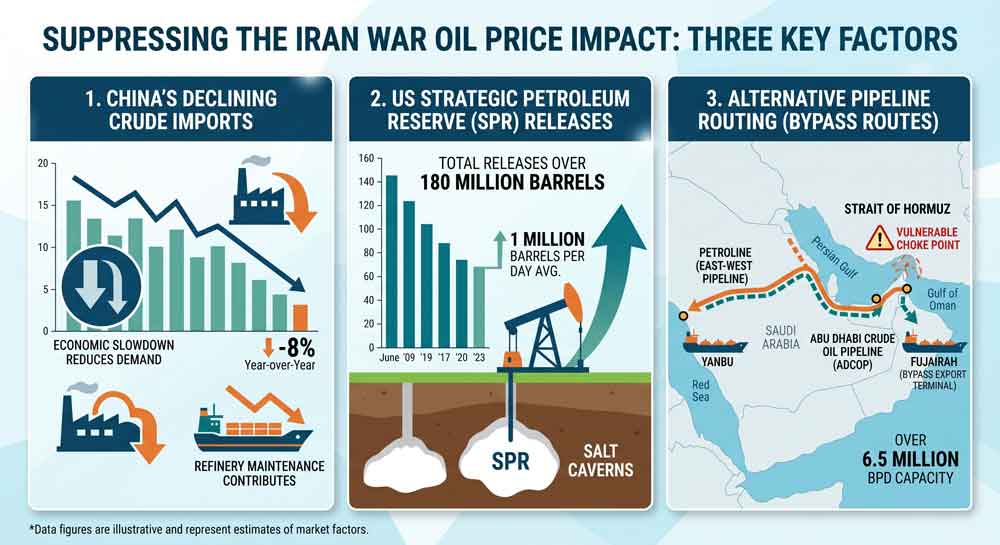
Demand destruction from China has been the single most important factor. China’s crude imports dropped nearly 40% in May compared to last year’s average — an enormous swing for the world’s largest oil importer. The drivers are structural: China quietly stopped its years-long strategic reserve build-up, coal-chemical conversion is substituting for petroleum-based processes, and electric vehicle penetration has materially suppressed gasoline demand. Chinese refinery throughput fell to roughly 13 million barrels per day in May and June — a level not seen since early 2020, against a prior-year average of 14.8 million barrels per day.
American supply flexibility is the second pillar. The shale revolution, launched over a decade ago, turned the US into a net exporter of crude and refined products — and it’s precisely that energy independence that gave Washington the confidence to engage militarily in the Gulf. Since the war began in late February, US crude and fuel exports have run more than 2 million barrels per day above prior-year averages. The Trump administration’s Strategic Petroleum Reserve releases have also exceeded expectations, with one week in May seeing SPR drawdowns hit 1.4 million barrels per day, nearly half of which was shipped to Europe and other overseas destinations.
Alternative routing and diplomatic manoeuvres provided additional buffers. Saudi Arabia has been pushing crude through its East-West pipeline to Red Sea terminals. The UAE has redirected flows through its pipeline to the port of Fujairah, bypassing the Strait entirely. Washington also partially lifted Russian oil sanctions, making it easier for India to ramp up purchases — Russian exports to India hit 1.76 million barrels per day in May, up 63% from February. A pre-war supply surplus provided extra cushion. Even the Strait itself, despite vessel traffic collapsing from nearly 100 ships per day pre-war to just 2–3, has seen close to 1,000 commercial vessels transit over the past two months through government-to-government arrangements and increasingly covert passages.
These Buffers Are Being Consumed
The stability is real — but it’s borrowed time. Global oil inventories are drawing down at a record pace, and the emergency mechanisms keeping prices in check are not indefinitely sustainable.
| Inventory / Buffer | Current Status | Risk Threshold |
|---|---|---|
| US total petroleum stocks | Lowest in 20+ years | Reached |
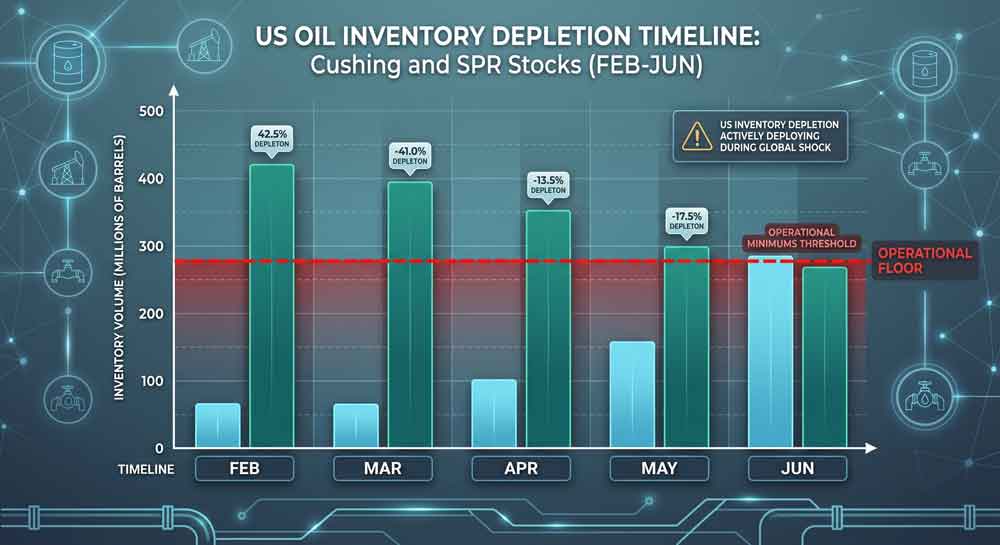
| Cushing, OK hub stocks | Near operational minimum | Near breach |
| US Strategic Petroleum Reserve | Near depleted after releases | Minimal remaining capacity |
| Global commercial inventories | Drawing ~70–80M bbl/week | Exhaustion in months |
The rate of global inventory draw is approximately 70–80 million barrels per week. That’s not a pace that can be sustained. At some point — and the window is measured in months, not years — the buffers run out. When they do, the market loses its shock absorbers. A relatively minor supply disruption at that point could trigger the kind of price spike that hasn’t materialised yet.
US domestic supply is already showing strain. American refineries are running above capacity, competing with export demand for the same crude barrels. The US simply cannot sustain current export volumes indefinitely. Cushing inventories are approaching the minimum operational level — below which pipelines and tanks cannot function normally. Summer driving season is arriving precisely when fuel stocks are at critical lows.
Will Oil Prices Finally Spike?
The honest answer is: the conditions for a violent price surge are building, not receding.
Diplomatic signals from Washington have partly suppressed oil futures markets — open interest in Brent crude futures has fallen to its lowest since August last year, and the whiplash between peace rumours and renewed fighting has pushed many long-position traders to the sidelines, operating with smaller positions and shorter time horizons. That dynamic keeps a ceiling on prices — for now.
But the peace timeline keeps getting pushed back. The minimum threshold for Strait of Hormuz shipping to resume any semblance of normalcy — at least 20 vessels per day for a consecutive week — requires a durable US-Iran settlement. That settlement keeps receding into the future. And even if talks succeed, the best realistic outcome is a reopened Strait and a nuclear deal no more comprehensive than the 2015 JCPOA. A hundred days of war, and the optimistic scenario is returning to the pre-war baseline.
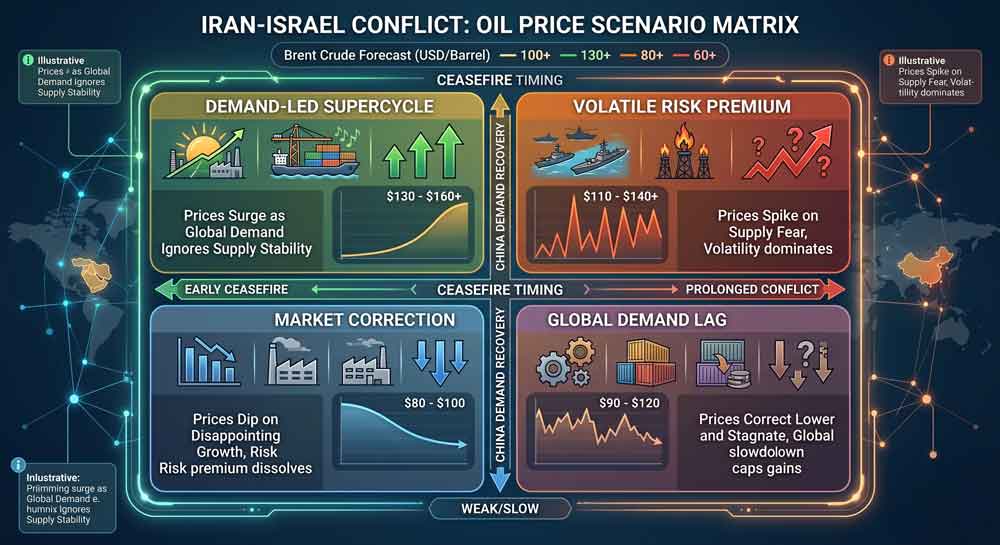
The market’s dominant variable is when — and whether — China returns to pre-war crude purchasing levels. Chinese demand is the demand destruction that has most effectively offset lost Middle Eastern supply. If China resumes buying aggressively while the Strait remains closed, the supply-demand math changes dramatically.
| Scenario | Oil Price Outlook | Timeline |
|---|---|---|
| Durable ceasefire + Strait reopens | Gradual decline toward $70–80 | 3–6 months post-deal |
| Prolonged conflict, China demand recovery | Sharp spike toward $130–160+ | Within 2–4 months |
| Negotiated pause (partial Strait transit) | Range-bound $95–115 | Near-term |
| Escalation / broader regional conflict | Potential for $150–200+ | Immediate risk |
Even under optimistic scenarios, there’s a structural deficit that won’t disappear overnight. Roughly 1 billion barrels of oil that would normally have flowed through global markets over these 100 days simply hasn’t. That’s inventory that doesn’t exist. When supply routes reopen, the first priority will be rebuilding those depleted stocks — meaning actual market tightness persists even after headlines improve.
What This Means for Energy Markets
The Iran war oil price shock hasn’t produced the disaster many feared — yet. But the mechanics that prevented catastrophe are being exhausted one week at a time. The global oil system has demonstrated remarkable resilience through a combination of demand destruction, American supply flexibility, and coordinated strategic reserve releases.
The fragility underneath that resilience is real. Depleted inventories, maxed-out US export capacity, a frozen Strait, and an uncertain diplomatic timeline mean the market is operating without its normal shock absorbers. The question is no longer whether the buffers will run out — it’s whether a deal arrives before they do.
If it doesn’t, the $200-per-barrel forecast that seemed alarmist three months ago may yet find its moment.
For context on global oil market dynamics, see the reference sources below.
Reference URLs
- Goldman Sachs — Oil Market Outlook: Supply Shocks and Price Resilience
- IEA — Oil Market Report — Emergency Stock Release Coordination
- Reuters — Strait of Hormuz closure: Impact on global oil flows
- S&P Global Commodity Insights — China crude imports and refinery throughput data
- Energy Information Administration — US Strategic Petroleum Reserve levels and drawdown history
- Vortexa — Real-time tanker tracking: Middle East crude flows
- Kpler — Global crude inventory draws and refinery run data
- ElevenLab — US-Iran Conflict Oil Prices: 3 Alarming Ways Russia Secured a $6.5B Windfall
- ElevenLab — UAE Exits OPEC: 7 Powerful Reasons This Changes Global Oil Forever
- ElevenLab — Gold Safe Haven Fails During Oil Crisis Shocks