UAE Exits OPEC: 7 Powerful Reasons This Changes Global Oil Forever
The UAE exits OPEC effective May 1, 2026 — and while many are treating this as another round of Middle East political drama, I think the real implications run far deeper than the headlines suggest. This is not a temporary tantrum over quota allocations. It is a structural fracture in the architecture of coordinated global oil supply that has governed energy markets for over six decades.
When Energy Minister Suhail Al Mazrouei announced the departure, his language was measured and diplomatic. But the message underneath was unmistakable: the UAE is done subordinating its national economic ambitions to collective OPEC discipline. And that decision will ripple outward in ways most market observers have not yet fully priced in.
Table of Contents
How OPEC’s Price Coordination Actually Works
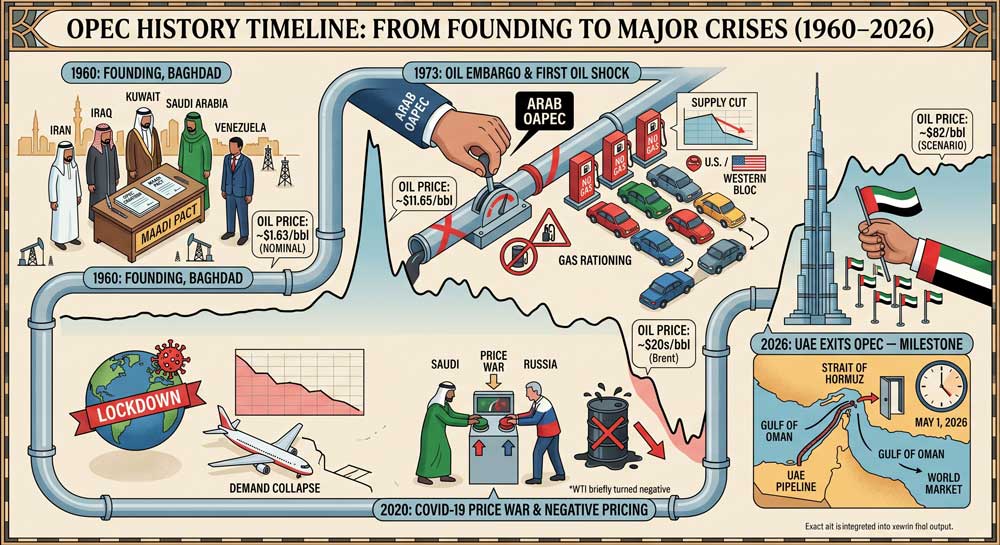
To understand why this exit matters, it helps to understand what OPEC was designed to do in the first place. Founded in 1960 by Iran, Iraq, Kuwait, Saudi Arabia, and Venezuela, the organisation’s core function is to coordinate production quotas among member states so that no single country floods the market and drives prices down for everyone.
The logic is straightforward: if you collectively restrict supply, you push prices up. Every barrel left in the ground today is a higher-priced barrel tomorrow. Saudi Arabia, as the group’s largest producer and de facto leader, has historically absorbed the deepest cuts to hold the coalition together.
This mechanism has delivered real results at critical moments. During the 1973 oil embargo, OPEC members reduced output and imposed export bans that drove oil prices from roughly $3 per barrel to over $12 — a fourfold increase that sent shockwaves through Western economies. More recently, during the COVID-19 collapse in demand in 2020, the OPEC+ coalition — which includes Russia and other non-OPEC producers — agreed to a historic coordinated cut of 9.7 million barrels per day to stabilise a market that had briefly seen oil trade at negative prices.
The system works — but only when every member is willing to sacrifice short-term revenue for collective price stability. That willingness is now visibly eroding.
UAE Exits OPEC: The Quota Conflict That Made It Inevitable
The UAE has been a member of OPEC for nearly 60 years and was its third-largest producer behind Saudi Arabia and Iraq. But over the past several years, Abu Dhabi National Oil Company (ADNOC) has been executing one of the most ambitious upstream expansion programmes in the world — a $150 billion capital investment targeting a production capacity of 5 million barrels per day by 2027.
The problem is that OPEC+ production quotas have kept the UAE’s actual output constrained to roughly 3.2–3.4 million barrels per day — less than 70% of its capacity. That means billions of dollars invested in infrastructure that is sitting idle under cartel rules. The frustration this generates is not difficult to understand.
The tension broke into the open as early as 2021, when the UAE refused to agree to an extension of production cuts unless its baseline quota was raised. It ultimately backed down that time, but the underlying grievance never went away. With the current conflict in the Persian Gulf creating additional Strait of Hormuz pressure, and with OPEC+ again resisting UAE quota increases, the breaking point finally arrived.
| Metric | OPEC+ Quota | UAE Actual Capacity | Difference |
|---|---|---|---|
| Current daily output (approx.) | ~3.2M bbl/day | ~4.85M bbl/day | ~1.65M bbl/day idle |
| 2027 production target | N/A (quota-limited) | 5.0M bbl/day | Requires OPEC exit |
| Capital invested (2023–2027) | — | $150 billion | Largely constrained under quota |
The arithmetic is stark. The UAE has spent $150 billion building capacity it is not allowed to use. Staying inside OPEC is, at this point, a financial decision to destroy value.
The Strategic Ace: Fujairah and the Hormuz Bypass Pipeline
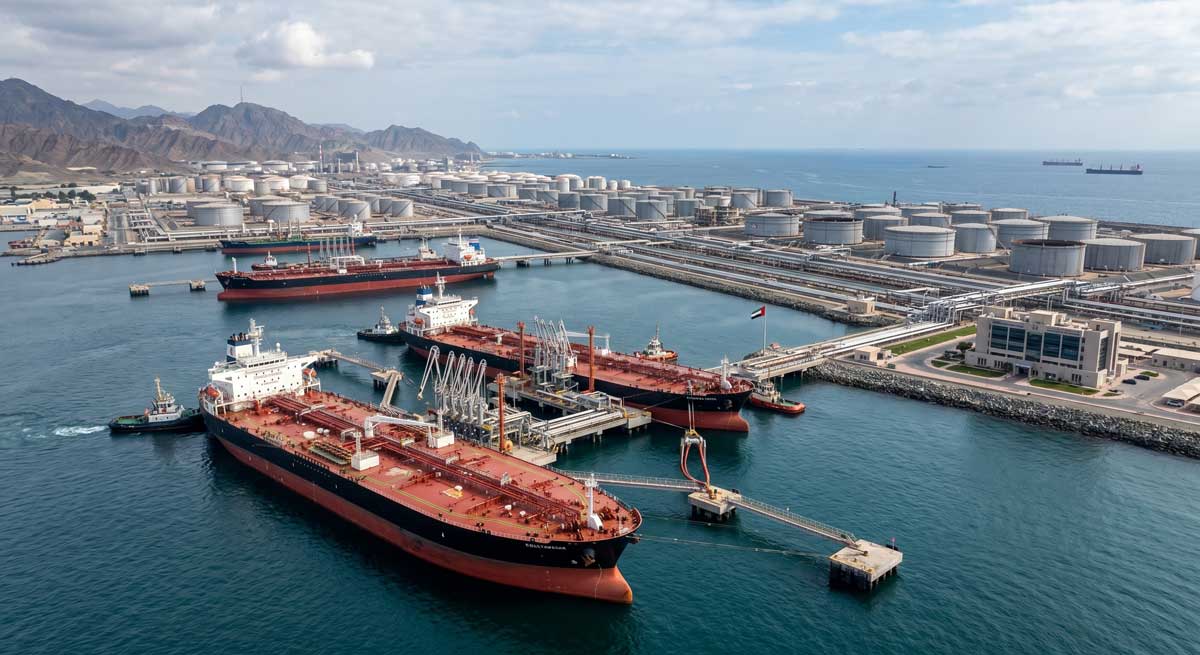
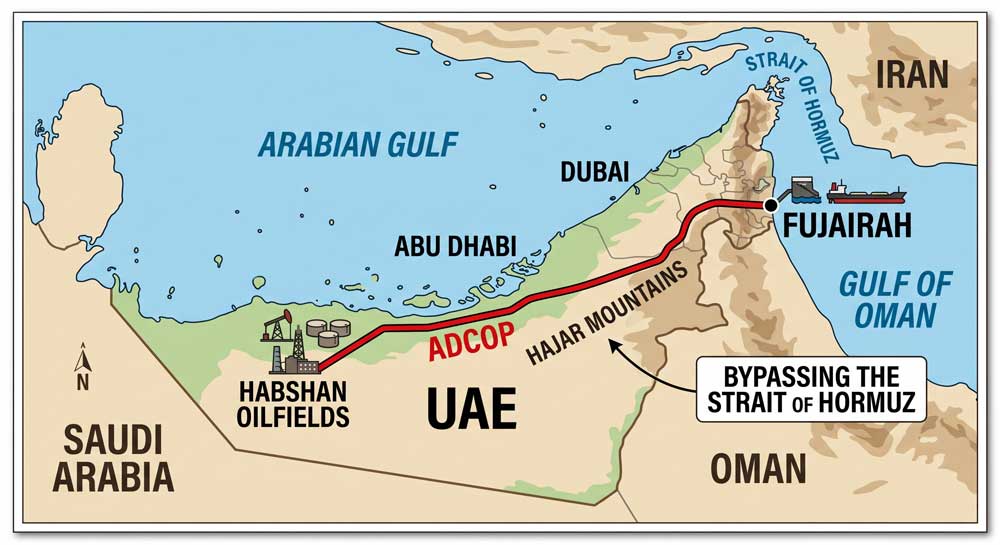
One of the first objections I hear when discussing this exit is: “What does it matter how much the UAE produces if the Strait of Hormuz is under threat and ships can’t move?” It is a fair question, but it overlooks a critical piece of infrastructure that gives the UAE genuine independence — the Abu Dhabi Crude Oil Pipeline (ADCOP), also called the Habshan–Fujairah pipeline.
Commissioned in 2012 at a cost of $4.2 billion, the ADCOP stretches approximately 380 kilometres from Abu Dhabi’s inland oil fields, across the Hajar Mountains, to the port of Fujairah on the Gulf of Oman — completely bypassing the Strait of Hormuz. Its designed throughput capacity is 1.5 million barrels per day, with a surge capacity of up to 1.8 million barrels per day.
This is not a theoretical backup. During the recent period of heightened Hormuz tension, Fujairah export volumes have risen sharply, demonstrating that the pipeline is operational and increasingly load-bearing in the UAE’s export strategy. Industry estimates suggest the UAE can independently export somewhere between 1.5 and 1.8 million barrels per day through this route, entirely outside the geopolitical risk posed by the strait.
That pipeline is the reason the UAE can afford to make this move. It has physically decoupled a significant portion of its export capability from the vulnerabilities that constrain every other Gulf producer.
| Infrastructure | Details |
|---|---|
| Pipeline name | Abu Dhabi Crude Oil Pipeline (ADCOP) |
| Route | Habshan (Abu Dhabi) to Fujairah (Gulf of Oman) |
| Length | ~380 km |
| Operational since | 2012 |
| Capacity | 1.5M bbl/day (surge: 1.8M bbl/day) |
| Cost | $4.2 billion |
| Hormuz bypass | Complete — no Strait exposure |
What This Means for Global Oil Markets
In the short term, I do not expect a dramatic oil price move from the UAE’s exit alone. The incremental supply that can reach markets through Fujairah in the near term is constrained by current pipeline utilisation, and broader geopolitical risk in the region is keeping a floor under prices.
The medium-to-long-term picture is considerably more consequential.
The demonstration effect is real. Angola left OPEC at the end of 2023 after its own quota dispute. Angola’s departure caused minimal market disruption because its production, at roughly 1.1 million barrels per day, is relatively small. The UAE, at nearly five times that volume and with far greater strategic weight, is a different matter. If the UAE thrives outside OPEC — and the economics suggest it will — other disgruntled members like Iraq and Nigeria will do the maths for themselves.
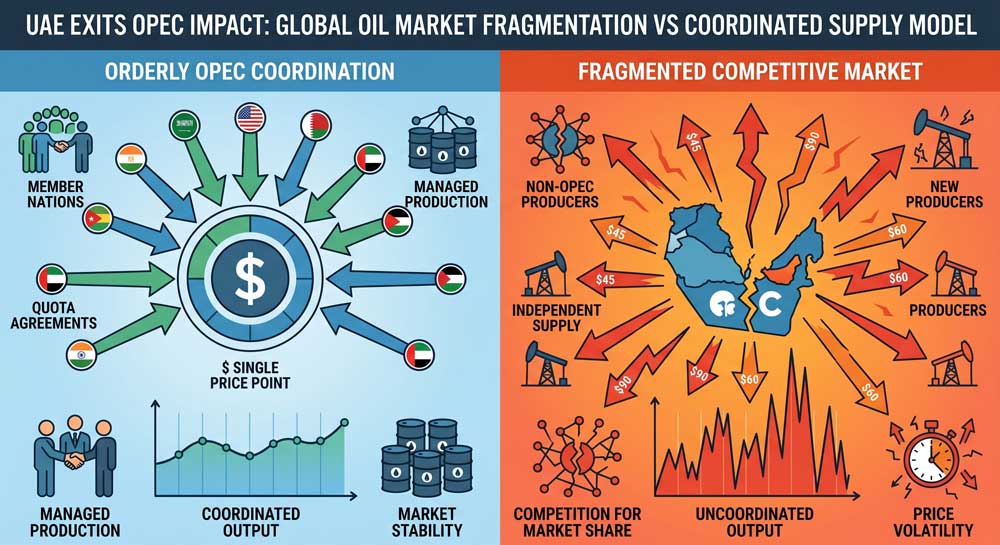
Saudi coordination power weakens. The entire OPEC price management system depends on Saudi Arabia’s ability to enforce discipline through its willingness to absorb the largest production cuts. The more members exit or cheat on quotas, the less leverage Riyadh holds. A fragmented cartel is a weaker cartel.
Price volatility could increase. One underappreciated function of coordinated OPEC production management is that it smooths out supply-side volatility. When the coordination mechanism weakens, oil markets become more reactive to demand shocks, geopolitical events, and individual country production decisions — meaning wider price swings in both directions.
| Scenario | Short-Term (0–12 months) | Long-Term (2–5 years) |
|---|---|---|
| Oil price impact | Limited — geopolitical risk dominates | Higher volatility; downward pressure as UAE ramps up |
| OPEC cohesion | Weakened but intact | Risk of further exits (Iraq, Nigeria) |
| UAE market position | Modest output increase via Fujairah | Potential to become world’s 2nd-largest net exporter |
| Saudi influence | Reduced but still dominant | Significantly diminished if other exits follow |
Downstream Opportunity: Beyond Crude
Energy Minister Al Mazrouei’s public statement framed the exit in terms of flexibility to meet future demand for crude, petrochemicals, and natural gas. That framing is deliberate. The UAE’s ambitions extend well beyond simply pumping more crude — ADNOC has been aggressively investing in downstream refining, petrochemical production, and LNG capacity as part of a broader strategy to capture more value from each barrel rather than selling it raw.
This downstream push opens up investment opportunities across the global energy supply chain — from refineries and chemical plants to LNG terminal infrastructure and shipping. Investors tracking ADNOC’s project pipeline and Fujairah port throughput data will have a material information edge over those watching only the headline oil price.
My Take on the Bigger Picture
I want to be direct about what I think this event actually represents. For the past several decades, global oil markets have operated within a framework of managed supply, predictable coordination, and relative price stability — imperfect and frequently tested, but fundamentally functional. The UAE’s exit is not by itself the end of that framework, but it is one of the clearest signals yet that the framework is under genuine structural stress.
If more major producers conclude that national production maximisation beats collective quota compliance — and the economic incentives increasingly point in that direction — we could be moving toward a more fragmented, competitive, and volatile global oil market. That is a significant shift with consequences for energy security, inflation, geopolitical relationships, and capital allocation across the entire global economy.
This is not a story about the UAE having a disagreement with Saudi Arabia. It is a story about whether coordinated production management among sovereign nations is still a viable model in an era where individual countries have the infrastructure, technical capability, and financial motivation to go it alone. The UAE, in exiting OPEC, has made its answer clear.
Reference Links
- CNBC — UAE to leave OPEC May 1, 2026 — energy minister statement and market reaction
- Gulf News — UAE to leave OPEC, OPEC+
- Al Jazeera — UAE leaves OPEC in blow to oil cartel during war on Iran
- Reuters — UAE brings forward oil production capacity expansion to 2027
- Arab News — UAE starts up pipeline to bypass Strait of Hormuz — ADCOP Fujairah pipeline overview
- Enerdata — ADNOC brings forward 5 million barrel per day capacity target to 2027
- Discovery Alert — UAE’s ADNOC Crude Capacity Expansion to 5M Barrels — strategic drivers analysis
- ElevenLab — Australia Fuel Crisis: 7 Urgent Risks as Global Conflict Threatens Economic Collapse
- ElevenLab — 5 Devastating Realities of the Middle East Energy Crisis Destroying Global Markets
- ElevenLab — Strait of Hormuz Semiconductor Crisis: 5 Devastating Threats to the Global Tech Supply Chain