5 Devastating Realities of the Middle East Energy Crisis Destroying Global Markets
The Middle East energy crisis is no longer a regional conflict — it has become a precision-engineered assault on the arteries of the global economy. Iran’s strategy is asymmetric by design: inflict maximum destruction at minimum cost, then let time do the rest. Every additional day of fighting doesn’t just consume military resources. It compounds economic damage measured in months and years, not days.
Iran’s Islamic Revolutionary Guard Corps (IRGC) has now executed the 70th wave of “Operation True Promise-4,” deploying Khaibar Shekan and Ghadr missiles against high-value targets. Despite sustained U.S. and Israeli strikes on Iranian launch infrastructure, Tehran’s daily missile and drone output has increased over the past ten days — not decreased.
While catastrophic strikes have hit energy facilities across Qatar, Saudi Arabia, Kuwait, Bahrain, and the UAE, Iran’s own oil exports continue flowing. This is not coincidence. It is doctrine.
Table of Contents
Reality 1: The Asymmetric Advantage Fueling the Middle East Energy Crisis
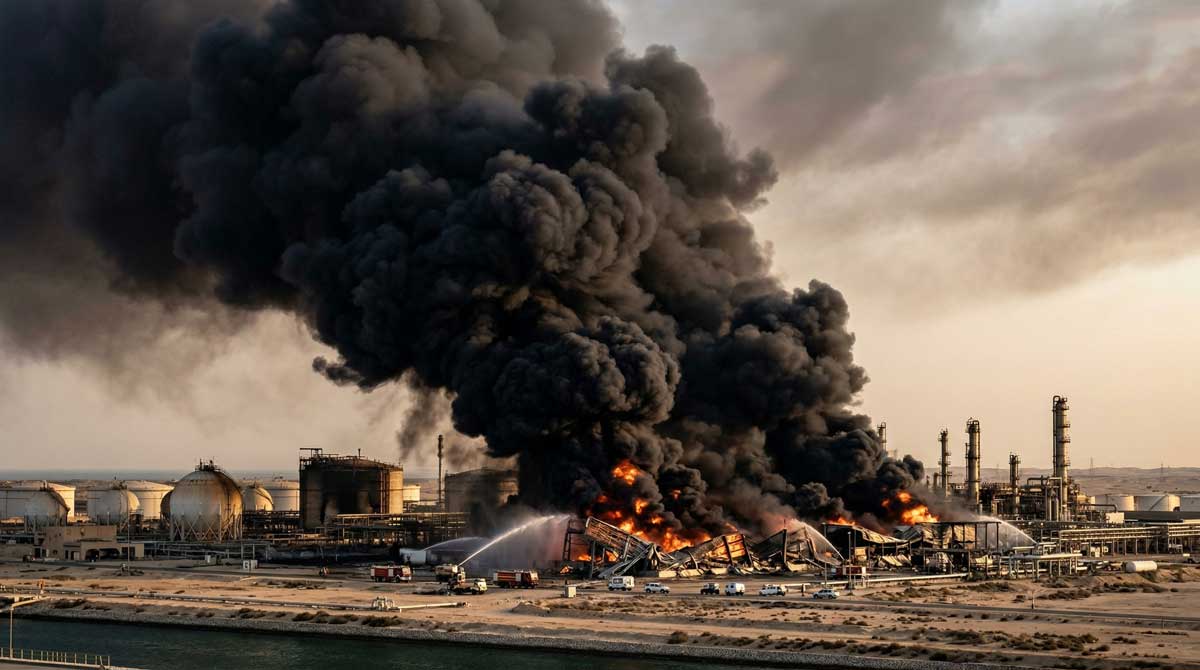
Alt text: Industrial oil and gas facility representing the Middle East energy crisis
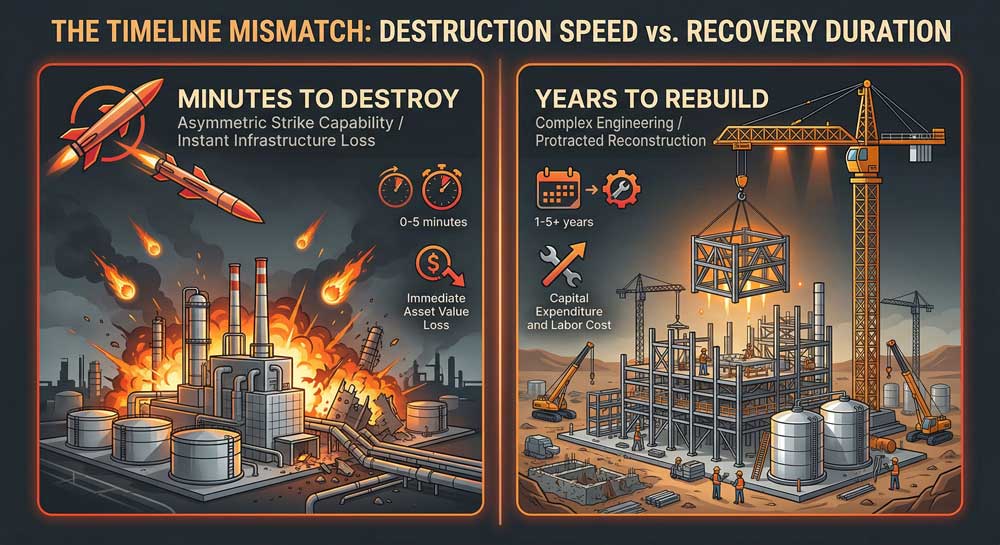
A single drone strike costs hundreds of thousands of dollars to execute and takes minutes to deliver. Repairing what it destroys costs billions and takes years. This is the foundational logic of the current Middle East energy crisis.
Senior Adviser at the International Crisis Group and author on Iranian foreign relations, frames it directly:
“Iranians have learned a crucial lesson — they can cause immense destruction and chaos cheaply and easily. Now, they want the global stage to recognize this reality.”
Iran doesn’t need to win militarily. It only needs to make the cost of continued conflict unbearable for everyone else.
Reality 2: The Strait of Hormuz Is Holding the World Hostage
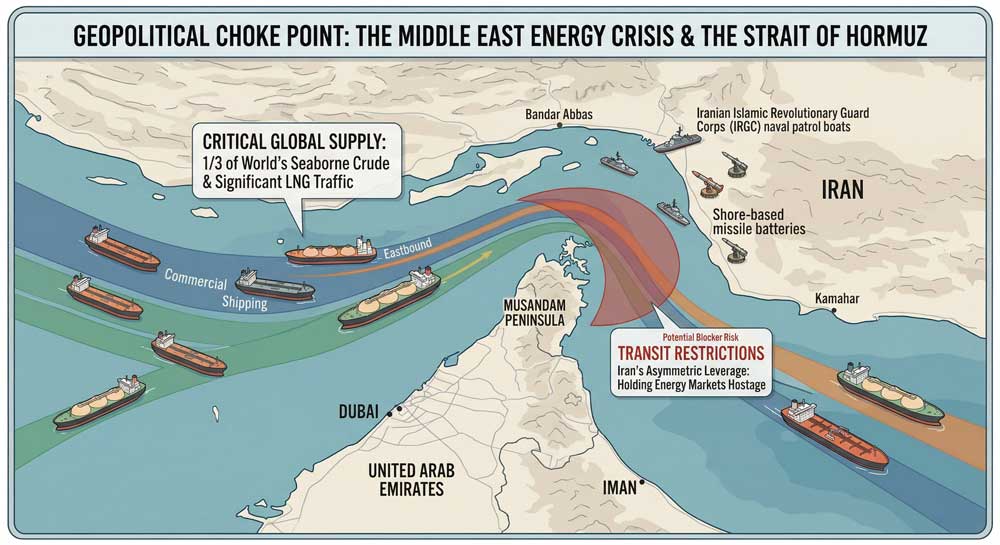
The Strait of Hormuz carries approximately one-third of all seaborne crude oil globally. Iranian Foreign Minister Abbas Araghchi insists Iran hasn’t “blocked” the strait — only imposed transit restrictions on vessels from hostile nations. In practice, the world’s most critical energy corridor now operates only under Tehran’s tacit permission.
| Metric | Detail |
|---|---|
| Share of global seaborne crude | ~33% |
| Daily oil flow at risk | ~21 million barrels |
| Nations most exposed | EU, Japan, South Korea, India, China |
| Iran’s stated position | “Selective restriction,” not full closure |
This deepens the Middle East energy crisis daily — soaring energy prices, stalled shipping, and cascading supply chain failures compound with every passing week.
Reality 3: Qatar’s Wound — 1 Strike, 5 Years to Recover
The single most concrete measure of the Middle East energy crisis’s long-term damage is Qatar’s LNG infrastructure.
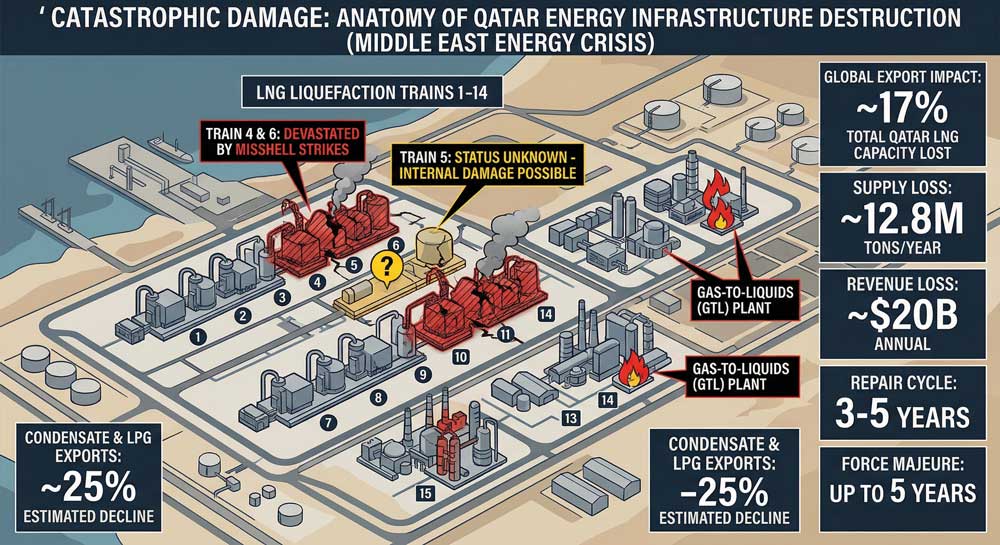
On March 19, Iranian missiles struck the Ras Laffan Industrial City — the heart of Qatar’s global LNG export network. QatarEnergy CEO Saad al-Kaabi confirmed the scale of destruction:
- Liquefaction Trains 4 and 6 destroyed; Train 5 status unclear
- Repair timeline: 3 to 5 years
- Lost export capacity: ~12.8 million tonnes per year (~17% of total)
- Estimated annual revenue loss: ~$20 billion
- Condensate exports may fall by ~25%; LPG exports by 13%
- Force majeure notices issued to European and Asian clients for up to 5 years
Al-Kaabi was unambiguous: no production recovery can begin while hostilities continue.
Unlike oil, LNG has no safety net. As Bernstein Research director Neil Beveridge stated bluntly: “LNG has no strategic reserves.”
| Metric | Oil Market | LNG Market |
|---|---|---|
| Strategic Reserves | High (U.S. SPR, IEA stocks) | Virtually non-existent |
| Market Buffer | Moderate | Extremely low |
| Price Volatility | High | Extreme — spiked 35% in one day |
| Recovery Timeline | Months | 3 to 5 years |
Reality 4: JPMorgan Warns the Supply Gap Is Worse Than Markets Think
JPMorgan commodities analyst Otar Dgebuadze has sharply revised the firm’s Middle East energy crisis supply projections, cutting Qatar’s LNG utilization assumption from 90% to 80% as the new medium-term ceiling.
| Scenario | Estimated Supply Loss |
|---|---|
| Hormuz reopens within 1 month of conflict end | 36 billion cubic meters (BCM) |
| Previous JPMorgan estimate | 25–30 BCM |
| Each additional month of delay | +7 BCM |
| Assumed restart timeline | 30 days post-reopening; 80% capacity in ~2 months |
JPMorgan explicitly warns that downside risks dominate — actual recovery will likely be slower. More critically, the bank concludes this event has fundamentally dismantled earlier market assumptions of an LNG oversupply era. Long-term European gas benchmark prices have not yet priced in this new reality.
Reality 5: The Timeline Mismatch — Why Economic Damage Compounds Daily
Qatar is a microcosm of a much larger systemic threat to global economic stability.
According to Goldman Sachs research covering the five largest supply shocks of the past 50 years, affected nations still averaged a 42% production loss four years after the initial event — driven by physical infrastructure destruction and chronic underinvestment. Goldman warns oil could remain above $100 per barrel far longer than markets currently model.
This risk extends to Europe specifically. A recent outlines how the Middle East energy crisis could trigger a full European energy crisis, given the continent’s continued dependence on Gulf LNG after its post-Russia supply restructuring.
Even the United States cannot isolate itself. Baker Hughes data shows a widening gap between surging oil prices and active U.S. rig counts — shale operators, disciplined by the boom-bust trauma of the 2010s, are refusing to ramp production blindly. Capital restraint, not growth, is Wall Street’s mandate.
Monetary policy is equally constrained. With pre-conflict inflation already trending above target, Federal Reserve Chair Jerome Powell has adopted a notably hawkish stance. Markets are now pricing in the possibility of rate hikes in the remaining months of 2026 — a scenario that would have seemed improbable before hostilities began.
7 Compounding Damage Vectors of the Middle East Energy Crisis
- LNG supply destruction — Qatar’s 3–5 year repair timeline removes 17% of its export capacity permanently for this cycle
- Hormuz shipping restriction — each additional month of delay adds 7 BCM to the global gas deficit
- Energy price inflation — European gas futures doubled in a day; oil trending toward $100+
- Force majeure cascade — long-term contracts broken, Gulf supply reliability structurally damaged
- Supply chain disruption — manufacturing, agriculture, and transport sectors globally exposed
- U.S. supply inelasticity — shale capital discipline means no rapid production offset
- Monetary policy compression — energy inflation eliminates central bank flexibility at the worst moment
As the conflict stretches into its third week with no clear endgame, global energy markets are no longer just tracking battle maps. They are calculating a recovery timeline measured not in days — but in years.
Authoritative Sources
- International Crisis Group — Dina Esfandiary profile and Iran analysis
- Goldman Sachs — Oil supply shock historical analysis
- Atlantic Council — How the Iran war could trigger a European energy crisis
- U.S. EIA — Strait of Hormuz energy flow fact sheet
- Baker Hughes — North America rig count data
- IEA — Emergency oil stocks and strategic reserves
- 5 Epic Reasons the Hong Kong Safe Haven Thrives After Dubai’s Collapse
- 4th Oil Crisis: 5 Powerful Turning Points That Broke the $100 Barrier
- Strait of Hormuz Semiconductor Crisis: 5 Devastating Threats to the Global Tech Supply Chain