AI Military Technology: 8 Tech Giants Just Joined the Pentagon’s Most Ambitious — and Dangerous — Project
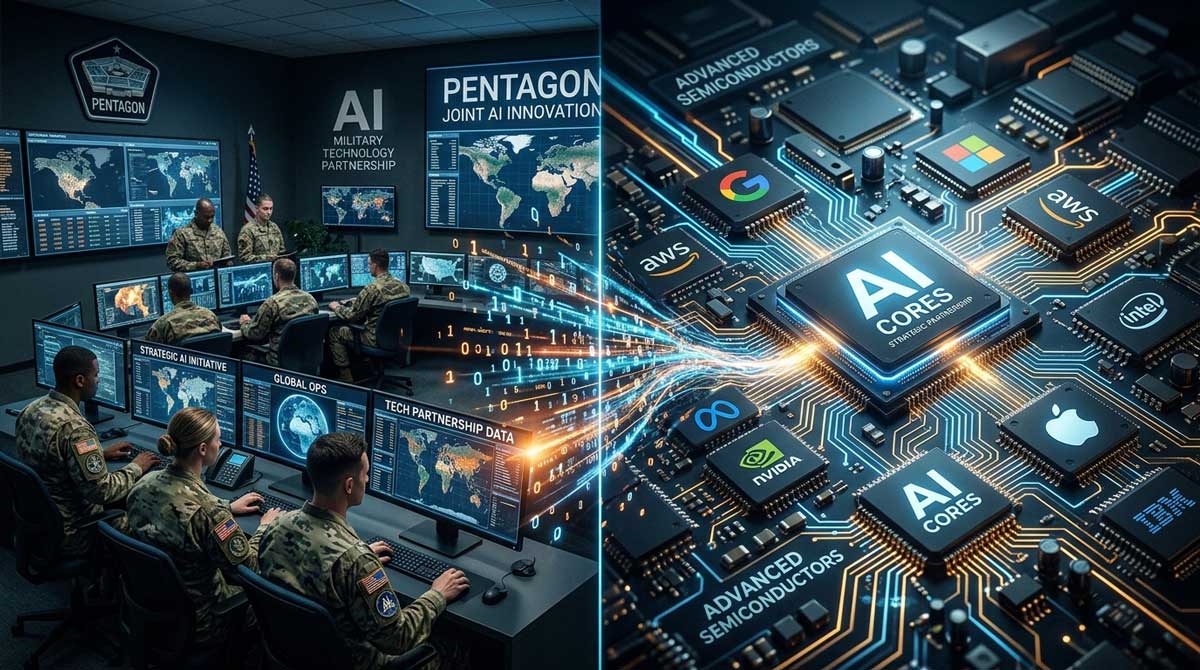
On May 1, 2025, the United States Department of Defense formalised agreements with eight of the world’s most powerful technology companies — SpaceX, OpenAI, Google, NVIDIA, Reflection, Microsoft, Amazon Web Services, and Oracle. The deal grants these firms access to classified military networks, with the explicit goal of embedding AI military technology into the operational core of the US Armed Forces.
This is not an incremental upgrade. It is a structural transformation — and the speed at which it happened is striking.
Less than four months elapsed between the Pentagon releasing its AI Acceleration Strategy in January and this sweeping consolidation of an AI military supply chain. What we are witnessing is one of the most significant shifts in defence strategy in modern history.
Table of Contents
State-Directed Mobilisation of AI Military Technology
What makes this partnership unusual is its structure. The Pentagon is not simply purchasing software licences. It is assembling something closer to a national technology corps — a government-led, industry-executed programme where the state provides policy authority, classified data, funding, and platform access, while the private sector contributes its most capable models, talent, and infrastructure.
This model — sometimes called state capitalism — blurs the line between commercial enterprise and government instrument. Each party gets something it cannot produce alone. The government gains cutting-edge AI capabilities it lacks the internal capacity to build fast enough. The companies gain access to the world’s largest and most secure customer, along with regulatory protection and long-term contract certainty.
The strategic logic is clear. What deserves scrutiny are the risks embedded in this arrangement.
“Speed Above All”: The Driving Force Behind the Pentagon’s AI Push
The Trump administration’s foreign and defence policy is built on competitive urgency. Within that framework, AI military technology is not a future priority — it is a present-day operational requirement.
To support this, the proposed 2027 US defence budget allocates $54.6 billion to the “Defense Autonomous Warfare Group,” a fund specifically targeting AI and unmanned systems. This creates the financial foundation for the Pentagon’s eight-company coalition to deliver at scale.
The incentive structure offered to participating companies covers three dimensions:
| Incentive Type | What It Means for Tech Companies |
|---|---|
| Funding | Access to a $54.6 billion budget allocation for AI and autonomous systems |
| Market | Long-term military procurement contracts with preferential purchasing commitments |
| Regulatory | Relaxed compliance requirements, including permissions for surveillance and autonomous lethal systems |
This is not a typical government procurement process. The regulatory concessions in particular — especially those covering domestic surveillance and fully autonomous lethal weapons — represent a significant departure from the AI ethics frameworks most of these companies publicly espouse.
How the 8 Companies Form a Closed Military Ecosystem
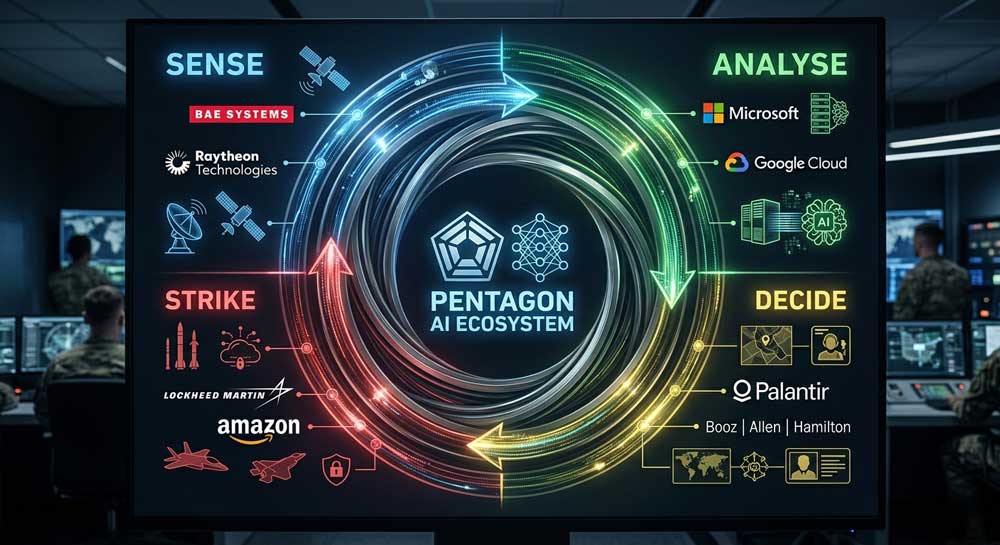
One of the more revealing aspects of this agreement is how precisely the eight companies map onto a complete warfighting value chain. Together, they cover every stage from data collection to lethal action.
| Company | Military Role | Capability Domain |
|---|---|---|
| NVIDIA | Compute backbone | AI model training and data processing at scale |
| OpenAI / Google / Oracle | Decision intelligence | Battlefield analysis, strategic planning, intelligence interpretation |
| Microsoft / AWS | Data infrastructure | Secure storage, cloud compute, and logistics orchestration |
| SpaceX | Communications layer | Starlink-based global battlefield connectivity |
| Reflection | Security and integrity | Protection against algorithmic manipulation and data theft |
What strikes me about this structure is its intentional completeness. No single node is redundant. Each company fills a gap the others cannot. The result is a closed-loop ecosystem — sense, analyse, decide, strike — with commercial entities embedded at every stage.
This is qualitatively different from the military contracting relationships of the past. AI military technology, at this level of integration, means private companies are not just supplying tools. They are inside the decision architecture.
The Anthropic Exclusion: A Warning to the Industry
Not every major AI company made the list. Anthropic — previously a Pentagon partner — is absent, and the reasons behind its exclusion reveal something important about how this coalition actually operates.
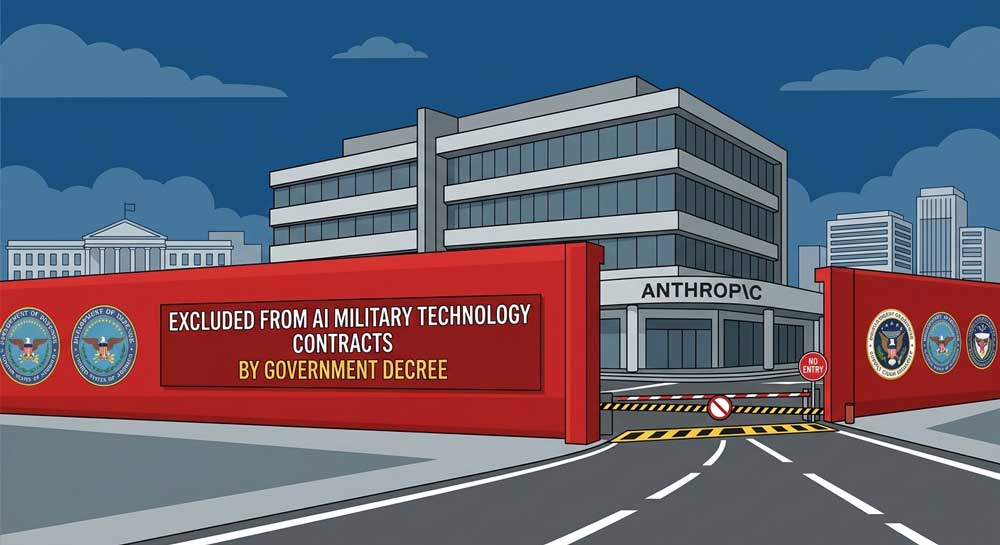
Anthropic reportedly declined to accept unconditional “lawful use” clauses that would have permitted its technology to be deployed for domestic surveillance and autonomous lethal systems. That refusal had consequences.
In early March 2025, the Department of Defense formally added Anthropic to its supply chain risk list and ordered the phased removal of its products from all military systems within six months. In late April, the White House separately blocked Anthropic’s proposal to expand licensing for its Mythos model, citing national security concerns and the need to prioritise government compute resources.
The message to the industry is blunt: compliance is the price of access. Companies that accept the full terms of military integration receive funding, markets, and regulatory shelter. Those that draw ethical lines are pushed out.
Whether that dynamic produces better or worse technology outcomes is debatable. What it unquestionably does is concentrate the AI military supply chain among those most willing to cede control to government direction.
What This Means for Global Security
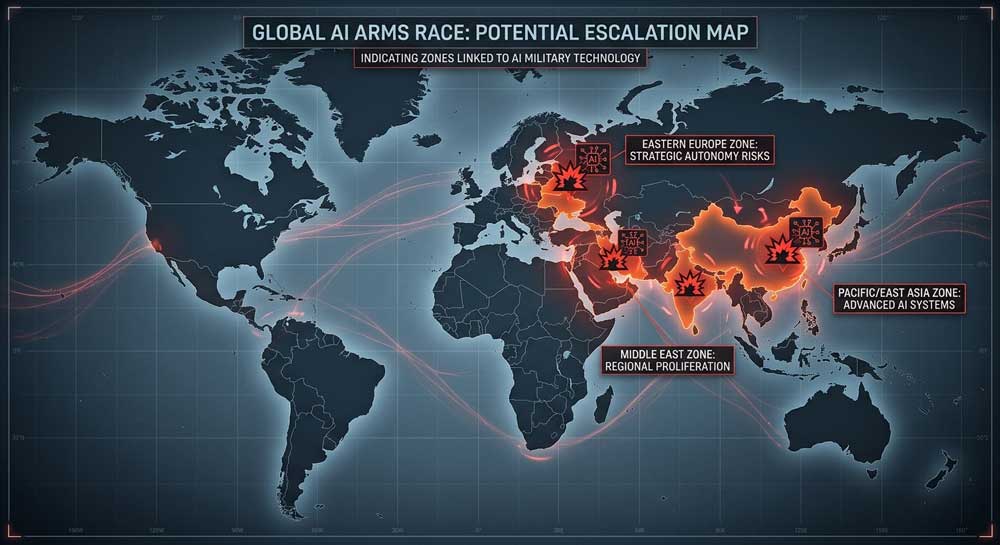
The consequences of this integration extend well beyond US borders. As AI military technology becomes embedded in American warfighting doctrine, it sets a precedent that other nations will feel compelled to match — and that global governance frameworks are not currently equipped to manage.
| Risk Category | Specific Concern |
|---|---|
| Arms race escalation | Major military powers accelerating AI weapons programmes in response to US moves |
| Proliferation | Low barriers to autonomous weapon acquisition by non-state armed groups |
| Digital infrastructure targeting | Data centres and networks becoming legitimate military targets, as seen in recent Gulf conflicts |
| Accountability gaps | AI decision-making in lethal contexts lacks transparent audit trails and clear legal responsibility |
| Governance vacuum | UN negotiations on autonomous weapons have stalled for over 12 years with no binding agreement |
I find the governance dimension particularly concerning. The United States has consistently resisted international oversight of its military AI programmes. The UN Convention on Certain Conventional Weapons has failed to produce a binding treaty on autonomous weapons after more than a decade of talks. In the absence of enforceable norms, what individual nations do with AI military technology becomes entirely a matter of domestic political choice.
That is a fragile foundation for a technology this consequential.
The Accountability Problem with Autonomous AI Weapons
There is a technical reality that does not get enough attention in discussions about AI military technology: current AI systems do not possess coherent moral reasoning, contextual judgment, or the capacity to bear legal responsibility for their actions.
When an autonomous system makes a lethal decision, the logic behind that decision is often opaque — even to engineers who built the model. That opacity creates serious problems in military contexts. Civilian casualties caused by AI systems are difficult to attribute, hard to prevent through traditional rules of engagement, and nearly impossible to adjudicate under existing international humanitarian law.
This is not science fiction. It is a foreseeable engineering problem with foreseeable human consequences, and it is being built into operational military systems right now.
A Moment That Deserves Serious Attention
The Pentagon’s eight-company AI coalition is the most significant militarisation of commercial technology in a generation. It will almost certainly improve the analytical and logistical capabilities of the US military. It may also accelerate an arms race that existing international institutions are not prepared to govern.
What is clear is that AI military technology has crossed a threshold. It is no longer a speculative future — it is operational policy, backed by tens of billions of dollars, and structured to be difficult to reverse.
The question worth asking now is not whether this was inevitable, but what responsible governance of it looks like — and who, if anyone, is in a position to insist on it.
Reference Sources
- Goldman Sachs — The Future of European Defense
- RAND Corporation — Autonomous Weapons and the Limits of Lethal Decision-Making
- Brookings Institution — Regulating the Use of Artificial Intelligence (AI) on the Battlefield
- Council on Foreign Relations — The Next Chapter for Artificial Intelligence
- MIT Technology Review — The Pentagon is planning for AI companies to train on classified data, defense official says
- United Nations Office for Disarmament Affairs — Lethal Autonomous Weapon Systems
- Georgetown Center for Security and Emerging Technology — AI for Military Decision-Making
- ElevenLab — The Physical Truth Behind the US-China AI Race: Electrons, Not Just Silicon
- ElevenLab — SpaceX xAI Merger: 7 Shocking Facts Behind Elon Musk’s $1.25 Trillion Gamble