The Physical Truth Behind the US-China AI Race: Electrons, Not Just Silicon
For the past two years, the narrative of the US-China AI rivalry has been dominated by a single variable: Silicon.
The focus has been almost exclusively on the “Compute Gap”—the export bans on Nvidia’s H100/H800 chips and the technological blockade on advanced semiconductor manufacturing. The prevailing view is that China’s AI ambitions are being effectively choked off.
However, while the world fixates on silicon, a different anxiety is gripping Wall Street and Silicon Valley. As Microsoft CEO Satya Nadella and Elon Musk have recently warned, the bottleneck is shifting from GPUs to Gigawatts.
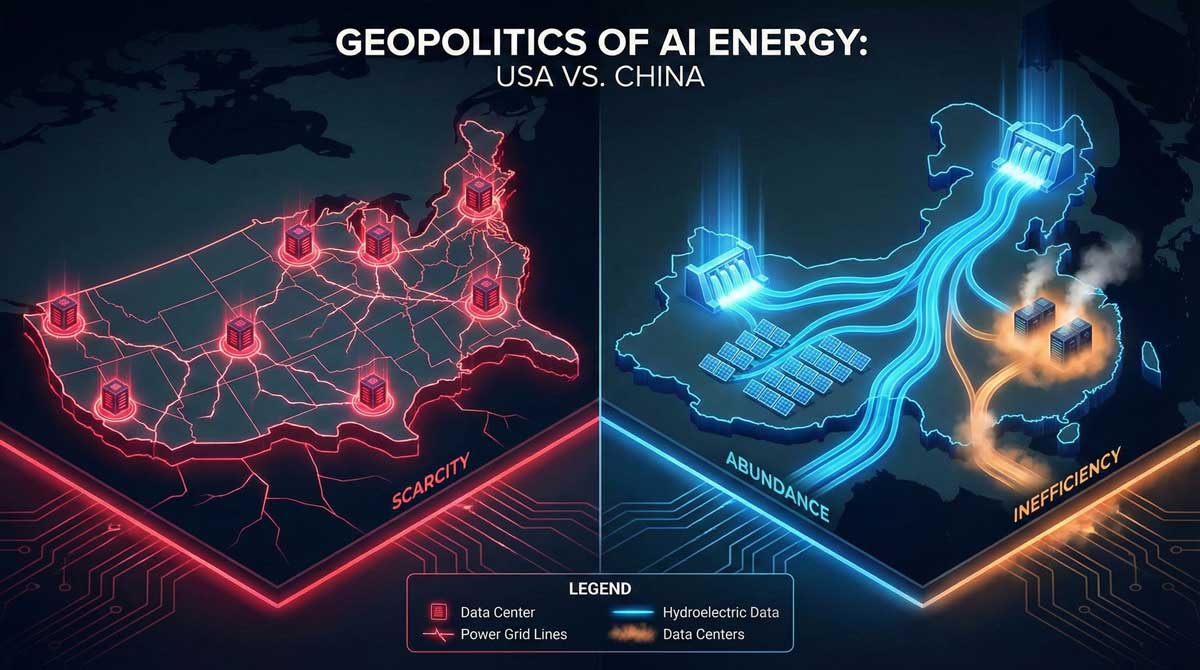
In the foundational layer of AI physics—electricity supply—the two superpowers face diametrically opposed “existential crises.” The United States is facing a severe power shortage, while China sits on a 20-fold surplus.
Yet, a paradox remains: Even with cheaper, abundant electricity, the energy cost of running AI in China could be 40% higher than in the US.
Here is the untold story of the “Electron War.”
1. The US Dilemma: A Manhattan Project for Power
To understand the scale of the US energy crisis, consider recent data from Macquarie Research.
By 2030, the incremental power demand for AI in China is projected to represent only 1% to 5% of the country’s new power generation capacity added over the past five years. In stark contrast, US AI power demand is expected to consume 50% to 70% of its new capacity over the same period.
McKinsey forecasts that US data center power demand will triple or quadruple by 2030, reaching 80–100 GW.
The Implication:
China has effectively pre-built a massive reservoir of power redundancy. Its grid can absorb the AI “whale” with barely a ripple. The US grid, however, is aging, fragmented, and facing a massive replacement cycle. To accommodate the AI beast, the US would need to dedicate the vast majority of its new energy infrastructure solely to data centers, leaving little for other industries.
In 2023 alone, the US added approximately 51 GW of power capacity. China added 429 GW—an 8-fold difference.
This physical disparity explains why OpenAI’s Sam Altman is reportedly seeking $7 trillion to reshape the semiconductor supply chain. But his more immediate problem isn’t just making chips; it’s finding the electricity to run them. In Virginia’s “Data Center Alley,” utility Dominion Energy has already warned that power transmission bottlenecks could stall new facility connections for years.
Table 1: The Power Gap – US vs China Energy Infrastructure (2023-2030)
| Metric | United States 🇺🇸 | China 🇨🇳 | Gap / Implication |
| 2023 New Power Capacity | 51 GW | 429 GW | 8x Disparity in infrastructure speed. |
| AI Demand Impact (2030) | Consumes 50-70% of new capacity | Consumes 1-5% of new capacity | US grid faces massive strain; China has redundancy. |
| Grid Condition | Aging, fragmented, slow approval (NEPA). | Modern, Ultra-High Voltage (UHV) integrated. | US faces “Transmission Bottleneck”. |
| Primary Challenge | Scarcity (Not enough power) | Utilization (Too much power, need distribution) | Opposing existential crises. |
2. The Efficiency Paradox: Why “Cheap Power” Isn’t Enough
Given China’s massive power advantage, one might assume it holds the strategic upper hand. But there is a critical catch: Energy Efficiency.
This brings us back to semiconductor physics.
- The US Advantage: Top-tier US AI chips (like Nvidia’s Blackwell architecture) are manufactured on TSMC’s cutting-edge 3nm or 4nm nodes.
- The China Constraint: Due to sanctions, mainstream domestic AI chips in China are largely restricted to 7nm or mature processes.
The Physics of Lag:
Older process nodes don’t just mean lower performance; they mean significantly lower Performance per Watt. To achieve the same computational output (FLOPs) as a 3nm chip, a 7nm chip requires more transistors, higher voltages, and generates significantly more heat.
The “Efficiency Black Hole” Scenario:
Let’s hypothesize a cost comparison.
- US Energy Cost: $0.12 per kWh.
- China Energy Cost: $0.08 per kWh (33% cheaper due to coal/renewables).
Table 2: The “Efficiency Black Hole” Simulation
| Cost Component | US Scenario (Advanced Nodes) | China Scenario (Legacy Nodes) | Impact Analysis |
| Chip Technology | 3nm / 4nm (TSMC) | 7nm / Legacy | US chips are physically more efficient. |
| Energy Cost | $0.12 / kWh | $0.08 / kWh (33% Cheaper) | China has a raw energy price advantage. |
| Energy Consumption | 1.0x (Baseline) | 2.5x (Due to efficiency lag) | Older chips need more power for same math. |
| Total Cost per Token | $0.12 equivalent | $0.20 equivalent | China pays ~166% more effectively. |
However, if domestic Chinese chips require 2.5x the energy to perform the same task as an Nvidia B200 due to efficiency lag, the math flips.
- Result: The final electricity cost to generate one AI token in China could be 140% of the cost in the US.
This explains why Chinese tech giants are aggressively pivoting to “System Engineering”—emphasizing liquid cooling and cluster optimization. When you cannot break the laws of physics at the nanometer level (chips), you must compensate at the meter level (data centers).
3. Divergent Strategies: Decentralization vs. The Super Grid
The two nations are adopting radically different strategies to solve their respective bottlenecks.
The US Strategy: Decentralized Breakthroughs
Facing a gridlocked public grid, US tech giants are going “off-grid.”
- Nuclear: Amazon bought a data center directly powered by a nuclear plant. Microsoft and OpenAI are betting on Small Modular Reactors (SMRs) and fusion.
- Innovation: The US approach is to force technological breakthroughs in energy generation to bypass infrastructure deficits.
- Key Theme: Distributed resilience and nuclear renaissance.
The China Strategy: Macro-Grid Dominance
China is leveraging its state capacity to integrate AI into the energy system itself.
- UHV Transmission: Using Ultra-High Voltage lines to transport wind and solar energy thousands of kilometers from the west to the computing hubs in the east (“East Data, West Computing”).
- Storage: Integrating massive battery arrays (from giants like CATL and BYD) directly into data centers for peak shaving.
- Key Theme: System-level brute force and infrastructure integration.
US vs China AI Energy Strategies
| Dimension | US Strategy | China Strategy |
|---|---|---|
| Grid | Decentralized (SMRs) | UHV Super Grid |
| Power Source | Nuclear/Fusion | Coal + Renewables |
| Key Players | Amazon, MSFT | CATL, BYD |
| Export Model | Chips only | Turnkey infra |
4. The Global “Turnkey” Solution
The ultimate competition may not be about who builds the best AI for themselves, but who can export the best AI infrastructure to the world.
Imagine a developing nation—say, Saudi Arabia or Brazil—wants to build Sovereign AI. They face two choices:
- Option A (The US Model): Buy expensive Nvidia H200s (if approved by the Dept. of Commerce). Then, figure out how to upgrade your own grid, build liquid cooling systems, and source clean power.
- Option B (The China Model): A “Turnkey Solution.” Chinese firms can offer a package deal: the AI servers (less efficient, but available), plus a GW-scale solar farm, plus a grid-scale battery storage system, plus the cooling infrastructure.
This “Green Energy + Digital Infrastructure” bundle is a formidable export product. While the US dominates the absolute peak of chip technology, China is mastering the supply chain of landing compute into physical reality.
Conclusion: Two Kinds of Anxiety
The AI war is not just being fought in the nanometer world of lithography machines; it is being fought in the gigawatt world of transformers and transmission lines.
- The US Anxiety: “Starvation.” Having the best engines (chips) but running out of fuel (power).
- The China Anxiety: “Metabolism.” Having abundant fuel, but engines that burn it inefficiently.
These two distinct anxieties will shape the technological trajectory of the next decade. The game has moved beyond just code and silicon—it is now about the electrons that power them.
References & Further Reading
- McKinsey & Company: Investing in the rising data center economy
- IEA (International Energy Agency): Electricity 2024 – Analysis and forecast to 2026
- Data Center Frontier: Dominion Energy and the Virginia Power Crunch