Silver Price Forecast 2026: 5 Supply Cracks That Could Drive Silver to $300–$500
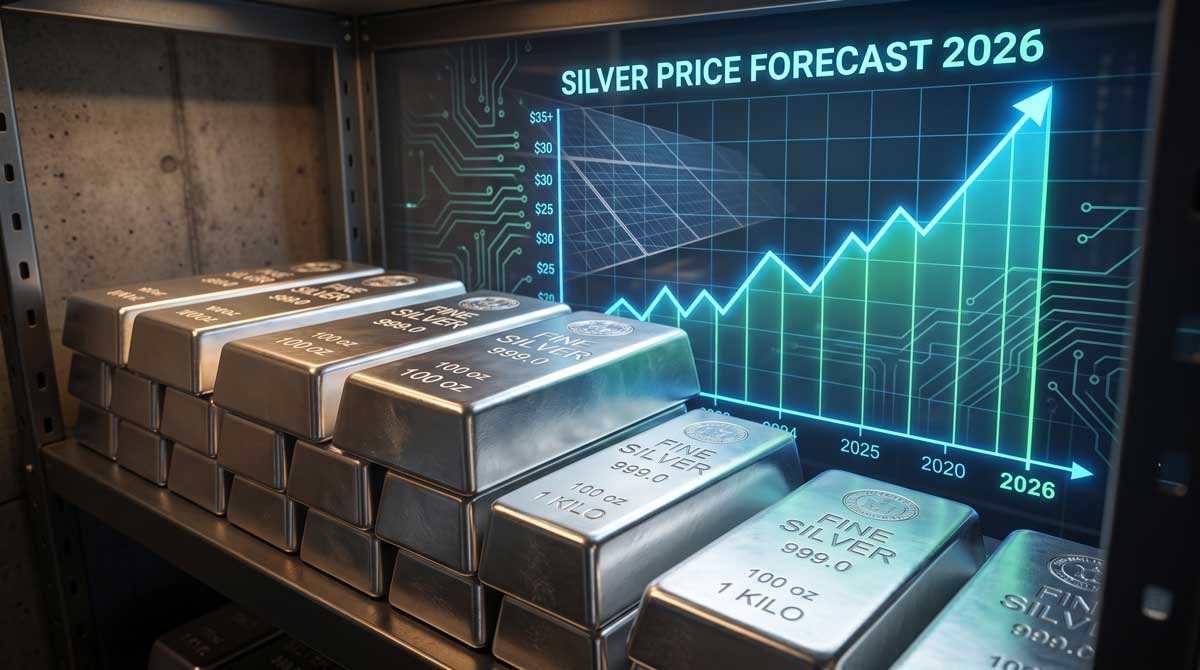
Silver price forecast 2026 points to a convergence of forces unlike anything seen in previous bull markets — a sixth consecutive supply deficit, inelastic industrial demand from solar, EVs and AI, and a gold-silver ratio that has begun compressing at a pace most analysts have not seen in years.
Between May 6 and 8, 2026, silver staged a powerful V-shaped recovery. The Shanghai Futures Exchange’s front-month silver contract surged 4.57% in a single session on May 7, closing at 19,493 yuan per kilogram. International spot silver climbed to $80.29 per ounce by May 8 — a 10.4% rebound from its May 4 low of $72.74. COMEX silver futures spiked 5.77% on May 6 alone, closing at $80.84.
While the market was still digesting that whipsaw, one of the few analysts who called the 1987 Black Monday crash put out a judgment that deserves serious attention.
Table of Contents
Who Is Michael Oliver and Why Does His View Matter?
Michael Oliver is the founder of Momentum Structural Analysis (MSA), a methodology that does not rely on traditional candlestick charting. Instead, it focuses on the displacement force of price relative to long-term moving averages — a system Oliver has refined over decades and which has been referenced by multiple institutional research desks.
Oliver correctly predicted the 1987 Black Monday crash. His recent interview, circulated through precious metals research channels, contains his most explicit silver price forecast yet.
“Once this violent congestion and pullback process ends,” Oliver stated, “silver will seek out a new price reality — probably between $300 and $500 — fairly quickly”. He adds that his momentum indicators have already broken out, and that the current rally is structurally different from previous ones. Unlike past rebounds that faded quickly, he sees this one leading into a near-vertical acceleration phase after the current consolidation resolves.
His framework on gold reinforces this view. Both prior gold bull markets — 1976 to 1980 and 2001 to 2011 — delivered roughly 8x gains from their starting points. The current cycle, which began around $1,050 in 2015, has so far produced approximately a 4x return. If history repeats, gold targets $8,000 per ounce — and Oliver believes current macro conditions could push it even further beyond that.
Silver, as the high-beta variant of gold, would amplify any sustained gold breakout by a significant multiple.
The Gold-Silver Ratio Is Sending a Structural Signal
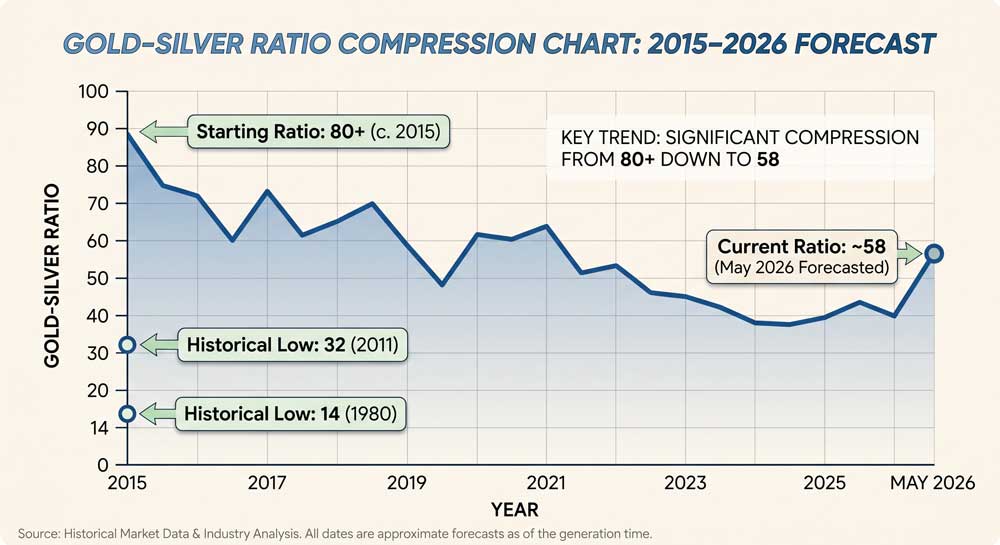
The gold-silver ratio compressed from approximately 62 on May 5 to around 58.7 by May 8’s close — a four-day move that is rare in recent months. This compression is more than a short-term sentiment swing. It reflects a market beginning to reprice silver’s fundamental scarcity relative to gold.
At the current ratio, silver is priced at roughly 1.6–1.7% of gold’s value. Oliver sees a realistic path toward 3–6%, implying a two-to-four-fold gain even before accounting for gold’s own upside. Historically, ratio compression of this kind during bull markets has preceded silver’s most aggressive price phases — as seen in 1979–1980 and 2010–2011.
| Gold-Silver Ratio Level | Implied Silver Price (Gold at $3,300) | Historical Precedent |
|---|---|---|
| 58 (current) | ~$57 | May 2026 |
| 40 | ~$82 | 2011 average |
| 32 | ~$103 | 2011 low |
| 14 | ~$236 | 1980 extreme |
| Oliver’s 3–6% target | $99–$198 | No direct precedent |
5 Supply Cracks That Make 2026 Different
The structural foundation behind the silver price forecast for 2026 is not speculative. It is built on a series of supply constraints that have been widening for six years.
1. A sixth consecutive year of supply deficit
The Silver Institute projects a 2026 silver supply deficit of 46.3 million ounces — a 15% increase over 2025’s shortfall. This marks the sixth straight year of structural undersupply. Mined output remains essentially flat at around 813 million ounces annually, while total demand runs near 1.12 billion ounces.
2. Three industrial engines running simultaneously
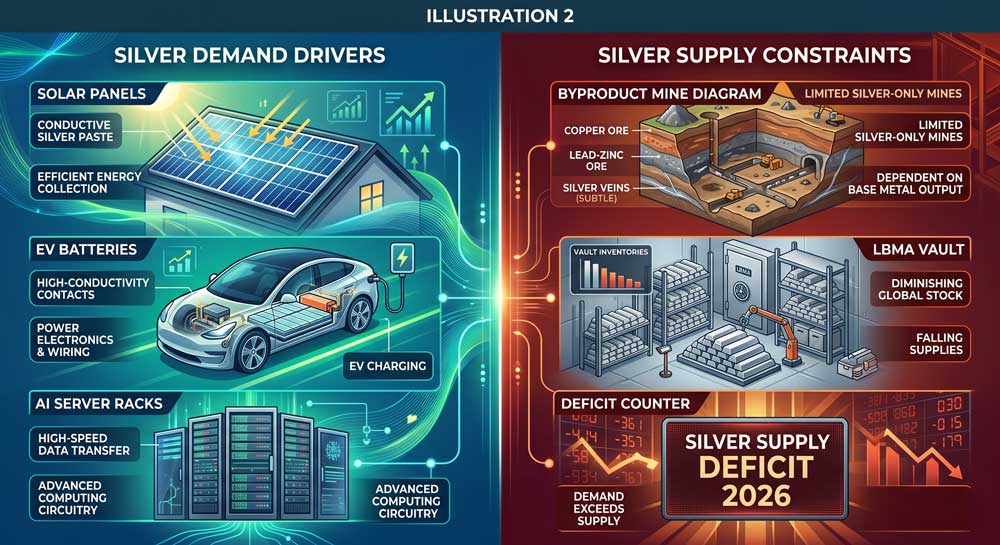
Solar, electric vehicles and AI data centres are consuming silver at a pace that cannot be quickly offset. Photovoltaic panels remain silver-intensive despite industry efforts to reduce per-unit consumption. Electric vehicles use roughly two-thirds more silver than internal combustion alternatives. And GPU packaging for AI computing clusters relies on silver’s unmatched conductivity — a dependency with no near-term equivalent material.
3. 80% of supply is a byproduct — price signals cannot unlock it
Approximately 80% of global silver is extracted as a byproduct of copper, lead, and zinc mining. This means silver’s own price cannot directly incentivise a production ramp. If the primary metal is not being mined, the silver simply does not come out of the ground. Supply elasticity is structurally capped in a way that most commodities are not.
4. Exchange inventories are near decade lows
LBMA silver stocks have declined roughly 25% from their 2019 peak. A major portion of remaining LBMA inventory is locked inside ETF structures and cannot flow freely to the physical market, compressing effective liquidity further. The large transfer of silver from London to New York in late 2025 — driven by tariff arbitrage — was a geographic redistribution, not a supply increase.
5. Short-squeeze conditions have not been neutralised
During October–December 2025, London spot silver commanded a rare premium over New York futures, and silver lease rates spiked above 100% annualised — a signal of acute physical tightness. COMEX registered warrant coverage relative to open interest remains at historically moderate-to-low levels. If delivery demand peaks again in the second half of 2026, the conditions that triggered January 2026’s extreme volatility could return.
What the Major Institutions Are Forecasting
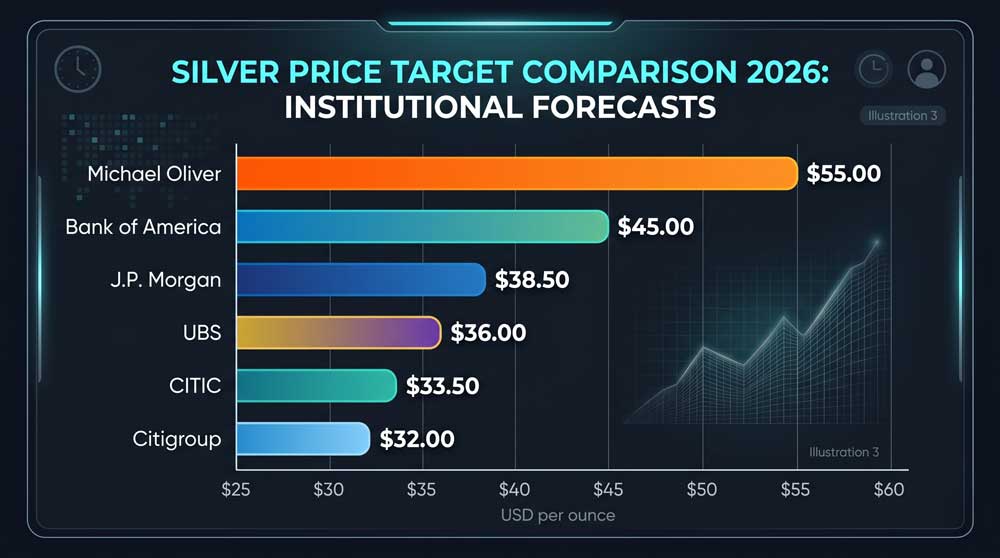
Not everyone agrees on how far this moves. The divergence in institutional silver price forecasts for 2026 is itself a notable signal — it reflects genuine uncertainty about the ceiling.
Oliver’s $300–$500 call no longer looks isolated when placed next to Bank of America’s $309 peak scenario. The more relevant question is not which number is right, but where the ceiling is when a supply-constrained market collides with demand that cannot be turned off.
Two Short-Term Headwinds Keeping Silver in Its Range
If the fundamental case is this strong, why has silver been grinding between $72 and $82 rather than breaking decisively higher? Two specific near-term pressures explain the hesitation.
Federal Reserve policy: the widest internal split since 1992
The April 2026 Fed decision held rates steady, but the vote was 8 to 4 in favour of holding — the largest dissenting bloc since 1992. The statement upgraded inflation language to “elevated” and flagged “high uncertainty” around the Middle East. ADP payrolls came in well above expectations, while wage growth remained muted. This creates a policy fog where rate cuts are priced in and out almost weekly, making a sustained trend move in precious metals difficult to sustain without a clear catalyst.
Middle East: simultaneous negotiations and skirmishes
The May 2026 silver rally was partly fuelled by ceasefire signals in the Middle East, including US-Iran negotiations described as centred on a one-page framework. Yet within days, a naval exchange near the Strait of Hormuz destabilised that narrative. With both sides offering competing accounts of the incident, the risk premium embedded in precious metals remains reactive and unstable. Any genuine de-escalation would reduce safe-haven demand and could trigger a swift pullback.
Five Risks That Could Interrupt the Bull Case
Even with the structural argument intact, five specific risks deserve attention before acting on any silver price forecast for 2026.
| Risk Factor | Mechanism | Historical Precedent |
|---|---|---|
| Exchange intervention | Margin hikes, position limits, delivery rule changes | 1980 Hunt Brothers, 2021 Reddit squeeze |
| Hidden inventory release | Above-ground stocks mobilised at high prices | 2011 ETF liquidations |
| Middle East de-escalation | Risk premium evaporates, safe-haven outflows | N/A — dependent on geopolitics |
| Silver substitution in solar | Copper paste and electroplated copper replacing silver busbars | Industry targeting 2027–2028 rollout |
| Leveraged long liquidation | Forced selling when crowded positions unwind | January 2026 — silver dropped 35%+ intraday |
The January 2026 episode is worth emphasising. Silver fell more than 35% in a single session largely because the exchange raised margin requirements in rapid succession. Anyone who bought silver near $121 during that peak experienced that shock firsthand. The structural bull case does not make violent drawdowns impossible — it makes them more likely during the path toward any long-term target.
Is This Time Actually Different?
Every major silver rally in history has ended with exchange intervention or a forced unwind of leveraged positions. Every previous bull cycle also had its advocates arguing that “this time is different.” The discipline is in distinguishing between narratives and structural data.
Oliver’s argument is not based on a narrative. It is based on a momentum framework with a 40-year track record that flagged the 1987 crash and has tracked multiple precious metals cycles. His observation that the current gold cycle has only completed roughly half the gain typical of prior 8x bull markets — and that silver’s ratio to gold sits at less than half its historical midpoint — is a quantitative argument, not wishful thinking.
The convergence of inelastic industrial demand (solar, EVs, AI), a structurally constrained supply chain (byproduct mining dependency), six consecutive deficit years, and a gold-silver ratio compressing from historically elevated levels creates a setup that is genuinely uncommon. Short-term macro noise from the Fed and geopolitical reversals will continue to create volatility. But the underlying architecture of this market is different from 2011, where the driver was primarily monetary speculation.
The real move, as Oliver frames it, comes after the consolidation ends. When it does, the compressed ratio, depleted inventories, and inelastic demand will not politely wait for latecomers.
Reference URLs
- Silver Institute — 2026 Silver Supply and Demand Forecast: Sixth Consecutive Deficit
- StoneX — Silver Faces Another Deficit in 2026: Supply-Demand Analysis
- J.P. Morgan Global Research — How Will Silver Prices Fare in 2026?
- VBL Gold Fix / Substack — MSA’s Michael Oliver Says Silver Will Seek Out New Price Reality Between $300 and $500
- Jerusalem Post — Expect Accelerated Phase for Gold and Silver — Michael Oliver Interview
- Discovery Alert — Silver Supply Deficit and Fed Rate Cuts: 2026 Market Outlook
- GoldBuzz — Why 2026 Could Be the Year Silver Finally Catches Gold
- ElevenLab — 5 Crucial Reasons the Gold Safe Haven Fails During Oil Crisis Shocks
- ElevenLab — US Dollar Purchasing Power: 8 Powerful Metrics Exposing a Worrying Fiscal Reality
- ElevenLab — Storage Chip Prices Are Exploding: 3 Shocking Reasons Your Next SSD Will Cost More