Operation Epic Fury & the Middle East Geopolitical Crisis: 8,000 Airstrikes, 3 Market Warnings, and 1 Economic Tipping Point
The Middle East geopolitical crisis now known as Operation Epic Fury has entered its 18th consecutive day of large-scale aerial operations, with combined U.S.-Israeli strike sorties estimated between 8,000 and 10,000 — already exceeding the entire 11-day Vietnam “Linebacker II” campaign of 1972. For global investors and strategic analysts, the conflict has crossed a critical threshold: it is no longer a short shock to price in, but a sustained systemic risk to manage.
Table of Contents
The Air Campaign in Numbers
Operation Epic Fury opened on February 28, 2026, with a tempo that stunned military analysts. A U.S. official confirmed 900 strikes in the first 12 hours alone, combining Tomahawk cruise missiles, F-35 strike packages, and drone swarms. By Day 13, Pentagon briefers reported over 6,000 cumulative targets struck and more than 90 naval vessels destroyed or disabled.
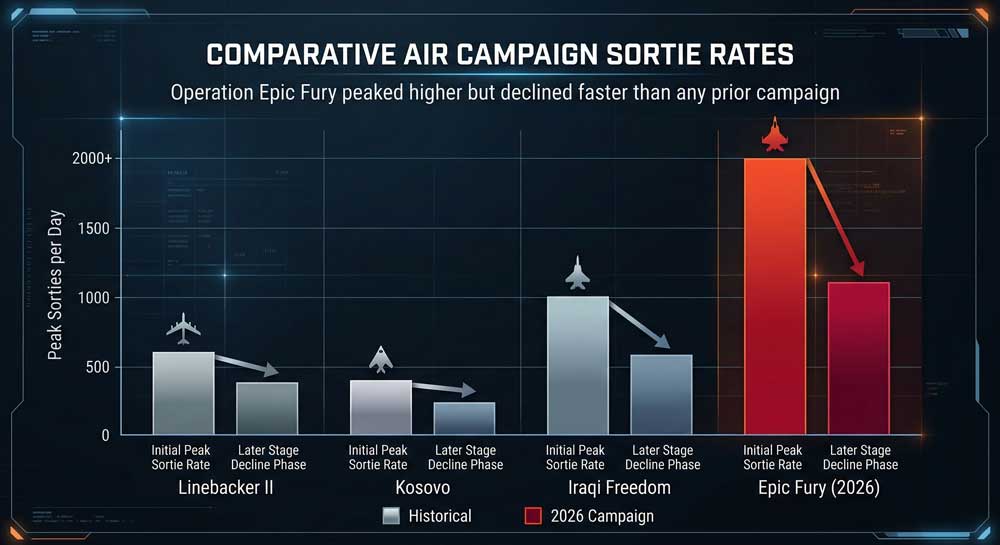
Placed in historical context, the scale is remarkable — but so is the precedent it sets for what comes next:
| Air Campaign | Year | Duration | Est. Total Sorties | Daily Peak |
|---|---|---|---|---|
| Operation Linebacker II | 1972 | 11 days | ~3,000 | ~270 (B-52 focus) |
| NATO Kosovo (Allied Force) | 1999 | 78 days | ~38,000 | ~487 |
| Operation Iraqi Freedom | 2003 | 41 days | ~41,000 | ~1,000 |
| Operation Epic Fury (to date) | 2026 | 18+ days | ~8,000–10,000 | ~1,000 (Day 1–3), now ~200 |
The shift from 1,000 to ~200 daily sorties is not a minor operational footnote — it is the single most important tactical fact of this conflict.
Why Sortie Rates Are Falling
The initial surge was never sustainable. A combined fleet of an estimated 400–500 fighter aircraft — operating from carriers, Gulf bases, and Israeli airfields — cannot maintain maximum tempo indefinitely. By Day 7, the IDF and USAF jointly announced fewer than 200 combat sorties, a figure that has remained broadly stable since.
The drivers are structural: extreme pilot fatigue from long-duration missions, logistical strain on munitions resupply chains, and the practical requirement to rotate crews. Flight Global’s analysis concludes that Operation Epic Fury has already revealed the limits of Western airpower in a sustained, contested-environment campaign.
The parallel with Russia’s Ukraine air campaign is instructive. Russia sustains approximately 100–150 combat sorties per day — supplemented by 300 Shahed drones and dozens of cruise missiles — and has failed to achieve rapid strategic collapse after years of effort. The current ~200 U.S.-Israeli daily sortie rate, while tactically superior, faces an analogous attrition problem.
Unless the coalition commits an additional 200–300 frontline aircraft to the theater, the daily strike rate is unlikely to recover to its opening tempo — and regional munitions stockpiles are already under pressure.
Asymmetric Defense: The Drone and Missile Equation
Traditional air defense platforms have been largely overwhelmed by the coalition’s integrated electronic countermeasures (ECM) network. Domestically developed systems have proven ineffective against AI-assisted targeting and jamming at scale — a gap wider than anything seen in the Gulf War or Iraq War eras.
Yet the defensive response has adapted around three asymmetric strengths:
- ISR drone attrition: Unmanned ISR platforms (MQ-9 Reaper variants) operating at ECM boundary zones remain vulnerable to passive IR-guided interception. The U.S. has acknowledged at least 11 MQ-9A/B losses; total drone attrition across all types exceeds 30 airframes. This matters strategically — ISR drones are the primary tool for locating and targeting mobile ballistic missile launchers
- Ballistic missile conservation: With an estimated stockpile of 2,500–6,000 medium and long-range ballistic missiles, the defending side has deliberately slowed its launch tempo, preserving reserves for a protracted campaign projected to last 60+ days
- Industrial drone production: Independent assessments place Iranian drone manufacturing capacity at approximately 10,000 units per month — a figure that provides long-run attrition resilience even as precision missile stocks thin
| Asset Class | Estimated Stock | Monthly Production | Strategic Role |
|---|---|---|---|
| Medium/Long-Range Ballistic Missiles | 2,500–6,000 | Limited | Strategic deterrence, city targeting |
| Shahed-type Drones | Actively depleting | ~10,000/month | Area harassment, ISR suppression |
| Naval Mines | ~6,000 | Undisclosed | Hormuz denial |
| Anti-ship Missiles | Classified | Undisclosed | Gulf tanker interdiction |
This “logistical warfare” model — multi-wave, low-intensity, high-persistence strikes against military and economic infrastructure — forces the attacking coalition into a costly, time-intensive suppression campaign with no clean endpoint.
Strategic Chokepoints and the Energy Risk
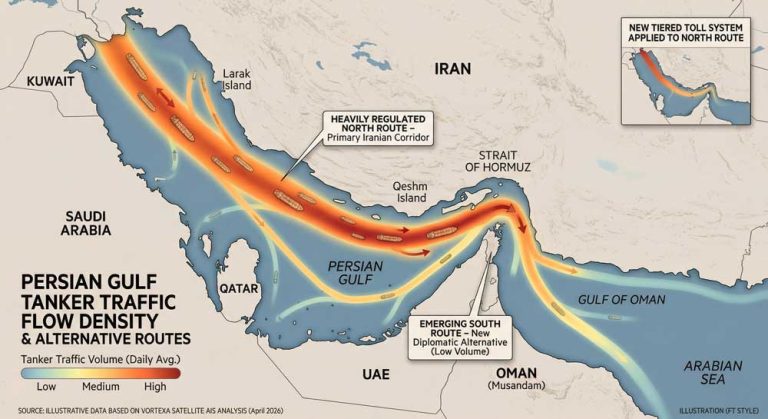
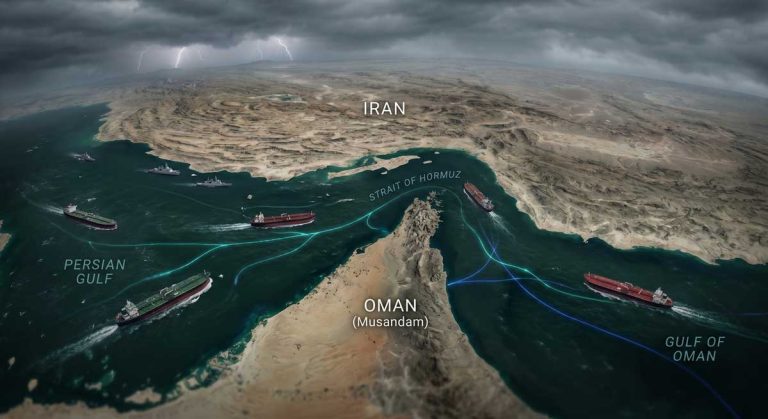
The Strait of Hormuz carries roughly 20% of the world’s daily traded oil. Despite 18 days of intense aerial operations, exports from major Gulf terminals remain — for now — largely uninterrupted. That is the only piece of good news for global markets.
The scenarios if that changes are severe:
| Conflict Duration | Global GDP Impact | Brent Crude Estimate | Global CPI Impact | Gulf GDP Change |
|---|---|---|---|---|
| Short-term (< 2 weeks) | −$330 billion | ~$80/bbl | +0.4 pp | −4% |
| Medium-term (4–6 weeks) | −$770 billion | $100–$120/bbl | +1.0 pp | −11% |
| Extended (3–6 months) | −$2.2 trillion | >$130/bbl | +2.5 pp | −22% |
Source: Yahoo Finance / independent economic modeling, March 2026
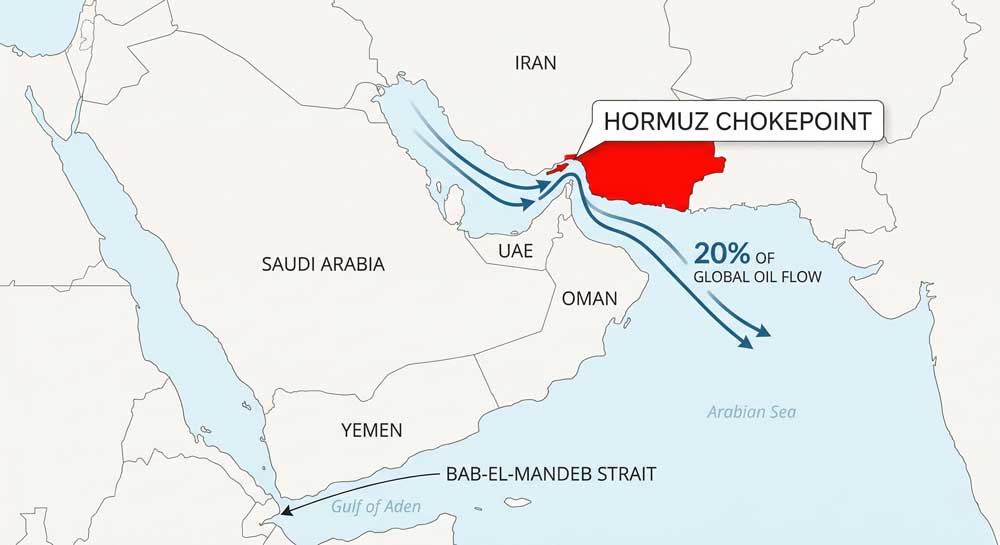
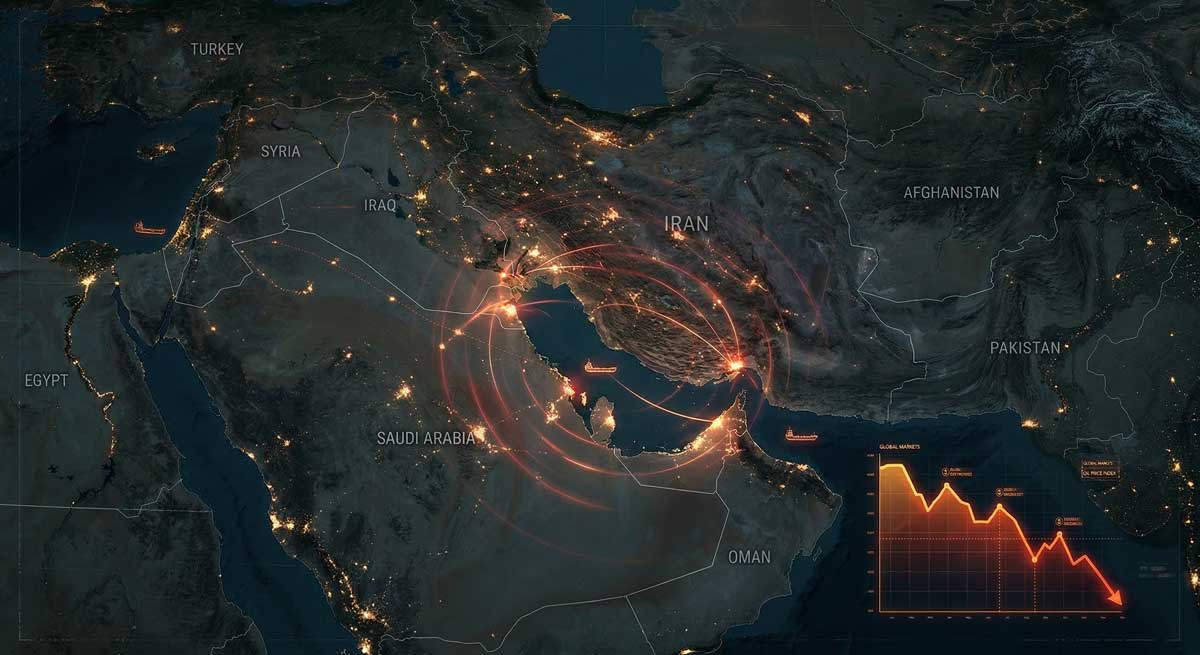
The extended scenario approaches the economic severity of the 1973 Arab oil embargo — a potential trigger for synchronized global stagflation at a time when central banks have limited rate-cutting room. European TTF gas prices have already surged 180% since hostilities began; Gulf equity markets are down 15–35%; war-risk insurance for Gulf-routed tankers has jumped 300–500%.
Two coalition escalation pathways are now openly debated:
- Amphibious assault on strategic Gulf islands to forcibly reopen Hormuz — logistically circular (the Strait must be cleared to clear the Strait)
- Nuclear coercive signaling — references to tactical nuclear options have appeared in public statements, interpreted by analysts as psychological pressure rather than operational planning — but the ambiguity itself is destabilizing
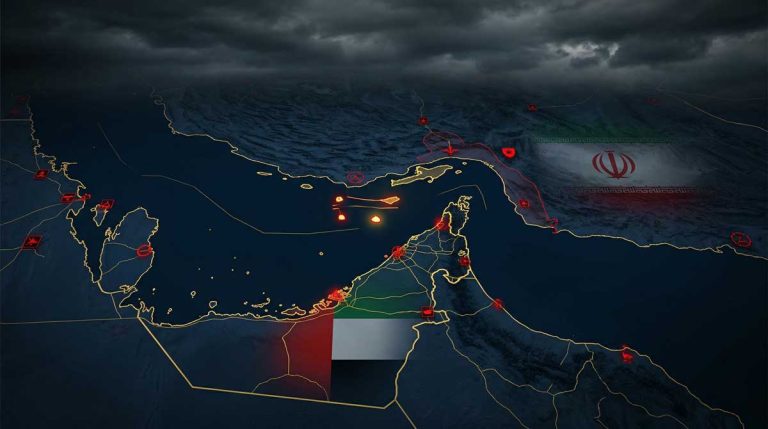
If the conflict extends and energy export routes are permanently severed, a retaliatory expansion targeting GCC petrochemical infrastructure in Saudi Arabia, the UAE, and Qatar becomes strategically rational — a “mutual assured economic destruction” doctrine that would pull the entire global economy into recession.
Goldman Sachs: 3 Warnings for Investors
Goldman Sachs issued its starkest client guidance of the conflict this week. Three warnings stand out:
Warning 1 — The Ceasefire Trap
Prediction markets currently assign a ~35% probability to a ceasefire by end of April — and that figure is declining. Equity markets, however, appear to price in a faster resolution. This divergence is dangerous. The Russia-Ukraine precedent is explicit: ceasefire headlines in 2022–2023 triggered sharp rallies that reversed within days. Goldman’s guidance: the session after a ceasefire announcement is a selling opportunity, not a buying one.
Warning 2 — Institutional De-leveraging Is Not Done
Last week’s positioning data tells a stark structural story:
- Asset managers sold near-record volumes of S&P 500 futures (CFTC-confirmed)
- Fundamental long/short hedge fund gross leverage fell 5.1 percentage points in one week — the largest weekly drop since October 2024 — landing at 218.1%, the 87th percentile over the past year
- Global equity net selling has continued for four consecutive weeks, the largest aggregate since April 2025
- CTA models have approximately $70 billion in equities queued for sale this week; execution brings positioning to neutral
The result is a market dynamic where index short-squeeze bounces occur while quality individual stocks stagnate — a trap for retail buyers chasing apparent “recoveries.”
Warning 3 — Credit Spreads Are the Real Signal
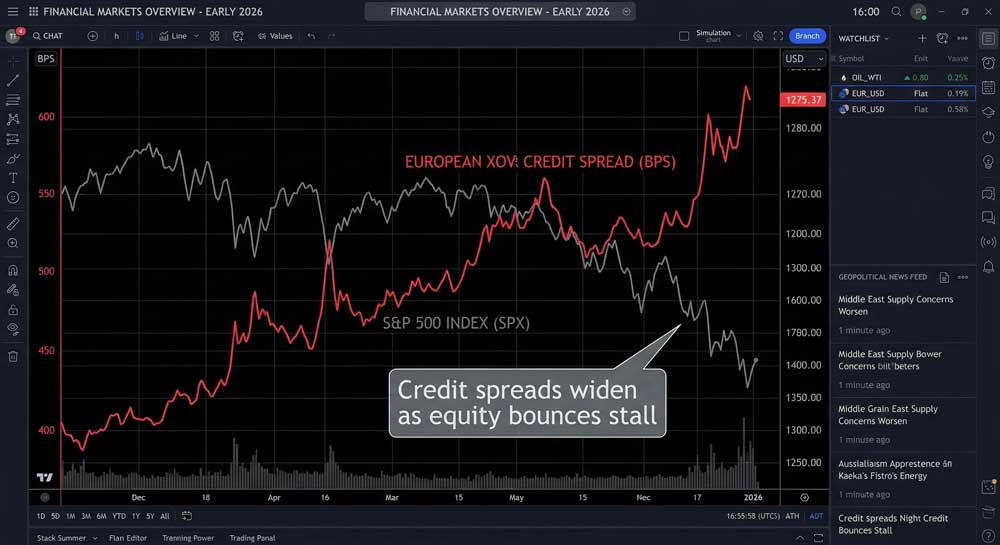
Goldman’s strategist is explicit: European XOVER credit spreads are the single most important indicator to monitor right now. These spreads have widened back toward recent highs despite equity-level bounces — which is precisely why those bounces feel fragile. Equity markets can be short-squeezed; credit markets cannot.
Market Signals That Actually Matter
This week is the most macro-dense of the crisis. The Federal Reserve, Bank of England, ECB, Bank of Canada, and Swiss National Bank are all holding rate meetings simultaneously — with the BOE decision carrying the most binary uncertainty.
The policy constraint is structural: central banks in both Europe and the U.S. remain anchored by the 2022 inflation experience and are reluctant to cut, even as growth risks mount. Last week’s CPI data already pushed core PCE forecasts higher. Commodity cost pressures — metals up sharply in January-February, logistics indices deteriorating — are compounding the picture before oil prices have fully fed through.
Tactical positioning considerations cited by Goldman and Bank of America:
- Brazil equities: Structural beneficiary of extended Middle East disruption — agricultural and energy exporter, geographically remote from Hormuz, with a narrowing political election dynamic adding a tactical catalyst
- Defensive sectors: Outperform when rates stabilize; quality over growth in this environment
- Energy equities vs. crude futures: Retail is chasing oil ETFs while institutions rotate out of crude futures — a classic divergence signal
- Avoid naked index longs: The long-stock / short-futures hedge fund structure means index bounces will continue to be sold, not sustained
The bottom line from every major institution tracking this conflict is consistent: capital preservation outranks speculative positioning until either a credible diplomatic framework emerges or the coalition achieves a decisive, irreversible military breakthrough — neither of which is visible on the current horizon.
📚 Authoritative Sources
- Operation Epic Fury: Airpower’s Limits — Flight Global
- Hudson Institute: Operation Epic Fury Battlefield Situation Report
- CFR: Iran’s War with Israel and the United States — Live Tracker
- Crisis Group: A Sprawling Middle East War Explodes
- Reuters: Iran could disrupt Hormuz with drones for months
- Yahoo Finance: Hormuz closure puts up to $2.2 trillion of GDP at risk
- Goldman Sachs: How will the Iran conflict impact oil prices?
- Investopedia: Stocks Goldman Sachs recommends during the Iran war
- Moomoo / Goldman Sachs: Could Iran learn from Ukraine? Full note
- Bank of America: Markets may be underpricing Iran risks
- RUSI: US and Israeli Strikes — Military and Nuclear Proliferation Analysis
- Al Jazeera: 12 Days — How the Iran Blueprint Trapped US-Israel in a Longer War
- Morningstar/MarketWatch: Retail vs institutional oil positioning divergence
- Business Insider: Goldman Sachs sees Iran war driving oil shock
- 5 Epic Reasons the Hong Kong Safe Haven Thrives After Dubai’s Collapse
- 5 Critical Warning Signs the US Private Credit Crisis Is Triggering a $4.2 Trillion Banking Meltdown
- 4th Oil Crisis: 5 Powerful Turning Points That Broke the $100 Barrier
- Hormuz Strait Oil Disruption: 7 Critical Impacts Reshaping the 2026 Global Energy Market