5 Critical Warning Signs the US Private Credit Crisis Is Triggering a $4.2 Trillion Banking Meltdown
The US private credit crisis is no longer a shadow banking problem — it has broken containment. What began as isolated redemption stress in alternative asset funds has now drawn in Deutsche Bank, JPMorgan, and triggered the largest wave of withdrawal freezes the $2 trillion sector has ever seen.
If you hold positions in financial stocks, pension funds, or any vehicle with private credit exposure, here is what you need to understand right now.
Table of Contents
What Is Private Credit — And Why Is It Cracking?
Private credit refers to direct lending by non-bank asset managers — firms like BlackRock, Blackstone, Blue Owl, and Cliffwater — that make loans to companies outside the traditional banking system. The asset class exploded after the 2008 financial crisis, growing from a niche market to over $1.8 trillion in AUM by early 2026, as investors chased higher yields and banks retreated from riskier corporate lending.
The structural vulnerability was always the same: these funds offer quarterly liquidity windows to investors, but hold illiquid, long-dated loans that cannot be sold quickly without steep discounts. That mismatch was manageable during the boom years. Now, it is unraveling.
Sign #1: AI Disrupts the Core Collateral
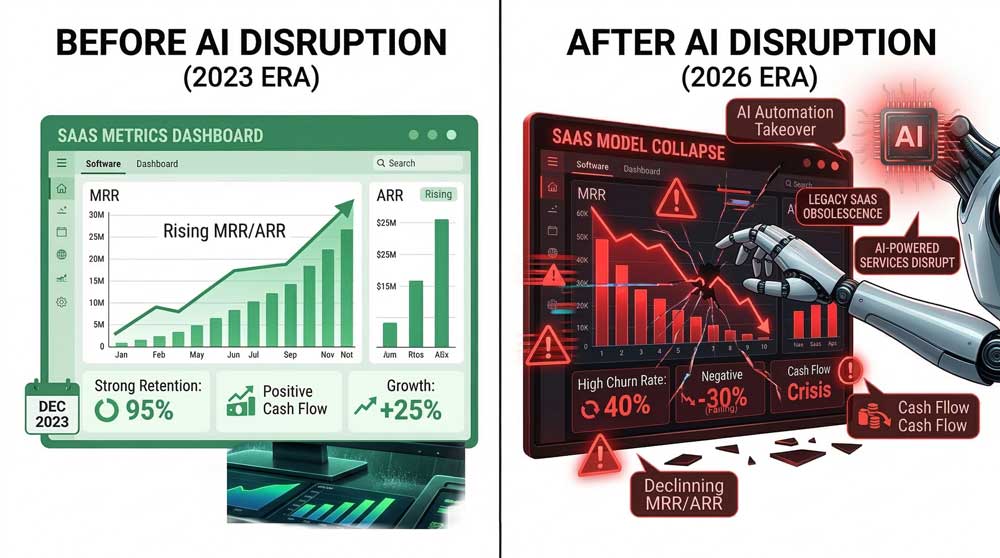
The trigger for the US private credit crisis is rooted in a specific portfolio concentration problem. According to reports from Barclays and UBS, some private credit funds have up to 55% of their portfolios in software and technology company loans. These loans were underwritten when SaaS revenue multiples were elevated and subscription cash flows seemed predictable.
Generative AI changed that calculus abruptly. As AI tools began replacing enterprise software functions, markets started aggressively repricing legacy tech firm valuations — the very collateral underpinning billions in private credit loans. Default rates in private credit institutions hit 5.8% in January 2026, the highest level since August 2024. Business development company (BDC) stocks — public proxies for private credit health — have declined 18% over the past year, even as the S&P 500 gained an equivalent amount.
Sign #2: The “Margin Call Moment” — Blue Owl Sells at a Discount
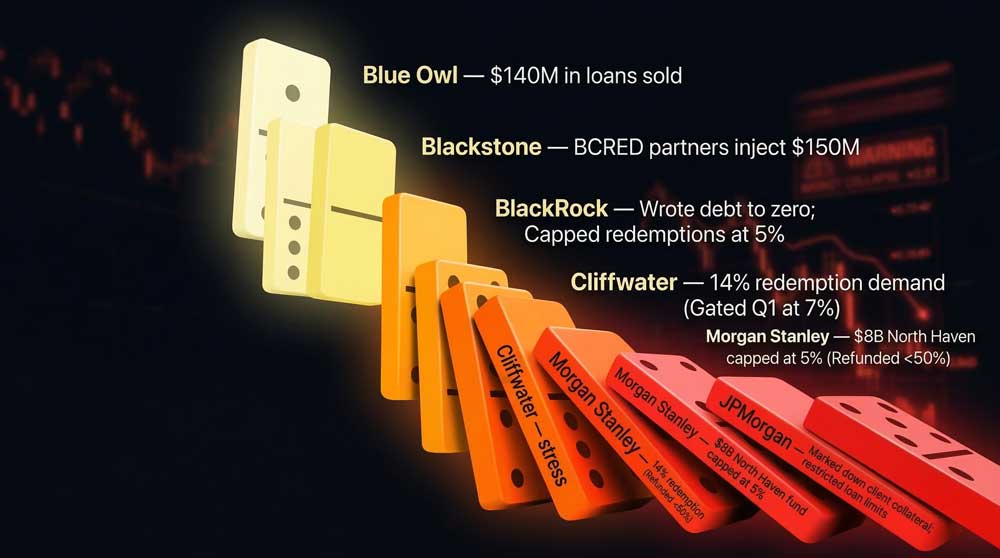
The first domino fell when Blue Owl Capital executed a $1.4 billion secondary transaction to accelerate capital returns to investors in its OBDC II fund, followed by selling $140 million in loans at just 99.7 cents on the dollar to meet redemption requests. Market analysts immediately labelled this the private credit sector’s “margin call moment” — the point where a fund is forced to liquidate assets at unfavorable prices simply to satisfy investor exits.
The move backfired in one critical sense: rather than restoring confidence, it publicly revealed just how thin secondary market liquidity had become. Blue Owl’s shares hit all-time short interest levels following the disclosure.
Sign #3: The Fatal Blow — BlackRock Writes a Loan to Zero
The pivot from stress to full-blown panic came when BlackRock marked a $25 million subordinated debt position to zero in just three months — reducing it from full face value to nothing. The firm then imposed a 5% redemption cap on its $26 billion HPS Corporate Lending Fund, even though investors had submitted withdrawal requests totalling 9.3% of fund assets.
This was the moment the industry’s unspoken rules broke down. As financial commentators noted, by publicly acknowledging a near-total wipeout on a loan position, BlackRock validated every fear investors had quietly held — and rationally incentivised every remaining investor to join the redemption queue before the next round of gates closed.
Key Institutional Responses to the Liquidity Crisis
Sign #4: Traditional Banks Are Now Exposed
The US private credit crisis has breached the firewall between shadow banking and regulated institutions. Deutsche Bank disclosed in its 2025 annual report that its private credit exposure had risen to €25.9 billion (~$30 billion), representing 5% of its entire loan book — one of the highest figures among major Wall Street banks. Its technology sector lending alone reached €15.8 billion. Deutsche Bank shares dropped over 5% in Frankfurt following the disclosure, now down approximately 22% year-to-date.
The bank explicitly flagged “rapid expansion, lack of transparency, and potential interconnected risks” in private credit as a heightened risk theme, noting that loans in this space are now subject to “heightened scrutiny due to recent default events in the market”.
Sign #5: The $4.2 Trillion Time Bomb in Bank Balance Sheets
This is the number that should concern every investor — not the individual fund gates, but the systemic exposure lurking inside traditional banks.
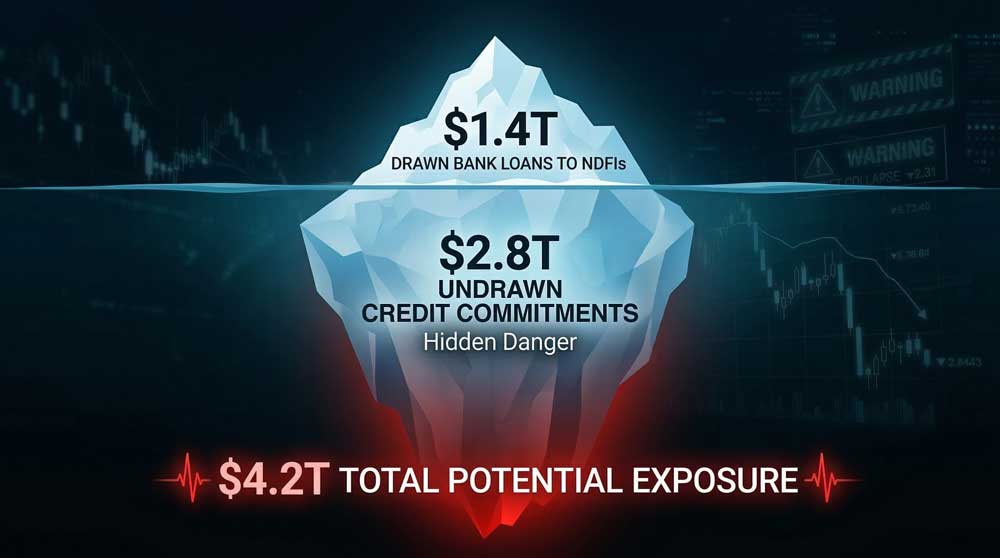
FDIC data shows that U.S. bank loans to non-depository financial institutions (NDFIs) surged 35% year-over-year, reaching $1.4 trillion at end-2025 — up from less than 1% of total bank loan portfolios in 2010 to approximately 11% today. Among NDFI categories, private credit represents the single largest share.
Even more alarming: banks hold an estimated $2.8 trillion in undrawn credit commitments to these same institutions. Under Basel III exposure-at-default rules, a non-bank firm can draw these committed lines and immediately default — transferring massive losses directly onto bank balance sheets.
U.S. Banking System Exposure to NDFIs
Unlike corporate bonds, no credit default swaps exist for NDFI loans, meaning banks have no standard hedging mechanism against this exposure.
What Comes Next: Q1 2026 Disclosures Are the Next Flashpoint
Analysts at Barclays have warned that Q1 2026 fund flow disclosures — due in the coming weeks — could reveal further capital outflows across the private credit sector, widening credit spreads and deepening institutional anxiety. The key metrics to watch:
- Whether additional interval funds breach their redemption caps
- JPMorgan’s Q1 collateral valuation updates on private credit clients
- Federal Reserve and FDIC guidance on NDFI systemic risk classification
- Default rate trajectory for software-dependent borrowers beyond 5.8%
The era of unchecked private credit expansion — fuelled by a 2,320% growth in bank-to-NDFI lending over 15 years — is facing its most serious reckoning. The question now is whether the correction stays contained within the shadow banking system, or follows the well-worn path of financial crises past: slowly, then all at once.
Authoritative Sources (DoFollow External Links)
- Bloomberg: Private Credit’s Gate-Crashers Are Forcing Funds Into a Brutal Spot
- Bloomberg: Deutsche Bank Flags a $30 Billion Exposure to Private Credit
- Bloomberg: Morgan Stanley Limits Redemptions on Private Credit Fund
- Reuters: Cliffwater’s Private Credit Fund Redemptions Hit 14%
- Reuters: Blue Owl Shares Extend Losses After Blocking Redemptions
- Forbes: Bank Lending to Private Credit and Non-Banks Is at Historic Highs
- FDIC: Bank Lending to Nondepository Financial Institutions
- Morningstar: Private Credit’s Liquidity Squeeze Puts Lenders in a Tight Spot
- WSJ: Cliffwater Fund Joins Private-Credit Vehicles Limiting Redemptions
- Daily Reckoning: Loans to Nonbanks Threaten Banking Crisis
- State Street Global Advisors: 2026 Credit Research Outlook
- Global Banking & Finance Review: Deutsche Bank Grows Private Credit Portfolio, Flags Sector Risks
- ElevenLab: Nvidia H200 Chips China Sales Hit Zero: 7 Shocking Reasons Trump’s Strategy Backfired
- ElevenLab: Trump Tariffs European Inflation: 5 Shocking Ways US Trade Barriers Are Crushing Eurozone Prices
- ElevenLab: Must Read: The 2028 Global Intelligence Crisis and the “Ghost GDP”