Trump Tariffs European Inflation: 5 Shocking Ways US Trade Barriers Are Crushing Eurozone Prices
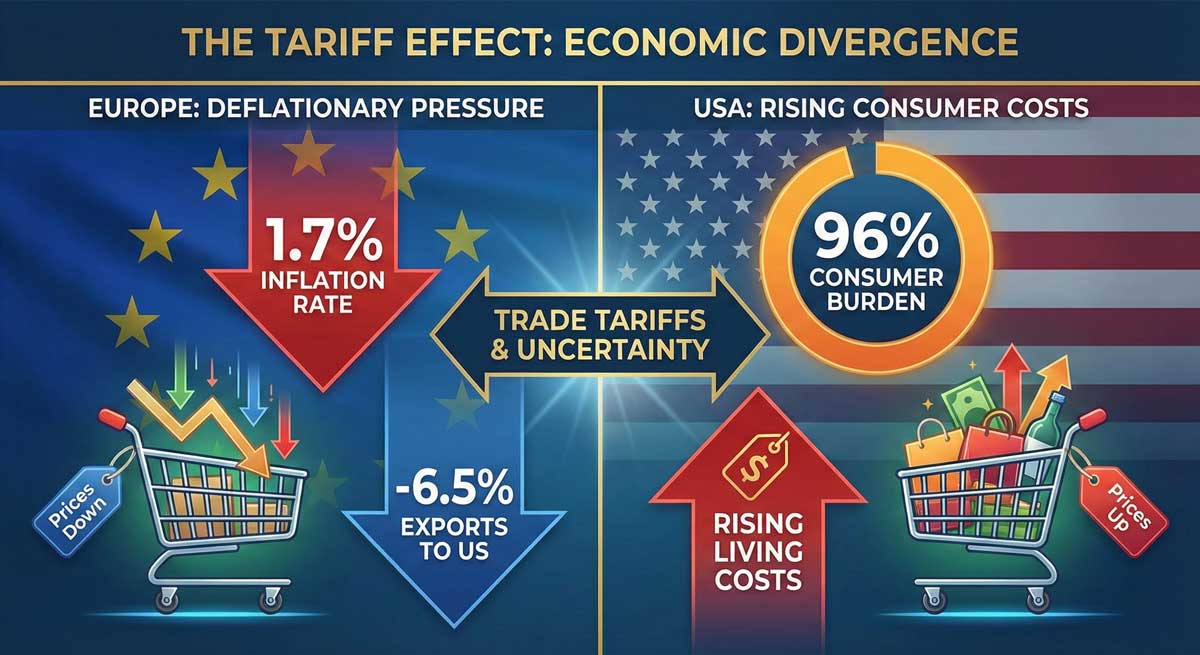
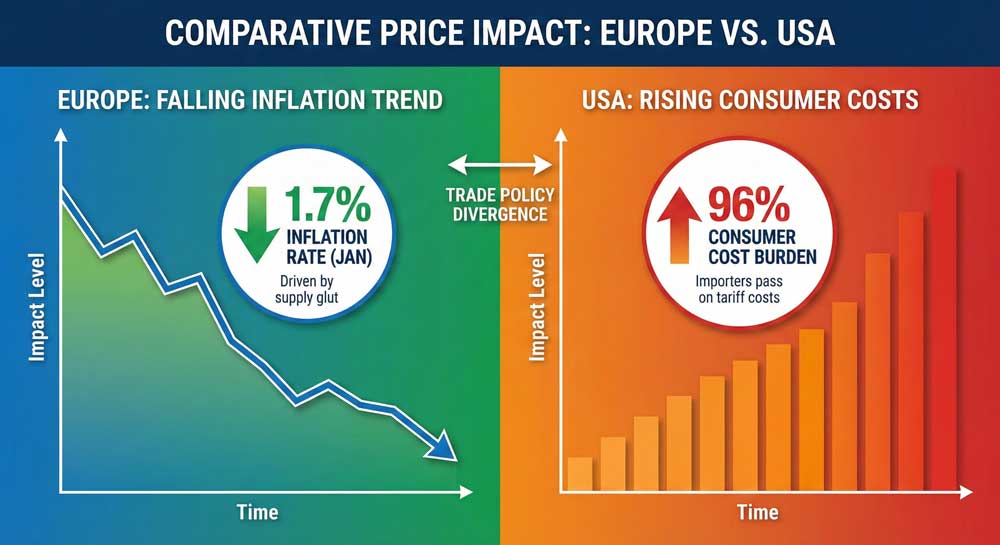
Trump tariffs European inflation dynamics reveal a shocking paradox: US trade barriers designed to protect American manufacturing are instead crushing eurozone prices while American consumers shoulder 96% of the cost. Recent European Central Bank data shows trump tariffs European inflation impact drove exports down 6.5% year-over-year, dragging inflation to just 1.7%—dangerously below the ECB’s 2% stability target.
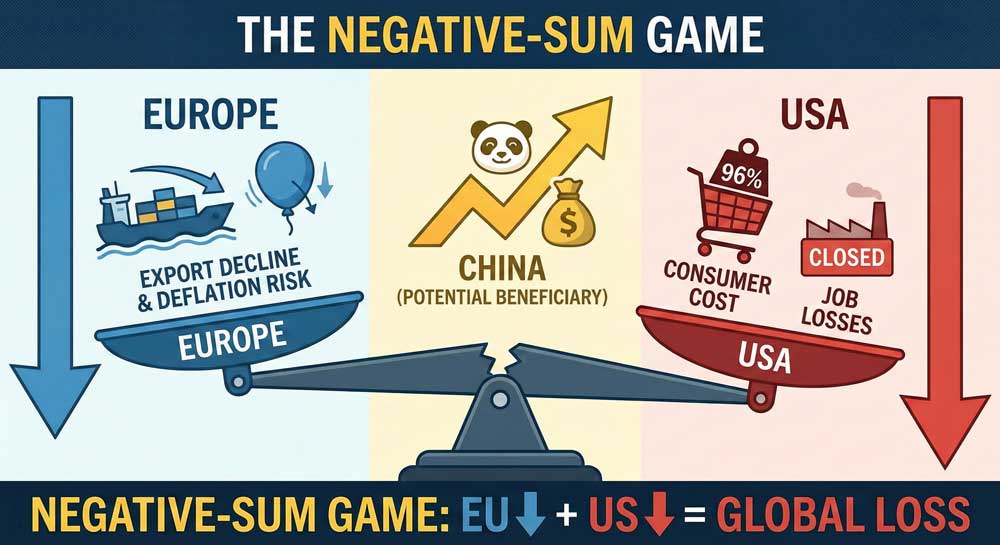
Gianmarco Ottaviano, Professor of Economics at Milan’s Bocconi University, warns this represents a “negative-sum game” where both sides lose. The real winner? Potentially China, as Western resources shift from innovation to protecting obsolete industries.
1. How Trump Tariffs European Inflation Collapse: The Supply Glut Mechanism
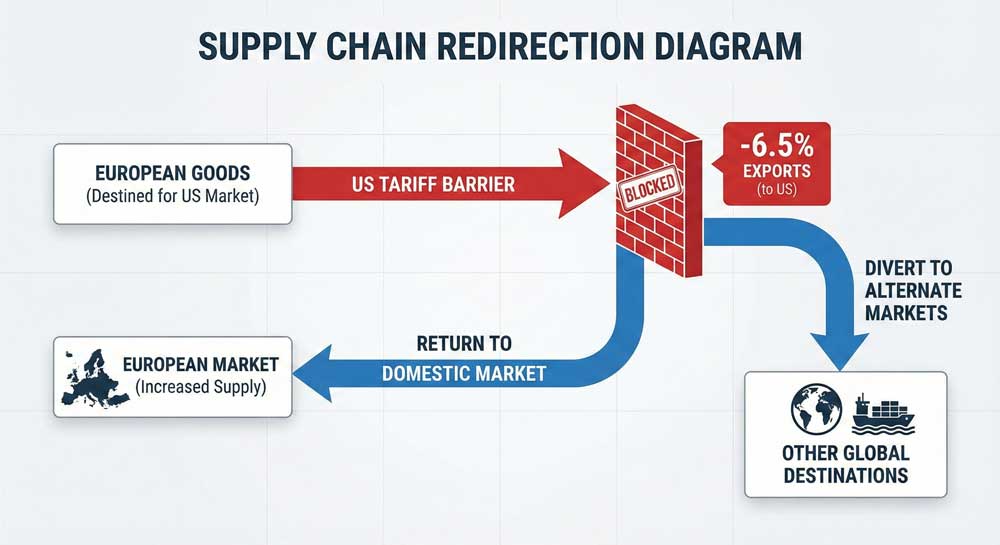
The Impact of Trump Tariffs on European Inflation follows a counterintuitive economic sequence that defies protectionist expectations. When Washington imposed sweeping levies on European machinery, automobiles, and chemicals, the anticipated surge in American manufacturing orders never materialized.
Instead, a mechanical process unfolded:
- Export blockage: European goods became prohibitively expensive for US importers, with average tariff rates jumping from 2.6% to 13% by late 2025
- Internal oversupply: Products originally destined for American markets remained trapped within Europe or redirected to alternative destination
- Price collapse: Excess supply relative to demand created systematic downward pressure on eurozone consumer
“From the European perspective, the situation reverses completely,” Ottaviano explains. “Products stay in the internal market or shift to other destinations, increasing supply relative to demand and forcing prices down. External demand falls, internal supply rises—textbook deflation.”
The Tariff-to-Deflation Pipeline
| Stage | Mechanism | Timeframe | Impact on Europe |
|---|---|---|---|
| 1. Tariff announcement | US importers face 10-100% levies | Immediate | Export orders cancelled |
| 2. Supply redirection | Goods remain in EU or seek new markets | 1-3 months | Inventory accumulation |
| 3. Price adjustment | Excess supply forces competitive pricing | 3-6 months | Wholesale price drops |
| 4. Consumer deflation | Lower costs pass through to retail | 12-18 months | -0.1% per 1% export decline |
European Central Bank economists calculate that every 1% reduction in US-bound exports corresponds to approximately 0.1% lower consumer prices within 18 months —a seemingly modest figure that Ottaviano warns carries profound implications.ecb.
“For a central bank, this is a critical alarm signal,” he emphasizes. “It means zero inflationary pressure when you’re targeting 2% for economic stability. The real risk becomes persistent sub-target inflation and potential deflationary spirals.”
2. Trump Tariffs European Inflation Impact: Sectoral Vulnerability Analysis
Three core export sectors absorb the brunt of tariff damage, representing approximately 60% of analyzed industries and half of European industrial output:
High-Risk Industry Exposure Matrix
| Sector | US Export Dependence | Tariff Sensitivity | Interest Rate Leverage | Deflationary Risk |
|---|---|---|---|---|
| Automotive | Very High (25-30% of output) | Critical | High | Severe price pressure |
| Machinery & Equipment | High (20-25% of output) | Critical | High | Order cancellations mounting |
| Chemicals | High (15-20% of output) | Moderate | Medium | Supply chain disruption |
| Technology Hardware | Medium (10-15%) | Low-Moderate | Low | Uncertainty dampening investment |
The silver lining? These tariff-vulnerable sectors also demonstrate high sensitivity to interest rate changes. As the ECB cuts borrowing costs to combat deflationary pressures, lower financing expenses could partially offset negative trade impacts through cheaper capital investment.ecb.
However, this monetary policy buffer only works if business confidence remains intact—which brings us to the more insidious threat.
3. The Uncertainty Tax: Why Volatility Damages More Than Tariffs Themselves
Professor Ottaviano argues the genuine danger transcends direct tariff percentages—it’s the whiplash volatility that freezes economic decision-making.
“Tariff rates surge from 10% to 100%, then crash to 25% within weeks,” he notes. “This makes serious long-term capital planning impossible for businesses and investors. Companies cannot calculate return on investment when the rules change daily.”
This “uncertainty tax” manifests in measurable ways:
- Suppressed capital expenditure: Firms delay factory construction and equipment purchases
- Hiring freezes: Unable to forecast demand, companies stop workforce expansion
- Investment flight: Capital redirects toward stable, predictable markets (often outside the West)
- Innovation slowdown: R&D budgets shrink as management focuses on crisis response
Oxford Economics projects new US tariffs could push the eurozone to the brink of recession, with economic costs ranging from 0.3% to 1.0% of GDP by end-2026. The Centre for European Policy Studies warns that unpredictable tariff volatility corrodes business confidence more than static trade barriers ever could.
4. America’s Mirage: The Savings Depletion Crisis
While Europe confronts deflationary pressures, American households face the mirror-image crisis: rising costs fueled by tariff-driven inflation and collapsing savings reserves.
US Consumer Financial Stress Indicators
| Metric | 2024 Baseline | Late 2025 Status | 2026 Projection | Trend |
|---|---|---|---|---|
| Personal savings rate | 4.8% | 3.5% | Sub-3.0% | ⬇️ Dangerous decline |
| Household tariff burden | $400/year | $1,000/year | $1,300/year | ⬆️ Accelerating |
| Retail sales growth | +2.1% | Near zero (Dec 2025) | Negative | ⬇️ Consumption stalling |
| Pandemic savings drawdown | Moderate | Rapid depletion | Near exhaustion | ⚠️ Critical |
“Consumer spending increasingly relies on burning through pandemic-era accumulated savings, not income growth,” Ottaviano observes. “Americans are still consuming, but they’re draining savings reserves. That’s unsustainable.”
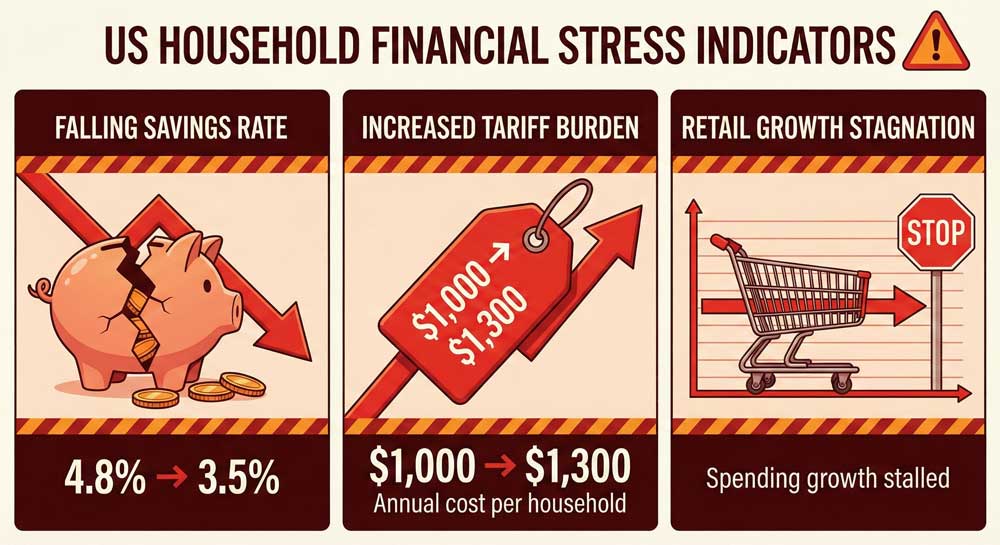
December 2025 retail sales remained essentially flat, while rising living costs—especially in major urban centers—forced households to defer big-ticket purchases like vehicles and appliances. The Tax Foundation estimates tariffs increased the average household’s tax burden by $1,000 in 2025, projected to reach $1,300 in 2026.
Ottaviano’s skepticism cuts to the core strategic flaw: “The US already leads in advanced technology, digital services, and finance. Protectionist rhetoric focuses on traditional heavy industry. The risk is protecting yesterday’s sectors instead of investing in tomorrow’s—and if resources shift away from tech innovation, the real winner will be China”.
5. The 96% Solution: Who Really Pays for Tariffs?
The research evidence on tariff cost distribution is unambiguous and devastating to protectionist narratives.
Tariff Cost Burden Distribution
| Study | Institution | US Share of Costs | Foreign Exporter Share | Methodology |
|---|---|---|---|---|
| Kiel Institute Analysis | Kiel Institute for World Economy | 96% | 4% | 25 million transactions analyzed |
| New York Fed Study | Federal Reserve Bank of NY | 90% | 10% | Import price pass-through modeling |
| Yale Budget Lab | Yale University | 100% consumer pass-through | Near-zero absorption | GDP impact modeling |
The Kiel Institute’s examination of 25 million transactions found approximately 96% of tariff costs land on US importers—ultimately American businesses and consumers. Foreign exporters absorb only about 4% through marginal price reductions, preferring instead to reduce shipment volumes.
The Federal Reserve Bank of New York corroborates this finding: 90% of heightened tariff burdens fall on US companies, with pass-through rates to consumers approaching 100%. Rather than accepting lower margins, exporters in Brazil, India, and Europe simply cut volumes.
“The timing creates the fundamental problem,” Ottaviano explains. “Tariffs function as taxes taking effect immediately—prices rise at once. But the supposed industrial benefits, even if they eventually materialize, require years to develop. Meanwhile, consumers pay elevated prices without any compensation period.”
Yale Budget Lab projects tariffs will:
- Slow US GDP growth by 0.4 percentage points in 2026
- Reduce annual economic expansion by 0.3% (~$100 billion)
- Increase unemployment by 0.6 percentage points
- Eliminate 1.3 million jobs by year-end 2026
The Negative-Sum Endgame
From a pure economic perspective, the Impact of Trump Tariffs on European Inflation reveals a lose-lose scenario. “Today’s tariffs represent a negative-sum game: damaging both those who impose them and those who endure them,” Ottaviano concludes.
Yet the political calculus operates on different logic. Trump effectively weaponizes tariffs as bargaining chips across negotiations spanning geopolitics, digital taxation, NATO spending, and bilateral trade deals. They function less as economic policy tools and more as political leverage instruments—but the collateral damage to efficiency and growth accumulates regardless of intent.
The most corrosive long-term impact remains the uncertainty itself. Tariff policy volatility suppresses investment, erodes confidence, warps resource allocation, and penalizes forward-looking planning. Ironically, large technology corporations demonstrate relative resilience in this chaotic environment—yet these are precisely the sectors that employ relatively few traditional industrial workers, undermining the stated protectionist goals.
Protectionism promises economic strength but currently delivers growth obstacles, European deflation risks, American consumer pain, and potential strategic advantage to China as Western resources divert from innovation to preserving obsolete industrial capacity.
Deep-Dive Sources
- Euro zone inflation to take hit from tariffs but rate cuts could offset – Reuters (ECB Economist Analysis)
- Lower inflation, weaker activity: what foreign import tariffs mean for the euro area – European Central Bank Official Blog
- Opposite effect: Could Trump’s tariffs end up cooling inflation in Europe? – Euronews Business Analysis
- Costs from Trump’s tariffs paid mainly by US firms and consumers – BBC News Economics
- Americans Bear Almost All the Cost of Trump Tariffs – Yahoo Finance (Kiel Institute Study)
- US companies, consumers bear nearly 90% of tariff costs – Retail Dive (New York Fed Research)
- New US tariffs would push Eurozone to brink of recession – Oxford Economics Research
- ECB member warns of deflationary impact from US tariffs – Investing.com (Central Bank Commentary)
- Unpredictable tariffs by the US: implications for euro area monetary policy – Centre for European Policy Studies
- Personal Saving Rate Official Data – U.S. Bureau of Economic Analysis
- Silver’s 50% Crash and 30% Rebound: 5 Critical Insights for 2026 Investors
- The Great Capital Migration: Why Global Investors Are Fleeing Australian Assets in 2026
- 5 Brutal Truths the Clawdbot AI Assistant Reveals About Siri’s Future in 2026