US Stock Market All-Time High: 5 Powerful Forces Behind the $75 Trillion Surge
The US stock market all-time high crossed the $75 trillion mark in May 2026 — a milestone that is as remarkable as it is worth scrutinising closely. That single number now exceeds the combined GDP of the European Union, China, and Japan. And yet, beneath the headline sits a market story that is far more concentrated, more conditional, and more complex than the record alone suggests.
Table of Contents
What $75 Trillion Actually Means
To put this in context: the total US market capitalisation of roughly $75 trillion is approximately 2.8 times the United States’ own annual GDP. As recently as January 2026, the S&P 500’s market cap alone stood at $62.3 trillion, meaning the broader market — including all NYSE, Nasdaq, and OTC-listed companies — has surged by several trillion dollars in just a few months.
For comparison, the global equity market was estimated at around $127.4 trillion at the start of 2026. That means the United States alone accounts for well over half of the entire world’s publicly listed corporate value, despite representing roughly 25% of global GDP.
US Market Cap vs. Major Global Economies (2026 Estimates)
| Economy / Index | 2025 GDP (approx.) | Notes |
|---|---|---|
| United States (GDP) | ~$27 trillion | US market cap is ~2.8× its own GDP |
| European Union (GDP) | ~$19 trillion | World’s largest trading bloc |
| China (GDP) | ~$18 trillion | Second-largest economy globally |
| Japan (GDP) | ~$4.2 trillion | Major developed-market economy |
| EU + China + Japan combined | ~$41 trillion | Less than the US stock market alone |
| US Total Stock Market Cap | ~$75 trillion | Historic all-time high, May 2026 |
This Is Not a Broad Rally — It Is a Concentration Story
I think one of the most important things to understand about this US stock market all-time high is that it does not reflect an even, across-the-board rise in corporate value. The gains are extraordinarily concentrated.
More than 70% of the market cap increase can be attributed to a handful of technology giants — Nvidia, Alphabet (Google), Apple, Microsoft, Amazon, Meta, and Tesla. These companies, often called the Magnificent Seven, have effectively carried the entire index on their backs.
As of early May 2026, the top three US companies by market cap are Nvidia at approximately $4.85 trillion, Alphabet at $4.66 trillion, and Apple at $3.98 trillion. Nvidia alone led rankings at $4.48 trillion as recently as January 2026. Alphabet saw a single-day gain of nearly 10% following strong earnings, adding over $400 billion in market value overnight — catapulting it to the number two spot globally.
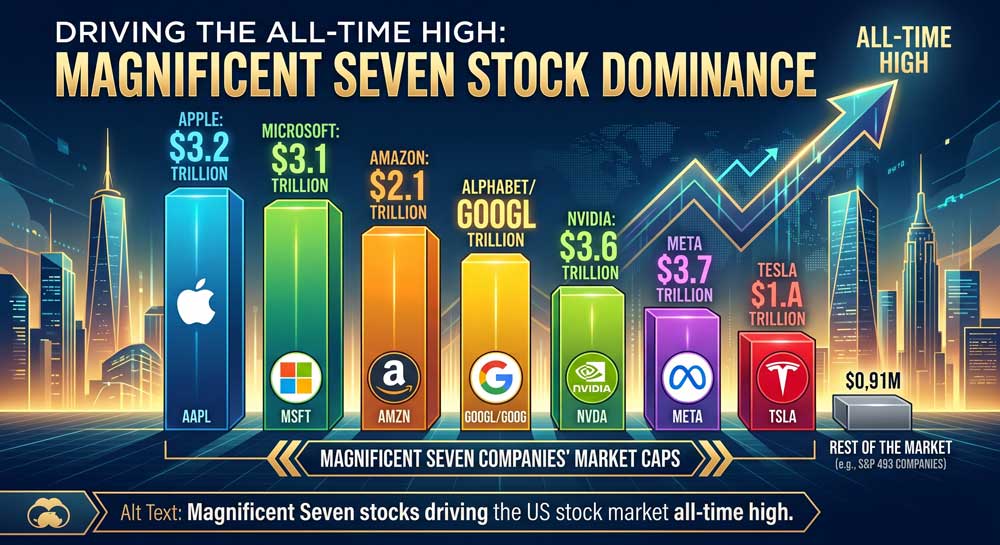
Magnificent Seven: Estimated Market Cap Contributions (Early 2026)
| Company | Approx. Market Cap (2026) | Key Driver |
|---|---|---|
| Nvidia | ~$4.85 trillion | AI chip dominance |
| Alphabet (Google) | ~$4.66 trillion | AI monetisation, cloud |
| Apple | ~$3.98 trillion | Services ecosystem |
| Microsoft | ~$3.48 trillion | Azure AI, Copilot integration |
| Amazon | ~$2.6 trillion | AWS, logistics |
| Meta | ~$1.5 trillion | Ad revenue, AI infrastructure |
| Tesla | ~$1.0 trillion | EV + autonomy narrative |
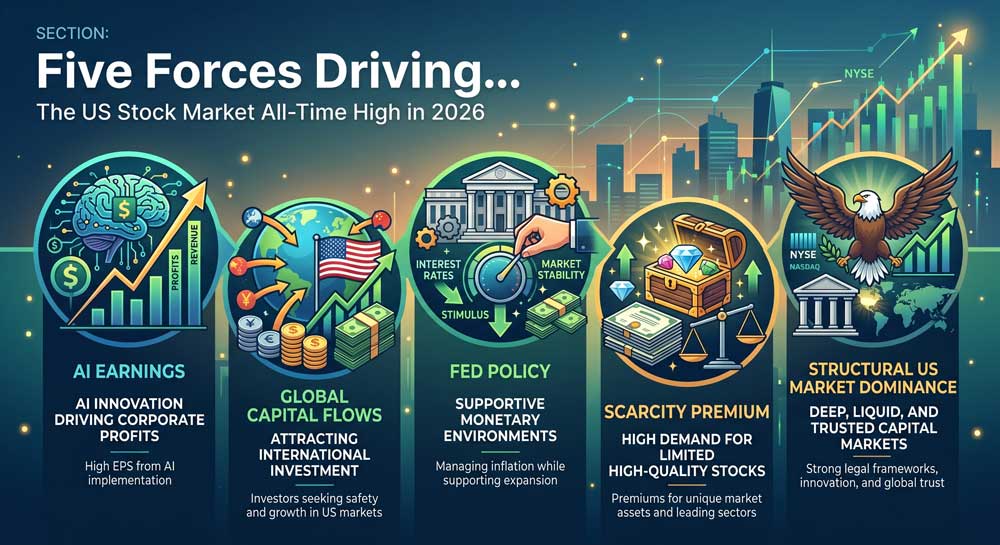
Five Forces Driving the US Stock Market All-Time High
1. AI Earnings Are Delivering Real Results
This rally is not purely speculative. The companies leading it are posting earnings that exceed market expectations by meaningful margins. Nvidia’s AI chip revenue has remained extraordinary, while Google and Microsoft’s AI-integrated cloud services are converting AI investment into hard revenue. In a global environment where genuine high-growth assets are scarce, that kind of earnings visibility commands a significant premium.
2. The “Best of a Bad Bunch” Dynamic in Global Capital
Capital flows globally toward the best available risk-adjusted return. With eurozone growth sluggish, China’s recovery uneven, and emerging markets facing currency and geopolitical headwinds, the United States remains the most liquid and institutionally stable destination for large-scale capital. The US dollar’s reserve currency status reinforces this dynamic further.
3. Federal Reserve Expectations — and the Recalibration
At the start of 2026, markets widely anticipated multiple Fed rate cuts. That narrative has since cooled sharply, with major institutions including JPMorgan and HSBC projecting the possibility of zero rate cuts for the full year. Despite this, capital has continued flowing into US equities. That resilience suggests the underlying bull case — strong earnings, dollar strength, AI productivity — is doing more work than monetary policy alone.
4. The Scarcity Premium on Certainty
In markets where uncertainty is the default, assets offering earnings visibility become disproportionately valued. The Magnificent Seven companies have repeatedly demonstrated the ability to grow revenues and margins even in challenging macro environments. That perceived reliability commands a scarcity premium that further inflates their valuations.
5. Structural Dominance of US Equity Markets
The United States already accounted for more than half of global equity market capitalisation before this rally. Index-linked investing, pension fund mandates, and sovereign wealth fund allocations all systematically direct capital toward large-cap US equities. As valuations rise, index weightings increase — creating a self-reinforcing cycle.
The Valuation Question Cannot Be Ignored
I find it intellectually dishonest to discuss this US stock market all-time high without confronting the valuation picture directly.
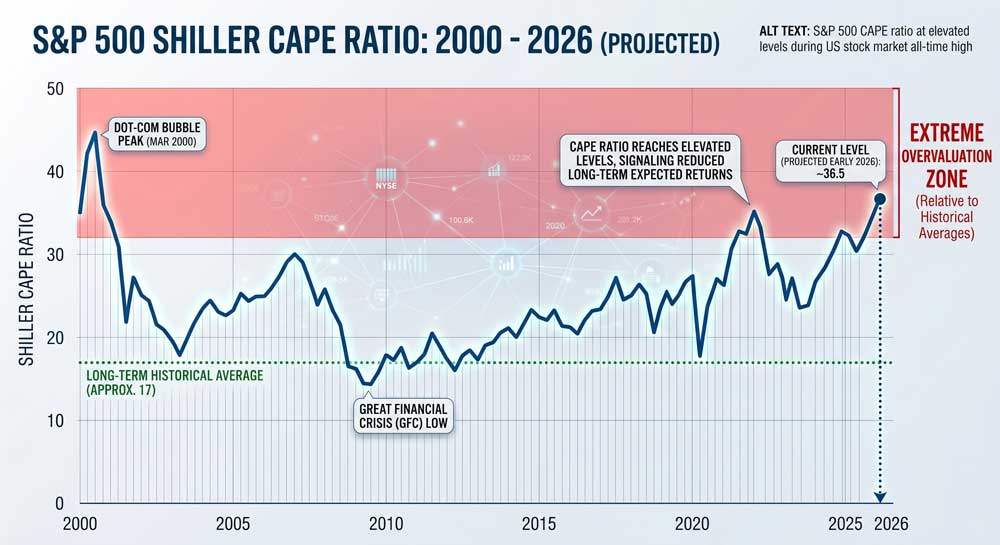
The S&P 500’s trailing price-to-earnings ratio stood at approximately 27.5× as of May 1, 2026 — above the five-year average range of 19.8–26.3× and well above the ten-year average of around 20×. The Shiller CAPE ratio (cyclically adjusted PE) was sitting near 31× as of late April 2026, roughly double the historical median of approximately 16×.
Goldman Sachs noted in their 2026 outlook that the S&P 500 was already trading at a forward P/E of 22× in January — matching the 2021 peak multiple and approaching the record 24× seen in 2000. The firm explicitly warned that elevated multiples increase downside risk if earnings disappoint.
Valuation Snapshot: S&P 500 P/E Ratio
| Metric | Current (May 2026) | Historical Benchmark | Signal |
|---|---|---|---|
| Trailing P/E Ratio | ~27.5× | 10Y avg: ~20× | Elevated |
| Shiller CAPE Ratio | ~31× | Historical median: ~16× | Significantly elevated |
| Forward P/E (consensus) | ~22× | 2021 peak: 22×; 2000 record: 24× | At cycle peak |
| 5Y P/E average range | 19.8–26.3× | — | Current above range |
Risks Worth Taking Seriously
Earnings deceleration: If the AI hardware and software revenue cycle plateaus — or if hyperscaler capex spending faces scrutiny from boards — the premium multiples assigned to these companies become difficult to sustain.
Rate sensitivity: Should inflation re-accelerate and force the Fed into a more hawkish stance, higher discount rates will mechanically compress the present value of future earnings, hitting high-multiple growth stocks hardest.
Concentration risk: When 70%+ of market cap gains depend on fewer than ten companies, the market’s resilience is only as good as those companies’ continued outperformance. That is a structurally fragile foundation.
Dollar dominance and global imbalance: The flow of global capital into US equities reinforces dollar demand and strengthens its reserve status — but it also amplifies capital outflows from emerging markets, widening global financial imbalances.
Regulatory and geopolitical exposure: The Magnificent Seven companies face ongoing antitrust scrutiny in both the US and EU. Any significant regulatory action could reshape their business models and cap future earnings growth.
What This Means for Individual Investors
For those with exposure to broad US equity index funds — which increasingly means most investors globally through pension and superannuation vehicles — this environment rewards patience but demands realistic expectations. The index-level returns of recent years have been exceptional, but they have been concentrated in a way that makes mean-reversion a more credible scenario than further exponential expansion.
Diversification across geographies and asset classes remains a rational hedge. It is also worth distinguishing between the narrative of “AI will transform everything” and the investable question of which companies will capture that value at what price, over what time horizon.
For a broader perspective on market valuations and risk management, Morningstar’s 2026 US Stock Market Outlook provides a useful framework for thinking about where value currently exists in this environment.
Reference Sources
- Goldman Sachs — The S&P 500 Expected to Rally in 2026: Valuation and Earnings Outlook
- Morningstar — 2026 US Stock Market Outlook: Where to Find Investing Opportunities
- World PE Ratio — S&P 500 Current P/E Ratio — Live Data
- LongtermTrends — S&P 500 Shiller CAPE PE Ratio — Historical Chart
- Siblis Research — Total Market Value of the U.S. Stock Market — Historical Data
- Intellectia AI — Alphabet vs Apple 2026 Market Cap Race
- Voronoi — S&P 500 Sets New Records: 6,979 Index Level and $62.3 Trillion Market Cap
- ElevenLab — Must Read: The 2028 Global Intelligence Crisis and the “Ghost GDP”
- ElevenLab — 5 Critical Warning Signs the US Private Credit Crisis Is Triggering a $4.2 Trillion Banking Meltdown
- ElevenLab — 5 Crucial Reasons the Gold Safe Haven Fails During Oil Crisis Shocks