5 Harsh Realities of the US Oil Price Impact: Why Energy Independence Isn’t Enough
The US oil price impact is one of the most misunderstood forces in modern American economics. For years, a reassuring narrative has dominated policy circles: the shale revolution transformed the United States from a dependent importer into a net energy exporter, effectively insulating the nation from Middle Eastern volatility.
The data appears to support this. The U.S. achieved net energy exporter status in 2019 for the first time since 1952. Crude production surged over 50% in a decade. LNG export capacity has expanded by roughly one-third since the Russia-Ukraine war began. Goldman Sachs estimates that a major Middle East oil shock would reduce U.S. GDP growth by only 0.3 percentage points — down to approximately 2.2% annually.
That headline number sounds manageable. The structural reality beneath it is far more volatile — and far more dangerous.
Table of Contents
Reality 1: Energy Independence Does Not Mean Immunity from the US Oil Price Impact
Unlike petrostates such as Saudi Arabia or the UAE — where economies are built around energy exports and rising prices deliver broad government revenues — the United States has the world’s most diversified economy. That diversification is precisely what makes it vulnerable.
Fossil fuels in America are not just export commodities. They are the foundational input cost for transportation, manufacturing, food logistics, residential heating, and increasingly, the AI data centers driving the country’s most strategic industrial investments. When oil prices spike 50% in three weeks, “net exporter status” does not distribute that windfall equally. Instead, the US oil price impact turns inward — triggering a brutal redistribution of wealth between winners and losers who all share the same national borders.
This is the key distinction that aggregate GDP figures obscure: total output can hold steady while internal fractures deepen dramatically.
Reality 2: The US Oil Price Impact Divides America Along Geographic Lines
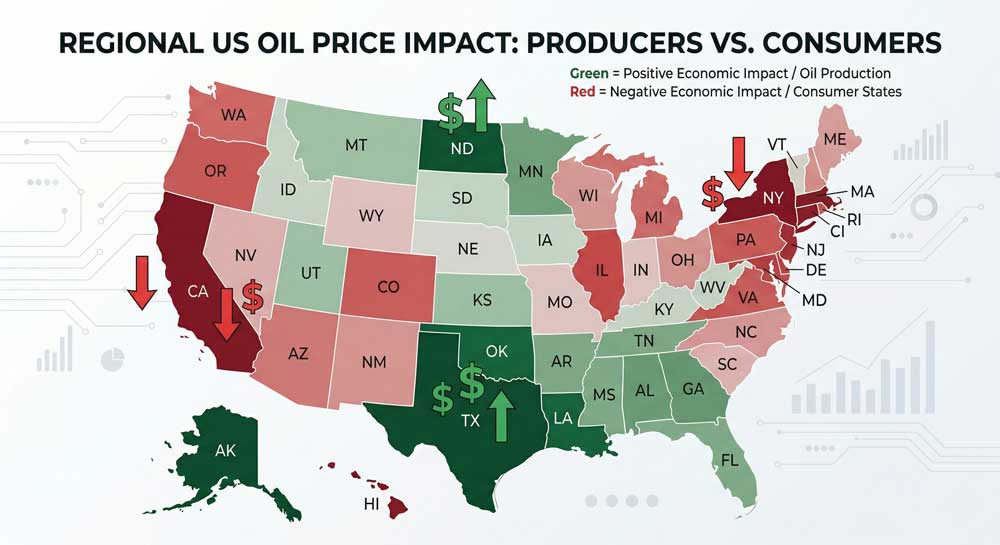
The 2022 Russia-Ukraine oil shock provided a clear preview. While most U.S. states experienced economic slowdowns from inflated input costs, Texas accelerated. Alaska, New Mexico, and other resource economies posted counter-cyclical growth. This time, with expanded LNG facilities and higher production capacity ready to monetize elevated prices, the divergence is likely to be sharper.
| Region | Primary Economy | Impact of Oil Price Surge | Likely Outcome |
|---|---|---|---|
| Texas, Louisiana, Alaska | Extraction, refining, LNG export | Massive revenue surge, job creation | Budget surpluses, localized boom |
| New Mexico, North Dakota | Shale drilling, royalty income | Windfall revenues | Infrastructure investment |
| California, New York | Tech, finance, retail, services | Margin compression, cost squeeze | Budget pressure, consumer pain |
| Midwest manufacturing belt | Auto, agriculture, freight | Input cost inflation | Reduced competitiveness |
Houston energy executives calculate record quarterly profits while Los Angeles commuters and New York small business owners absorb compounding cost increases. LNG terminals in Texas and Louisiana are projected to expand output a further 10% by year-end — benefiting a relatively small number of companies and their investors while the consumer half of the economy pays elevated prices.
Under one flag, different states are experiencing opposite economic realities. Federal cohesion gets stress-tested every time a state’s economic interest runs directly against its neighbor’s.
Reality 3: The US Oil Price Impact Creates a Dangerous Sector Split
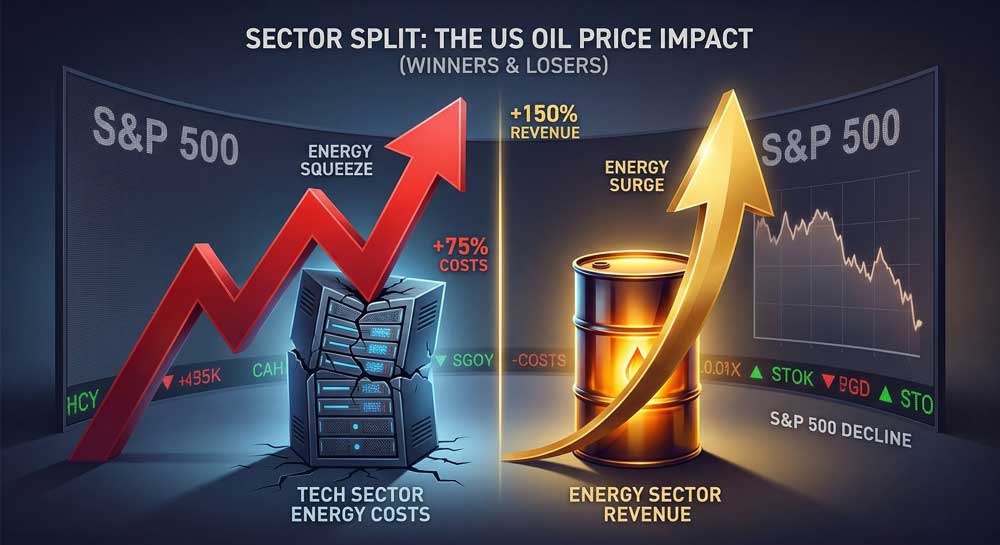
When oil prices spike sharply, equity markets tell a precise story. In a typical shock scenario, the S&P 500 contracts around 4%. Of the 11 major S&P sectors, 10 decline — information technology drops, materials fall harder. The sole winner: the energy sector, gaining over 4%, with major producers like Chevron posting individual gains of 6% or more.
The deepest irony sits in the technology sector. As artificial intelligence moves from software algorithms into massive physical infrastructure, Microsoft, Google, and Amazon are building some of the most energy-intensive facilities in American history. The numbers are striking:
- Natural gas supplies over 40% of U.S. electricity generation
- Goldman Sachs estimates 60% of incremental data center power demand will be met by natural gas
- By 2030, data centers are projected to add 3.3 billion cubic feet per day of additional natural gas demand
Surging energy commodity prices directly threaten the economic viability of the AI infrastructure buildout — America’s most strategically important industrial expansion. The US oil price impact doesn’t just tax consumers; it undermines the country’s technological future while rewarding its fossil fuel past.
Reality 4: The US Oil Price Impact Is a Regressive Wealth Transfer Machine
If geographic and sectoral fractures represent corporate-level conflicts, the wealth redistribution that high energy costs trigger reaches into the bedrock of social stability.
| Income Group | Energy as % of Household Budget | Impact of 50% Oil Spike | Portfolio Effect |
|---|---|---|---|
| Bottom 20% | ~8–10% | Survival-level — cuts to food, healthcare, essentials | Minimal stock ownership; pure loss |
| Middle 40% | ~4–6% | Significant reduction in discretionary spending | Limited offset from investments |
| Top 20% | ~2–3% | Manageable inconvenience | Energy stock gains partially offset costs |
| Top 1% | <1% | Negligible | Net financial winner via dividends and buybacks |
The lowest-earning quintile of American households spends nearly twice the proportion of their income on gasoline and electricity compared to the wealthiest quintile. The same absolute price increase is a survivability question for one group and a rounding error for the other.
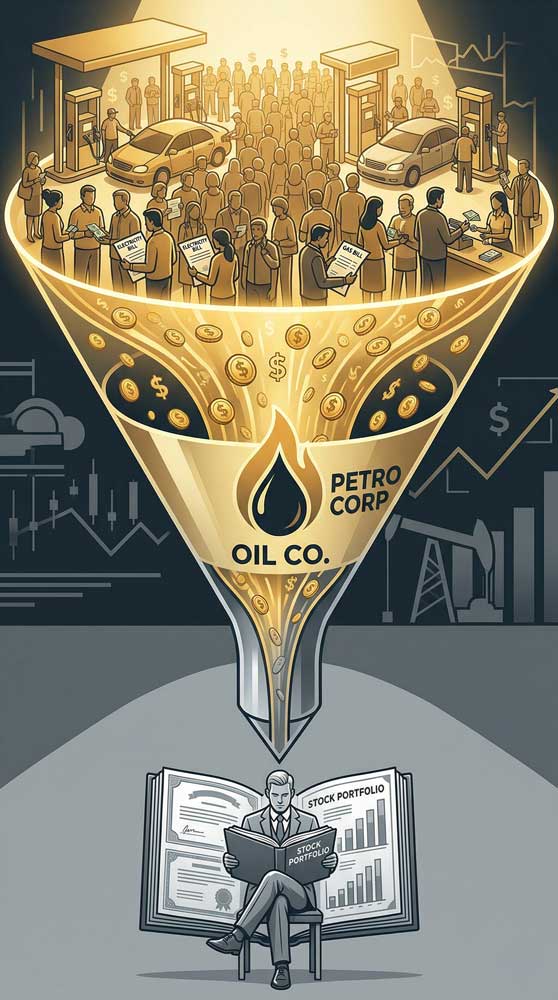
The wealth transfer mechanism operates in a closed loop:
- Low-income households pay more at the pump and on utility bills
- Extra payments flow directly into energy company revenues
- Record profits become stock buybacks and dividends
- Financial gains flow predominantly to the top 20% of earners, who own the vast majority of U.S. equities
The US oil price impact functions as a regressive tax with the proceeds distributed upward. This isn’t a theoretical model — it’s the documented pattern from every major oil shock since the 1970s.
The downstream consequences compound over months: lower-income families cut consumption → retail and service revenues decline → entry-level employment contracts → vulnerable households deteriorate further. A textbook negative feedback spiral, playing out quietly without the drama of a market crash.
Reality 5: The Political US Oil Price Impact — The Gas Station as National Mood Indicator
Unlike rent increases or healthcare inflation — which are slow, complex, and semi-invisible — gasoline prices are updated in real time on illuminated signs at every major intersection in every American city and town. The US oil price impact is the most high-frequency, most visible price signal in everyday American life.
Stanford research documents that when U.S. gasoline prices exceed $3.50 per gallon, media coverage and public anxiety spike sharply and disproportionately relative to other consumer price movements. Voters do not feel inflation through quarterly CPI reports. They feel it every time they fill their tanks.
This creates an almost inescapable political paradox:
- Politicians arguing that net exporter status means the country “benefits” from high prices are technically defensible at the macro level — and completely unconvincing at the household level
- Voters don’t process trade balances; they process the cost of commuting to work twice a day
- Political blame becomes self-reinforcing: blue states frame it as corporate greed; red states frame it as regulatory obstruction; neither framing reduces the anger or the cost
When that cost anxiety intersects with existing cultural and political fractures, the result is not just polling volatility — it is the acceleration of anti-establishment sentiment across income brackets. High energy costs stop being an economic variable and become identity politics fuel.
The Structural Paradox: Energy Independence Makes the Splits Worse, Not Better
| Factor | 1970s Oil Crisis | Today |
|---|---|---|
| U.S. net export status | Net importer | Net exporter |
| Domestic production capacity | Limited | Near-record high |
| Concentration of energy profits | Moderate | Highly concentrated |
| Wealth inequality (Gini coefficient) | ~0.35 | ~0.49 |
| Political polarization | High | Historically extreme |
| AI/data center gas dependency | None | Rapidly growing |
Here is the deepest paradox of the US oil price impact: the more energy-independent America becomes, the more severe its internal economic splits during price shocks — not less.
When the U.S. was a net importer, an oil shock was an external problem requiring collective national sacrifice. Now that the U.S. is both a major producer and a major consumer, an oil shock is an internal zero-sum redistribution event. There is no foreign adversary to unify against. The political tension has nowhere to go but inward — toward the neighbors, the opposite party, the other coast.
The true danger of sustained high oil prices for the United States is not a mild GDP recession. It is the country’s inability to absorb the US oil price impact without tearing its social and economic fabric at the seams. GDP can hold at 2.2% growth while inequality deepens, political radicalization accelerates, and the shared belief that Americans are participating in the same economy quietly collapses.
That is the Achilles heel that energy independence cannot fix — and may actually make worse.
Authoritative Sources & Further Reading
- U.S. Energy Facts: Imports and Exports — U.S. Energy Information Administration
- How Higher Gas Prices Hurt Less Affluent Consumers — Brookings Institution
- Lower Oil Prices and the U.S. Economy: Is This Time Different? — Brookings Institution
- How Smart Energy Strategies Are Reshaping Data Centers — Reuters
- Energy Burden and Income Inequality — American Council for an Energy-Efficient Economy
- How Virtual Power Plants Can Help the United States Win the AI Race
- Goldman Sachs Economic Research: Oil Price Shock Analysis — Bloomberg Energy
- 7 Reasons Why Silicon Valley Pivots to Natural Gas Investment for AI Power
- The $5 Trillion AI Investment Bubble: Can the Boom Outrun Reality?
- The Great Capital Migration: Why Global Investors Are Fleeing Australian Assets in 2026