7 Reasons Why Silicon Valley Pivots to Natural Gas Investment for AI Power
While headlines hype Elon Musk’s orbital data centers and solar-powered dreams, the real investment memos being exchanged in Silicon Valley boardrooms discuss pipeline valves and turbine yields.
This energy reality defines the US-China AI race as much as chip technology does.
This isn’t a rejection of the future — it’s a recalibration toward it. In 2026, Natural Gas Investment has become the most pragmatic foundation for sustaining digital growth, especially in the age of artificial intelligence.
1. The Physics of Progress: Energy Before Innovation
Every digital revolution begins with stable electricity. From ancient fire to cloud computing, energy has always preceded technological and cultural leaps.
Cheap, scalable power isn’t a luxury; it’s a civilizational prerequisite. When energy becomes volatile, societies face inflation, unrest, and falling productivity. Energy obeys thermodynamic laws, not policy ambitions — a principle Silicon Valley investors now rediscover.
“Innovation without affordable energy is imagination without infrastructure.”
2. Natural Gas — The Efficient, Scalable Workhorse
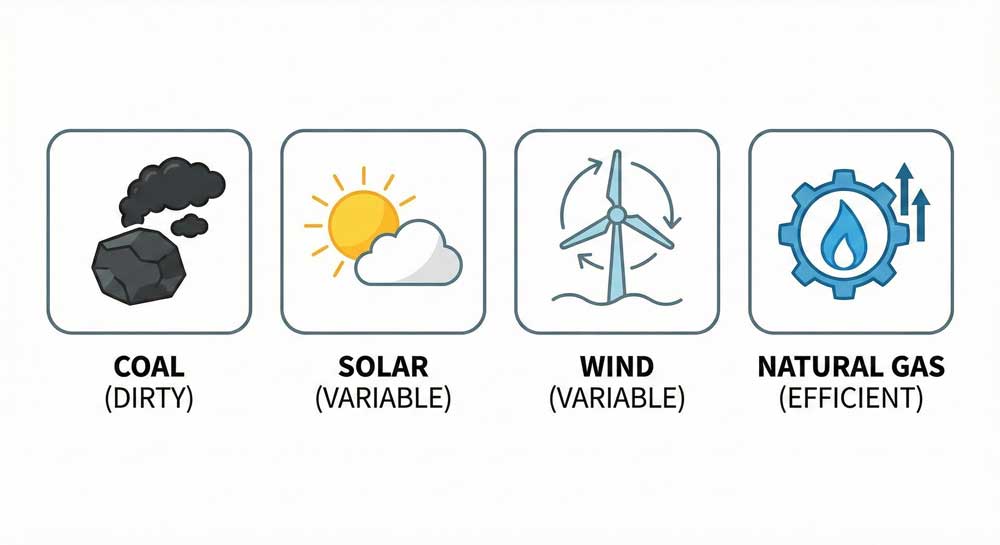
At the molecular level, natural gas embodies efficiency: one carbon atom bound to four hydrogens releases more heat with fewer carbon emissions than most fossil fuels.
This makes it the bridge fuel of the century — capable of powering data centers, cities, and grids cleanly enough to buy time until fusion, long-term storage, or hydrogen become viable.
| Energy Source | Emission Intensity (gCO₂/kWh) | Dispatchability | Maturity | Grid Role |
|---|---|---|---|---|
| Coal | 950 | Stable | Declining | Base Load (high carbon) |
| Solar | 40 | Intermittent | Growing | Variable Generation |
| Wind | 11 | Intermittent | Mature | Variable Generation |
| Natural Gas | 450 | Flexible | Established | Anchor & Balancer |
| Nuclear | 12 | Rigid | Mature | Constant Base |
Source: IEA World Energy Statistics 2025
3. Grid Stability: Civilization’s Invisible Backbone
Electricity can’t be stored like data — it must be consumed the instant it’s produced.
Grid operators face a second-by-second balancing act; any mismatch triggers instability, blackouts, or hardware failures.
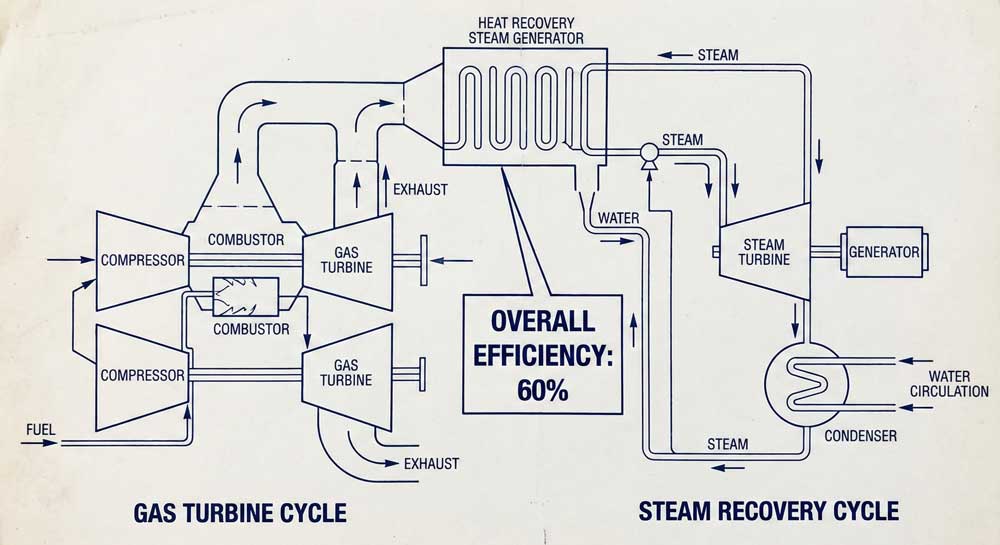
This is where Natural Gas Investment becomes existential. Gas turbines, especially Combined Cycle Gas Turbines (CCGTs), can ignite within minutes, covering shortfalls from solar and wind volatility.
CCGT plants recover waste heat from the first turbine to drive a secondary steam turbine, achieving 60–65% efficiency — the highest rating of any large-scale power technology today.
4. America’s Advantage: Infrastructure and Incentives
The U.S. holds a unique position:
- Massive shale gas reserves.
- Mature extraction technologies.
- A dense, nationwide pipeline network.
- Capital markets ready to fund long-term returns.
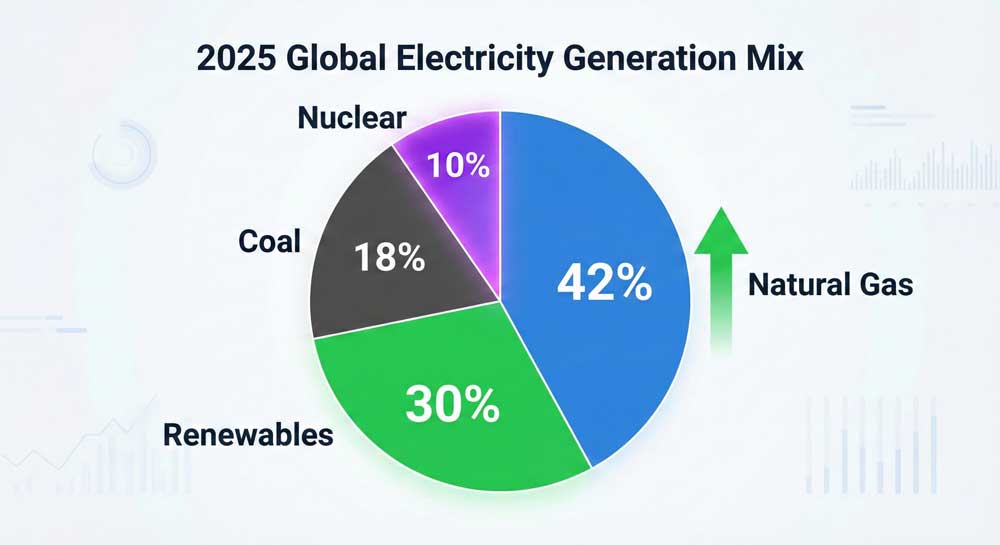
This ecosystem wasn’t centrally planned — it evolved. As of 2025, natural gas supplies over 40% of U.S. electricity, replacing coal not through ideology, but ROI logic.
| Metric | Coal | Natural Gas | Solar | Wind |
|---|---|---|---|---|
| Share of U.S. Grid (2025) | 18% | 42% | 16% | 13% |
| Average LCOE (USD/MWh) | 120 | 60 | 42 | 47 |
| EROI Ratio | 20:1 | 40:1 | 14:1 | 16:1 |
Source: U.S. Energy Information Administration (EIA, 2025)
5. The AI Power Crunch: Data Centers Need Dispatchable Energy
AI training is an energy glutton. Models like ChatGPT or Gemini require ongoing terawatt-hours of compute cycles.
Google’s ecosystem dominance in this space will depend on who masters energy infrastructure first.
The International Energy Agency (IEA) estimates that global data center power use will double by 2026, surpassing 800 TWh — equivalent to all of Japan’s annual consumption.
This fits the fractured global growth pattern of 2025.
AI doesn’t tolerate interruption. GPUs can’t “pause” for a cloudy day.
Hence, the power race for AI supremacy is as much about energy reliability as about algorithms.
The smartest investors see energy infrastructure not as an expense, but as a competitive moat for AI scalability.
6. The Bridge Investment: Capital’s Pragmatic Pivot
Investing in natural gas isn’t a denial of green technology — it’s a bridge strategy.
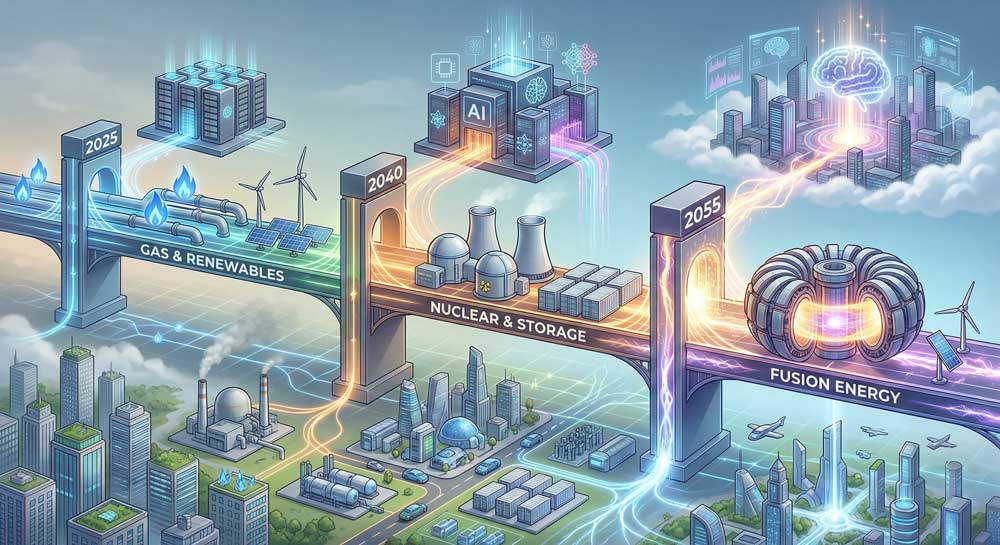
Between 2025 and 2045, before scalable fusion or long-duration storage arrive, gas represents the only dispatchable, cost-effective, and relatively clean solution.
| Timeline | Dominant Transition Strategy | Implication |
|---|---|---|
| 2020–2030 | Gas + Renewables | Energy reliability focus |
| 2030–2045 | Gas + Nuclear + Storage | Transition phase |
| 2045–2055 | Fusion + Advanced Renewables | Post-fossil era |
“We are not abandoning sustainability,” as one venture partner told BloombergNEF, “we are buying time to reach it without collapsing the grid.”
7. The Strategic Lesson: Dream High, Build Grounded
Energy is destiny. Space computing, quantum AI, and the metaverse all require stable electrons before they can become stable businesses.
Human imagination may reach for the stars, but it still stands on physics. Natural Gas Investment reminds us: progress must first stay powered on.
The future is born in imagination — but it runs on electricity.