7 Harsh Realities of AI Job Displacement: Why 4,000+ Tech Layoffs Are Just the Beginning
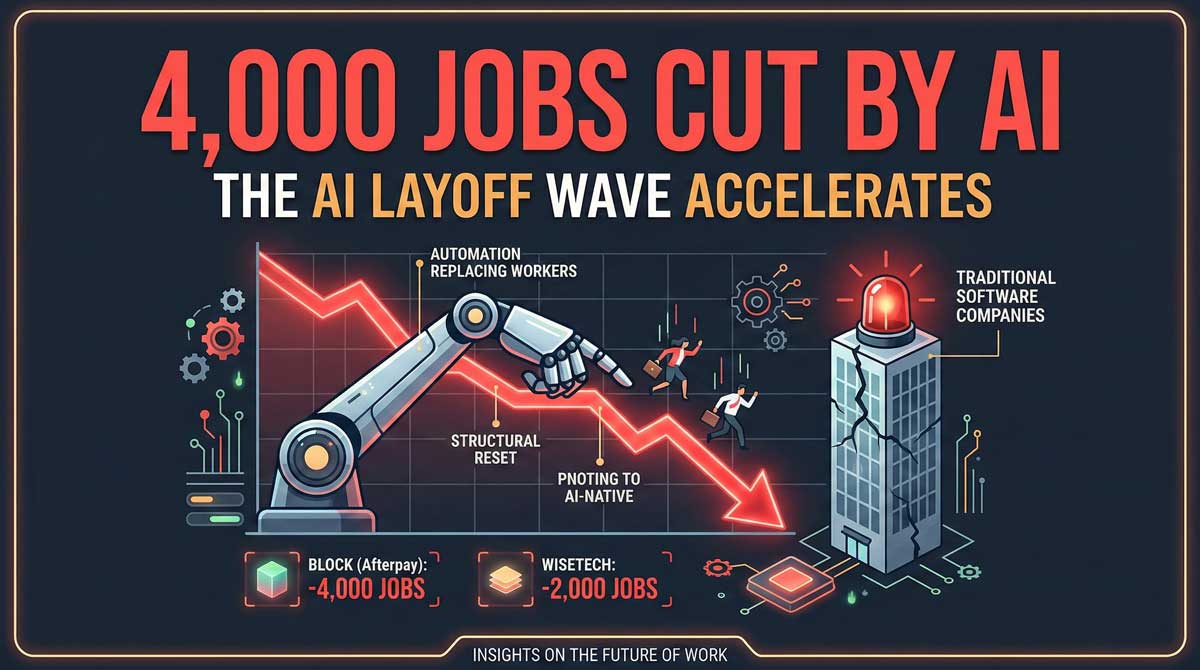
AI job displacement is no longer a distant concern — it’s restructuring the global workforce right now. Jack Dorsey, CEO of Block (parent company of Afterpay), recently declared that artificial intelligence is fundamentally “changing the meaning of creating and operating a company.” Days after Australian logistics giant WiseTech announced 2,000 layoffs, Block confirmed it would cut 4,000 roles — 40% of its entire workforce.
This isn’t a cyclical downturn. Executives across fintech, logistics, banking, and telecom are calling it a permanent structural reset, and the data backs them up.
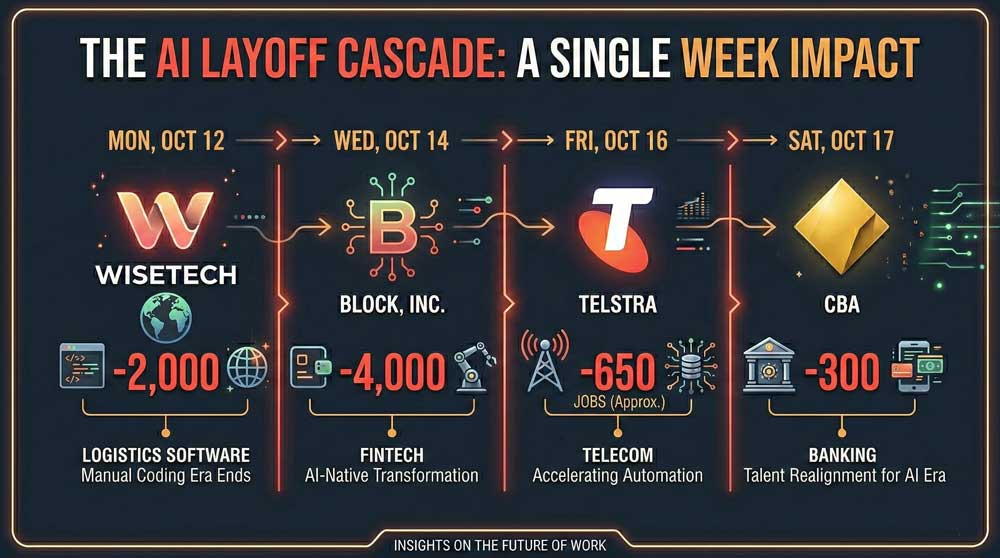
Table of Contents
The Unprecedented Scale of AI Job Displacement
Dorsey’s reasoning goes beyond cost-cutting. He argues that AI models hit an “order-of-magnitude leap in intelligence” in late 2024, opening a fundamentally new architectural path for how companies can be built. Intelligent tools are now compounding in capability week over week — making large human teams in many roles structurally redundant.
Block expects most layoffs in Q1 2025, with restructuring complete by Q2. Despite the cuts, the company posted 24% gross profit growth to $2.87 billion USD (~$4.04B AUD) for the quarter ending December 31. Markets rewarded the move — Block’s stock surged over 20% in after-hours trading.
“Most companies are late on this. We realized it — maybe not early enough,” Dorsey said.
Recent Layoffs Driven by AI: The Scale of the Shift
| Company | Sector | Jobs Cut | % of Workforce | Stated Driver |
|---|---|---|---|---|
| Block (Afterpay) | Fintech | 4,000 | 40% | AI-native architecture |
| WiseTech Global | Logistics Software | 2,000 | 30% | End of manual coding era |
| Salesforce | Cloud Software | ~4,000 | — | AI efficiency gains |
| Social Media | ~15% | 15% | Pivot to AI roles | |
| Telstra | Telecom | ~650 | — | Automation acceleration |
| Commonwealth Bank | Banking | ~300 | — | Workforce restructuring |
Why Software Is Ground Zero for AI Job Displacement
The software industry is in freefall. Because generative AI can now not only write code but maintain and debug it, the core value proposition of large engineering teams has collapsed. Stocks from Atlassian to Adobe have swung wildly as investors reprice the cost of human software development.
WiseTech CEO Zubin Appoo was the bluntest voice of this cycle:
“The era of manual coding as a core engineering behavior is over.”
He stated that large language models have fundamentally altered how code is developed — making workforce reduction not just possible, but competitively necessary.
Australia’s Tech and Finance Sectors: One Week, Three Announcements
The AI job displacement wave is hitting Australian companies simultaneously. Within a single week in early 2025, WiseTech, Telstra, and Commonwealth Bank all announced significant cuts — a clustering that reflects broader structural forces rather than company-specific struggles.
Telstra is cutting ~650 roles and outsourcing software engineering work to Infosys to accelerate automation. CEO Vicki Brady acknowledged the complexity: “It’s difficult to define which specific role AI is replacing — but some roles are simply no longer needed.”
Commonwealth Bank is cutting ~300 employees while officially distancing the move from AI. Yet CEO Matt Comyn is simultaneously building a talent roadmap to help 50,000 staff develop AI-era skills — an implicit acknowledgment that the transition is already underway.
Beyond Tech: Global Giants Accelerate the Trend
AI job displacement isn’t confined to software. Traditional corporate giants are adapting — just with more careful public messaging.
- Amazon CEO Andy Jassy has stated plainly that generative AI will shrink total corporate headcounts over the coming years
- Salesforce cut ~4,000 roles in 2024, citing AI-driven productivity gains
- Pinterest is cutting 15% of its workforce to reallocate resources toward AI-specific positions
For further context on how this trend compares to previous technological disruptions, see our analysis of automation and the future of employment.
The Human Element: Where AI Job Displacement Has Limits
Richard Valente, VP of Customer Experience Strategy at Teleperformance Australia, offers an important counterpoint. He describes the current wave not as a business cycle, but as a “structural reset of the labor market.”
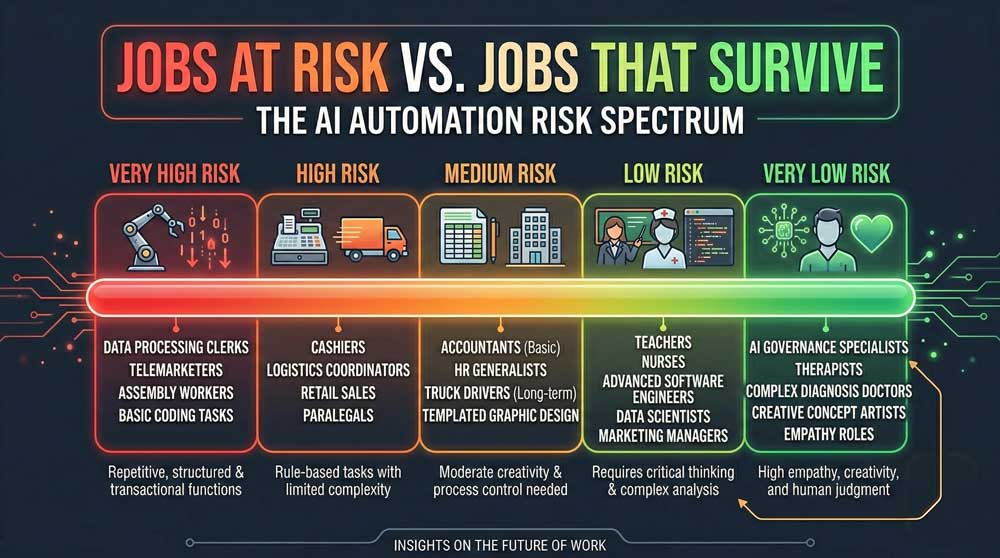
| Role Type | Displacement Risk | Reason |
|---|---|---|
| Repetitive data processing | Very High | Fully automatable |
| Basic coding and QA | High | LLMs outperform at scale |
| Mid-level knowledge work | Medium-High | AI drafts, summarizes, analyzes faster |
| Strategic oversight | Low | Requires judgment and context |
| AI governance and auditing | Very Low | New category — growing demand |
| Empathy-driven roles (fraud, crisis) | Low | Human trust is irreplaceable |
Valente’s warning is pointed: companies that eliminate human empathy entirely in pursuit of AI efficiency risk serious trust deficits — particularly in financial fraud resolution, mental health services, and complex dispute handling. The human role isn’t disappearing; it’s concentrating in high-stakes judgment calls.

What Workers and Investors Should Watch Next
Dorsey predicts the broader economy will see an even larger wave of AI-linked layoffs over the next 12 months. Companies that delay restructuring may face steeper, less controlled adjustments later.
For investors, the signal is clear: markets are rewarding AI-native operational efficiency aggressively. For workers, the playbook is shifting toward skills that AI cannot easily replicate — strategic thinking, ethical judgment, interpersonal trust, and the ability to oversee and interrogate AI outputs.
Key Takeaways
- AI job displacement in 2025 is accelerating across fintech, logistics, banking, and software
- Block’s 40% cut is one of the largest single AI-linked layoffs on record
- Australian companies WiseTech, Telstra, and CBA all restructured within the same week
- Executives are framing cuts as permanent structural shifts, not temporary adjustments
- Roles requiring empathy, oversight, and AI governance face far lower displacement risk
References
- Block Q4 2024 Earnings Press Release — Block Investor Relations
- WiseTech Global Restructuring — Australian Financial Review
- Salesforce Layoffs and AI Strategy — The Verge
- Amazon CEO on AI and Workforce Reduction — CNBC
- The Economic Potential of Generative AI — McKinsey Global Institute
- Future of Jobs Report — World Economic Forum
- How Generative AI Is Changing Developer Work — MIT Sloan Management Review
- Blackstone AI Investment Australia: $15 Billion Bet on Infrastructure vs. Reality of Productivity Crisis
- AI Agents Replacing Apps: 3 Brutal Forces Behind the 80% App Shakeout
- Labor Devaluation Exposed: 5 Shocking Reasons Why It’s More Dangerous Than Unemployment in 2026