Labor Devaluation Exposed: 5 Shocking Reasons Why It’s More Dangerous Than Unemployment in 2026
The financial media fixates on tech layoffs and unemployment statistics, but a far more insidious transformation is reshaping the American economy beneath the headlines. Labor devaluation—the systematic erosion of workers’ economic power and income share—represents a more permanent and damaging threat than cyclical job losses.
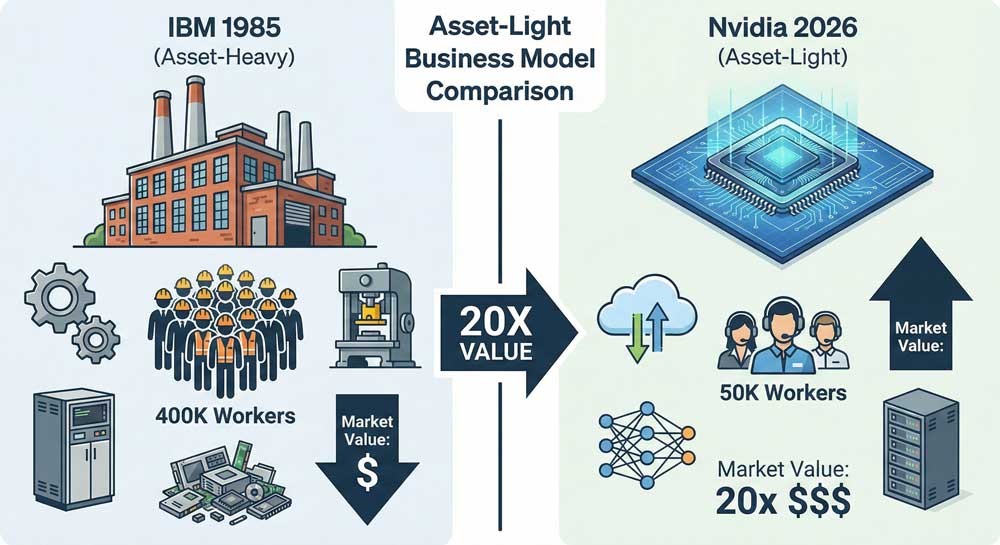
In 1985, IBM dominated the American economy as both the most valuable company and one of the nation’s largest employers, supporting nearly 400,000 workers. Today, Nvidia’s inflation-adjusted market capitalization reaches approximately 20 times IBM’s 1985 peak, with profits surpassing it fivefold. Yet this AI semiconductor giant accomplishes this with merely one-tenth of IBM’s historical workforce—demonstrating how modern wealth creation has fundamentally decoupled from labor intensity.
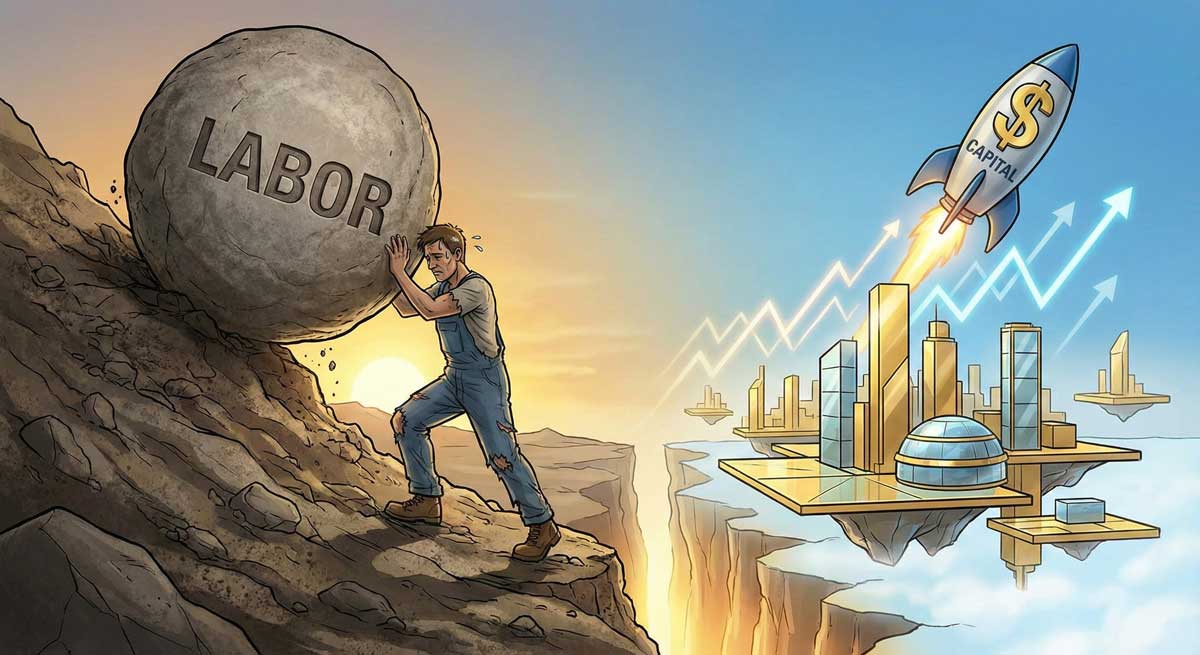
This four-decade trajectory reveals the core reality of labor devaluation: economic rewards flow disproportionately toward capital owners rather than workers.
1. The Great Income Divergence: Numbers Don’t Lie
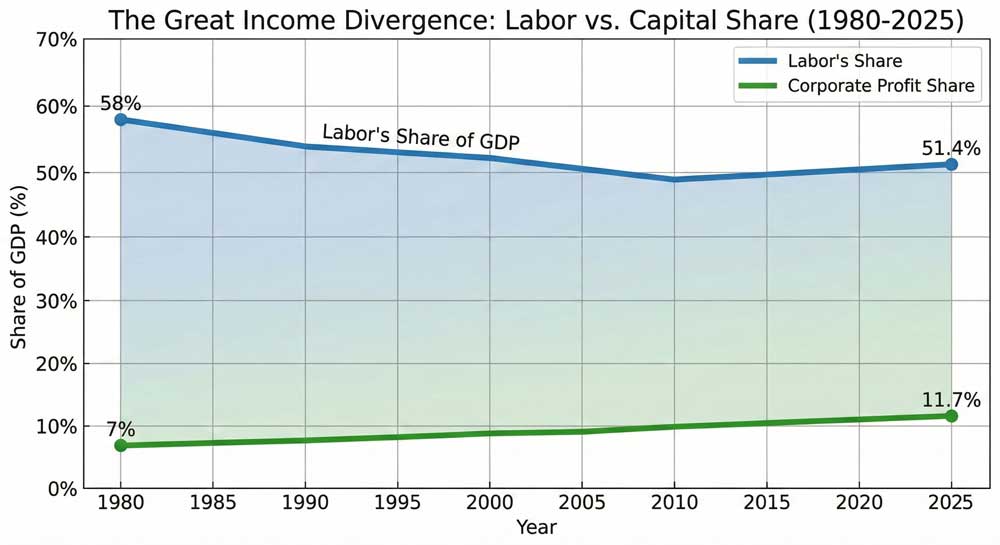
The separation between productivity gains and wage growth transcends economic theory—it represents documented statistical reality. Labor’s share of Gross Domestic Income (GDI) plummeted from 58% in 1980 to just 51.4% by Q3 2025, while corporate profit share surged from 7% to 11.7% over the same period.
| Economic Measure | 1980 | 2025 | Change Impact |
|---|---|---|---|
| Labor Share of GDI | 58.0% | 51.4% | -6.6 points (major decline) |
| Corporate Profit Share | 7.0% | 11.7% | +4.7 points (67% increase) |
| Manufacturing Labor Share | 66% | 45% | -21 points in value-add |
| Worker Wage Growth (2019-2025) | Baseline | +3% | Inflation-adjusted |
| Corporate Profit Growth (2019-2025) | Baseline | +43% | Inflation-adjusted |
Yale economist Pascual Restrepo identified that during the 1980s, 66% of factory-generated value flowed to workers, but by the 2000s this collapsed to 45%. This wasn’t efficiency optimization—it represented wealth transfer from labor to capital.
Since late 2019, inflation-adjusted average hourly wages grew a mere 3% while corporate profits exploded by 43%. This staggering 14-fold disparity explains why robust macroeconomic indicators coexist with widespread consumer pessimism about personal finances.
2. Stock Market Euphoria Masks Worker Struggles
February 2026’s market dynamics perfectly illustrated the capital-labor divide. Early in the month, technology stocks declined amid concerns about slow AI investment returns. However, when tech giants reported earnings exceeding expectations—driven substantially by aggressive workforce reductions—market sentiment reversed instantly. The Dow Jones Industrial Average achieved its historic breakthrough above 50,000 points precisely as white-collar job security deteriorated.
American household stock wealth now approaches 300% of annual disposable income, up from 200% in 2019. Yet this prosperity remains extraordinarily concentrated: the wealthiest 1% control 54% of public equity markets (up from 40% in 2002), while the top 10% own 93% of total stock market wealth. The bottom 50% of Americans hold less than 1% of stock market assets.
When companies announce AI-driven “workforce optimization,” capital markets immediately reward these decisions with surging valuations. Labor devaluation has evolved from economic side effect to deliberate corporate strategy that shareholders explicitly incentivize.
3. The Asset-Light Revolution Eliminates Middle-Class Jobs
Modern technology giants operate fundamentally differently from industrial-era corporations. Their primary capital consists of algorithms, intellectual property, user networks, and data rather than physical infrastructure or large workforces.
Nvidia exemplifies this transformation: the company focuses exclusively on chip design while outsourcing all manufacturing, creating massive value with minimal labor requirements. Alphabet demonstrates similar dynamics—revenue increased 43% over three years while employee counts stagnated or declined.
| Company Model | Primary Assets | Labor Intensity | Value Creation |
|---|---|---|---|
| IBM (1985) | Manufacturing plants, machinery | 400,000 employees | Hardware sales |
| Nvidia (2026) | Chip designs, patents, algorithms | ~50,000 employees | Licensing & design |
| Alphabet (2023-2026) | Search algorithms, user data, platforms | Flat headcount despite +43% revenue | Advertising & cloud services |
This “asset-light, labor-light” business model means the most profitable corporations require minimal workforces. Within these organizations, only elite technical talent receiving substantial stock compensation cross into the capital class, while ordinary positions face extreme compression and labor devaluation.
4. White-Collar Automation Repeats Blue-Collar History
Labor devaluation began with 1980s factory automation and union decline. Globalization and outsourcing systematically weakened worker bargaining power throughout the 1990s and 2000s. The pandemic briefly shifted leverage toward workers through labor shortages, but inflation quickly neutralized wage gains while technology companies consolidated their economic dominance.
Artificial intelligence now executes the final stage of labor devaluation. Anthropic CEO Dario Amodei warns that AI functions not as replacement for specific tasks but as a “general substitute for human labor” across entire job categories. This enables lean startups to displace large established enterprises while employing skeleton crews.
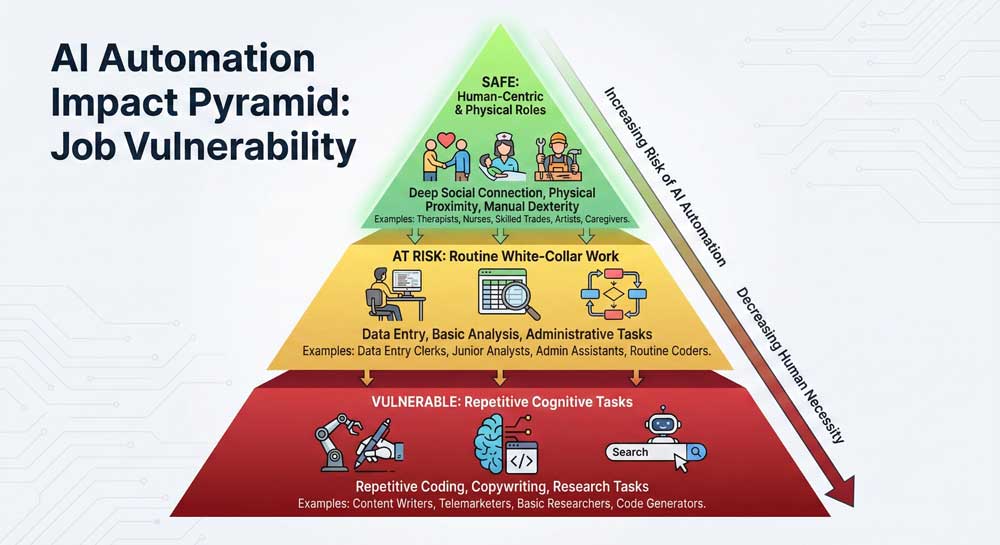
Economist Pascual Restrepo predicts AI will inflict the same “displacement effect” on white-collar professionals that factory automation imposed on manufacturing workers decades earlier. Middle-skill office work faces particular vulnerability—roles involving coding, data analysis, copywriting, and routine research already experience significant AI substitution.
5. The Wealth Concentration Endgame
The ultimate beneficiaries of labor devaluation remain shareholders positioned at market peaks. Jobs requiring deep interpersonal connection, physical presence, or manual dexterity may retain value, while consumers benefit from cheaper goods. However, workers depending solely on wages face permanently diminished economic prospects.
Corporate profit margins will never return to 1950s-60s levels, just as powerful unions and three-martini business lunches have permanently vanished. The economy has fundamentally restructured around capital accumulation rather than labor compensation.
How Workers Can Combat Labor Devaluation
While systemic change requires policy intervention, individual strategies can partially mitigate labor devaluation’s impact:
- Build capital ownership: Regular investment in index funds or employer stock programs creates wealth alongside markets rather than depending solely on wages
- Develop AI-resistant capabilities: Focus on skills requiring human judgment, emotional intelligence, creativity, and physical presence that AI cannot easily replicate
- Diversify income sources: Create multiple revenue streams through side businesses, freelancing, or passive income to reduce wage dependency
- Advocate for labor-friendly policies: Support minimum wage increases, union rights, progressive taxation, and full employment initiatives
The Uncomfortable Truth
The evidence overwhelmingly demonstrates that owning capital matters more than selling labor in today’s economy. Understanding labor devaluation represents the essential first step toward adapting personal financial strategy to this new reality. The 50,000-point Dow Jones milestone celebrates capital’s triumph—recognizing this shift determines whether you benefit from or suffer under the transformation.
Related Sources & Further Reading
- Where Did Labor’s Share of Income Go? – Economic Analysis
- The Productivity–Pay Gap – Economic Policy Institute
- What’s Driving the Surge in U.S. Corporate Profits? – Federal Reserve Bank of St. Louis
- The wealth of the top 1% reaches a record $52 trillion – CNBC
- The Richest 1 Percent Own a Greater Share of the Stock Market Than Ever Before – Institute for Policy Studies
- AI’s ability to displace jobs is advancing quickly – Axios exclusive interview with Anthropic CEO
- The Decline of the U.S. Labor Share – Brookings Institution
- A new look at the declining labor share of income in the United States – McKinsey
- Silver’s 50% Crash and 30% Rebound: 5 Critical Insights for 2026 Investors
- The Financial System Explained: 5 Stages from Basic Lending to Global Markets
- Europe’s Cinema Renaissance: Is Hollywood Losing Its Edge?