Iran’s Undersea Leverage: 7 Reasons the Strait of Hormuz Seabed Could Reshape Global Power
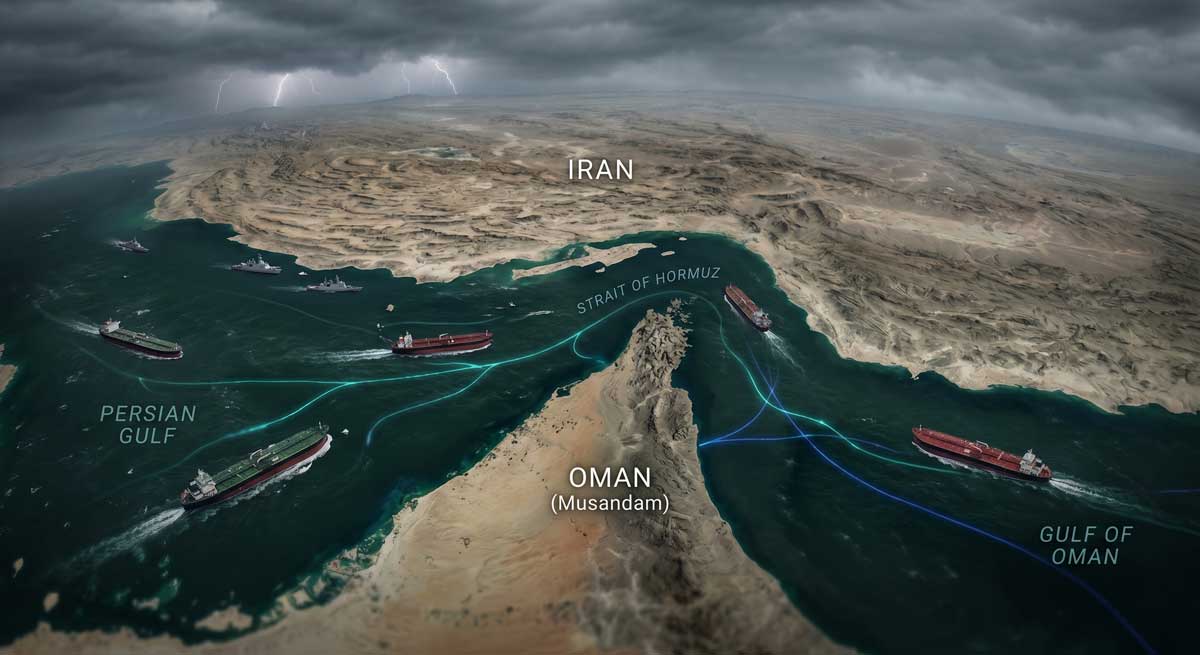
The Strait of Hormuz has long been synonymous with oil. But there is another chokepoint hidden beneath its waters — one that I think deserves far more attention than it currently gets.
Iran submarine cables are now at the centre of one of the most consequential and underreported geopolitical standoffs of 2026. Tehran is reportedly advancing a plan to assert control over the submarine cables running through the Strait of Hormuz — including levying transit fees, requiring compliance with Iranian law, and reserving all maintenance rights for Iranian companies. At first glance this may seem like a bureaucratic maneuver. I believe it is anything but.
Table of Contents
Iran’s Undersea Cable Strategy Is More Than a Bluff
In late April, Iran’s parliamentary speaker Mohammad Bagher Ghalibaf posted on social media that the United States had overstated its leverage in the ongoing energy standoff — and that Iran still held unused “critical cards.” The submarine cable network beneath the Strait of Hormuz appears to be exactly what he had in mind.
My read on this is straightforward: Iran has not yet acted against these cables precisely because their value lies in being an unplayed hand. Deploying this threat prematurely would eliminate its deterrent power. By simply signalling the capability and intent, Iran gains leverage over Gulf Arab states that might otherwise deepen security cooperation with Washington, while also strengthening its negotiating position in any future talks over sanctions relief or a nuclear deal.
This is a classic example of asymmetric deterrence — and it is working.
The Digital Chokepoint Beneath the Oil Route
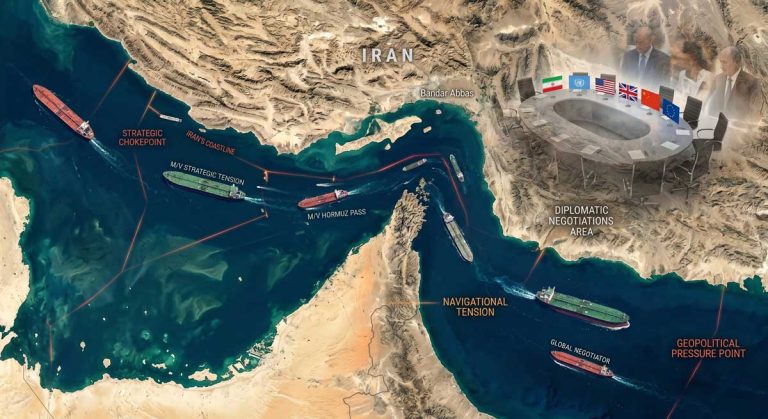
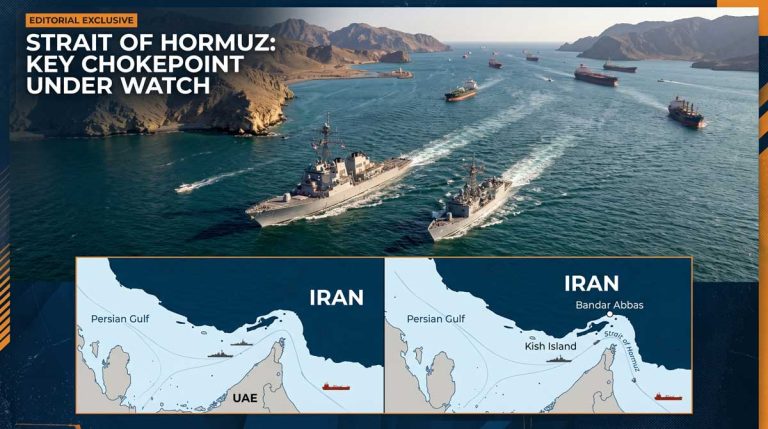
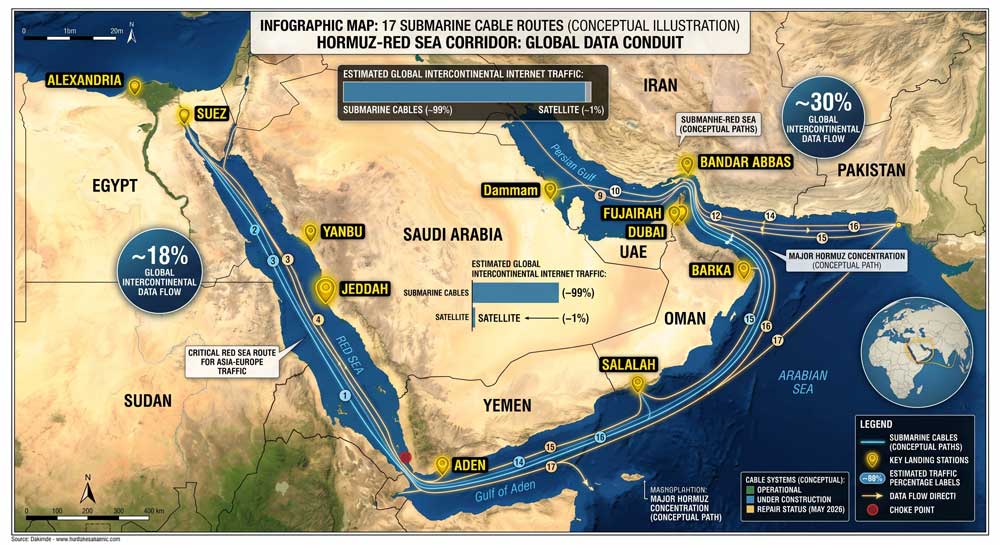
Most coverage of the Strait of Hormuz focuses on crude oil. Before the current conflict escalation, roughly one-fifth of the world’s oil supply passed through this narrow waterway. But beneath the seabed, at least seven major submarine cables carry enormous volumes of data traffic between Europe, the Middle East, and Asia.
According to global cable mapping data, at least 17 core cables run through the Hormuz-Red Sea corridor, collectively handling approximately 18% of global internet traffic. The Gulf states’ high-speed internet infrastructure, data centres, and AI computing clusters are almost entirely dependent on this cable network.
| Cable Corridor | Estimated Traffic Share | Key Regions Served |
|---|---|---|
| Strait of Hormuz | ~18% of global internet | Europe, Middle East, Asia |
| Red Sea (broader) | ~25% of Asia-Europe data | Southeast Asia, India, EU |
| Arabian Sea feeders | Supplementary routing | South Asia, East Africa |
The strategic calculus here is significant. Gulf states, particularly the UAE, have invested heavily in AI infrastructure over the past several years, attracting major US technology companies to build data centres in the region. That investment dramatically increases the cost of any disruption to Hormuz seabed cables — not just for regional players, but for the American tech firms now embedded in Gulf digital ecosystems.
Iran’s Defence Committee Raised the Stakes in March
This is not speculative territory. On March 23, Iran’s Defence Committee issued a formal statement warning that any attack on Iranian coastlines or islands would result in the severing of both shipping lanes and communication lines in the Gulf region, along with potential mining of waters along the Iranian coast.
What struck me about that statement was the explicit elevation of “communication lines” to the same strategic level as shipping lanes. That is not standard military doctrine — it signals a deliberate broadening of Iran’s deterrence framework to include digital infrastructure as a legitimate target or bargaining chip.
| Threat Dimension | Traditional Focus | Iran’s Expanded Framework |
|---|---|---|
| Shipping | Oil tanker routes | Maintained |
| Military | Air and naval assets | Maintained |
| Digital | Not previously foregrounded | Now explicitly included |
| Economic leverage | Oil export controls | Extended to data infrastructure |
The Red Sea Precedent Makes This Credible
Skeptics might dismiss Iran’s cable threats as posturing. The 2024 Red Sea incidents make that position hard to defend.
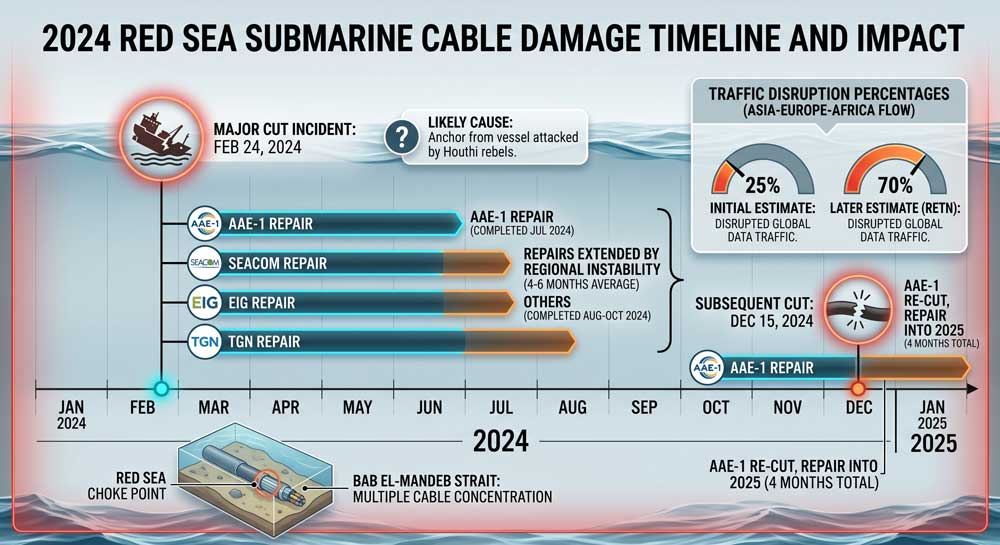
In early 2024, Houthi operations in the Red Sea damaged at least four major submarine cables running between Asia and Europe. The disruption directly affected roughly 25% of data flows between the two continents. Repair operations were slow, complex, and expensive — and protecting thousands of kilometres of seabed cable from determined actors is, frankly, an almost impossible task for any navy.
The precedent is clear: submarine cables are vulnerable, repairs take months, and the economic fallout is immediate. Iran has observed this playbook closely, and I have little doubt it has drawn the appropriate conclusions.
Why Gulf AI Ambitions Amplify the Risk
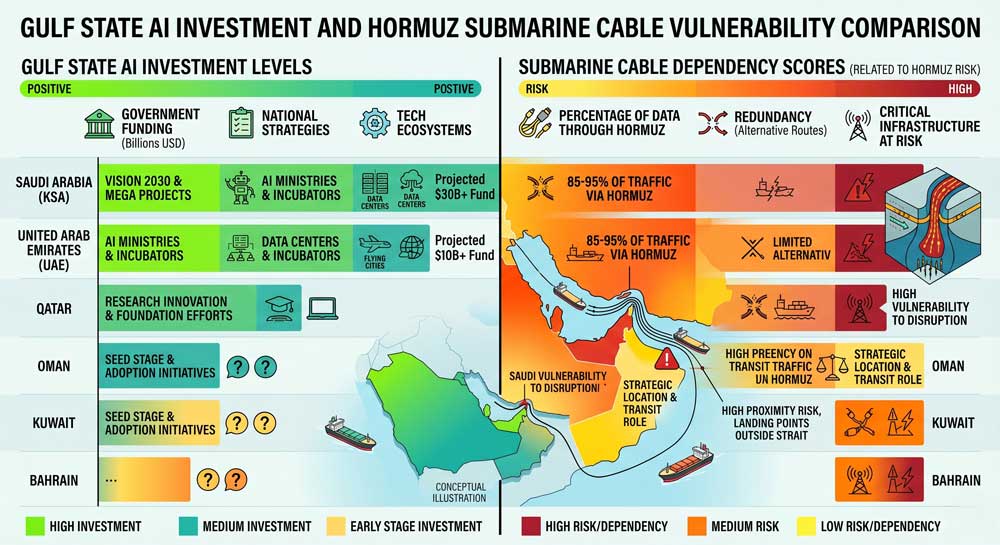
The UAE’s aggressive push into artificial intelligence — including partnerships with major US hyperscalers and the construction of large-scale GPU compute clusters — has inadvertently increased Iran’s leverage. The more dependent Gulf digital economies become on Hormuz seabed cables, the higher the cost of disruption.
This creates an uncomfortable dynamic. The Gulf states need US security guarantees to feel protected from Iran. But the deeper their AI and data centre investments grow, the more Iran has to gain from merely threatening the cables — without ever cutting them.
| Country | AI Investment Scale | Hormuz Cable Dependency | Vulnerability Level |
|---|---|---|---|
| UAE | Very high (Falcon, G42, hyperscaler deals) | High | High |
| Saudi Arabia | High (NEOM, Vision 2030 digital layer) | High | High |
| Qatar | Moderate | Moderate | Moderate |
| Kuwait/Bahrain | Lower | Lower | Lower |
Where the Diplomacy Stands
On May 10, Iranian media reported that Tehran had rejected the latest US ceasefire framework. Iran’s stated conditions included lifting maritime blockades, removing oil sanctions within 30 days, and unfreezing Iranian assets. The same day, President Trump declared the Iranian response “completely unacceptable” on social media.
I think both sides are currently in a posturing phase, each trying to establish the outer limits of their leverage before any serious negotiation begins. The submarine cable issue fits neatly into this pattern — it is a card Iran wants the other side to see, not one it necessarily intends to play.
The harder question is what happens if diplomacy stalls completely. At that point, the incentive structure shifts, and assets that were once deterrents become tempting targets.
What This Means for the Global Internet
For anyone invested in the stability of global digital infrastructure, the Hormuz cable situation warrants serious attention. Unlike oil disruptions, which have established rerouting mechanisms and strategic reserves, internet traffic disruption through this corridor has no equivalent buffer.
Rerouting major cable traffic around the Hormuz-Red Sea corridor would require either satellite alternatives — which currently lack the bandwidth and latency performance of fibre — or entirely new terrestrial or submarine routes that would take years and billions of dollars to build.
The internet was designed to route around damage. But at 18% of global traffic concentrated through a single geopolitical flashpoint, the redundancy assumption is being stress-tested in ways its architects never anticipated.
Reference URLs
- TeleGeography — Interactive Submarine Cable Map showing Hormuz and Red Sea routes
- Reuters — How does the Iran war threaten subsea cables?
- Stimson Center — Beneath the Strait: Iran Could Threaten Gulf Data Centers and Undersea Cables
- Al Jazeera — Why are people blaming the Houthis for cutting the Red Sea cables?
- Data Center Dynamics — Subsea cable repairs in Houthi-controlled waters in the Red Sea completed
- Analysys Mason — AI data-centre investment in the GCC will exceed USD5 billion in 2026
- Gulf International Forum — Gulf AI Infrastructure: Examining the Business and Economic Case
- Habtoor Research — What If: Iran Targeted Submarine Internet Cables in the Arabian Gulf?
- ElevenLab — Pakistan Iran Land Trade Routes Beat the Hormuz Blockade
- ElevenLab — Iran US Blockade Strategy: 3 Deadly Moves Threatening Iran’s Survival in 2026
- ElevenLab — 1 Ultimate Key to the Middle East Endgame: The Strait of Hormuz Toll Explained