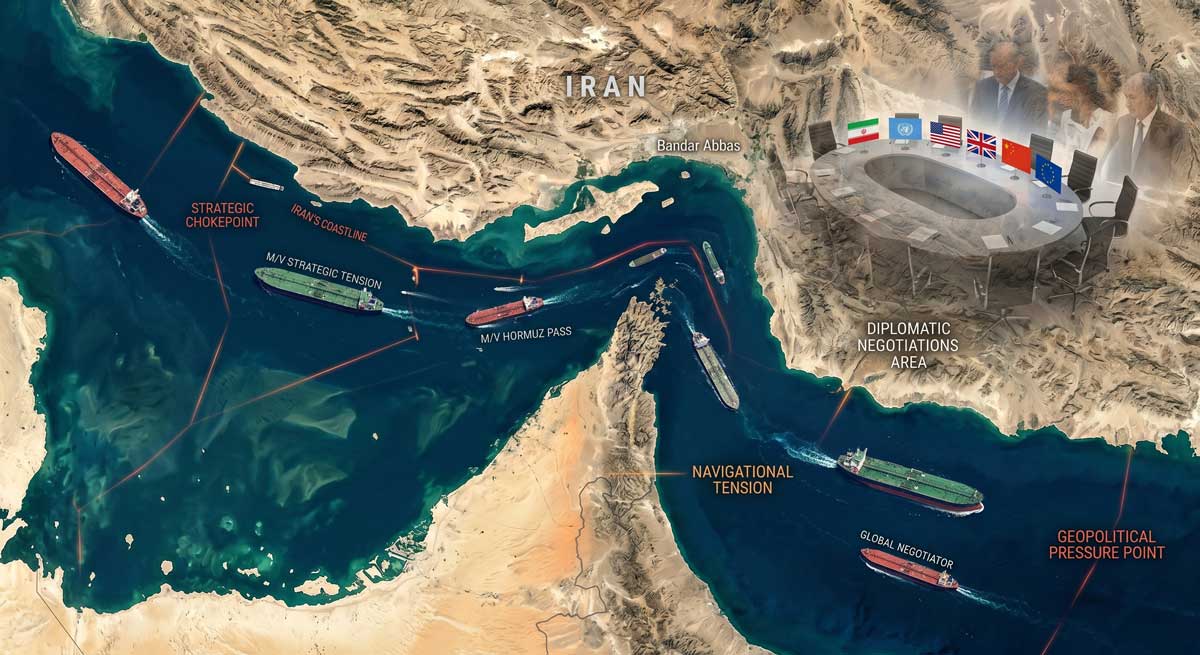
Strait of Hormuz: Iran’s Most Powerful Negotiating Weapon — 5 Critical Truths Gulf States Need to Hear
The Strait of Hormuz Iran negotiations have reached a turning point that few analysts saw coming. What began as talks about nuclear enrichment, missile programmes, and proxy militias has quietly shifted into a direct confrontation over control of the world’s most important energy chokepoint. Iran has spent years preparing for this moment — and the Gulf states are now realising they may be the last to have any say in the outcome.
Table of Contents
Why the Strait of Hormuz Is Iran’s “Golden Asset”
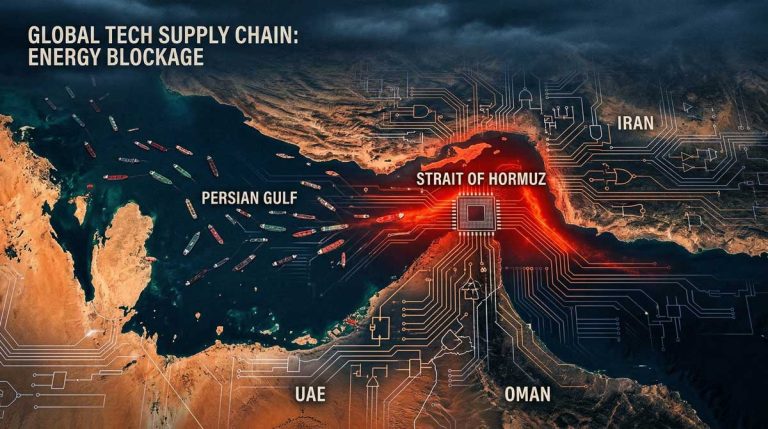
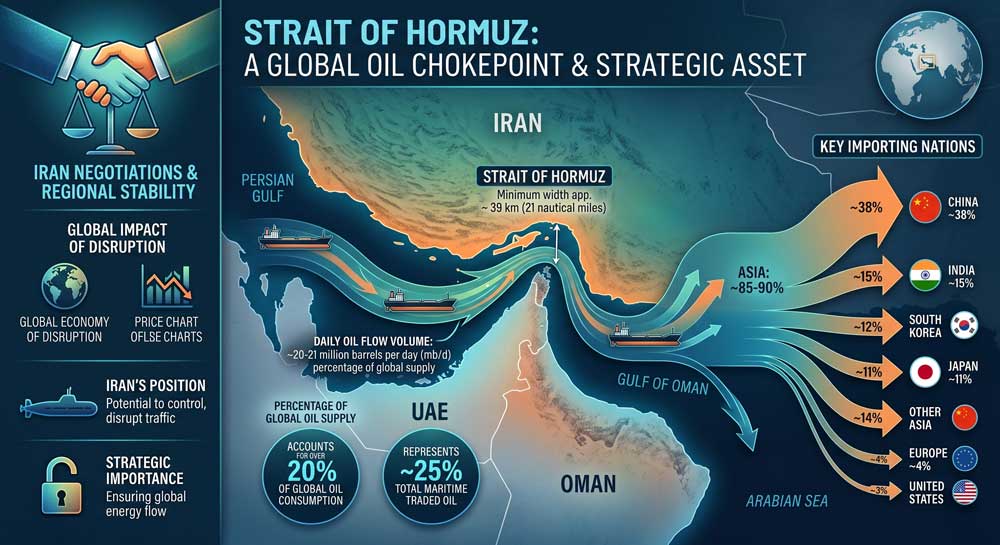
Iran does not treat the Strait of Hormuz as a last resort. It treats it as the centrepiece of a long-term deterrence strategy — a geographic advantage that no external power can simply dismantle. Nearly 20% of the world’s oil supply passes through this narrow waterway, and Iran sits directly astride it. That is not a coincidence of geography; it is the foundation of Tehran’s entire strategic posture.
What makes this leverage so durable is that threatening the Strait does not require crossing a nuclear threshold. Even the mere suggestion of disruption causes shipping companies to withdraw and insurers to cancel coverage — producing massive economic effects before a single vessel is blocked. Iran has effectively built a non-nuclear weapon of mass economic disruption, and it has been quietly sharpening it for years.
Dmitry Medvedev, former Russian president and current Deputy Chair of Russia’s Security Council, made this explicit in an April 8 post on X, comparing the Strait of Hormuz to a nuclear weapon that Iran has already successfully “tested” — one with inexhaustible potential. That framing, coming from Moscow, was not idle commentary. It was a public signal that the rules around the Strait had fundamentally changed.
The Shocking Shift in US-Iran Negotiation Priorities
When the Islamabad talks were first announced, the expectation was a familiar agenda: uranium enrichment caps, missile programme constraints, and reining in Iran’s network of regional proxies. That is not what materialised.
Based on reporting from officials and analysts close to the process, the negotiations pivoted toward two core issues: limiting uranium enrichment levels and managing — not eliminating — Iran’s control over the Strait of Hormuz. The word “managing” is doing a great deal of heavy lifting in that sentence. It signals a fundamental shift in ambition: from dismantling Iran’s leverage to accommodating it.
Iran’s position on enrichment remains firm. Tehran has refused to reduce its enriched uranium stockpile to zero and will not agree to transfer it abroad. The deadlock on that front appears to have pushed negotiators toward the Strait as a more tractable issue — one where a framework agreement feels achievable because both sides have economic incentives to keep the waterway open.
| Negotiation Track | Previous Priority | Current Priority |
|---|---|---|
| Nuclear Enrichment | Full dismantlement | Capped enrichment levels |
| Missile Programme | Addressed as core demand | Largely sidelined |
| Proxy Networks | Central to talks | Deprioritised |
| Strait of Hormuz | Off the table (taboo) | Central bargaining chip |
| Gulf State Involvement | Assumed stakeholders | Formally excluded |
This table tells the real story. The issues that matter most to Gulf states — missiles, drones, proxy forces — have been effectively demoted. The issue that matters most to global energy markets has taken centre stage.
Iran’s Strategic Calculus: Revenue, Deterrence, and Global South Leverage
I think the most underappreciated dimension of Iran’s Hormuz strategy is how many objectives it serves simultaneously. Control over the Strait is not just about military deterrence. It is also a revenue mechanism, a sanctions-busting tool, and a diplomatic asset with countries in the Global South.
Iran has already begun charging transit tolls on vessels passing through the Strait. Economists estimate that at least 80% of those fees would ultimately be borne by Gulf Arab states — potentially as much as $14 billion per year on oil alone. That is an extraordinary transfer of wealth extracted from the very countries most threatened by Iranian regional policy.
Beyond revenue, the Strait gives Iran something it has never had so openly: economic deterrence. Any country considering military action against Iran must now factor in the risk of a global energy shock. That changes the cost-benefit calculus for everyone — the United States, Israel, and every energy-importing nation in Asia.
There is also a third layer: influence with Global South nations. Countries dependent on Persian Gulf oil are now incentivised to engage diplomatically with Tehran, soften their stance on sanctions, and deepen economic ties in exchange for predictable Strait access. Iran has, in effect, turned a geographic fact into a foreign policy platform.
Gulf States: The Stakeholders Left Out of Their Own Security Future
The countries bearing the most direct consequences of these negotiations are not at the table. That is the central injustice — and strategic failure — of the current process.
Gulf officials have been explicit about their concerns. The Islamabad talks were structured as a bilateral US-Iran negotiation covering uranium enrichment, proxy funding, and Hormuz transit authority — three issues that directly determine the security trajectory for Saudi Arabia, the UAE, and their neighbours for a generation. None of those countries had a formal seat at the table.
Ebtesam Al-Ketbi, President of the Emirates Policy Centre, frames it precisely: a genuinely good deal must address missiles, proxy forces, and the Strait simultaneously. A deal that resolves only the Hormuz dimension without constraining Iran’s broader regional behaviour does not reduce danger — it reorganises it. The Gulf states absorb the costs of missiles and drone strikes while the global community benefits from open energy lanes.
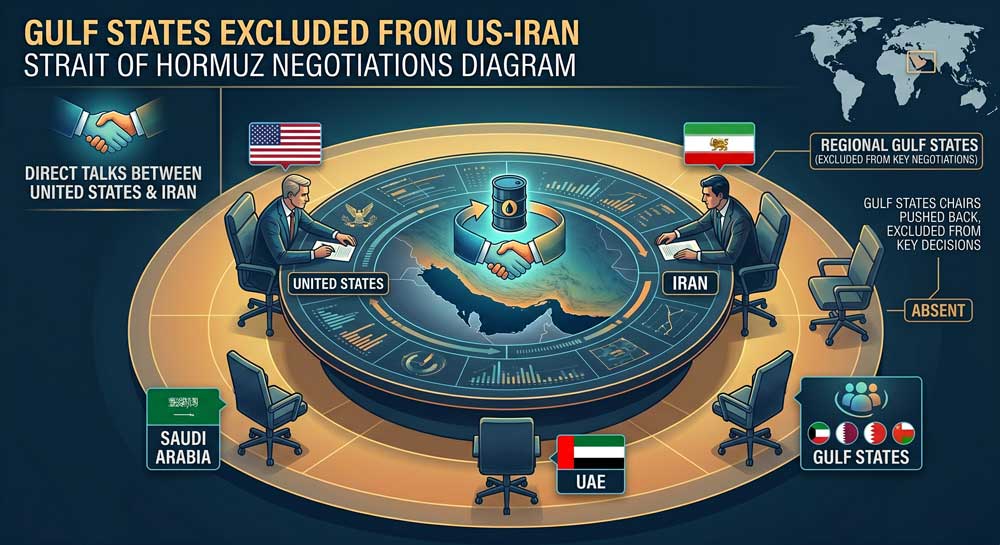
One Gulf source close to government circles put it bluntly: the goalposts have moved. The Strait of Hormuz was never a negotiating issue — it was assumed to be off-limits as a bargaining chip. Now it is the centrepiece. That shift alone represents a structural change in how Middle East security is being defined.
| Stakeholder | Core Concern | Currently Addressed in Talks? |
|---|---|---|
| United States | Nuclear proliferation, energy stability | Partially — enrichment caps |
| Iran | Sovereignty, sanctions relief, Hormuz control | Yes — central to talks |
| Gulf Arab States | Missiles, drones, proxy forces, toll burden | No — sidelined |
| Global Energy Markets | Strait access, oil price stability | Yes — primary driver |
| Global South Nations | Affordable energy access | Indirectly — via Iran leverage |
The Long-Term Risk: Managing Leverage Is Not the Same as Reducing It
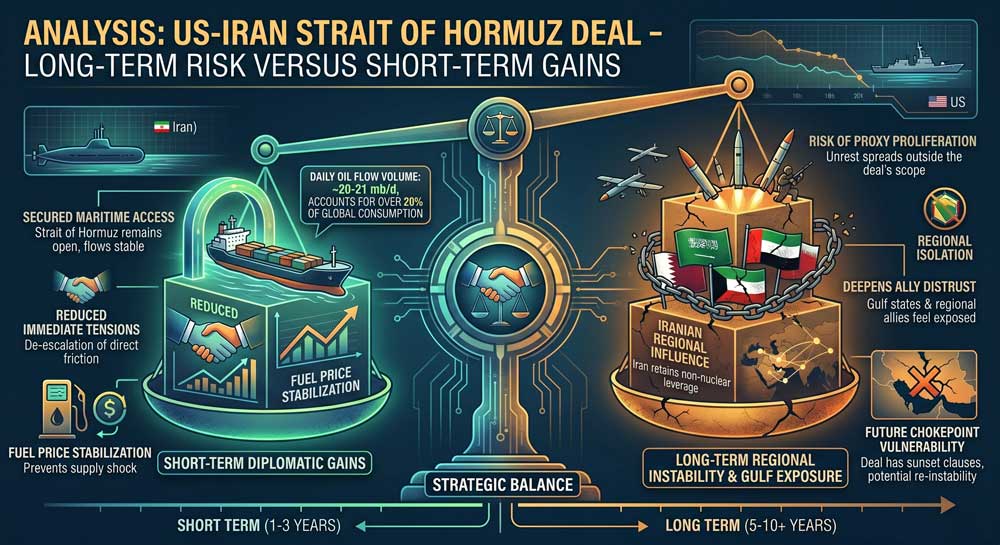
The fundamental problem with the current negotiating framework is that “managing” Iran’s Strait leverage is categorically different from eliminating it. A managed arrangement still leaves Iran with a loaded weapon pointed at the global economy — it just means both sides have agreed on the rules of engagement for now.
Historically, arrangements built on managed leverage rather than structural resolution tend to be fragile. They hold as long as both parties find the deal advantageous and fall apart the moment the calculation shifts. If Iran believes it can extract more concessions by threatening the Strait again, nothing in a managed agreement prevents it from doing so.
The broader shift I see here is from a rules-based international order to a power-based regional arrangement. The question is no longer who controls the Strait — it is who gets to write the rules of passage. That is an enormous structural change, and the countries who will live with its consequences most directly are precisely the ones who had no voice in shaping it.
| Scenario | Short-Term Outcome | Long-Term Risk |
|---|---|---|
| Managed Leverage Deal | Strait remains open; US-Iran tension reduced | Iran’s control legitimised; Gulf states exposed |
| Full Dismantlement | Comprehensive security reduction | Politically unlikely; Iran won’t accept |
| Gulf Exclusion Continues | Bilateral deal finalised | Permanent structural imbalance in the region |
| Multilateral Framework | Shared oversight of Strait | Requires trust and political will currently absent |
What a Genuinely Balanced Deal Would Look Like
A durable agreement on the Strait of Hormuz Iran negotiations cannot be a bilateral transaction. Energy security at this scale is inherently multilateral. The countries that depend on Hormuz passage — India, China, Japan, South Korea, and the EU alongside Gulf producers — all have legitimate stakes that a US-Iran bilateral cannot adequately represent.
A credible framework would need to address at minimum: verifiable enrichment limits, a binding constraint on Iran’s missile and drone development, a mechanism for Gulf state participation in security arrangements, and a transparent legal regime governing Strait transit rather than bilateral toll agreements. The International Crisis Group and Chatham House have both advocated for confidence-building measures and multilateral dialogue as prerequisites for any lasting resolution.
The current trajectory risks producing a short-term diplomatic win that leaves a long-term structural wound. Energy stability and regional security are not competing priorities — but the way the Strait of Hormuz Iran negotiations are currently framed treats them as if they are.
Frequently Asked Questions
Why is the Strait of Hormuz so strategically valuable to Iran?
The Strait is a natural chokepoint controlling roughly 20% of global oil flow. Iran’s geographic position gives it leverage no external power can neutralise, and it can generate economic disruption without crossing a nuclear threshold.
Why have missiles and proxy forces been deprioritised in current talks?
The shift reflects a practical calculation: managing the Strait, with its direct impact on global energy markets, offers quicker diplomatic wins than dismantling Iran’s missile or proxy networks, which Iran has firmly refused to negotiate away.
What is the financial impact on Gulf states from Hormuz toll collection?
Economists estimate Gulf Arab states would bear 80–95% of Iran’s transit tolls — potentially $14 billion annually on oil shipments alone — making them the primary financial victims of an arrangement they had no role in shaping.
What did Medvedev’s April 8 post signal?
It publicly framed the Strait as a tested, inexhaustible strategic weapon comparable to a nuclear asset — effectively endorsing Iran’s leverage and signalling Russian support for Tehran’s negotiating position.
Reference Sources
- Deutsche Welle — How Iran is wielding the Strait of Hormuz as leverage
- The Almendron / The Conversation — Iran has a powerful new tool in the Strait of Hormuz that it can leverage long after the war
- House of Saud Analysis — Gulf Exclusion from US-Iran Talks Is Not a Snub
- Middle East Council — Talks in Pakistan Failed. Why the Gulf Must Be There Next Time
- INSS — Institute for National Security Studies — The Strait of Hormuz as a Key Theater of War — The Legal Dimension
- IJFMR Academic Journal — Conflict at the Crossroads: Security Tensions in the Strait of Hormuz
- Discovery Alert — Hormuz Blockade: Global Economic Impact Analysis
- ElevenLab — Iran Oil Blockade: 15-Day Critical Window Before Production Cuts Begin
- ElevenLab — 1 Ultimate Key to the Middle East Endgame: The Strait of Hormuz Toll Explained
- ElevenLab — 3 Secret Motives Behind the Dangerous UAE Strategy Against Iran in 2026