Iran Oil Blockade: 15-Day Critical Window Before Production Cuts Begin
The Iran oil blockade is no longer a distant hypothetical — it is now a ticking clock with a measurable endpoint. Based on current storage capacity, export flow data, and production constraints, Iran faces a hard deadline: roughly 15 days before forced production cuts begin, and around 30 days before exports could be reduced to near zero.
I believe this timeline is now the single most important variable pricing global energy markets, and the implications extend well beyond the Strait of Hormuz.
Table of Contents
The Storage Math Behind the Iran Oil Blockade
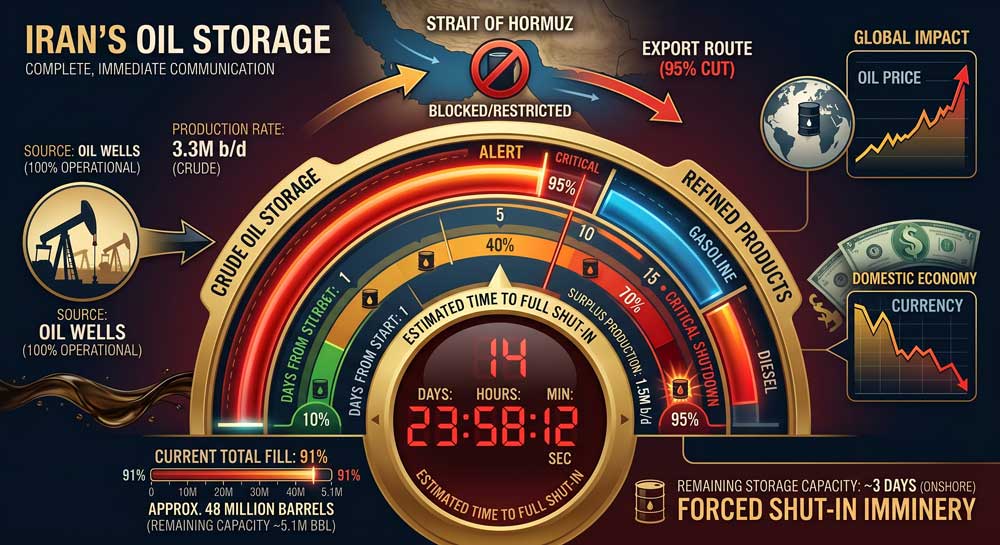
Iran’s onshore tank farms currently hold approximately 86 million barrels of capacity, of which around 54% — roughly 47 million barrels — is already filled. That leaves an effective buffer of only about 40 million barrels. At an export rate of approximately 1.8 million barrels per day, those tanks fill in roughly 22 days.
Additional buffer comes from roughly four Very Large Crude Carriers (VLCCs) associated with Iran that remain inside the Strait of Hormuz. If fully loaded, these could add around 8 million barrels to the cushion, extending the window to approximately 26 days. Meanwhile, Kpler data places Iran’s offshore floating storage — tankers anchored beyond the Gulf — at around 176 million barrels, of which approximately 142 million barrels have already moved outside the Gulf region and remain temporarily accessible for export.
However, the critical operational reality is this: production cuts will come before tanks actually overflow. Industry experience consistently shows that producers begin curtailing output well before storage reaches physical limits, because forcing a complete shutdown risks permanent reservoir damage — an outcome that is vastly more costly than a managed, gradual reduction.
Iran’s Oil Storage and Export Buffer at a Glance
| Variable | Estimate |
|---|---|
| Total onshore tank capacity | ~86 million barrels |
| Current fill level | ~54% (~47 million barrels) |
| Remaining onshore buffer | ~40 million barrels |
| Days to full (at 1.8 mb/d export) | ~22 days |
| VLCC buffer (inside strait) | ~8 million barrels |
| Extended window with VLCC | ~26 days |
| Offshore floating storage (outside Gulf) | ~142 million barrels |
| Days before forced production cuts begin | ~15–16 days |
| Days to near-total export halt | ~30 days |
Why Cuts Begin at Day 15, Not Day 22
The distinction between “storage full” and “cuts begin” is critical and often misunderstood. The 22-day figure reflects when tanks physically overflow. The 15-day figure reflects when Iran’s upstream operators would need to start dialling back production to avoid that outcome — because the logistics of winding down oil fields take time, and because reservoir engineers will not allow wells to be shut in abruptly.
The J.P. Morgan analysis referenced in the original reporting describes approximately 16 days as the trigger point, with cuts then escalating progressively until they approach the full export volume of roughly 1.9 million barrels per day by day 30. That deadline, working forward from mid-April, places the critical threshold around 20 May.
Iran produces approximately 3.6 million barrels per day in total. Of that, roughly half — around 1.8 million barrels — is consumed domestically and cannot be cut. The export component is therefore the only operational variable. Historical records show that since 1973, Iran’s production has only fallen below its domestic consumption floor once — during the 1979 Islamic Revolution — which gives some sense of how extreme a full blockade scenario would be.
The Blockade’s Tightening Grip
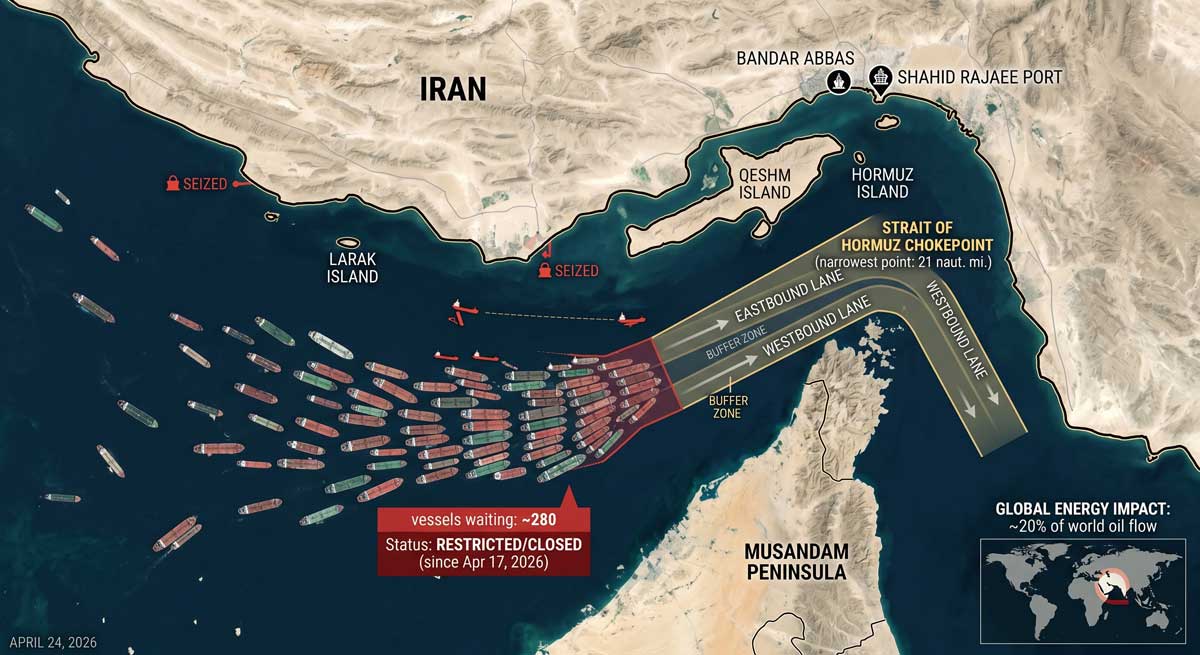
Transit volumes through the Strait of Hormuz have already fallen sharply. By the weekend, Hormuz passage was reported at roughly 4% of normal levels — the lowest since April began. Iran’s current actual export run rate is estimated at around 800,000 barrels per day, approximately half of its March level.
Compounding the pressure, U.S. sanctions waivers on Iranian oil purchases expired on 19 April, tightening the policy framework around the physical blockade and making it harder for buyers — particularly in Asia — to continue taking Iranian barrels without facing secondary sanctions risk.
The blockade also differs fundamentally from previous sanctions regimes. Prior financial sanctions imposed costs on buyers and intermediaries but left physical logistics intact. A naval blockade is a mechanical constraint: it physically prevents tankers from moving, irrespective of payment structures or grey-market arrangements. That distinction significantly narrows the workarounds Tehran has previously relied upon — ship-to-ship transfers, flag switching, and third-country routing — though these options have not been entirely exhausted.
Iran’s Current Export Channels and Vulnerabilities
| Export Channel | Status Under Blockade |
|---|---|
| Kharg Island terminal (main export hub) | Directly interdicted |
| Ship-to-ship transfers at sea | Severely disrupted, partially ongoing |
| Chinese-flagged tanker routing | Reduced but not fully halted |
| Floating storage (142m bbl offshore) | Temporarily accessible; supply dwindling |
| Domestic refinery output (gasoline) | Self-sufficient since ~2019; import need minimal |
Iran’s energy infrastructure profile matters here. Since the Persian Gulf Star refinery came online in 2017 and reached full capacity around 2019, Iran has been largely self-sufficient in gasoline production, reducing its import dependence from around 100,000 barrels per day to roughly 8,000 barrels per day. This means a blockade cannot easily apply leverage through cutting off refined product imports — a tool that would have been more effective a decade ago.
The Financial Cost of a Full Blockade
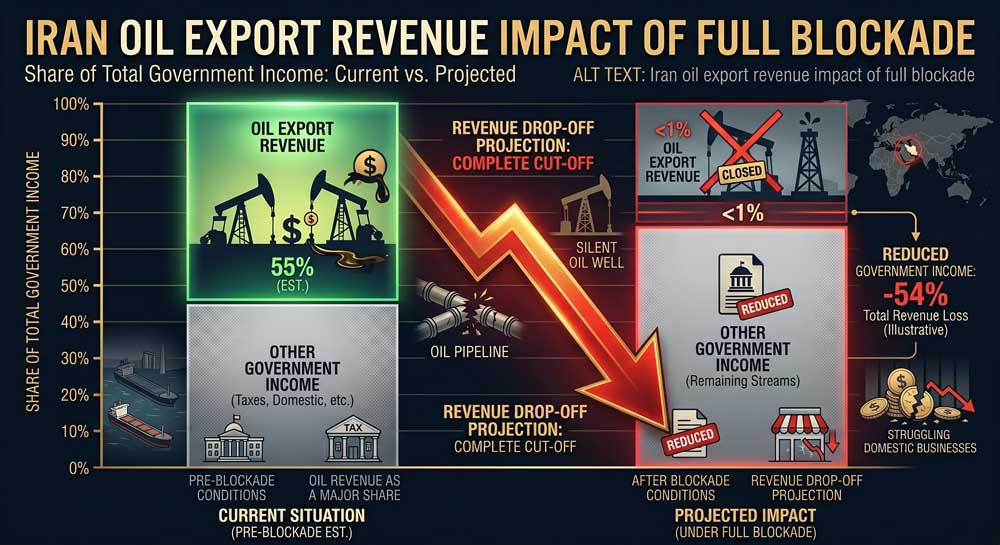
Oil and gas exports account for over 80% of Iran’s total export revenue. Estimates of the daily financial hit from a complete export shutdown range from approximately $435 million to $500 million per day. Annualised, that represents an existential strain on the Iranian state budget.
That said, I think it is important to acknowledge the nuance here. Iranian oil revenues heading into the current conflict were reportedly running above the government’s 2026 budget projections, meaning Tehran entered this standoff with a degree of financial cushion. In the early phase of the blockade, Iran was still exporting at half its normal rate while prices were elevated — effectively banking revenue at a premium. That window is now closing rapidly.
The broader fiscal picture remains grim for Tehran if the blockade holds. Iran holds approximately 208 billion barrels of proven crude reserves — the world’s third largest — and oil infrastructure is the backbone of state finance. Without export revenue, the government’s capacity to fund subsidies, military expenditures, and proxy networks contracts sharply.
Escalation Risks: From Hormuz to Bab el-Mandeb
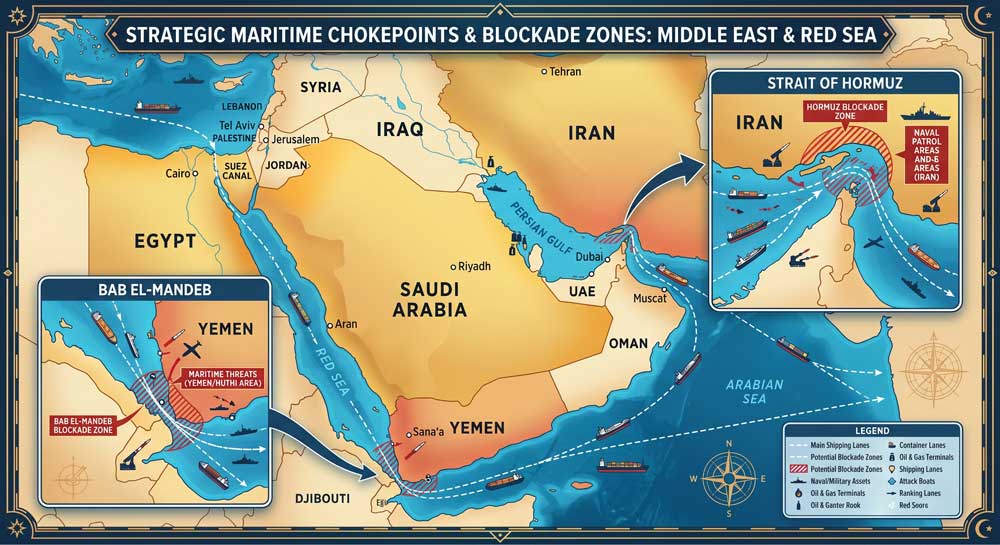
Iran has made clear it will not absorb a blockade passively. Iranian officials have stated publicly that oil exports cannot simply be “switched off” while other countries enjoy safe passage through the Strait of Hormuz. The implicit threat — closing the strait to all traffic — has been on the table throughout this crisis.
More specifically, there are credible warnings that Iran could leverage the Houthi movement in Yemen to obstruct the Bab el-Mandeb Strait, the narrow chokepoint between the Arabian Peninsula and the Horn of Africa through which Saudi Arabia’s alternative oil export route currently flows. Houthi forces have already declared the strait closed in response to U.S. seizure of Iran-linked tankers. If that threat is enforced, Saudi Arabia and the UAE — currently the swing producers offsetting potential Iranian supply losses — would face their own export disruptions, creating a compounding shock to global oil supply.
This is the escalation scenario that most concerns energy security analysts. A Hormuz disruption affects Iranian exports. A simultaneous Bab el-Mandeb closure affects the entire Gulf export complex.
Geopolitical Escalation Pathways
| Scenario | Probability | Market Impact |
|---|---|---|
| Iran accepts partial deal before Day 15 | Moderate | Oil prices ease |
| Forced production cuts begin Day 15–16 | High (if talks stall) | Oil prices spike |
| Full 1.9 mb/d export halt by Day 30 | Moderate-High | Significant global supply shock |
| Houthi closure of Bab el-Mandeb | Moderate | Extreme price spike; Saudi exports threatened |
| Iran challenges naval interdiction militarily | Low-Moderate | Severe regional escalation risk |
A Battle of Endurance
The core question is not whether Iran will feel pain — it clearly will. The deeper question is whether that pain translates into changed behaviour fast enough to satisfy U.S. objectives, and whether Washington can sustain the political and market costs of a prolonged blockade.
Analysts at Chatham House have noted that Iran’s government views this conflict in existential terms, which tends to produce a “resist at all costs” posture even at severe public expense — a dynamic that erodes political legitimacy over time but also makes rapid capitulation less likely. The analytical framing from J.P. Morgan is apt: the blockade is an attempt to seize leverage, but the Trump administration may find the timeline to a negotiated outcome far longer than initially anticipated.
The 142 million barrels of Iranian crude currently stored on tankers outside the Gulf represents weeks of continued supply — and its rate of depletion will serve as the real-time indicator of where this standoff is heading. When that number starts falling sharply, the endgame clock will have truly started.
Reference Sources
- J.P. Morgan Commodities Research — JPMorgan Sees Iran Oil System Hitting Shut in Threshold Within 15 Days
- Reuters — Iran’s main oil and gas production and infrastructure
- The New York Times — What the U.S. Blockade Means for Iran’s Economy
- Times of Israel — Iran economy looks set to withstand US naval blockade, analysts say
- Anadolu Agency — EXPLAINER – Iran’s energy reserves, production and exports
- Al Habtoor Research — What If: The Houthis Close Bab el-Mandeb?
- Yahoo Finance / AFP — Iran Says Blockade Of Its Ports Will Come At ‘Significant Costs For All’
- Tavakoli Structured Finance — Iran Oil Strategy 2025: Avoiding Historical Mistakes
- ElevenLab — Operation Epic Fury & the Middle East Geopolitical Crisis: 8,000 Airstrikes, 3 Market Warnings, and 1 Economic Tipping Point
- ElevenLab — Strait of Hormuz Semiconductor Crisis: 5 Devastating Threats to the Global Tech Supply Chain
- ElevenLab — Iran US Blockade Strategy: 3 Deadly Moves Threatening Iran’s Survival in 2026