7 Secrets Why Hermes Agent Crushed OpenClaw: An Explosive 2026 Review
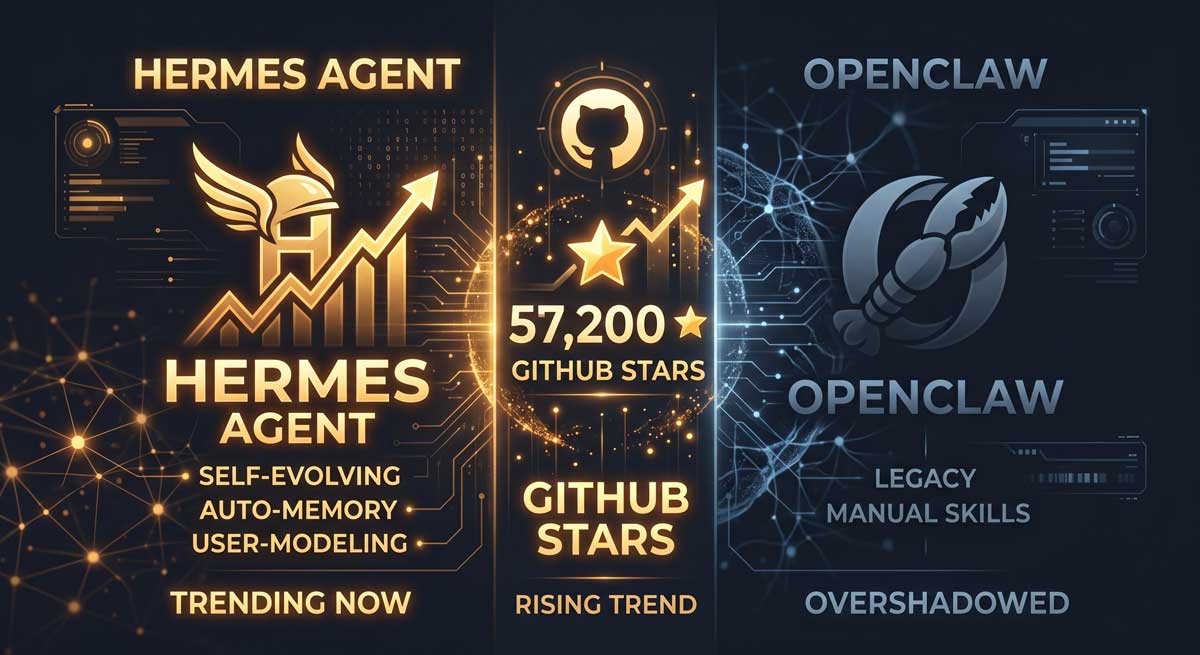
Hermes Agent has done something extraordinary: in just two months, it dethroned OpenClaw — the developer community’s darling — accumulating over 57,000 GitHub stars and holding the top spot on GitHub Trending for weeks on end. The AI community has rallied around a unified narrative: Hermes represents a paradigm shift in open-source autonomous agents, with self-evolving skills, proactive memory management, and deep user modeling that leaves its predecessor behind.
Even Anthropic is paying attention. Nous Research founder Teknium publicly noted that Anthropic appears to be replicating Hermes Agent’s signature feature — proactively judging when a task is complete and notifying users automatically.
But before accepting the hype wholesale, it’s worth asking the harder question: what is actually driving this migration at the architectural level? The answer reveals something more interesting than a simple feature war.
Table of Contents
The Illusion of Feature Parity
Strip away the buzzwords, and the functional overlap between these two frameworks is staggering. The claim that Hermes Agent offers “absolute crushing” over OpenClaw in raw capabilities is a myth.
Hermes Agent vs. OpenClaw: Core Feature Matrix
| Capability | Hermes Agent | OpenClaw |
|---|---|---|
| Task Scheduling | Human-readable + cron, isolated sessions | at / every / cron; JSON-persisted across restarts |
| Sub-Agent Delegation | Up to 3 parallel sub-tasks, fully isolated env | Background isolation + configurable nesting depth |
| Browser Automation | ✅ Camofox anti-detection (v0.7+) | ✅ Built-in |
| TTS / Voice / Vision | ✅ Full stack | ✅ Full stack |
| Image Generation | ✅ | ✅ |
| Messaging Gateways | ✅ 20+ (Telegram, Discord, Slack, Signal…) | ✅ 20+ (identical protocol support) |
| Skill System | ✅ Auto-generated + offline evolution | ⚠️ Manual create / install / authorize / restart |
| Memory Write Trigger | ✅ Active — every ~15 turns | ⚠️ Passive — fires before context overflow |
| Memory Retrieval | SQLite FTS5 full-text search (default) | Keyword search on flat files |
| Advanced Memory Backend | 7 pluggable options (v0.7) | ContextEngine plugin (v2026.3.7+) |
The engines are nearly identical. The real differentiation lies not in what these agents can do — but in who decides to do it, and when.
Secret 1: Skills That Write and Evolve Themselves
The single hardest technical differentiator in Hermes Agent is its closed-loop, self-evolving Skill system.
A Skill is a Markdown file — essentially an operational blueprint that tells the agent how to approach a task category, which tools to call in sequence, and how to recover from failure. Both platforms have Skills. Only one drives its own Skill lifecycle forward automatically.
Phase One: Silent Generation
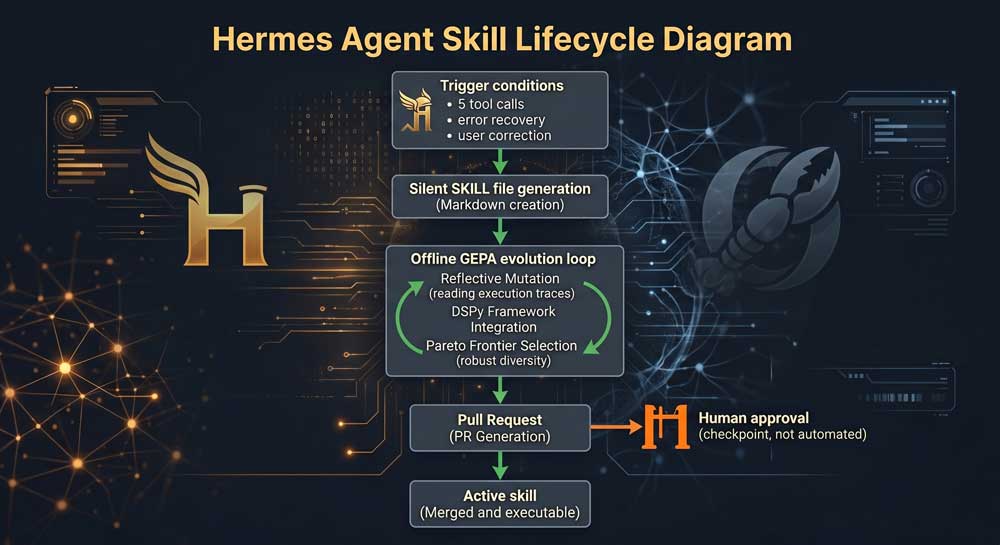
As you use Hermes Agent, it watches for specific deterministic triggers. When any of the following conditions fire, a hardcoded rule packages the completed workflow into a local SKILL file — silently, with no user prompt required:
- 5+ tool calls in a single task execution
- Successful error recovery via retry or self-correction
- Direct user correction of agent output
You often won’t realize it just taught itself a new trick. The four-tier skill loading system (Tier 0 loads only names and descriptions into ~3,000 tokens of system prompt; deeper tiers load full content on demand) keeps context costs manageable as the skill library grows.
Phase Two: Offline Evolution via GEPA
The companion repository hermes-agent-self-evolution implements GEPA — Genetic-Pareto Prompt Evolution — an algorithm accepted as an Oral paper at ICLR 2026.
Rather than using reinforcement learning (as competing frameworks like SkillRL and SAGE do), GEPA discards gradient updates entirely. The paper’s central claim: reflective prompt evolution using LLM self-critique outperforms RL, with better sample efficiency.
How GEPA Works
| Component | Mechanism | Why It Matters |
|---|---|---|
| Reflective Mutation | LLM reads past execution traces and rewrites prompts based on specific natural-language diagnoses | Far more informative than a scalar reward score |
| Pareto Frontier Selection | Retains any candidate skill that tops even one evaluation sample | Preserves diversity; avoids premature convergence |
| Natural Language Feedback Signal | “Failed to check boundary condition” beats a float score of 0.6 | LLMs act more reliably on language than numbers |
Benchmarks show GEPA outperforms GRPO (a leading RL method) by 6 percentage points on average and up to 19pp on harder tasks, while using up to 35× fewer training rollouts.
One critical catch: after offline evolution, Hermes does not auto-merge the improved skill. It submits a Pull Request that requires human review before any evolved skill goes live. The “zero human intervention” community narrative is a myth — generation is silent, but evolution is gated by human approval.
OpenClaw’s skill system, by contrast, demands manual file creation, installation, authorization, and a full gateway restart to register each new skill. Hermes says “I’ve got this.” OpenClaw says “you go first.”
Secret 2: Proactive Memory vs. Panic Saving
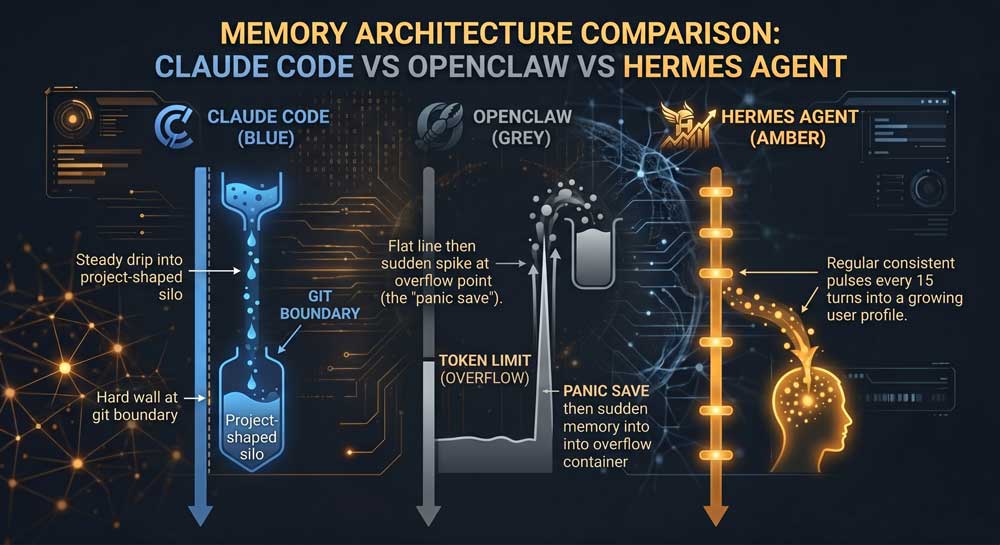
The second pillar of the Hermes Agent mythology — “it knows who I am” — comes down to architecturally different memory trigger philosophies across the three major agents.
Memory System Deep Comparison
| Dimension | Claude Code | OpenClaw | Hermes Agent |
|---|---|---|---|
| Write Trigger | Continuous during work | Panic — fires before context overflow | Active — nudge every ~15 turns |
| Scope | Per-project (git root hard boundary) | Cross-project (MEMORY.md / USER.md) | Cross-project + structured user modeling |
| User Modeling | ❌ Project only | ⚠️ Passive accumulation | ✅ Dialectic reasoning (Honcho opt-in) |
| Default Retrieval | Project-level index | Keyword search | SQLite FTS5 full-text search |
| Advanced Backends | — | ContextEngine plugin | MEM0, Honcho, ByteRover + 4 others (v0.7) |
Claude Code is disciplined but impersonal — its Auto-memory organizes build commands and architecture notes, runs an Auto Dream consolidation every 24 hours, but never crosses the git root boundary. It remembers projects, not people.
OpenClaw feels magical at first — it loads MEMORY.md and USER.md at every boot, creating the sensation of genuine continuity. But the write mechanism is a survival reflex: it fires a “silent turn” only when the context window is about to overflow, hastily summarizing the session and jotting preferences before the compaction fires.
Hermes Agent flips this entirely. Its nudge mechanism fires every ~15 conversation turns — proactively, regardless of context pressure — forcing the agent to reflect: “What did I just learn about this user worth recording?” Native SQLite FTS5 full-text search ships as the default retrieval layer, letting the agent scan its entire conversation history without a vector database setup.
When the optional Honcho backend is enabled, it goes further: after each session ends, a background model call performs asynchronous dialectic reasoning on the conversation — resolving contradictions, extracting structured “Insights,” and building a genuine user model rather than a flat log. It is expensive in tokens, which is why v0.7 made it optional.
Secret 3: Hiding Complexity Behind Hardcoded Defenses
Here is the counterintuitive insight that explains both Hermes Agent’s stability and its limitations: the system is opinionated precisely because it doesn’t trust its own LLM.
Complexity cannot be destroyed — only relocated. When Hermes’s developers built the automation harness, they concluded that letting the model make system-level judgment calls was too risky. Research validated this instinct: a 2025 arXiv study found that LLM performance in multi-turn conversations drops an average of 39% versus single-turn — and up to 85% in worst-case scenarios. ChromaDB’s 2026 context stress tests of 18 frontier models including GPT-4.1, Claude 4, and Gemini 2.5 confirmed that reliability degrades significantly as context length grows.
Hermes Agent’s response is a suite of deterministic rules that replace model judgment at every critical junction:
- Context Compression: When context hits 85% capacity, the
ContextCompressorperforms pure string replacement — swapping old tool outputs for static placeholders. No LLM summarization, no hallucination risk. Memory snapshots are frozen at session start and reloaded only on restart, keeping prefix cache hit rates stable and cutting token input costs by ~75%. - Security Approval: The built-in Smart approval mode uses hardcoded regex blacklists against terminal operations — no model is asked whether a command is dangerous. Match the blacklist, require human confirmation.
- Plugin Isolation: Of 6 Event Hook types, 5 are fire-and-forget. Plugin return values are ignored. Even a crashing third-party plugin cannot destabilize the main agent loop.
The philosophy is clear: when models fail at long context, the most intelligent thing a system can do is stop asking them to judge.
Secret 4: The Automation Spectrum
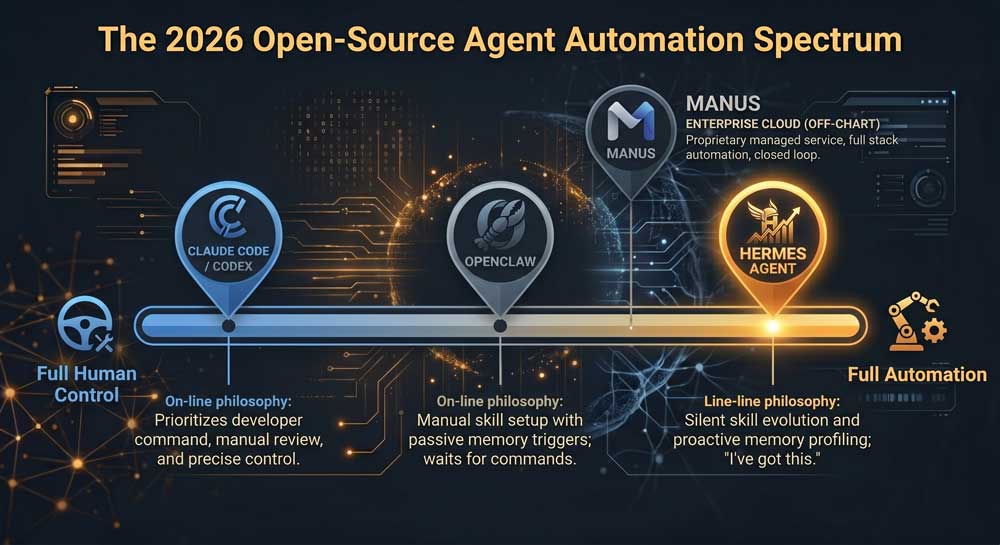
Mapping the 2026 open-source agent landscape reveals a clean spectrum on a single axis — how much does the system decide for the user?
The 2026 Open-Source Agent Spectrum
| Agent | Philosophy | Primary User | Core Tradeoff |
|---|---|---|---|
| Claude Code / Codex | Human reviews every diff and command | Professional developers | Maximum control, zero surprises |
| OpenClaw | Passive automation, manual skill setup | Power users | Balance of control and convenience |
| Hermes Agent | Fully autonomous defaults, rules-driven | General users | Maximum convenience, harder to override |
| Manus | Cloud-orchestrated multi-agent | Enterprise teams | Scale over transparency |
Hermes Agent occupies the far end deliberately. Its bet: most users neither want to understand nor should need to understand how their agent works. Skill matching, memory filing, and context compression all happen invisibly. The product ambition is not to feel useful — it’s to become more capable without the user noticing.
Secret 5: Where Hermes Agent Still Falls Short
The same automation that makes Hermes Agent compelling creates its most serious failure modes.
Skill overwriting is the top power-user complaint: carefully hand-tuned skills, built over hours of iteration, can be silently overwritten by the automated evolution pipeline. In professional contexts, this is not a minor annoyance — it is a potential disaster.
The nudge memory paradox: The proactive nudge asks the agent to self-assess whether a task was completed successfully — but community testing consistently finds that Hermes almost always judges itself as having succeeded. The resulting memory entries are shallow and incomplete.
Unsuitable for high-stakes work: Core contract review, production code audits, complex financial modeling — in these domains, full automation is a liability, not a feature. Professional-grade tools remain deliberately non-autonomous for exactly this reason.
Where Hermes shines today: high-tolerance, repetitive daily tasks — drafting reports, web research, file organization — where 20+ iterations allow its skill and memory systems to compound into genuine, measurable reliability gains.
Secret 6: The Strategic Retreat of v0.7
On April 3, 2026, Hermes Agent released its v0.7 “Resilience” update — and made a quietly significant reversal.
The previously hardcoded Honcho memory backend — the complex, token-intensive AI-native system — was demoted from required default to one of seven equal plugin options alongside MEM0, ByteRover, and four others. The new default became the simplest possible option: flat files plus SQLite full-text search.
A system that claimed to make all decisions for you handed the most important decision back to the user. This is not weakness — it is the first-mover’s privilege. Having established the narrative, Hermes can afford to simplify. Challengers cannot.
Secret 7: OpenClaw Is Playing Catch-Up — Fast
While Hermes retreated one step toward simplicity, OpenClaw sprinted two steps forward toward automation.
- April 5: OpenClaw launched Dreaming — offline memory consolidation that promotes short-term diary entries into durable MEMORY.md records during idle periods, similar to Claude Code’s Auto Dream
- April 10: OpenClaw launched Active Memory — a dedicated memory sub-agent that fires before every main reply, with configurable recall modes (message / recent / full context)
OpenClaw’s Active Memory sub-agent approach is arguably more granular and more intelligent than Hermes’s fixed 15-turn nudge. It uses a full LLM-as-judge architecture for recall decisions rather than a deterministic interval.
This confirms the thesis: the entire field is converging on proactive autonomous memory. Hermes Agent simply got there first, planted the flag, and built the community narrative while competitors were still designing their roadmaps.
The Endgame: Ecosystem Before Perfection
Hermes Agent’s ultimate bet is not that its current system is the best — it’s that it’s good enough, right now, to accumulate the users, skills, and memory bases that will matter when the underlying models improve.
Once frontier LLM context handling crosses a reliability threshold, every conservative rule Hermes has encoded can be relaxed: frozen memory snapshots can refresh in real time, hardcoded compression logic can yield to intelligent summarization, and regex security blacklists can give way to model judgment.
By that point, Hermes will already hold the skill ecosystem, the user base, and years of accumulated memory data. The infrastructure it’s building today — even imperfectly — is the moat it will defend tomorrow.
In the open-source agent wars, claiming a defensible position while the technology is just barely good enough has consistently proven more durable than pure technical superiority. Manus proved it. OpenClaw proved it. Now Hermes Agent is proving it again.
Authoritative Deep Links
- Hermes Agent — Official GitHub (NousResearch): https://github.com/nousresearch/hermes-agent
- Hermes Self-Evolution Repo (GEPA + DSPy): https://github.com/NousResearch/hermes-agent-self-evolution
- GEPA — ICLR 2026 Oral Paper: https://iclr.cc/virtual/2026/oral/10009494
- GEPA — arXiv Preprint (PDF): https://arxiv.org/abs/2507.19457
- Hermes v0.7.0 Full Release Notes: https://github.com/NousResearch/hermes-agent/blob/main/RELEASE_v0.7.0.md
- Hermes Memory Providers — All 7 Options Compared (Vectorize): https://vectorize.io/articles/hermes-agent-memory-providers-compared
- OpenClaw Active Memory v2026.4.10 Launch Coverage: https://www.binance.com/en-TR/square/post/311300562798018
- OpenClaw 4.12 Active Memory Deep Dive (SEN-X): https://senx.ai/openclaw-news/2026-04-13-openclaw-news
- “LLMs Get Lost In Multi-Turn Conversation” — arXiv 2025: https://arxiv.org/abs/2505.06120
- ChromaDB Context Rot Study — LLM Performance Degradation (ZenML): https://www.zenml.io/llmops-database/context-rot-evaluating-llm-performance-degradation-with-increasing-input-tokens
- DSPy: Self-Improving LLM Pipelines (Stanford NLP): https://github.com/stanfordnlp/dspy
- ElevenLab: https://elevenlab.net/category/ai-tech/
- ElevenLab: https://elevenlab.net/big-tech-ai-spending-670-billion-2026/