Iran Oil Crisis Impact: 5 Proven Reasons It Won’t Trigger a 1970s-Style Disaster
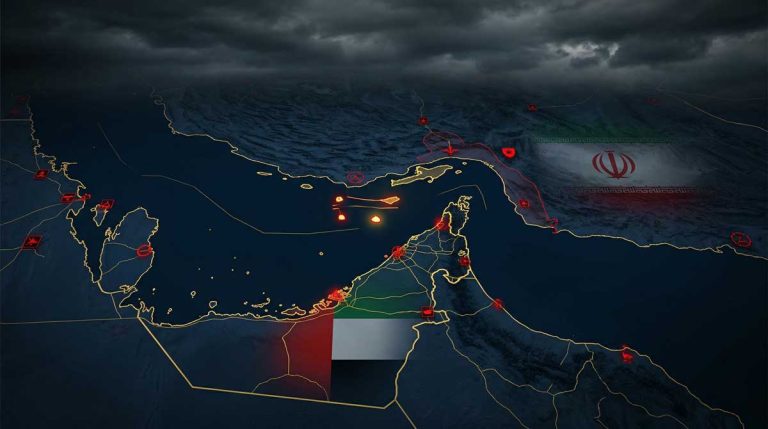
Watching Brent crude breach $73 in the middle of the night is unsettling — especially when diplomatic headlines one day claim “peace is within reach,” and markets tell a completely different story the next morning. The Iran oil crisis impact is dominating financial news cycles, and the fear of a 1970s-style economic catastrophe is understandable.
But the data says otherwise. Beneath the geopolitical noise lies a fundamentally different energy economy — one where oil’s grip on inflation, supply security, and monetary architecture has been structurally transformed. Here is exactly why, and what is really driving the current tensions.
Table of Contents
How Different Is 2026 From 1973?
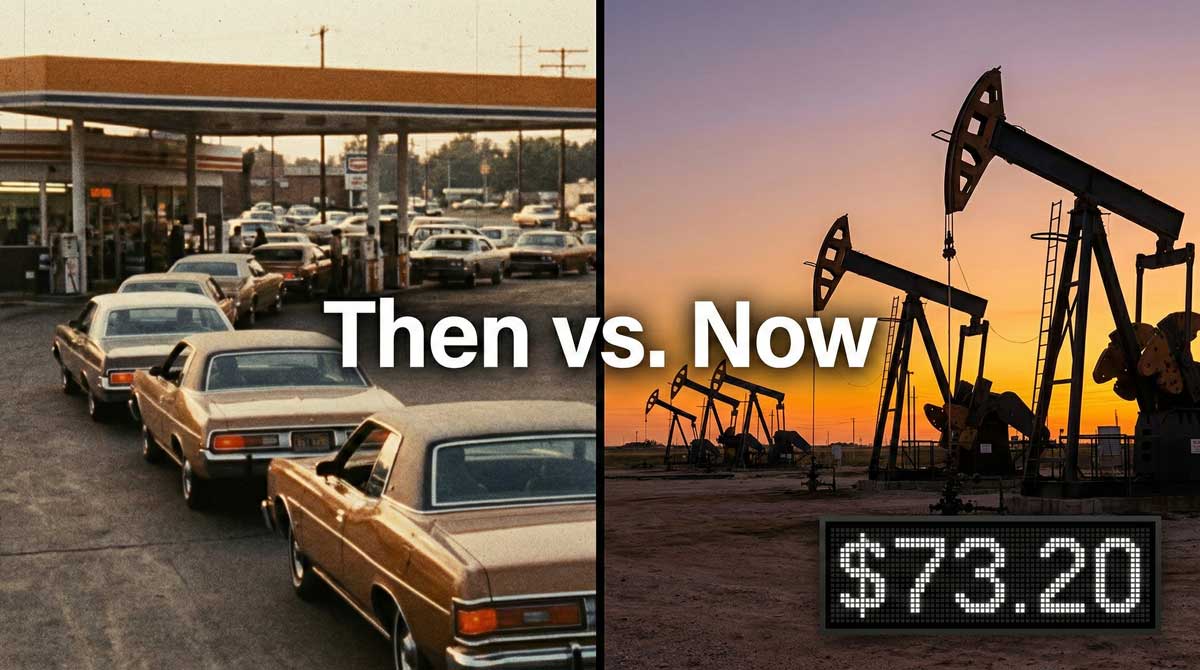
The 1970s oil crisis was a genuine physical emergency. Arab nations cut supply, American gas stations ran dry for miles, and factories ground to a halt. That crisis triggered double-digit inflation and ultimately forced Fed Chair Paul Volcker to raise interest rates to 20% — crushing inflation at the cost of a deep, prolonged recession.
The current Iran oil crisis impact operates in an entirely different structural environment across five critical dimensions.
Reason 1 — The U.S. Is No Longer Vulnerable to Middle East Supply Cuts
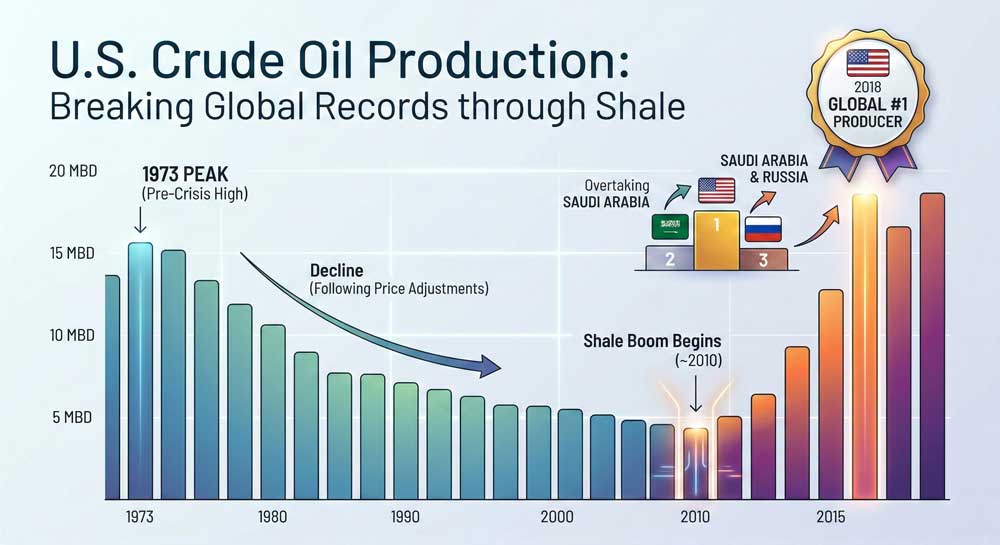
The 1970s nightmare forced the United States to make a generational bet on shale technology. That bet paid off dramatically:
- 2011: U.S. surpassed Russia as the world’s largest natural gas producer
- 2018: U.S. overtook both Saudi Arabia and Russia as the world’s largest crude oil producer
- 2026: Trump’s “drill, baby, drill” agenda and Strategic Petroleum Reserve refill mandates have further reinforced energy self-sufficiency
U.S. Oil Position: Then vs. Now
| Metric | 1970s | 2026 |
|---|---|---|
| Global production rank | Mid-tier, declining | #1 globally |
| Import dependency | High — vulnerable to Arab embargo | Near self-sufficient |
| Shale industry | Nonexistent | Profitable above ~$65/bbl |
| Strategic reserves | Reactive | Proactively managed |
| Market condition | Physical supply deficit | Structural oversupply baseline |
The contrast is stark: the 1970s crisis hit an economy structurally dependent on foreign oil. Today’s Iran oil crisis impact hits the world’s largest oil producer.
Reason 2 — Oil No Longer Drives CPI the Way It Once Did
In 1973, goods accounted for over 60% of the U.S. CPI basket. Because oil underpins manufacturing, logistics, agriculture, and plastics, a crude price spike translated almost instantly into broad consumer inflation.
Today’s CPI basket has been fundamentally restructured:
- Goods: now less than 40% of the basket
- Services: now dominant, with housing alone representing roughly one-third of total CPI
- Housing costs respond to rental expectations and interest rate conditions — not oil prices
The transmission from oil prices to consumer inflation is now far slower, far weaker, and filtered through multiple economic layers that simply did not exist in 1973.
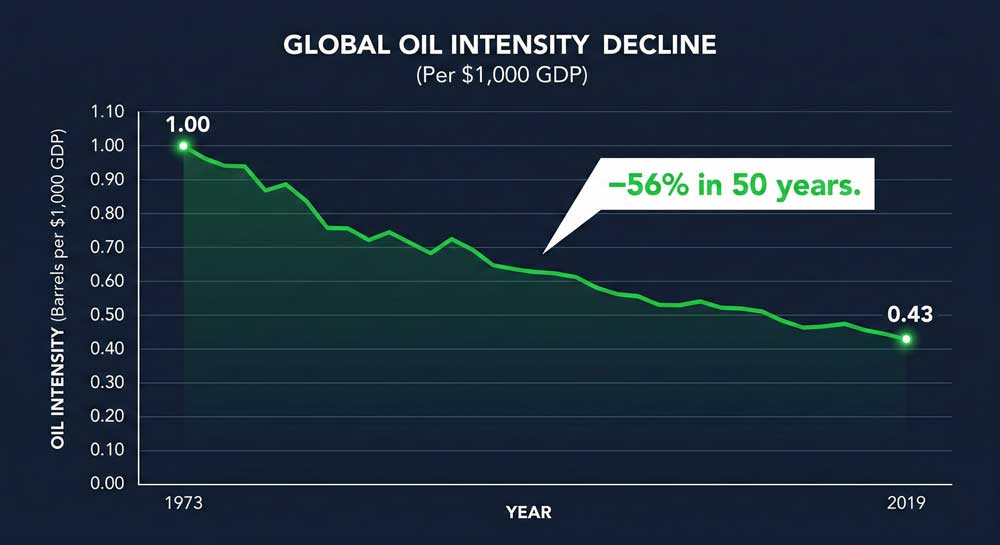
Reason 3 — Global Oil Intensity Has Fallen 56% Since 1973
Perhaps the most underappreciated structural shift is the dramatic decline in oil intensity — the volume of oil required to generate one unit of economic output.
Oil Intensity = barrels of oil consumed per $1,000 of GDP (constant 2015 USD). It is the single clearest measure of how dependent an economy is on crude oil for growth.
Research from the Columbia University Center on Global Energy Policy found that this metric has declined in an almost perfectly linear fashion since 1984:
Global Oil Intensity Trend
| Year | Barrels per $1,000 GDP | Change vs. 1973 |
|---|---|---|
| 1973 | ~1.00 bbl | Baseline |
| 1984 | ~0.75 bbl | −25% |
| 2000 | ~0.60 bbl | −40% |
| 2019 | 0.43 bbl | −56% |
Two structural forces are driving this decline:
- A shift from high-energy manufacturing to lower-intensity services industries
- Accelerating efficiency gains and renewable substitution — oil’s share of global energy use fell below 30% for the first time in 2024
The implication is direct: the same oil price shock that caused catastrophic 1970s inflation delivers roughly half the inflationary punch today.
Reason 4 — The Real Target Is the Petrodollar, Not Supply Security
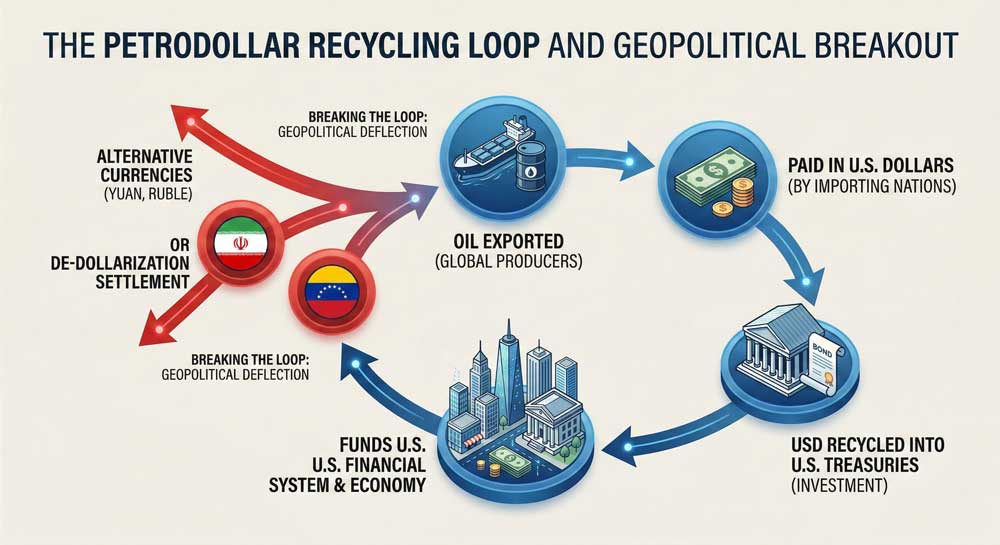
Here is the geopolitical logic that most mainstream coverage misses entirely. The U.S. is not primarily concerned about oil supply disruption — it is concerned about the petrodollar system unraveling.
Global oil is priced in U.S. dollars. When oil prices rise, global USD demand rises with it. Oil-importing nations need more dollars; oil exporters recycle surplus dollars back into U.S. Treasuries. This self-reinforcing loop is a foundational pillar of dollar hegemony.
Iran and Venezuela have been systematically trading oil in yuan, rubles, and other non-dollar currencies — directly eroding the foundations of this system. From Washington’s perspective, the collapse of the petrodollar poses a far more existential threat than any near-term inflation spike. Controlling rogue oil exporters who operate outside the dollar system is, at its core, a currency defense operation.
Reason 5 — There Is a “Goldilocks” Political Calculus
Trump’s energy policy requires a delicate balancing act that makes “controlled” geopolitical tension politically useful:
- Oil too low → U.S. shale companies (breakeven ~$65/bbl) go bankrupt; energy-state unemployment rises; core Republican voter base in Texas and other red states suffers
- Oil too high → Consumer inflation reignites; voter sentiment turns negative; midterm election risk rises
The result is a structural preference for managed geopolitical pressure — enough tension to keep crude in the $65–$80 range, supporting domestic producers and reinforcing petrodollar flows, without triggering a genuine supply crisis.
How Long Will the Iran Oil Crisis Impact Last?
The honest forecast: probably not long in its current form. Global oil market fundamentals in 2026 point to oversupply. ING analysts note that geopolitically-driven price spikes — absent a real physical supply deficit — historically dissipate as quickly as they appear. Rystad Energy’s scenario modelling shows that even limited military strikes would produce sharp but short-lived price reactions.
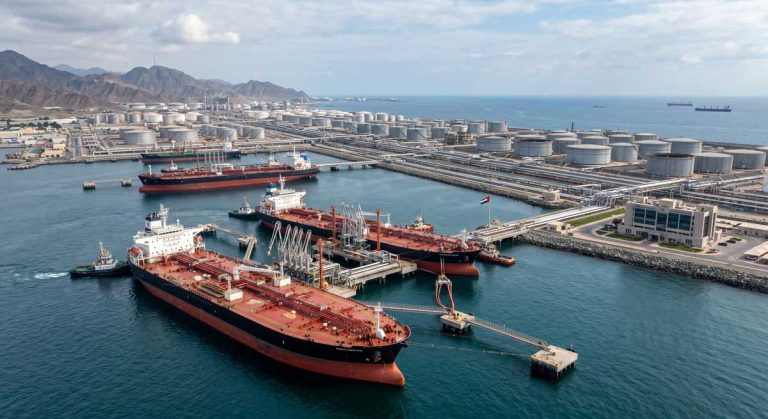
Watch the diplomatic signals carefully. Progress from Oman or other intermediaries would likely trigger a swift price retracement. Only a genuine Strait of Hormuz disruption — a tail-risk scenario — would produce a sustained, structural oil shock comparable in magnitude to 1973.
🔗 References
- Rystad Energy: Five Scenarios for Iran Geopolitics and Oil
- Columbia University CGEP: Oil Intensity — The Curiously Steady Decline of Oil in GDP
- ING Think: Geopolitical Uncertainty and the Crude Oil Market Outlook
- Dallas Federal Reserve: Middle East Geopolitical Risk and U.S. Inflation (2025)
- S&P Global / IEA: Oil’s Share in Global Energy Drops Below 30% in 2024
- The Independent Institute: Unpacking the Petrodollar War Theory
- Forbes: How the U.S. Shale Boom Turned the World Upside Down
- Trump Tariffs European Inflation: 5 Shocking Ways US Trade Barriers Are Crushing Eurozone Prices
- Labor Devaluation Exposed: 5 Shocking Reasons Why It’s More Dangerous Than Unemployment in 2026
- 5 Critical Reasons Why OpenAI’s $750B IPO Could Reshape AI Economics by 2027
- Silver’s 50% Crash and 30% Rebound: 5 Critical Insights for 2026 Investors