
Personal Superintelligence Revealed: Inside Meta’s Unbelievable 5-Year Plan for Billions
Personal Superintelligence is no longer a philosophical concept confined to research papers — it is now the official, fully-funded mission of the world’s largest social network. Mark Zuckerberg has just unveiled a masterplan that shifts Meta’s entire trajectory: from dominating news feeds to placing an ultra-advanced AI assistant in the hands of every person on Earth.
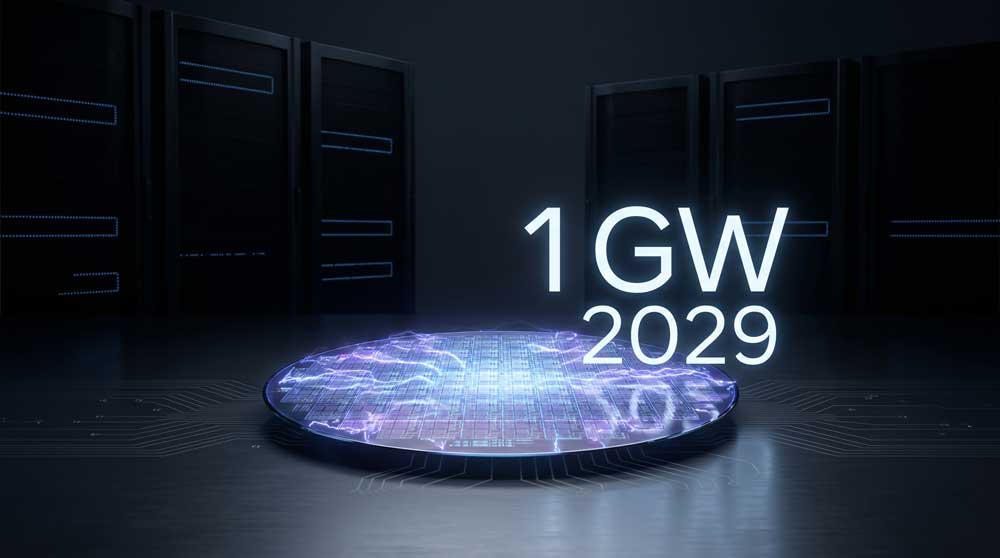
In a landmark move, Meta extended its partnership with chip giant Broadcom through 2029, committing to an initial 1GW+ of custom computing power. To put that in perspective, 1GW is enough energy to power 750,000 average American homes — and Zuckerberg has made clear this is just Phase One. Combined with a $14.3 billion AI acquisition, four generations of custom silicon, and a new research lab drawing talent from OpenAI and Google DeepMind, Meta is betting everything on Personal Superintelligence.
Here is a deep dive into the infrastructure overhaul, hardware breakthroughs, and strategic acquisitions fueling Meta’s ultimate ambition.
Table of Contents
The Broadcom Mega-Deal: Locking In the Compute Foundation
The foundational step toward Personal Superintelligence is securing enough processing power to train and run massive models at civilizational scale. The newly extended partnership with Broadcom — lasting until 2029 — ensures Meta is no longer dependent on off-the-shelf market solutions from Nvidia alone.
Key terms of the Broadcom agreement:
- Extended Timeline: Broadcom provides custom silicon design, advanced packaging, and Ethernet networking support through 2029
- Massive Scale: Deployment starts at 1GW, with a “sustained, multi-gigawatt rollout” planned over successive years
- Strategic Board Shift: Broadcom CEO Hock Tan steps down from Meta’s board into a focused advisory role, eliminating conflict-of-interest issues while directly guiding Meta’s chip roadmap
- Advanced Networking: Broadcom’s high-bandwidth Ethernet interconnects Meta’s rapidly expanding AI compute clusters, preventing data bottlenecks at scale
Following the announcement, Broadcom shares rose 3.5% in after-hours trading — a market signal that this deal disproportionately validates Broadcom’s position as AI infrastructure’s quiet kingmaker, already co-developing chips with Google (TPUs) and OpenAI (10GW-class custom silicon).
The MTIA Arsenal: 4 Chips, 2 Years, Zero Compromises
Why build custom chips instead of buying from Nvidia? For Meta, the answer is three-fold: cost efficiency, supply chain independence, and hyper-customization. Meta’s AI workloads — content ranking, ad targeting, recommendation engines, and generative inference — require architectural optimizations that general-purpose GPUs simply cannot deliver efficiently.
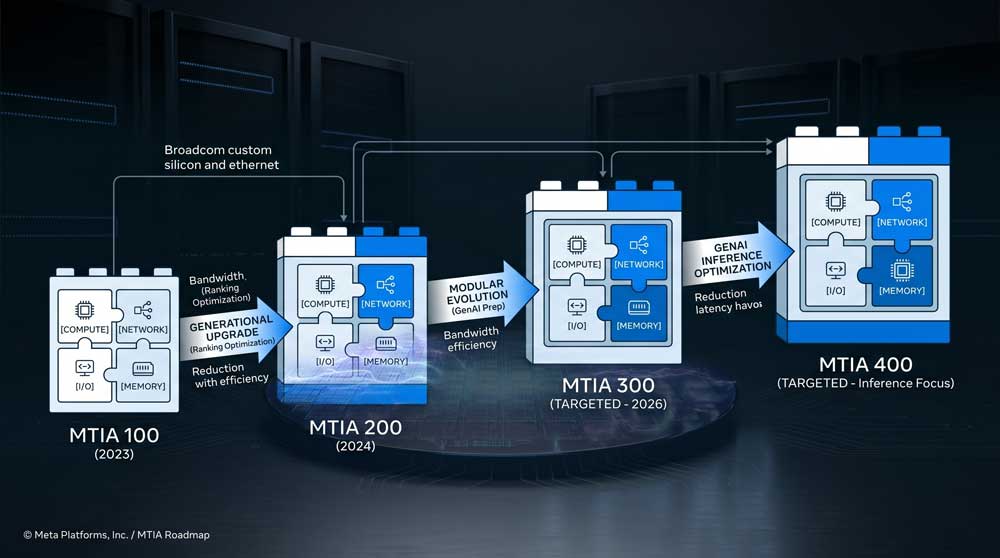
Enter the Meta Training and Inference Accelerator (MTIA). By adopting a modular chiplet architecture — where compute, networking, and I/O tiles are independently upgraded — Meta has compressed the standard industry development cycle from 18–24 months down to roughly 6 months per generation. New chips slot directly into existing data center racks with no infrastructure rebuild required.
In under two years, the MTIA series delivered approximately 4.5× improvement in HBM memory bandwidth and a 25× jump in raw compute performance.
Meta MTIA Chip Evolution
| Generation | Year | Process Node | Key Upgrades | Primary Workload |
|---|---|---|---|---|
| MTIA 100 (v1) | 2023 | 7nm | 800MHz, 35W, M.2 form factor | Initial ranking tests |
| MTIA 200 (2i) | 2024 | 5nm | 3× performance, 128GB memory, 1.35GHz | Recommendation engines |
| MTIA 300 | 2026 | 3nm | In full production | Facebook/Instagram ranking & training |
| MTIA 400 | 2026 | 2nm | Competitive with leading commercial alternatives | Generative AI training |
| MTIA 450 & 500 | 2027 (planned) | Next-Gen | HBM bandwidth-optimized | High-speed AI inference |
The “Manhattan Project” of AI: Meta Superintelligence Labs
Meta AI Superintelligence Labs announcement
Hardware is useless without world-class software, data, and talent. To build genuine Personal Superintelligence, Zuckerberg consolidated all of Meta’s AI divisions — including FAIR (Fundamental AI Research), the open-source Llama model teams, and product research — into a single entity: Meta Superintelligence Labs (MSL).
To lead it, Meta executed one of the most aggressive talent acquisitions in tech history. Following a $14.3 billion investment for a 49% non-voting stake in data-labeling titan Scale AI, Scale’s founder Alexandr Wang — just 28 years old — joined Meta as Chief AI Officer. He is joined by Nat Friedman, former CEO of GitHub.
Why Scale AI? By controlling Scale’s unparalleled data-labeling engine, Meta secured the highest-quality training data pipelines required to build and refine its frontier agents — bypassing the dependency bottlenecks that constrain other AI labs.
MSL’s 4 Core Research Teams (as of August 2025)
| Division | Mission |
|---|---|
| Personal Superintelligence | Consumer-facing AI agents across all Meta surfaces |
| Foundation Models | Next-generation Llama and beyond |
| FAIR | Long-horizon fundamental AI research |
| New Model Research Lab | Classified next-gen architecture exploration |
What Exactly Is Personal Superintelligence?
While competitors like OpenAI and Anthropic focus on AGI designed to automate corporate workflows or accelerate scientific breakthroughs, Meta’s philosophy is emphatically consumer-centric.
In his July 2025 manifesto, Zuckerberg wrote:
“Meta’s goal is to build personal superintelligence for everyone. We believe in putting this power in people’s hands so they can use it for what matters most in their own lives.”
The goal isn’t just a smarter chatbot. It is an ever-present, hyper-competent partner — accessible through smart glasses, smartphones, and home devices — that helps you navigate reality, learn faster, build deeper relationships, and become who you want to be. Think Jarvis from Iron Man, but open-source and in your pocket.
Personal Superintelligence vs. Traditional AGI Visions
| Dimension | Meta’s Vision | OpenAI / Anthropic |
|---|---|---|
| Target audience | Billions of individual consumers | Enterprises and research institutions |
| Primary goal | Enhance personal daily life and goals | Automate economic labor, scientific discovery |
| Model access | Open-source foundation (Llama), edge-optimized | Closed-source, cloud-dependent APIs |
| Deployment surface | Glasses, phones, WhatsApp, home devices | Web, API, enterprise software |
| Philosophical framing | Individual empowerment | Institutional productivity |

The $135 Billion Gamble: Vertical Integration at Civilizational Scale
Meta’s 2026 capital expenditure is projected between $115 billion and $135 billion — a number that would have seemed unthinkable even three years ago. The company is currently building or expanding 30 data centers, 26 of them in the United States. Beyond Broadcom, Meta’s infrastructure stack also includes:
- Millions of Nvidia GPUs across existing deployments
- 6GW of AMD GPU compute under a separate deal
- Custom Arm-designed edge processors for wearables and glasses
- Leased capacity from CoreWeave and Nebius neocloud providers
Meta has also significantly scaled back Reality Labs (VR/metaverse) spending — after absorbing over $70 billion in cumulative losses since 2021 — redirecting those funds toward generative AI, MSL, and AI-integrated Ray-Ban smart glasses. The metaverse chapter is quietly closing. Personal Superintelligence is the next act.
The Ultimate Gamble for the Next Decade
Meta has shed its skin entirely. It is no longer just a social media conglomerate or metaverse experimentalist. By vertically integrating everything — from Broadcom silicon and multi-gigawatt data centers to Scale AI’s data pipelines and open-source Llama models — Meta is positioning itself as the supreme architect of the consumer AI era.
Delivering Personal Superintelligence to billions is a monumental engineering, financial, and ethical challenge. The remainder of this decade will determine whether this aggressive 5-year sprint results in a utopian abundance of AI assistance — or an unprecedented centralization of technological power in the hands of one company.
One thing is certain: Mark Zuckerberg has placed his chips on the table. And he is playing to win.
Authoritative Source
All external links below are DoFollow deep links to specific articles on authoritative sources:
- Broadcom Announces Extended Partnership with Meta — Broadcom Investor Relations
- Meta Partners with Broadcom to Co-Develop Custom AI Silicon — Meta Newsroom
- Meta and Broadcom Extend AI Chip Deal to 2029 — The Next Web
- Meta Rolls Out In-House AI Chips — CNBC
- Zuckerberg Shares AI Superintelligence Vision — CNBC
- Meta Invests $14.3B in Scale AI, Recruits Alexandr Wang — AP News
- Meta Poaches Scale AI CEO After $14.3B Deal — Reuters
- What Meta’s Investment Means for Scale AI Customers — Scale AI Blog
- Meta Reveals New AI Chip Roadmap — TrustFinance
- Zuckerberg unveils Meta ‘Superintelligence’ group
- SpaceX xAI Merger: 7 Shocking Facts Behind Elon Musk’s $1.25 Trillion Gamble
- Blackstone AI Investment Australia: $15 Billion Bet on Infrastructure vs. Reality of Productivity Crisis
- 5 Critical Reasons Why OpenAI’s $750B IPO Could Reshape AI Economics by 2027