
7 Brutal Truths: How AI Workplace Transformation Is Crushing 80% of Cognitive Jobs in 2026
The AI workplace transformation is no longer a future scenario — it is the defining professional reality of 2026. As a power user clocking 2–12 hours daily across Claude Pro, Gemini, MiniMax, and active DeepSeek and Gemini APIs, I have lived this shift firsthand. Every word here is written by a human who has tested, failed, and succeeded with these tools across thousands of real working hours.
This is not hype. AI has crossed a critical threshold — it is now capable of outperforming humans across more than 80% of cognitive, knowledge-based tasks. Here is what that means for your workflow, your career, and your choices right now.
Table of Contents
The Numbers Behind the AI Workplace Transformation
The evidence is no longer theoretical. Anthropic CEO Dario Amodei has warned that AI could eliminate up to half of all entry-level white-collar jobs within five years, potentially pushing unemployment to 10–20%. In the first six months of 2025 alone, nearly 78,000 global tech job losses were directly attributed to AI adoption.
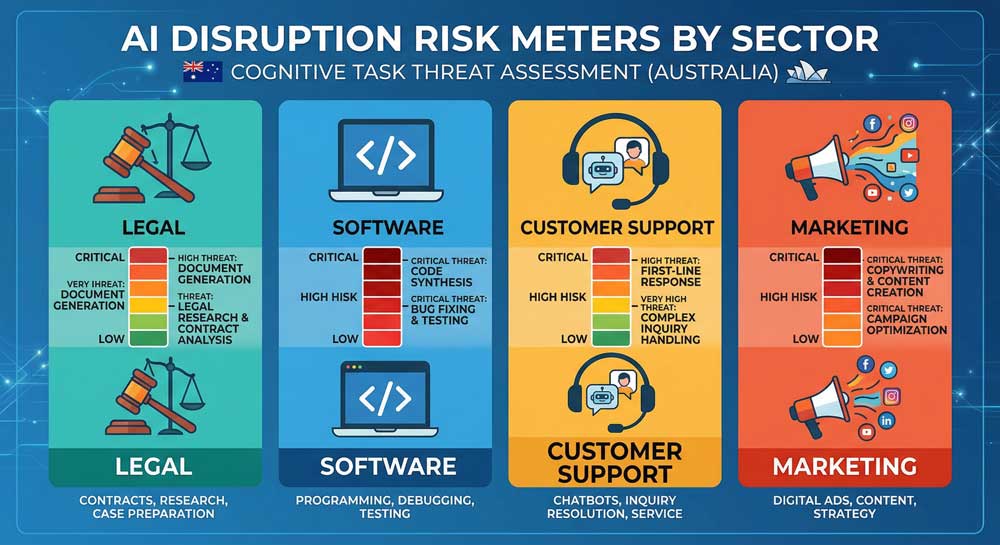
Australia is not exempt. Over 1,000 Australian tech positions were cut in early 2026, with companies explicitly citing AI-driven productivity gains. The ABC has confirmed that AI is already performing tasks across legal research, copywriting, software development, and customer support — roles long considered stable. The Senate has called these disruptions a sign that Australia is in a “dangerous place” — AI is being rolled out at scale without matching investment in worker retraining or regulatory safeguards.
| Sector | Disruption Risk | Tasks Being Automated |
|---|---|---|
| Legal | High | Research, document drafting, contract review |
| Software Development | Very High | Code generation, testing, debugging |
| Customer Support | Very High | Triage, FAQ resolution, scripting |
| Marketing & Content | High | Copywriting, SEO, analytics reporting |
| Accounting | Medium–High | Reconciliation, reporting, tax filing |
| Skilled Trades | Low | Physical labour, on-site judgment |
From ChatGPT to Claude Code: The Non-Linear Leap
My journey mirrors the industry arc. Late 2022: ChatGPT for basic document work. Mid-2024: Cursor dropped the barrier to <a href=”/programming-for-beginners”>programming for non-developers</a> and I started testing ideas that had been shelved for years. Then Claude Code arrived — and everything changed.
Claude Code doesn’t just autocomplete. It understands file architecture, rewrites legacy logic, and executes multi-step terminal tasks autonomously. Once properly integrated, it becomes a genuine engineering partner: give it a clear logical framework and it handles the heavy lifting.
The key insight: AI progress is not linear — it is exponential.
Think of solving a complex Sudoku puzzle. The first numbers are hard to place. But once a critical mass clicks into position, the rest resolves automatically. We saw this with AlphaGo — after it defeated Lee Sedol and Ke Jie, its successor AlphaZero surpassed all human comprehension without ever studying a single human game. Once AI crosses the capability threshold in a domain, it only accelerates.
Intellectual Democratisation: The Most Underrated Shift of Our Era
Throughout history, high-level knowledge was a scarce, gatekept resource. Elite Chinese scholars, Renaissance polymaths, and modern PhDs all operated through narrow, expensive channels that reinforced class divisions. Today, for the price of a daily coffee, any person with an internet connection can access an entity trained on the vast majority of verified human history, logic, and science.
| Dimension | Traditional Knowledge | AI-Powered Learning |
|---|---|---|
| Cost | High (degrees, tutors, institutions) | Low (monthly subscription) |
| Speed | Years of dedicated study | Instantaneous synthesis |
| Accessibility | Limited by geography and wealth | Universal with internet access |
| Application | Theoretical, rigid | Adaptive to your specific task |
The World Economic Forum estimates 44% of workers’ skills will be disrupted by AI. But the flip side is equally powerful: anyone who learns to direct AI effectively now has access to capabilities previously reserved for expensive consultants, senior developers, and legal specialists. Mastering AI is becoming a foundational literacy — as essential as reading, or knowing how to use the internet.
The 3 Pillars of Effective AI Collaboration
Stop treating AI like a search engine or a magic button. The right mental model is: AI is a highly capable but easily distracted junior employee with a short working memory. It has immense talent but defaults to laziness or hallucination if left without clear direction.
The era of hyper-rigid prompt engineering is fading as models get smarter — but successful delegation still requires three clear elements:
- Context Input — What information are you providing, and where should AI retrieve what it lacks?
- Processing Logic — How should it analyse that data? (“Act as a senior financial analyst” or “use a contrarian perspective”)
- Expected Output — What exact format do you need? (Bullet list, Python script, formal memo, JSON)
These are not AI-specific rules. They are the same fundamentals of effective delegation in any human team.
Build Multi-Agent Systems to Supercharge Your AI Workplace Transformation
For complex projects, a single chat window is not enough. The reason is architectural: AI models have a finite context window — their working memory. Pile too many unrelated tasks into one session and early instructions get diluted, producing vague or hallucinated output.
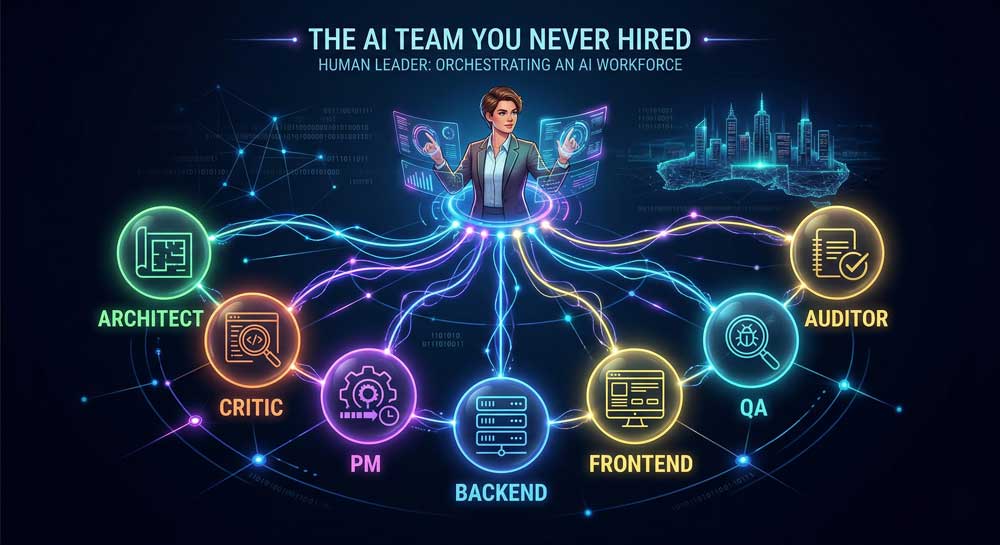
The solution is a Multi-Agent System — assign each AI instance one focused domain, exactly as you would with human specialists:
| Agent | Role |
|---|---|
| Agent A: Architect | Refines your raw idea into a structured roadmap |
| Agent B: Critic | Audits Agent A’s plan for gaps and vulnerabilities |
| Agent C: Project Manager | Oversees execution, reports to you |
| Agent D: Backend Dev | Builds database and server logic |
| Agent E: Frontend Dev | Builds UI and user-facing features |
| Agent F: QA Tester | Tests functionality and finds bugs |
| Agent G: Code Auditor | Reviews security and code quality |
The same logic applies outside of tech. Running five market research angles? Deploy five agents, each analysing one angle independently, with a master agent synthesising the results. The productivity gains are not additive — they are multiplicative.
Rule of thumb: One AI window = one focused task. Let each agent enter its flow state. Dumping an entire project into one prompt hoping for magic produces, reliably, garbage.
Which Humans Will Thrive? Two Profiles That Win
If AI handles 80% of cognitive work, what remains? This is the defining career question of our generation. Two profiles consistently emerge as winners:
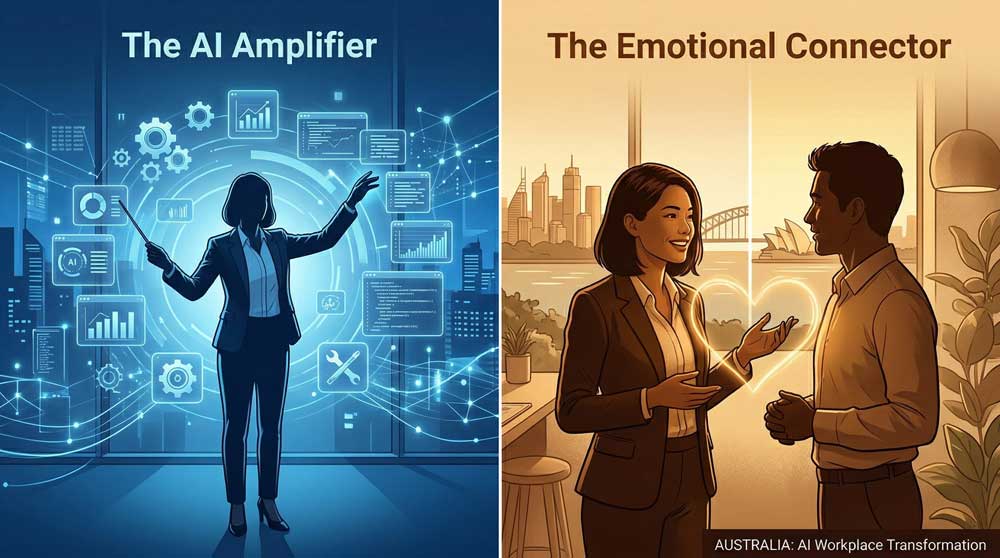
1. The AI Amplifier
These are professionals who relentlessly track AI advances and immediately integrate new tools into their daily workflows. They don’t compete with AI — they <a href=”/ai-agent-management”>orchestrate AI agents</a> the way a conductor leads an orchestra. Goldman Sachs research confirms that while AI may displace millions of roles, new higher-order positions centred on AI oversight and strategic direction will grow in parallel. Amplifiers are the ones companies will compete hardest to retain.
2. The Emotional Connector
As raw computational intelligence becomes cheap and abundant, genuinely human qualities — empathy, authentic trust, nuanced leadership, real emotional resonance — become premium, not obsolete. Coaches, therapists, skilled salespeople, community builders, and visionary leaders operate in a domain AI cannot credibly replicate. The 33% of companies that rushed to replace workers entirely with AI are now discovering they’ve lost institutional knowledge and relational capital they cannot recover.
The brutal truth: Sitting still is the highest-risk strategy available to you right now.
Practical Steps to Stay Ahead of the AI Workplace Transformation
You do not need to become an AI engineer. You need to become AI-literate — the same way a prior generation learned email and the web.
- Pick one tool and use it daily — Claude, ChatGPT, or Gemini. Apply it to real work tasks, not just experiments
- Write clear briefs — specificity is the skill that separates good outputs from garbage
- Explore agentic tools — Claude Code, Cursor, or AutoGen for multi-step workflows
- Audit your own job honestly — list your weekly tasks and assess which AI could do today vs. which require your uniquely human judgment
- Double down on human strengths — relationship-building, ethical reasoning, creative vision, and leadership remain your true career moat
Authoritative Sources & Further Reading
- ABC News Australia — AI is changing jobs fast and Australians are beginning to wonder
- Forbes Australia — AI could replace half of all white-collar jobs within 5 years
- TechRepublic — AI Job Cuts Signal White-Collar Reset in Australia
- ABC News — Australia in a dangerous place as AI adoption ramps up
- Goldman Sachs — How Will AI Affect the Global Workforce?
- Reworked.co — Silent Struggles: How AI Is Fueling a Hidden Workforce Crisis
- The Guardian Australia — Will AI take Australian jobs, or is it just an excuse for corporate restructure?
- GoCodeo — Claude AI by Anthropic: What Developers Need to Know in 2025
- Generative AI in Africa: 2025 Adoption Surge, Chinese Platforms Rise, and CEO Investment Battle
- Nvidia H200 Chips China Sales Hit Zero: 7 Shocking Reasons Trump’s Strategy Backfired
- Chinese AI Models: 7 Powerful Ways They’re Dominating the Global Developer Market in 2026