AI Distillation: 7 Shocking Truths About Extracting Human Skills in 2026
“Any sufficiently advanced technology is indistinguishable from magic.” — Arthur C. Clarke
AI distillation is rapidly becoming one of the most transformative — and philosophically disturbing — forces reshaping the modern workplace. What began as an engineering trick for compressing neural networks has evolved into something far stranger: a framework for extracting, packaging, and redeploying human expertise without the human attached.
If that sentence made you shift in your seat, good. That’s the correct reaction. Here’s why — traced from a 9th-century alchemist’s furnace all the way to a GitHub repository that detonated across Chinese tech offices in spring 2026.
Table of Contents
Truth #1: AI Distillation Has Already Left the Lab
In spring 2026, a GitHub project called colleague.skill went viral in Chinese tech circles. The premise is brutal in its simplicity: feed an AI model a coworker’s messages, code commits, emails, and documents — and generate a structured .skill file capable of substituting for that person operationally.
Today you can find distilled cognitive profiles modeled on Steve Jobs, Elon Musk, Charlie Munger, and Richard Feynman. Developers describe these not as quote collections, but as “cognitive operating systems” — structured reasoning frameworks built from books, interviews, and documented decisions.
You ask the agent a complex question; it responds using the original person’s probing, deductive methodology. The person may be unavailable. The skill file continues answering indefinitely.
This is no longer science fiction. It is a packaged, community-supported workflow with tutorials, open-source tooling, and a growing counter-movement of “worker protection protocols” specifying what employers may and may not extract from employees.
Truth #2: It Started With Geoffrey Hinton and “Dark Knowledge”
To understand why AI distillation carries such strange weight, you need its origin story.
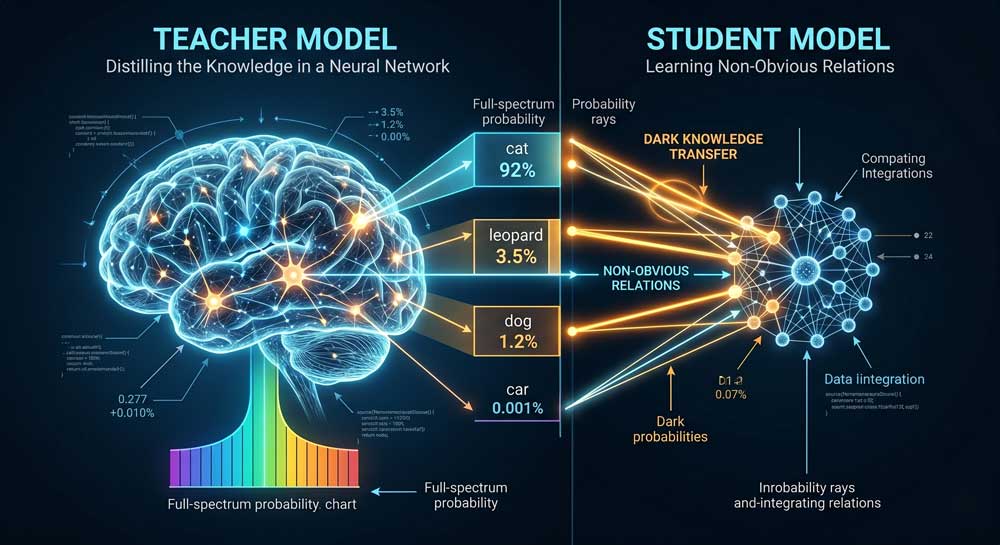
In 2015, Geoffrey Hinton — widely regarded as the “Godfather of AI” — and colleagues at Google published Distilling the Knowledge in a Neural Network. The engineering problem was straightforward: large language models were too expensive to deploy on mobile devices or real-time services. The solution was to train a smaller “student” model — but not from raw data. Instead, the student would learn by studying how the large “teacher” model thinks.
The breakthrough insight was this: when a large model classifies an image, it doesn’t just say “cat.” It outputs a full probability distribution:
- Cat: 92%
- Leopard: 3.5%
- Dog: 1.2%
- Car: 0.001%
Hinton argued that those wrong-answer probabilities contain more real knowledge than the correct answer alone. The fact that the model perceives a 3.5% similarity between cat and leopard — but only a 0.001% similarity between cat and car — reveals deep understanding of visual kinship. He called this hidden signal dark knowledge: information encoded not in answers, but in the spaces between answers.
Above: The teacher-student architecture at the heart of AI distillation — the student model learns not just answers, but the teacher’s entire probability worldview.
The mechanism for extracting it: a mathematical parameter called temperature. Raise it, and the large model’s internal hesitations become visible. Lower it, and only the confident answer shows. The entire art of distillation is controlling that temperature — knowing precisely how much heat to apply.
Teacher vs. Student: What Distillation Transfers
| Feature | Teacher Model (Large) | Student Model (Distilled) |
|---|---|---|
| Size & Cost | Massive, expensive to run | Lightweight, cost-effective |
| Learning Source | Raw world data | Teacher’s probability distributions |
| Output Style | Deep, nuanced patterns | Mimics teacher’s cognitive pathways |
| Best Use Case | Research & complex reasoning | Real-time deployment, mobile apps |
| Knowledge Type | Full probability landscape | Compressed, targeted approximation |
Truth #3: Distillation Now Captures How Models Think, Not Just What They Conclude
The decade since Hinton’s paper has seen the target of distillation undergo a qualitative transformation.
The DeepSeek-R1 breakthrough is where the philosophical ground shifts. Researchers fed the large model thousands of math and coding problems, then recorded its entire reasoning trajectory — every step, every pause, every moment of self-correction and revision — and used those traces to train the smaller model.
The result: a 32B distilled model outperforming OpenAI’s o1-mini on multiple benchmarks. More unsettling: models trained on AI-generated reasoning chains performed better than those trained on human-expert reasoning chains.
When AI distillation moves from “what is the answer” to “how do I doubt myself, adjust my logic, and find the truth,” the boundary between software engineering and human cognitive extraction begins to dissolve.
Truth #4: The Word “Distillation” Carries 1,000 Years of Alchemical Baggage
Here is the part that explains why the word triggers something deeper than professional anxiety.
In 2006, a comparable technique was called “Model Compression” — a clean, sterile engineering term. Large model becomes small model. Information packed. No heat, no residue, no hierarchy of purity. If that word had survived, we would today be discussing “compressing colleagues into skill files.” The discomfort would be different in character.
Hinton chose “distillation” — and with it imported a millennium of metaphorical infrastructure.
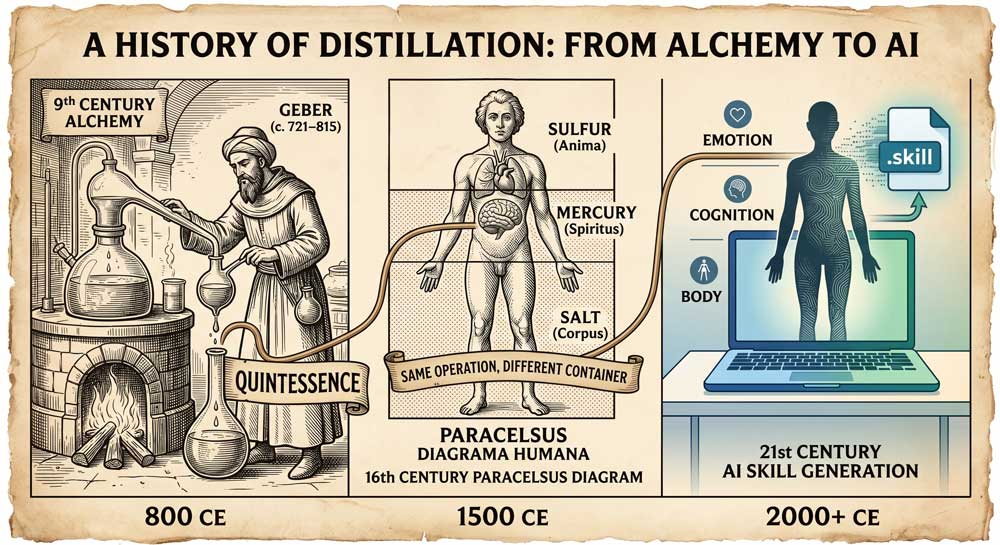
In the 9th century, Arab scholar Jabir ibn Hayyan (latinized as Geber) was among the first humans to systematically practice distillation. He believed the process could isolate the quintessence — the fifth element, purer than earth, water, fire, or air — from ordinary matter. Later alchemists argued you needed repeated distillation, “through continuous ascent and descent,” before the true essence would emerge.
By the 16th century, Swiss physician-alchemist Paracelsus had extended this framework directly to human beings. His argument: people are a mixture of three principles:
- Salt — the physical body, fixed and material
- Mercury — the spirit: imagination, judgment, all higher cognitive function
- Sulfur — the soul: emotion, desire, the animating drive
Since people are mixtures, Paracelsus concluded, they can be separated. Digestion is distillation. Breathing is distillation. Every moment of life, the body performs alchemy on itself.
When companies extract an employee’s decision frameworks into a skill file, they are extracting the Mercury — the cognitive and judgmental functions — while discarding the Sulfur and Salt as operational noise. The 16th-century framework and the 2026 HR strategy are running the same operation. Only the container has changed.
The 7 Alchemical Stages vs. AI Development
In alchemical tradition, the Great Work proceeds through seven stages. AI distillation sits at stage six — the penultimate step before coagulation (re-embodiment).
| Stage | Alchemical Meaning | AI Parallel |
|---|---|---|
| Calcination | Burning away impurities | Removing irrelevant training data |
| Dissolution | Breaking down fixed structure | Tokenization and embedding |
| Separation | Isolating components | Feature selection and pruning |
| Conjunction | Recombining essentials | Pretraining |
| Fermentation | New life from decomposition | Fine-tuning and RLHF |
| Distillation | Purifying the volatile essence | Knowledge distillation — Hinton, DeepSeek |
| Coagulation | Re-embodying purified spirit | Deployment into living context — still incomplete |
The seventh step has not been performed on human distillation. We extract the distillate. We deploy the skill file. Nobody re-embodies it into a living form with the tacit context restored. Without coagulation, alchemy yields pure spirit but no vessel. The work is incomplete — and by alchemical logic, potentially destructive.
Truth #5: Newton Was the Last Wizard — and It Changes Everything
In 1936, the Portsmouth family auctioned Newton’s private manuscripts at Sotheby’s. Economist John Maynard Keynes reassembled a significant portion. What he found: Newton had written approximately one million words of alchemical research — not casual notes, but systematic experiments, detailed records, and line-by-line commentary on ancient texts.
At Newton’s 300th birthday commemoration in 1946, Keynes’s posthumously delivered lecture concluded:
“Newton was not the first of the age of reason. He was the last of the magicians, the last of the Babylonians and Sumerians, the last great mind which looked out on the visible and intellectual world with the same eyes as those who began to build our intellectual inheritance.”
Newton’s law of gravity — invisible force acting across empty space — was, to his contemporaries, precisely the kind of “occult quality” that rational mechanics was supposed to have eliminated. Newton himself sought in alchemy a theory for how matter could act on matter without contact. He never found it. But that obsession shaped how he asked questions — and the shape of your questions determines the shape of your answers.
Chemistry performed a deliberate erasure of this lineage. In 1675, French pharmacist Lemery published a textbook explicitly labeling alchemists “charlatans and impostors.” Scholar Bruce Moran’s Distilling Knowledge documents how chemistry manufactured a “non-retrievable history,” repackaging “practical alchemical wisdom” as “chemical facts.”
The word spirits still carries the scar. In English, French (esprit), and German (Geist), the same word means both distilled liquor and soul. Alchemists called the vapor rising during distillation the material’s spirit — invisible, ascending, liberated from physical form. The etymology is still in every whisky bottle.
Truth #6: What Gets Lost in the Vapor
When AI distillation is applied to human beings, something profound is always left behind in the crucible — and it’s not noise. It’s signal that resists encoding.
Think of a seasoned manager making a difficult call. The final skill file records the steps they took. It does not record:
- The genuine hesitation before delivering harsh feedback
- The moment they broke their own rules because they sensed someone was struggling personally
- The three minutes spent staring out a window, questioning whether the project had any real purpose
- The intuition that contradicted the data — and turned out to be right
These elements are classified as impurities by the distillation algorithm. In reality, they are what makes human expertise generative rather than merely reproducible.
What Skill Distillation Captures vs. Loses
| Extracted (The Distillate) | Discarded (The Residue) |
|---|---|
| Standard decision frameworks | Intuitions that contradict the rules |
| Communication style and vocabulary | Empathy deployed contextually |
| Historical decision patterns | The ethical questioning behind each choice |
| Code style and workflow | The value of intentional delay |
| Explicit best practices | The failure that restructured everything |
Model distillation transfers a continuous probability distribution — every shade of uncertainty, quantified to high precision. Human skill distillation transfers discrete rule descriptions — “in situation X, follow steps 1-3.” The compression loss is enormous. And unlike model distillation, where you can measure the degradation, the human loss is invisible by design.
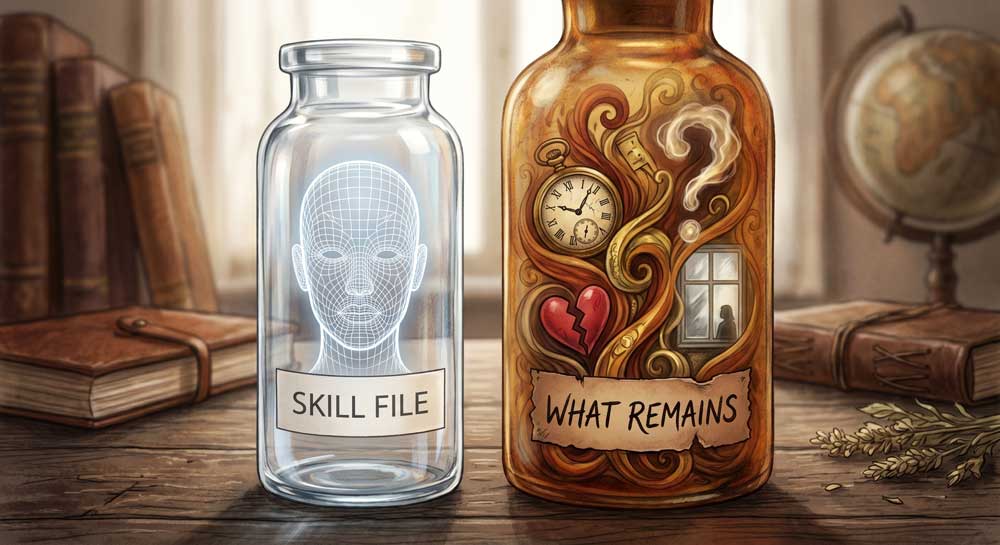
Truth #7: The Art Is Controlled Imperfection — We Are All Distillers
A master whisky distiller knows a trade secret: 100% pure alcohol is flavorless and sterile. The character, the aroma, the entire value of a fine whisky comes from the impurities — the trace esters, aldehydes, and copper ions that survive incomplete distillation. Perfect purity produces industrial ethanol. The art of distillation is not achieving absolute purity; it is controlling the degree of imperfection.
The same principle applies to knowledge.
Every article written, every lesson taught, every resume drafted is an act of self-distillation. We take chaotic, multidimensional lived experience and boil it into flat, consumable words. The thoughts that don’t fit the argument evaporate. The narrative that emerges is cleaner — and smaller — than the experience that generated it.
This is not a new pathology introduced by AI. It is the fundamental condition of communication. Writing is distillation. Teaching is distillation. Memory itself is distillation — you extract a narrative from a mass of sensation, and that narrative then replaces the original sensation. You can never go back to the raw experience.
What AI distillation changes is not the nature of the operation but its scale, speed, and extractive direction. Previously, you distilled yourself willingly, for communicative purposes. Now the process can be run on you by others, for operational purposes, without your participation or consent.
Martin Heidegger, writing about industrial technology in the 1950s, called this Gestell (enframing): technology’s tendency to reduce all beings — rivers, forests, humans — to Bestand (standing-reserve): calculable, callable, deployable resources. Replace “standing-reserve” with “skill file.” Replace “enframing” with “distillation framework.” The sentences require almost no editing.
The question distillation now forces on every professional is the one Paracelsus raised in 1530: Is a person a mixture? If so, which parts can be separated — and who bears the cost of what remains in the crucible?
The Path Forward: Becoming Conscious Distillers
The answer is not to resist distillation — that project has already failed. The answer is to develop what the best alchemists and the best whisky makers always possessed: craft.
Craft means knowing:
- What should be extracted, and what must remain untranslatable
- That the distillate is not the source — the map is not the territory, the skill file is not the person
- That “impurities” are not defects to be eliminated, but often the source of everything that matters
- That every act of compression destroys something, and the question is always whether what’s destroyed was expendable
Alchemical tradition held that the Great Work had seven stages, and distillation was only the sixth. The seventh — coagulation, the return of purified essence to embodied, living form — was considered the most difficult and the most sacred. Without it, all prior work was incomplete.
In 2026, we have mastered the sixth stage at industrial scale. The seventh stage — re-embodying distilled knowledge into contexts that restore its living complexity — remains almost entirely undeveloped.
That is the actual problem. Not that distillation is happening. But that we have built comprehensive infrastructure for extraction and almost none for re-embodiment.
The fifth element is still missing.
Further Reading — Authoritative Deep Links
- Hinton, Vinyals & Dean (2015). Distilling the Knowledge in a Neural Network. → https://arxiv.org/abs/1503.02531
- Sanh et al. (2019). DistilBERT, a distilled version of BERT: smaller, faster, cheaper and lighter. → https://arxiv.org/abs/1910.01108
- DeepSeek-R1 Technical Paper (2025). Incentivizing Reasoning Capability in LLMs via Reinforcement Learning. arXiv. → https://arxiv.org/html/2501.12948v1
- IBM Think (2024). Why is Knowledge Distillation Important? → https://www.ibm.com/think/topics/knowledge-distillation
- Intel Labs Neural Network Distiller. Knowledge Distillation — Dark Knowledge & Temperature Explained → https://intellabs.github.io/distiller/knowledge_distillation.html
- OfficeChai (2026). China’s Workers Are Weaponizing AI Against Each Other Through Colleague Skill Files → https://officechai.com/ai/chinas-workers-are-weaponizing-ai-against-each-other-through-colleague-skill-files-and-fighting-back/
- Nature (2025). DeepSeek-R1 incentivizes reasoning in LLMs through reinforcement learning → https://www.nature.com/articles/s41586-025-09422-z
- Stanford Encyclopedia of Philosophy. Isaac Newton — Alchemy → https://plato.stanford.edu/entries/newton/#Alch
- ElevenLab → https://elevenlab.net/google-vs-openai-ecosystem-strategy/
- ElevenLab → https://elevenlab.net/us-china-ai-energy-crisis/