Nvidia’s $40 Billion Bet: Is AI’s Biggest Chip Maker Inflating Its Own Bubble?
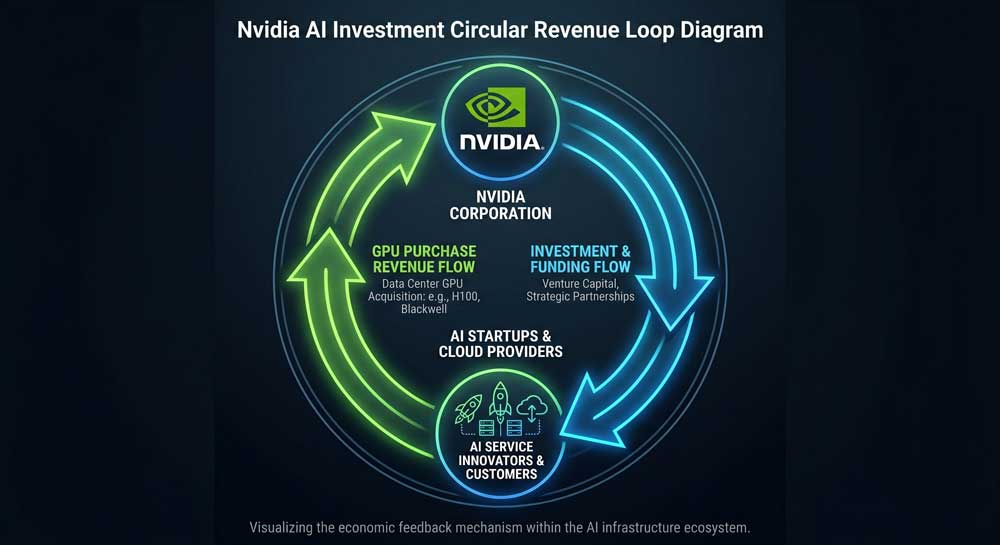
Nvidia is doing something that deserves close attention. It is taking its enormous cash reserves, investing them in companies that buy its GPUs, and then watching those companies use the money to purchase even more GPUs. One hand pours water to create the foam; the other adds the soap.
In just five months into 2026, Nvidia has committed more than $40 billion across investments spanning fibre manufacturing, data centre operations, and foundation model development. Its identity is shifting — from chip supplier to the most consequential capital allocator in the entire AI industry.
Some of that money is building real things. Some of it is making existing things look more valuable. Nvidia is doing both simultaneously, and that distinction matters enormously for investors trying to separate genuine AI infrastructure growth from financial engineering.
Table of Contents
Nvidia AI Investment Blitz: A Full-Stack Strategy Across the Entire Supply Chain
The pace of Nvidia’s dealmaking in 2026 has been striking. Every few weeks, the company rotates its focus and drops another multi-billion dollar commitment into a different segment of the AI supply chain. Synopsys received funding in December, CoreWeave in January, Lumentum and Coherent on the same day, Nebius in March, and Marvell shortly after.
The rhythm feels less like a portfolio strategy and more like a procurement department’s vendor list.
The scale escalated further in recent weeks. Nvidia struck a deal with Corning — a 175-year-old glass manufacturer — committing up to $3.2 billion to build three new optical technology factories on American soil. The agreement targets a tenfold increase in AI-facing optical connectivity capacity and a greater than 50% expansion in fibre production.
The very next day, Nvidia extended up to $2.1 billion in warrants to data centre operator IREN to jointly deploy 5 gigawatts of AI infrastructure.
Add in the $30 billion investment in OpenAI — Nvidia’s single largest bet — along with commitments to Anthropic and xAI, and the picture becomes clear. Nvidia has completed at least seven listed-company investments and participated in roughly 24 private funding rounds this year alone, forming a contiguous investment matrix covering chips, optical communications, data centres, and large language models.
Jensen Huang’s explanation sounds almost humble: there are too many excellent foundation model companies, he says, so rather than picking winners, Nvidia wants to support everyone. But reading the financials tells a different story. Almost every company in this portfolio is a significant buyer of Nvidia hardware. The investment activity directly stimulates demand for GPUs, optical modules, and data centre infrastructure — which then gets rented out to hyperscalers like Microsoft, Meta, and OpenAI. A self-reinforcing demand loop is taking shape.
The Circular Revenue Problem
This is where the legitimate criticism begins.
Goldman Sachs analysts have used the phrase “circular revenue” to describe what is happening with Nvidia’s OpenAI investment. A supplier is providing equity capital to its own customer, so that the customer can return that capital in the form of hardware purchases. It resembles a food supplier financing a struggling restaurant on the condition that the restaurant keeps buying its ingredients.
In fiscal 2026, Nvidia is expected to recognise approximately $13 billion in revenue from OpenAI alone. A significant portion of the gross profit from that relationship flows back into Nvidia’s investment in OpenAI. Some observers have noted that a portion of the money in AI’s apparent boom is essentially circling the same drain.
| Investment | Committed Amount | Primary Strategic Rationale |
|---|---|---|
| OpenAI | ~$30 billion | Foundation model demand; GPU sales anchor |
| Corning | Up to $3.2 billion | Optical fibre and connectivity supply chain |
| IREN | Up to $2.1 billion | Data centre deployment; 5GW AI infrastructure |
| CoreWeave | Undisclosed | Cloud GPU rental demand |
| Nebius | ~$700 million | European AI cloud expansion |
| Marvell | Undisclosed | Custom silicon and networking components |
Critics draw a direct parallel to vendor financing during the dot-com bubble — equipment manufacturers extended credit to customers so those customers could buy equipment, making demand appear robust until the cycle broke. Once sentiment shifted, artificial demand collapsed within a few quarters. The question hanging over Nvidia is whether a similar dynamic is quietly embedded in today’s AI capital expenditure figures.
Huang pushed back firmly. In a Bloomberg interview, he called the circular financing narrative “absurd,” arguing that Nvidia’s contributions represent a small fraction of what these companies require, and that the investments reflect genuine confidence in generational businesses rather than financial engineering.
The most eye-catching paper gain on Nvidia’s books, however, comes from Intel. In late 2025, Nvidia acquired approximately 215 million new Intel shares for $5 billion. Intel’s stock subsequently surged nearly sixfold over the following eight months, putting Nvidia’s unrealised gain in the vicinity of $25 billion.
Supply Chain Fortress or Financial Engineering?
Analysts are divided, and the division is instructive.
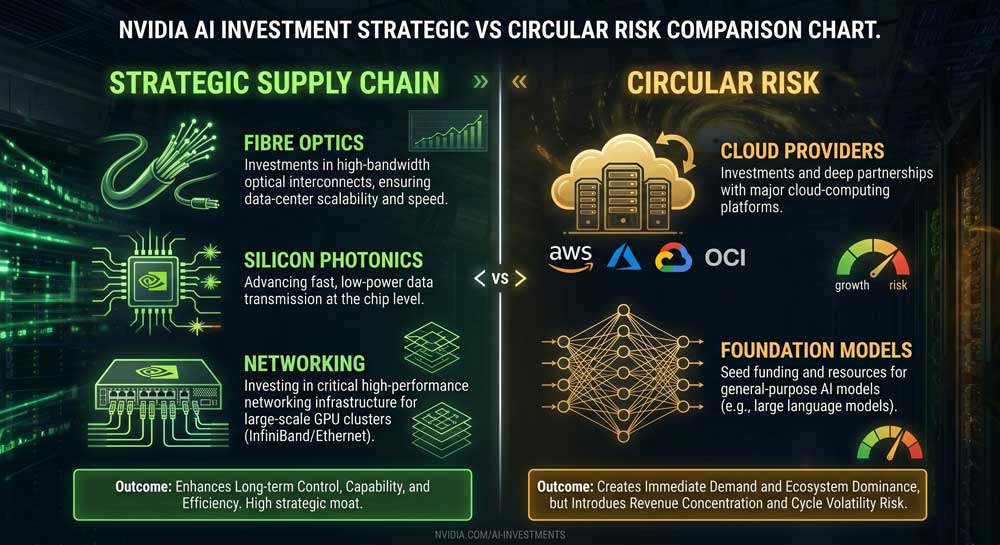
Wedbush Securities has noted that Nvidia’s dense deal-making “fits squarely within a circular investment framework,” while simultaneously acknowledging that if executed well, these investments are building a supply chain moat that competitors cannot easily replicate. Being the capital behind the fibre, the silicon photonics, the data centre buildout, and the models themselves creates a structural advantage that goes well beyond selling chips.
Mizuho’s chip analysts offer a useful distinction. Money directed at optical communications, fibre manufacturing, and silicon photonics components represents, in their view, highly intelligent capital deployment — accelerating the development of scarce technologies that Nvidia’s own supply chain depends on. That is legitimate strategic investment.
| Investment Type | Analyst Sentiment | Strategic Logic |
|---|---|---|
| Optical/fibre infrastructure (Corning, Lumentum, Coherent) | Broadly positive | Resolves genuine supply bottlenecks |
| Custom silicon and networking (Marvell, Synopsys) | Positive | Strengthens chip design ecosystem |
| New cloud providers (CoreWeave, Nebius, IREN) | Cautious to sceptical | Risk of pre-financing GPU demand |
| Foundation model companies (OpenAI, Anthropic, xAI) | Mixed | Revenue circularity concerns are real |
However, the same analysts are more candid about investments in emerging cloud providers like CoreWeave and Nebius. The concern is straightforward: this begins to look like paying in advance for your own product’s demand. The moral hazard is real, and if the AI investment cycle softens, that pre-financed demand could evaporate with it.
What the Numbers Actually Say
Any honest assessment of this situation has to start with Nvidia’s financial performance, because the numbers remain extraordinary.
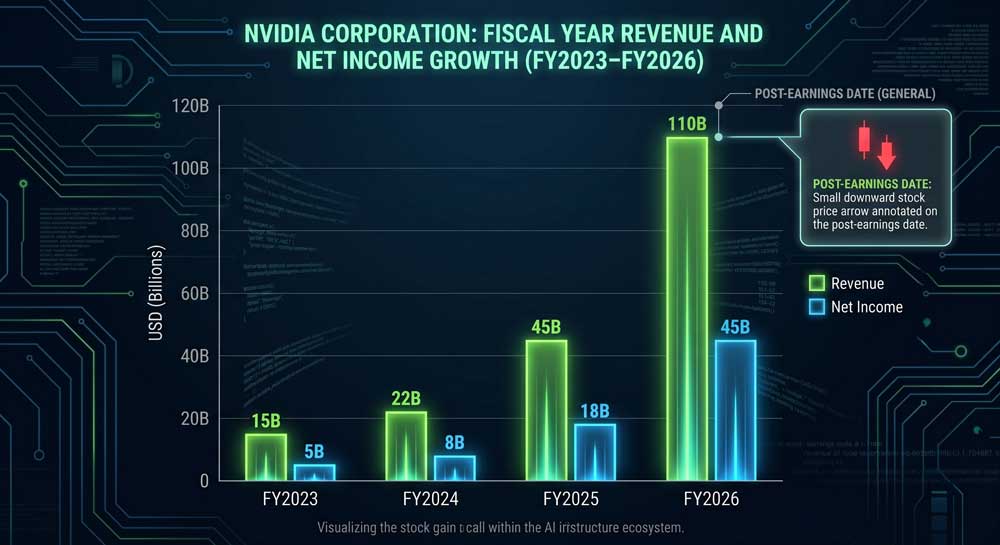
In Q4 of fiscal 2026, Nvidia reported $68.1 billion in revenue — up 73% year over year. Full-year revenue hit $215.9 billion, a 65% increase. Net income for the year came in at $120.07 billion. Free cash flow reached $97 billion. The company returned $41.1 billion to shareholders through buybacks and dividends.
| Metric | FY2026 | YoY Change |
|---|---|---|
| Quarterly Revenue (Q4) | $68.1 billion | +73% |
| Full-Year Revenue | $215.9 billion | +65% |
| Net Income | $120.07 billion | — |
| Free Cash Flow | $97 billion | — |
| Shareholder Returns | $41.1 billion | — |
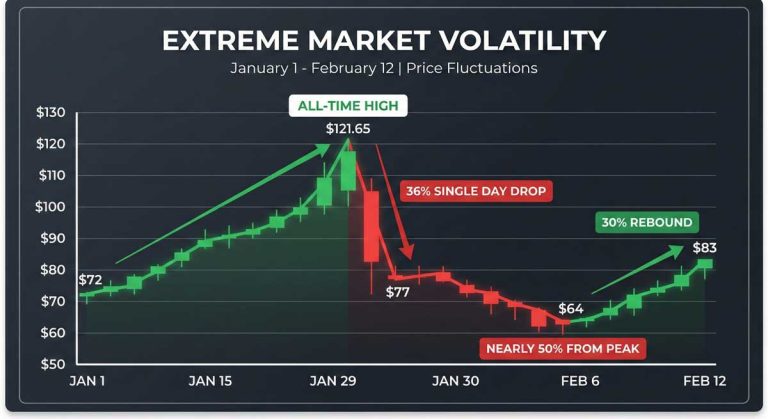
Despite these figures, Nvidia’s stock fell roughly 5.5% on the day following the earnings release — erasing approximately $260 billion in market capitalisation in a single session. The report was not disappointing; it was that “beating expectations” no longer generates marginal surprise when the bar is already set at extraordinary.
Markets are now focused on what comes next: the 2-nanometre Terafab chip facility, optical interconnects, the next-generation Rubin architecture. The problem is that the only certainty available is the next 12 months. Nobody can say with confidence how long the AI capital expenditure cycle can sustain its current trajectory, or whether demand beyond that horizon is organic.
Nvidia is not in financial distress. Its cash position means it can continue acting as the central water tower of the AI era for a long time. But capital is patient; confidence is not. Confidence fractures at the turn of the circular investment loop — when markets start asking how much of the visible demand on the lawn is natural rainfall, and how much is Nvidia quietly running the sprinklers itself.
Nvidia AI Investment Risk: A Bubble Doesn’t Have to Be a Fraud
I want to be precise here, because the word “bubble” gets misused. A bubble does not require dishonesty. It can simply be what happens when every participant simultaneously believes the same thing with equal conviction. The infrastructure being built is real. The chips are real. The models are real. The revenues are real.
But when a supplier must deploy its own balance sheet to sustain its customers’ demand, the market will eventually ask how much of that demand is structural and how much is synthetic. That is not a moral judgement on Nvidia — it is the mechanical question that every investment cycle eventually forces into the open.
The experiment Nvidia is running is genuinely novel, and the outcome is not predetermined. Investors who want to participate in it should do so with clear eyes about what they are actually owning: a company of extraordinary financial strength that is, at least in part, financing the very demand it is reporting.
Reference URLs
- Bloomberg — A Guide to the Circular Deals Underpinning the AI Boom
- Yahoo Finance — Nvidia Says It Isn’t Using Circular Financing Schemes — Short Sellers Disagree
- Reuters — Nvidia to Invest Up to $2.1 Billion in IREN as Part of AI Data Center Deal
- Bloomberg — Nvidia to Invest Up to $2.1 Billion in Data Center Firm IREN
- Forbes — NVIDIA’s Strong Earnings Report Dispels AI Bubble Fears Amid Circular Financing Controversy
- LinkedIn / Tomasz Tunguz — Does Nvidia’s $110B Bet Echo the Telecom Bubble?
- BlockEden — The Great AI Circular Financing Loop: When Vendors Fund Their Own Customers
- LinkedIn / Anna Liu — Nvidia Bets $500M on Corning in Push to Boost Optical Capacity
- ElevenLab — DeepSeek V4: 5 Explosive Reasons This $10B Fundraise Will Break Nvidia’s Grip
- ElevenLab — Nvidia H200 Chips China Sales Hit Zero: 7 Shocking Reasons Trump’s Strategy Backfired
- ElevenLab — Chinese AI Models: 7 Powerful Ways They’re Dominating the Global Developer Market in 2026