Strait of Hormuz Shipping Crisis: 7 Brutal Truths Reshaping Global Trade
The Strait of Hormuz shipping crisis did not begin when the first missile struck a cargo ship. It began the moment insurers stopped writing policies — and that distinction changes everything about how we should understand what happened.
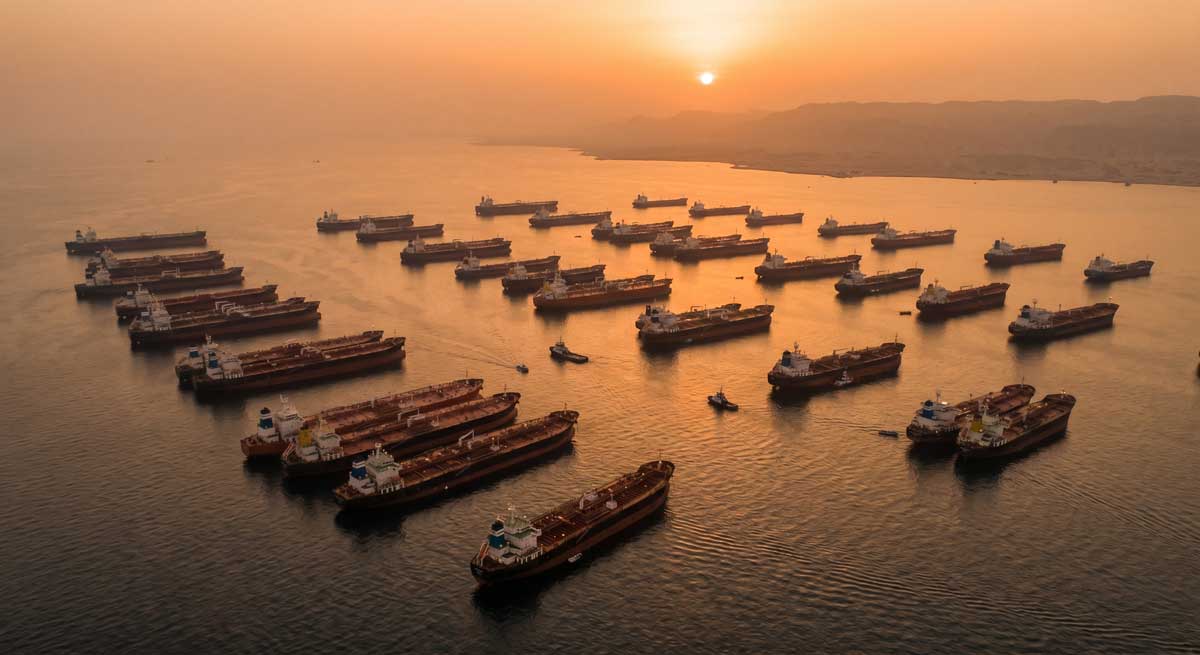
In mid-April 2026, the Persian Gulf had become a floating parking lot. More than 3,200 commercial vessels sat at anchor across the strait and surrounding waters, their engines idle, their crews trapped. A waterway that once handled roughly one-fifth of the world’s oil trade and a quarter of global liquefied natural gas shipments had, within 50 days of the conflict’s outbreak, effectively ceased to function as a commercial corridor.
Table of Contents
The Chokepoint the World Cannot Afford to Lose
The Strait of Hormuz is only 21 nautical miles wide at its narrowest point, yet it carries an outsized share of the world’s energy supply — including approximately 90% of the crude oil destined for Asian markets. Before the conflict, roughly 130 commercial vessels transited it daily. That figure collapsed almost overnight.
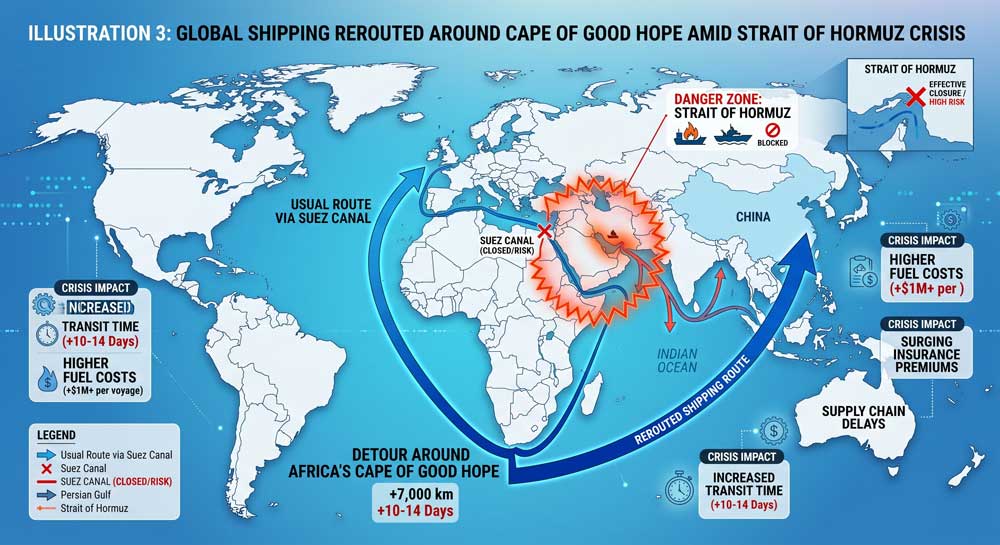
What makes this chokepoint so critical is precisely what makes its disruption so catastrophic: there is no viable short-term substitute. The alternative routes — overland pipelines and alternate sea lanes — carry a fraction of the required volume, and rerouting around Africa’s Cape of Good Hope adds approximately 11,000 nautical miles and up to two weeks of transit time per voyage. Every day the strait remained inaccessible compounded costs across the entire global trading system.
20,000 Seafarers Trapped in a Steel Cage
I think the human cost of this crisis has been drastically underreported. By mid-April 2026, according to international maritime monitoring bodies, more than 20,000 crew members were stranded across vessels anchored in and around the Persian Gulf. Many had been aboard for six weeks or longer, with limited fresh water and dwindling food supplies — conditions that large ocean-going ships are simply not designed to sustain while stationary at anchor for extended periods.
The attacks were real and relentless. On March 11, two projectiles struck the engine room of the bulk carrier Mayuree Naree, owned by Thailand’s Precious Shipping. Of the 23 crew aboard, 20 were evacuated to the Omani coast; three remained unaccounted for. Within hours of the same incident, two additional vessels — a Japanese-flagged container ship and a Marshall Islands-flagged bulk carrier — were struck in waters off the UAE. At least 18 such attacks on commercial vessels occurred within a single month.
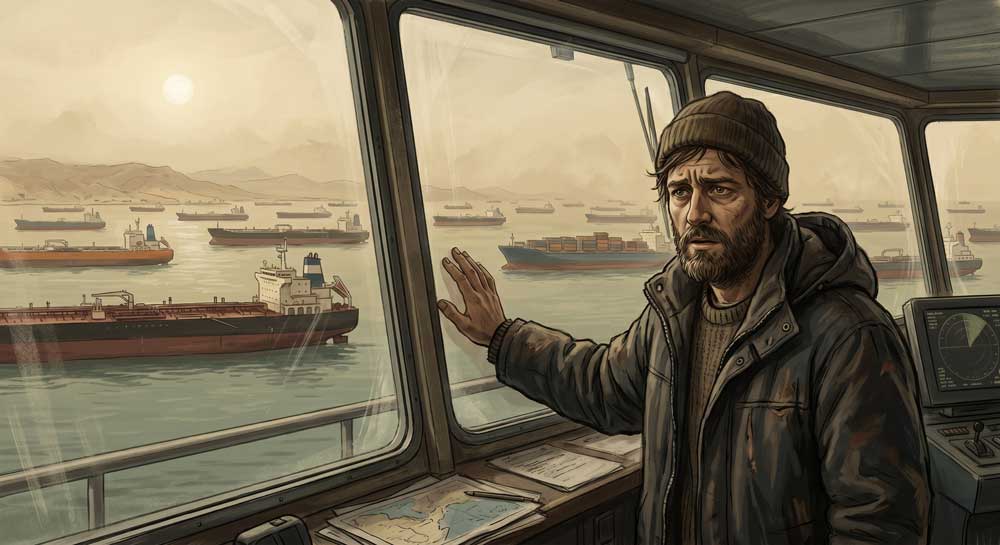
The psychological toll was equally severe. One tanker captain, speaking to an international seafarer welfare hotline, described what it felt like to sit anchored amid a cluster of supertankers each carrying tens of thousands of tonnes of flammable crude oil, knowing that a Kuwaiti tanker had just been hit just a few miles away. Filipino seafarers — who make up a disproportionate share of the global maritime workforce — were among the worst affected, with close to 5,000 nationals stranded in the conflict zone. At hearings before the Philippine Senate, labour organisations made clear that these workers had essentially become involuntary hostages to both their commercial contracts and the military standoff.
| Nationality | Estimated Seafarers Stranded | Key Concern Raised |
|---|---|---|
| Filipino | ~5,000 | Repatriation, not hazard pay |
| Indian | ~3,000 | Food and water shortages |
| Other nationalities | ~12,000+ | Physical safety, insurance cover |
The shift in sentiment among stranded crews was telling. Early calls to welfare hotlines focused on whether hazard bonuses would be paid. By late April, those same callers had only one request: to be sent home alive.
How War-Risk Insurance Became the Real Blockade
I find it remarkable — and deeply unsettling — that the most effective weapon deployed in this conflict was not a missile. It was a percentage figure on an insurance policy.
In peacetime, commercial shipping relies on two standard policy types: Protection and Indemnity (P&I) cover for crew liability and pollution, and Hull & Machinery insurance for physical vessel damage. Both routinely exclude war zones through standard “war exclusion clauses.” Once the Lloyd’s Joint War Committee (JWC) designated the Persian Gulf and surrounding waters as a high-risk conflict area, any vessel seeking to transit required a separate war-risk addendum valid for just seven days at a time.
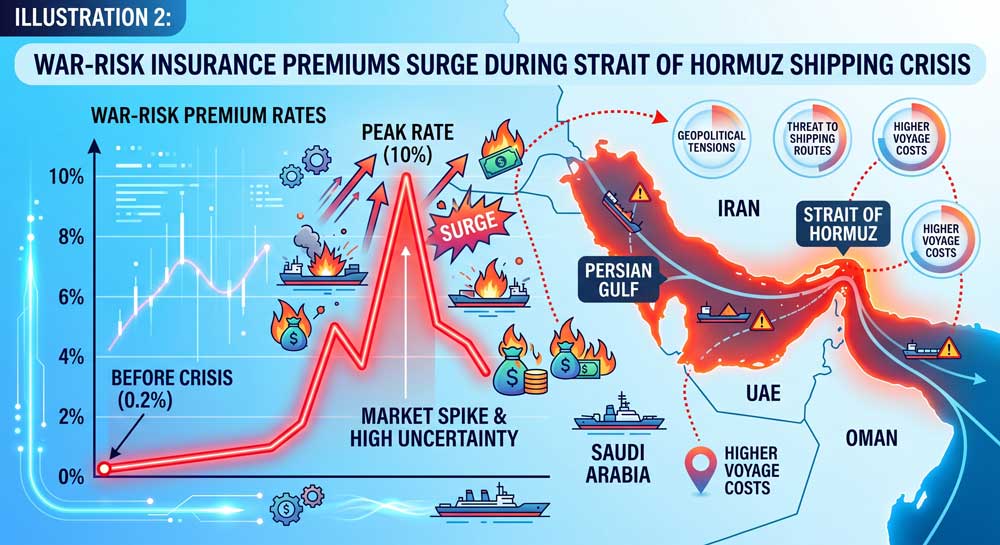
Before the conflict, a single-transit war-risk premium through the Strait of Hormuz sat between 0.15% and 0.25% of vessel value. That figure became almost unrecognisable within weeks of the first attacks.
| Vessel Category | Pre-Conflict Premium | Crisis-Period Premium |
|---|---|---|
| Standard general cargo | 0.15%–0.25% | ~1.0%–1.5% |
| Non-aligned flagged tanker | 0.15%–0.25% | ~1.5%–3.0% |
| US/UK/Israel-linked vessel | 0.15%–0.25% | 7.5%–10.0% |
To understand what those numbers mean in practice: a five-year-old Very Large Crude Carrier (VLCC) valued at approximately US$138 million, making a single seven-day transit of the Persian Gulf, faced a war-risk premium of US$10–14 million at the 7.5% rate. That single cost item exceeds the operating profit of most voyages, even accounting for the sharply elevated freight rates caused by the supply crunch.
Marine insurance premiums surged between five and twenty-five times their peacetime levels, and several major P&I clubs issued cancellation notices for hull war-risk cover entirely, leaving shipowners with no viable underwriting market. The result was that more than 80% of tankers simply declined to enter the strait — not because of direct military threat, but because the financial arithmetic made it impossible.
This is the critical insight: the “financial blockade” proved more comprehensive than any physical one could have been, because it required no naval assets to enforce. A handful of actuaries in the City of London, responding rationally to elevated risk data, effectively closed the strait to commercial traffic.
Rerouting the World: Cape of Good Hope and the Land Bridge
The response from container shipping lines was swift and unanimous. CMA CGM was among the first to announce a full suspension of transits through the affected waters. Maersk and Hapag-Lloyd followed within days. For global supply chains, this meant the world’s largest container ships — vessels connecting Asian manufacturers to European and American consumers — were suddenly rerouting around Africa’s southern tip.
The knock-on effects were immediate and compounding. An 11,000-nautical-mile detour adds roughly two weeks to each voyage, which cascades through vessel scheduling, port slot allocations, and inventory planning across the entire supply network. Fuel costs per voyage rose sharply. The major transshipment hub at Jebel Ali in Dubai, normally one of the world’s busiest container ports, saw its throughput collapse as feeder vessels and mainline services were simultaneously diverted.
| Route Comparison | Via Strait of Hormuz | Via Cape of Good Hope |
|---|---|---|
| Asia–Europe distance | ~12,000 nm | ~23,000 nm |
| Additional transit time | Baseline | +12 to +16 days |
| Additional fuel cost (est.) | Baseline | +US$1–1.5M per voyage |
| War-risk premium | High | Negligible |
As the crisis deepened, a secondary solution emerged: the “land bridge.” Cargo destined for or originating from the Gulf was unloaded at ports in Oman or Saudi Arabia’s Red Sea coast, then transported overland by truck convoys across hundreds of kilometres of desert road before being reloaded onto vessels in safer waters. This workaround placed enormous pressure on port infrastructure and road networks that were never designed to absorb this volume, but it kept some supply chains marginally functional during the worst weeks of the crisis.
The Geopolitical Arbitrage: One Ship’s Audacious Run
Not every vessel chose to wait. One of the most revealing episodes of the entire crisis was the passage of the Mombasa B, a Liberian-flagged VLCC, through the strait on April 12 — the same day that US-Iran ceasefire talks in Pakistan collapsed and the US president announced a naval blockade of Iranian ports.
The ship’s willingness to proceed was not reckless gamble. It was the product of precisely calibrated geopolitical positioning. The Mombasa B was managed by Hyundai Merchant Marine of South Korea. Weeks earlier, Korea had declined a US request to join a joint naval patrol, and Iran had formally designated South Korea as a “non-hostile nation” in exchange — granting Korean-managed vessels conditional safe passage rights through the strait upon advance coordination.
The financial logic was compelling. While US-linked vessels faced war-risk premiums of 7.5–10%, Korean-managed vessels could obtain cover at 0.8–1.5%. With Middle East–to–Asia benchmark crude freight rates running at more than US$423,000 per day — and a direct transit saving approximately US$8 million in opportunity costs versus a Cape detour — the voyage was enormously profitable despite the risks.
The Mombasa B made it through. Hours later, the US blockade came into legal effect. This episode illustrates something I believe will define the next era of maritime trade: the ability to navigate geopolitical fault lines is now a core commercial competency, not a diplomatic footnote.
The 7 Structural Shifts This Crisis Has Exposed
This was not merely a regional disruption. It was, in effect, a stress test of the entire post-Cold War global trading architecture — and it revealed multiple structural fault lines:
- Insurance as infrastructure: Global seaborne trade is more dependent on a concentrated Western insurance market than most policymakers had acknowledged. A handful of underwriting decisions in London can halt trade flows worth hundreds of billions of dollars.
- Single chokepoints remain catastrophic vulnerabilities: The Strait of Hormuz carries a share of global energy trade that no reasonable risk manager would have approved had it been designed from scratch.
- Financial blockades outperform physical ones: The lesson from this crisis is that the most effective way to close a sea lane is to make it commercially uninsurable, not to fire missiles at every passing vessel.
- Sovereign insurance capacity is now a national security asset: Countries that lack domestic war-risk underwriting capacity are structurally dependent on foreign financial institutions whose risk appetite may not align with national trade interests.
- Nearshoring and friendshoring will accelerate: Manufacturers who relied on Gulf energy inputs or Asian supply chains routed through the strait will accelerate moves toward closer, more politically aligned supply chains — accepting higher production costs in exchange for lower geopolitical exposure.
- Strategic stockpiling will increase globally: Governments will recalibrate reserve policies for energy, food and critical minerals upward, accepting the carrying cost as a form of strategic insurance.
- A permanent “security premium” is now embedded in global trade costs: This inflation will be structural, not cyclical — and consumers worldwide will ultimately absorb it.
What Comes Next
The geopolitical realignment of global shipping is not a temporary anomaly that will resolve when tensions ease. It is a structural transition, and the Strait of Hormuz crisis has compressed a decade’s worth of supply chain rethinking into 50 days.
For shipping companies, the priority will be diversifying flag registries, vessel ownership structures, and management entities to maximise access to geopolitically neutral insurance markets. For manufacturers and retailers, the calculation has fundamentally shifted: resilience is now a balance sheet item, not just a risk management talking point. And for policymakers, the lesson is stark — any nation whose economic lifelines can be severed by the actuarial decisions of a foreign insurance market needs to build sovereign alternatives before the next crisis, not during it.
Reference URLs
- India Today — How West Asia war is fuelling a shipping crisis through soaring marine insurance premiums
- Reuters — Maritime insurance premiums surge as Iran conflict widens
- Insurance Business Magazine — Conflict is reshaping global shipping routes and increasing marine insurance risks
- S&P Global — Navigating supply chain resilience amid rising geopolitical risk
- Tendify — Friendshoring 2.0: Compliant Nearshoring Strategies for manufacturers in 2026
- Bank of America Institute — Battle of the titans: Reshoring vs. friendshoring
- X2 UK Logistics — Geopolitical Resilience in Supply Chains: Strategies for Flexible Logistics
- ElevenLab — 5 Harsh Realities of the US Oil Price Impact: Why Energy Independence Isn’t Enough
- ElevenLab — Strait of Hormuz Control: 7 Shocking Reasons Iran Lost Its Ultimate Strategic Card
- ElevenLab — 5 Devastating Realities of the Middle East Energy Crisis Destroying Global Markets