Nvidia H200 Chips China Sales Hit Zero: 7 Shocking Reasons Trump’s Strategy Backfired
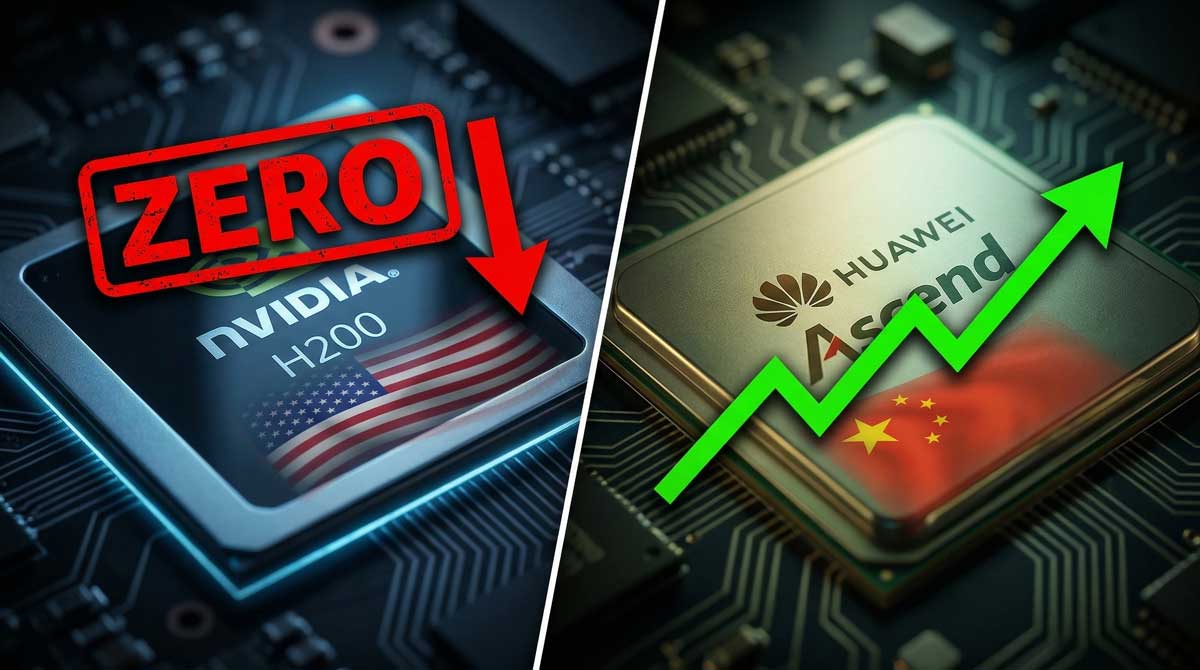
Nvidia H200 chips China sales stand at zero — two months after the Trump administration conditionally lifted export restrictions on one of America’s most powerful AI accelerators. Washington anticipated a billion-dollar demand surge. Instead, it got silence.
On February 24, 2026, David Peters, Assistant Secretary for Export Enforcement at the U.S. Commerce Department, confirmed before the House Foreign Affairs Committee that not a single Nvidia H200 chip had reached a Chinese customer since the policy shift. This is not a paperwork delay. It is a market rejection — and understanding why reveals just how fundamentally the U.S. miscalculated the dynamics of the global AI chip race.
Table of Contents
What Washington Actually Offered
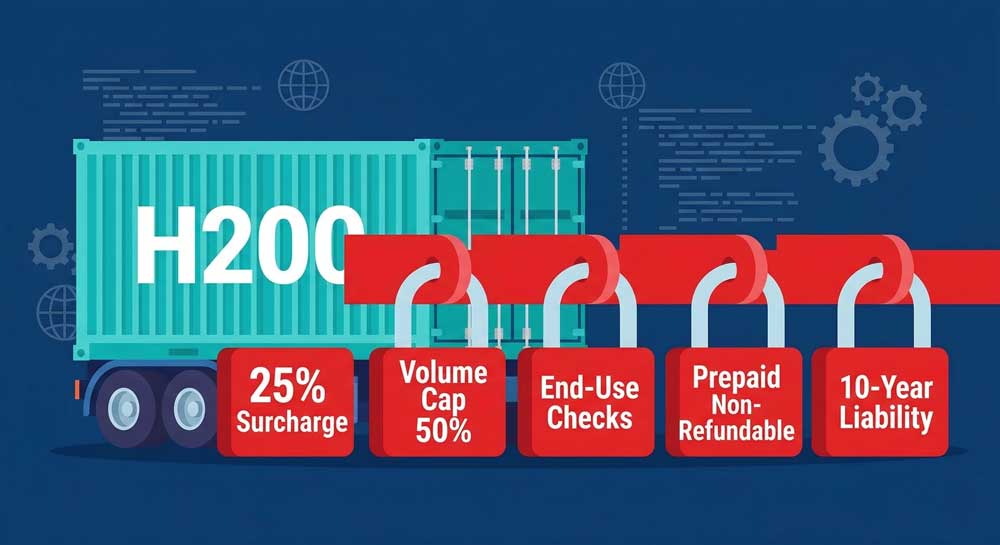
On January 13, 2026, the Bureau of Industry and Security (BIS) shifted its H200 export review from a blanket ban to a “case-by-case” licensing process. On paper, it looked like a significant concession — the H200 delivers roughly 6× the performance of the previously available “China-edition” H20 chip. In practice, the fine print made the deal commercially toxic.
The table below shows exactly what Chinese buyers would have to accept:
| Export Condition | Impact on Chinese Tech Buyers |
|---|---|
| 25% revenue surcharge to the U.S. government | Destroys ROI on AI infrastructure investment |
| Chinese purchases capped at 50% of U.S. customer volumes | Hard structural ceiling on deployment scale |
| Mandatory third-party chip testing in the U.S. | Delays and compliance friction before every shipment |
| Prepaid, non-refundable contract terms (reported) | Buyer bears 100% of financial risk |
| 10-year statute of limitations on smuggling; fines up to 400% of transaction value | Legal liability that chills any procurement decision |
| Chips prohibited for overseas data centers | Limits use cases for global Chinese cloud players |
This was not a market opening. It was a conditional access scheme designed to extract revenue and maintain surveillance over Chinese AI infrastructure.
The H20 Backdoor Scandal: How Trust Died First
To understand why Nvidia H200 chips China buyers are staying away, you have to rewind to the H20 — the neutered, China-specific chip Nvidia created after U.S. export controls blocked the H100.
| Date | Event |
|---|---|
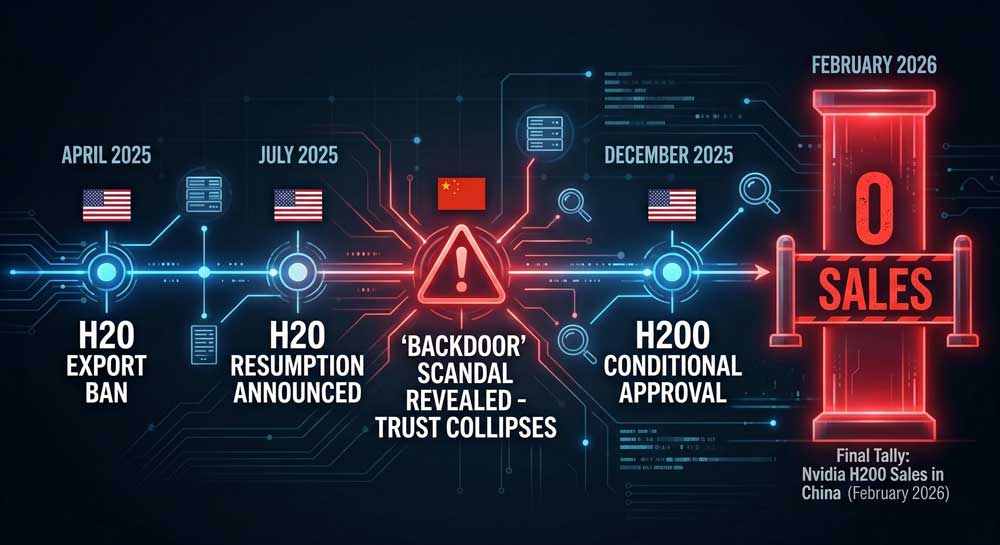
| April 2025 | Trump bans H20 exports to China citing national security |
| July 2025 | H20 exports to China resume |
| July 2025 | U.S. lawmakers push for mandatory “tracking features” in exported chips |
| July 31, 2025 | China’s Cyberspace Administration (CAC) formally summons Nvidia over H20 backdoor vulnerability risks |
| December 2025 | Trump announces conditional H200 export approval |
| January 13, 2026 | BIS formally shifts to case-by-case H200 review |
| February 24, 2026 | Congress hears: H200 China sales = zero units |
The CAC investigation was a watershed moment. China’s regulators demanded Nvidia explain the security risk and submit supporting documentation. For operators building national AI infrastructure — handling sensitive government and commercial data — a chip with credible backdoor allegations is simply not deployable. The H20 scandal didn’t just kill that chip’s market; it poisoned the well for the H200 before it even arrived.
Additionally, Chinese customs officials were reportedly instructed to block H200 chip shipments from entry, while domestic tech companies received government guidance to avoid purchases unless absolutely necessary.
China Didn’t Boycott — It Found Better Options
The most consequential factor isn’t politics or distrust. It’s that Nvidia H200 chips China enterprises need most are now available domestically — at lower cost, with no geopolitical strings attached.
Huawei Ascend: Closing the Gap Fast
Huawei’s Ascend 910C entered mass production in Q1 2025, delivering approximately 800 TFLOPS of FP16 performance and 3.2 TB/s memory bandwidth — roughly 80% of Nvidia’s H100. Alibaba, Baidu, and Tencent are among its first major customers.
The next step up, the Ascend 950PR, began shipping in Q1 2026 with a landmark innovation: Huawei’s own self-developed HBM memory (HiBL 1.0). This matters enormously. Until now, every AI chip maker in the world — including Nvidia — depended on DRAM suppliers like Samsung and SK Hynix for HBM. Huawei is now the only AI chip manufacturer globally with self-developed DRAM. Nvidia won’t ship its own HBM4E until approximately 2028.
Chip-by-Chip Performance Comparison
| Chip | Compute (FP8) | Memory | Bandwidth | Price (Est.) | Supply Risk |
|---|---|---|---|---|---|
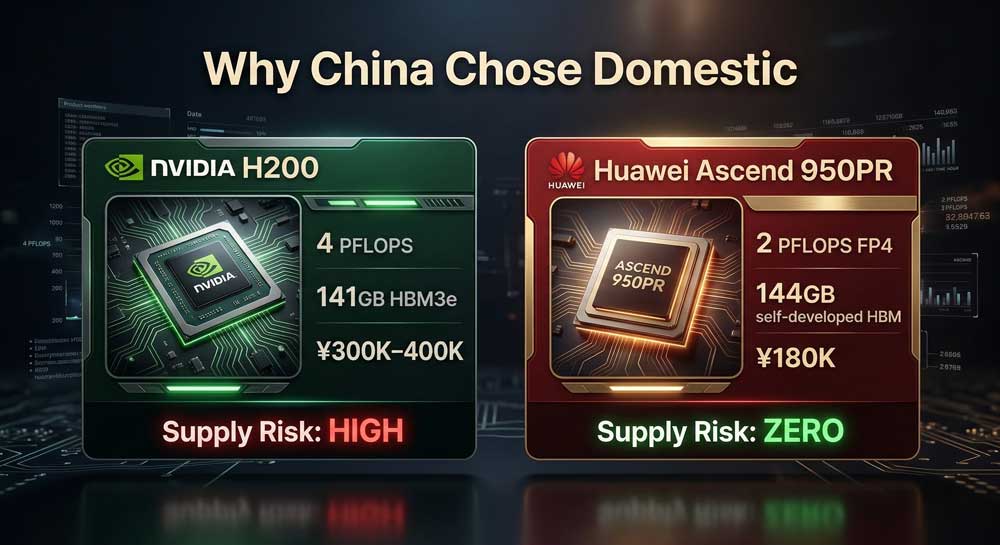
| Nvidia H200 | ~4 PFLOPS | 141 GB HBM3e | 4.8 TB/s | ¥300K–400K (~$41K–55K) | High — subject to U.S. policy |
| Huawei Ascend 910C | ~0.8 PFLOPS (FP16) | 64 GB | 3.2 TB/s | ~¥180K (~$25K) | None |
| Huawei Ascend 950PR | 1 PFLOPS (FP8) / 2 PFLOPS (FP4) | 144 GB HBM HiBL 1.0 | 4 TB/s | TBC | None |
| Huawei Ascend 950DT | 2 PFLOPS+ | 144 GB HBM HiZQ 2.0 | 4 TB/s | TBC | None |
| Huawei Ascend 960 (Q4 2027) | ~2–4 PFLOPS | 288 GB | 8 TB/s | TBC | None |
The 950PR’s gap with the H200 on raw compute is real, but the performance differential is narrowing visibly each generation — and the economic and supply chain advantages of the domestic option are already decisive.
The “Hunger Marketing” Gambit — And Why It Failed
When zero sales became public, the Trump administration’s reported response was to double down with manufactured scarcity. According to Bloomberg, the plan is to cap Nvidia H200 chips China customers can purchase at 75,000 units per buyer, with AMD’s MI325 counting toward the same quota.
The logic appears to be: restrict supply → create urgency → drive demand. But this only works when buyers want what is being rationed.
Consider the math: training a GPT-4-scale large language model requires tens of thousands of high-end GPUs running for months. ByteDance, Alibaba, and Baidu are reportedly seeking 150,000+ units each. A 75,000-unit cap would not just constrain growth — it would make competitive AI development structurally impossible using U.S. chips.
Meanwhile, the domestic upgrade cycle is already underway. Major Chinese cloud providers and regional smart computing centers are actively negotiating to replace their Ascend 910A/B, Nvidia 4090, A100, and A800 clusters with the Ascend 950PR — bypassing the H200 entirely.
7 Core Reasons Nvidia H200 Chips China Demand Collapsed
- Backdoor security scandal — The H20 CAC investigation destroyed institutional trust in U.S. silicon
- Punishing commercial terms — 25% surcharge, volume caps, prepaid contracts, and severe penalties
- Supply sovereignty risk — A chip that can be cut off overnight cannot anchor national AI infrastructure
- Chinese government guidance — Officials reportedly advised domestic firms to avoid purchases unless essential
- Domestic performance parity — Ascend 910C delivers ~80% of H100 performance at 45–55% of the cost
- HBM self-sufficiency — Huawei’s proprietary HBM breaks the last major hardware dependency
- Accelerating upgrade cycle — Enterprises are skipping H200 and ordering 950PR directly
What This Means for Nvidia and the U.S. Strategy
China historically represented at least 20% of Nvidia’s data center revenue. The H20 ban, then reversal, then H200 conditional approval — all within a single year — has created precisely the policy instability that pushes long-term infrastructure planners toward domestic alternatives.
The CFR has described the new H200 export policy as “strategically incoherent and unenforceable”. For Nvidia, the consequences are tangible: deferred high-margin revenue, rising inventory risk, and a shrinking window to re-enter the world’s largest AI compute market before domestic alternatives achieve full parity.
The irony of the hunger marketing approach is that it accelerates the decoupling it was designed to prevent. Every additional restriction signals to Chinese planners that dependence on U.S. chips is a strategic liability — which in turn speeds up investment in the Ascend roadmap, Cambricon, and in-house chip programs at ByteDance, Baidu, and Alibaba.
📚 Authoritative Sources (Deep Links)
- Bloomberg — Nvidia Has Sold Zero H200s to China, Top US Export Enforcer Says
- Bloomberg — US Mulls Capping Nvidia H200 Sales at 75,000 Per Chinese Customer
- Reuters — US approves Nvidia H200 chip exports to China with some conditions
- Reuters — China has not yet received any Nvidia H200 chips
- The Guardian — China blocks Nvidia H200 AI chips that US government cleared for export
- CNBC — Nvidia still hasn’t sold its US-approved China AI chips
- TrendForce — Huawei Unveils Ascend 950 with In-House HBM in 2026
- Tom’s Hardware — Huawei reveals long-range Ascend chip roadmap backed by in-house HBM
- Council on Foreign Relations — The New AI Chip Export Policy to China: Strategically Incoherent and Unenforceable
- IAPS — New BIS Licensing Policy for H200s: Tough Guidelines
- ElevenLab — Chinese AI Models: 7 Powerful Ways They’re Dominating the Global Developer Market in 2026
- ElevenLab — 7 Harsh Realities of AI Job Displacement: Why 4,000+ Tech Layoffs Are Just the Beginning
- ElevenLab — 5 Critical Reasons Why OpenAI’s $750B IPO Could Reshape AI Economics by 2027
- ElevenLab — The $5 Trillion AI Investment Bubble: Can the Boom Outrun Reality?