
AlphaGenome Breakthrough: 5 Ways Google DeepMind’s AI Decodes 98% of DNA “Dark Matter”
AlphaGenome, Google DeepMind’s groundbreaking AI system, has secured its place on the cover of Nature this week, marking a transformative moment in computational biology. If life is a four-billion-year codebase constantly iterating and evolving, AlphaGenome represents humanity’s most powerful debugger yet. This revolutionary model doesn’t just predict protein structures—it deciphers how DNA actually controls genes, especially across the vast 98% of the human genome that doesn’t code for proteins. By decoding this genomic “dark matter,” AlphaGenome gives scientists an unprecedented ability to identify, rank, and potentially target disease-linked DNA mutations with remarkable precision.

From AlphaFold to AlphaGenome: Decoding Life’s Operating System
In 2020, AlphaFold revolutionized structural biology by predicting protein structures with near-experimental accuracy—a breakthrough that earned the 2024 Nobel Prize in Chemistry. AlphaGenome represents the logical next frontier: while AlphaFold solved the shape of life, AlphaGenome tackles the logic of life. It reveals how DNA sequences regulate when, where, and how much genes are expressed across different cells and tissues.
Announced in June 2025, AlphaGenome can process up to one million DNA base pairs in a single computational pass while maintaining single-letter (base-pair) precision. This dual capability—long-range context with fine-grained resolution—means AlphaGenome can track how a single mutation in one genomic location can influence a gene hundreds of thousands of base pairs away.
Key AlphaGenome Resources
- Research Paper: https://www.nature.com/nature/volumes/649/issues/8099
- GitHub Repository: Open-source code at github.com/google-deepmind/alphagenome_research
- API Access: Free for non-commercial research via alphagenomedocs.com
- Official Announcement: DeepMind AlphaGenome blog post
Why 98% of Human DNA is “Dark Matter”
The Human Genome Project, completed in 2003, delivered the first complete “book of life”. Yet only about 2% of that book contains protein-coding instructions. The remaining 98%—once dismissed as “junk DNA”—actually functions as a sophisticated operating system controlling gene regulation.

Understanding Genomic Structure
| DNA Type | Percentage | Function |
|---|---|---|
| Coding DNA | ~2% | Direct instructions to build proteins |
| Non-coding DNA | ~98% | Regulatory elements controlling when, where, and how much each gene is expressed |
Most disease-causing mutations don’t break proteins directly; instead, they disrupt these regulatory switches located in non-coding regions. The challenge scientists faced before AlphaGenome was predicting which of the millions of possible non-coding variants actually matter for health and disease.
How AlphaGenome Solves the Resolution-vs-Range Trade-Off
Traditional genomics AI models faced a fundamental limitation: they had to choose between high resolution with short DNA sequences, or long-range context with blurry predictions. AlphaGenome, building on DeepMind’s earlier Enformer architecture, eliminates this trade-off entirely.
AlphaGenome’s Technical Advantages
AlphaGenome functions as both telescope and microscope simultaneously:
- Processes sequences up to 1,000,000 base pairs long in a single pass
- Maintains single base-pair resolution throughout predictions
- Unifies 11 biological modalities including gene expression (RNA-seq, CAGE, PRO-cap), splicing patterns, chromatin accessibility (DNase, ATAC-seq), histone modifications, transcription factor binding, and 3D chromatin contact maps
Where previous tools required scientists to juggle multiple specialized models—one for splicing, another for chromatin, a third for gene expression—AlphaGenome handles all these biological processes within one unified framework.
Performance Comparison: AlphaGenome vs Traditional Models
5 Major Breakthroughs Demonstrated by AlphaGenome
DeepMind’s Nature paper documents four core performance areas where AlphaGenome sets new standards, plus a unified architectural achievement that transforms how researchers approach genomics.

1. Doubled Disease Variant Detection Power
At a strict 90% accuracy threshold, AlphaGenome correctly identifies approximately 41% of known disease-causing regulatory variants. Previous state-of-the-art models could only detect around 19%—meaning AlphaGenome more than doubles variant detection sensitivity. For researchers hunting disease mutations in patient genomes, this breakthrough dramatically reduces the number of false leads while catching twice as many real disease drivers.
2. Best-in-Class Splicing Mutation Prediction
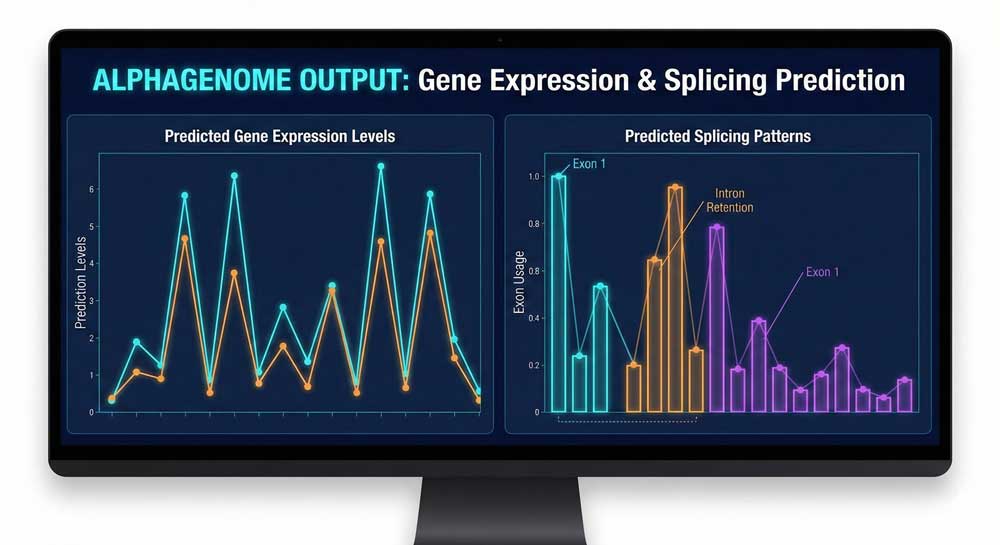
RNA splicing—the cellular process of cutting and pasting gene transcripts—is critical for producing functional proteins. When splicing goes wrong, cells produce defective proteins that can cause disease. Splicing errors account for approximately 15% of all genetic diseases.
AlphaGenome achieved first place in six out of seven authoritative splicing prediction benchmarks, outperforming specialized tools built exclusively for splicing analysis. For rare disease researchers working with unexplained splicing-related conditions, AlphaGenome provides an immediately useful prioritization tool.
3. Superior Chromatin State and Accessibility Forecasting
DNA doesn’t float freely in cells—it’s tightly wrapped around histone proteins in structures called chromatin. When chromatin is loosely packed, genes can activate; when tightly compacted, genes remain silenced. Mutations that alter chromatin packaging can have profound effects on gene regulation.
AlphaGenome outperforms purpose-built chromatin prediction tools by accurately forecasting how specific mutations change DNA accessibility and histone modification patterns. This capability reveals another crucial regulatory layer affected by genetic variants.
4. Real-World Cancer Validation: TAL1 Activation in Leukemia
To prove AlphaGenome works beyond theoretical benchmarks, DeepMind’s team applied it to real T-cell leukemia data. In this cancer, specific mutations act like faulty switches, inappropriately activating the dangerous TAL1 oncogene.
AlphaGenome not only predicted that these mutations would activate TAL1, but also mapped the complete activation pathway—predictions that matched experimental results that took scientists years of laboratory work to establish. This validation demonstrates AlphaGenome’s ability to generate clinically meaningful hypotheses that hold up under experimental scrutiny.
5. Unified “Swiss Army Knife” Architecture
Perhaps AlphaGenome’s most important innovation is architectural: it provides a unified sequence-to-function framework that handles multiple prediction tasks simultaneously. Research scientist Žiga Avsec describes this as moving from specialized single-purpose tools to a comprehensive “Swiss army knife” for genomic analysis.
This unified approach offers several advantages:
- Researchers no longer switch between incompatible tools with different assumptions
- Variant effects are interpreted within consistent biological context across all regulatory layers
- The same AlphaGenome model applies across diverse datasets from rare diseases to cancer research
Clinical Applications: From Research to Healthcare Impact
While AlphaGenome remains a research tool not approved for clinical diagnosis, its potential to reshape medical research is substantial.
Accelerating Rare Disease Diagnosis
Thousands of patients with rare genetic conditions undergo whole-genome sequencing yet receive no definitive diagnosis. The obstacle: their genomes contain numerous non-coding variants whose functional effects remain unknown.
AlphaGenome helps researchers and clinicians prioritize which variants most likely disrupt gene regulation and warrant deeper experimental investigation. While this doesn’t replace clinical judgment, it dramatically accelerates the search for disease-causing variants.
Guiding Safer CRISPR Gene Therapy Design
Gene-editing technologies like CRISPR promise to correct disease mutations, but carry risks if edits trigger unintended regulatory side effects. Because AlphaGenome predicts how specific DNA sequence changes alter regulatory signals genome-wide, it enables scientists to test thousands of potential edits computationally before laboratory experiments.
This capability could reduce off-target risks, guide safer therapeutic edit designs, and prioritize the most promising treatment strategies.
Enabling More Personalized Cancer Treatment
Cancer genomes accumulate numerous mutations, but only a subset truly drive tumor growth. AlphaGenome helps distinguish driver mutations from passenger mutations by assessing which variants actually alter gene regulation in biologically meaningful ways.
Long-term, such models could support more personalized treatment plans by highlighting the most actionable genomic changes in individual patients’ tumors, always combined with clinical and pathological data.
Open Science: Global Research Access
Following the successful AlphaFold playbook, Google DeepMind has made AlphaGenome resources available to the global scientific community. Since launching seven months ago, nearly 3,000 scientists from 160 countries have begun using AlphaGenome to advance research into cancer, neurodegenerative disorders, and infectious diseases.
How to Access AlphaGenome
- API Access: Free for non-commercial research at alphagenomedocs.com with approximately 1 million API calls daily
- Open-Source Code: Model implementation and research code available at github.com/google-deepmind/alphagenome_research
- Documentation: Comprehensive guides at alphagenomedocs.com/installation
DeepMind emphasizes that AlphaGenome is a research tool requiring experimental validation. Its predictions cannot substitute for clinical testing, medical expertise, or ethical review. As lead researcher Žiga Avsec notes, “Predicting disease manifestation from genomic data is an extremely hard problem, and this model is not able to magically predict that”.
Expert Perspectives on AlphaGenome’s Impact
Professor Kristian Helin, CEO of The Institute of Cancer Research, London, describes AlphaGenome as “a major advance in computational genomics, matching or exceeding the performance of current state-of-the-art models for predicting functional elements directly from DNA sequence”.
Pushmeet Kohli, DeepMind’s Vice President of Science, frames the challenge: “Understanding genetic variation effects is one of the most fundamental problems not just in biology—in all of science. The genome is like the recipe of life, and really understanding what is the effect of changing any part of the recipe is what AlphaGenome looks at”.
While independent researchers praise AlphaGenome’s technical achievements, they note continued areas for development. The ability to maintain single base-pair accuracy while analyzing megabase-scale DNA sequences represents a genuine computational breakthrough enabling previously impossible genomic analyses.
Research Tool Disclaimer and Responsible Use
Important: AlphaGenome is designed exclusively for research purposes and has not been validated for clinical diagnosis or treatment of any disease. All predictions require experimental validation before clinical application. Researchers should consult appropriate regulatory authorities and ethics boards before using AlphaGenome in any healthcare context.
The Road Ahead: From Structure to Logic to Systems
From AlphaFold’s revelation of protein structures to AlphaGenome’s decoding of regulatory logic, we’re witnessing the systematic digitization of biology. AlphaGenome transforms the 98% of “dark matter” DNA—once considered biologically inert—into readable regulatory code controlling life’s most fundamental processes.
For millions of patients with undiagnosed rare diseases caused by non-coding mutations, this technology offers genuine hope. For researchers developing next-generation gene therapies, AlphaGenome provides computational testing grounds that could save years of laboratory work. And for clinicians seeking to personalize cancer treatment, it offers new tools to distinguish signal from noise in complex tumor genomes.
The journey from initial concept to Nature publication took less than two years —a testament to how rapidly AI-driven biology now advances when world-class machine learning meets comprehensive genomic datasets.
Scientific Publications
- Nature: “Advancing regulatory variant effect prediction with AlphaGenome”
- National Human Genome Research Institute
- GENCODE Gene Annotation Database
AlphaGenome Tools
Related Reading
- Scientific American: Google DeepMind Investigates DNA’s Dark Matter
- STAT News: DeepMind Opens AlphaGenome Source Code