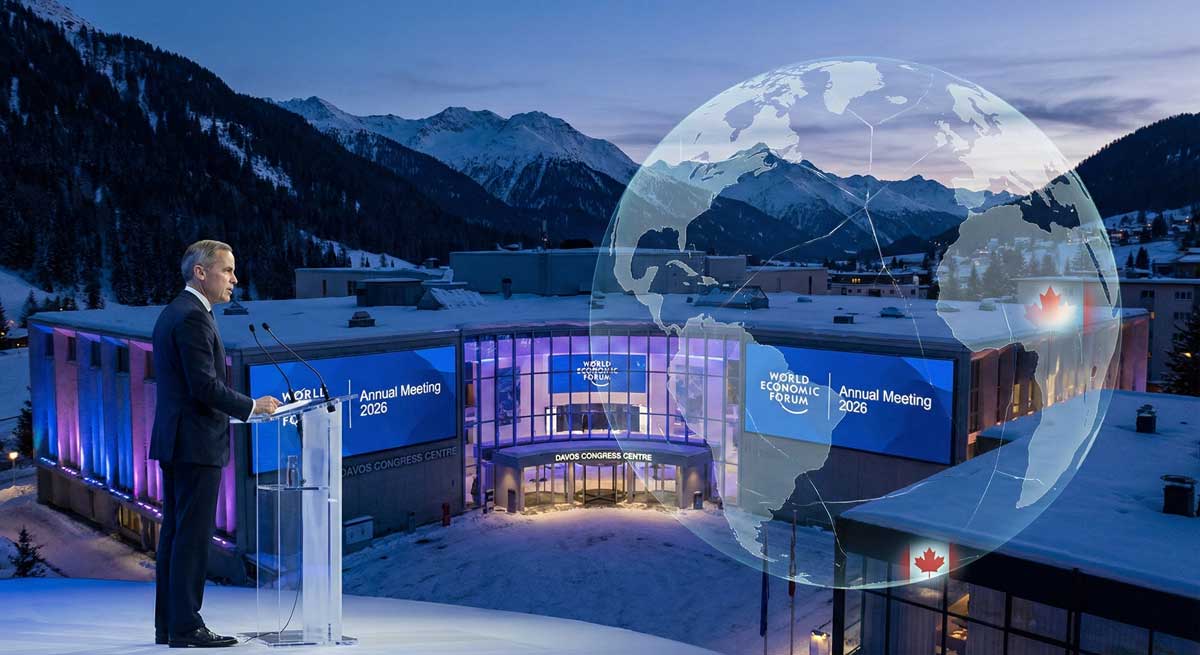
Davos 2026: Carney Warns of a Fractured Global Order and Calls for Middle-Power Unity
A Shifting Landscape at Davos
At the 2026 World Economic Forum in Davos, Canadian Prime Minister Mark Carney delivered one of the most-discussed speeches of the week. His central message was stark: “The old order is not coming back.”
Rather than targeting any single country, Carney’s remarks spoke to a broader reality — that the rules‑based international system many nations once relied on is under mounting strain. Large powers, he argued, increasingly employ economic tools as geopolitical leverage, leaving mid‑sized nations to navigate a far more fragmented and transactional world.
The End of the “Rules‑Based” Comfort Zone
For decades, middle powers such as Canada, Australia, South Korea, and several EU states thrived under what was commonly described as a “rules‑based international order.”
Yet Carney challenged this notion, calling it “a useful fiction.” In practice, global rules often bent under the weight of power politics: trade regulations were selectively enforced, and international law applied unevenly.
The benefits once offered by dominant powers — from stable financial systems and open sea lanes to multilateral dispute resolution — no longer appear guaranteed. Instead, crises in finance, energy, public health, and security over the past two decades have revealed the vulnerabilities of excessive interdependence.
When Integration Becomes Weaponization
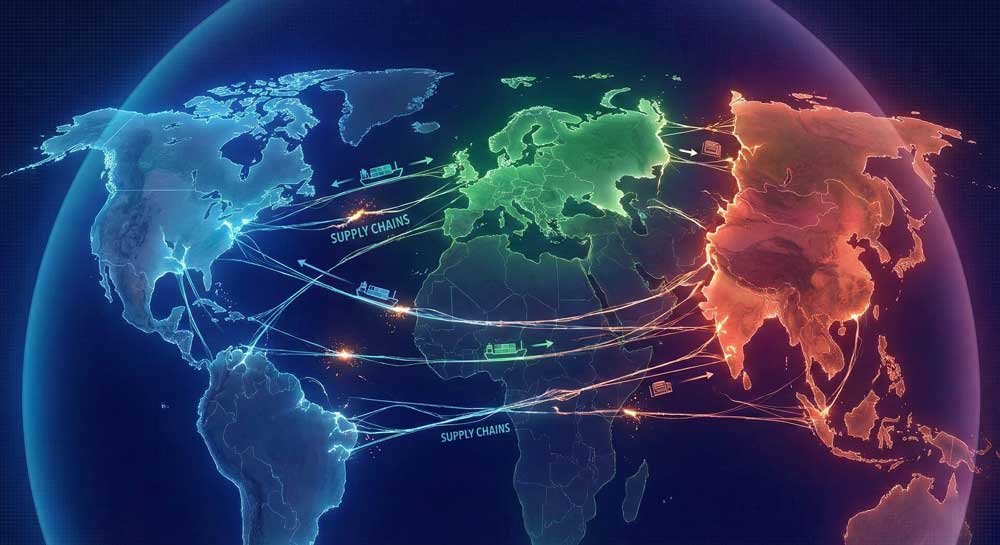
Carney’s warning reflected a wider concern among policymakers: globalization itself can now be turned into a strategic weapon. Key economic tools — tariffs, payment networks, export controls, and supply chains — have increasingly been used to exert political pressure.
| Mechanism | Example Usage | Strategic Impact |
|---|---|---|
| Tariffs & Trade Barriers | Sanctions or selective tariffs during disputes | Distorts comparative advantage, fragments markets |
| Financial Systems | Weaponization of payment infrastructure (e.g., SWIFT) | Limits access for targeted economies |
| Supply Chains | Restrictions on semiconductors or rare minerals | Creates technological dependencies |
| Energy Security | Oil and gas exports used as leverage | Alters alliances and energy policies |
Carney argued that such developments make it impossible to pretend global economic integration automatically brings mutual benefit. When interdependence becomes dependence, “mutual gain” can swiftly turn into vulnerability.
The Middle Power Dilemma
In this environment, middle powers face a strategic paradox. They lack the scale and coercive tools of great powers, yet remain essential to maintaining global stability. Carney urged these nations to act collectively rather than negotiate separately with major players.
“If we approach power asymmetry alone, we negotiate from weakness,” he warned. “But together, we can defend genuine sovereignty.”
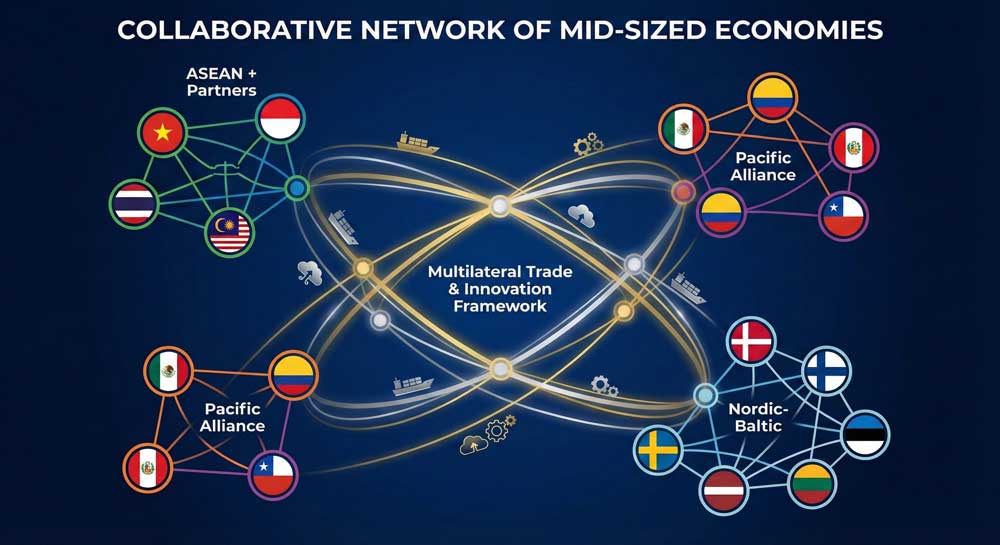
This “middle power coalition” concept echoes similar debates in recent years — from proposals for a Democracy 10 partnership to stronger North–South coordination within the OECD and G20 frameworks.
The Danger of Fortress Economies
Yet autonomy comes with trade‑offs. Attempting to achieve “strategic independence” in every domain — energy, food, minerals, or finance — could lead to what Carney termed a “fortress world.”
Such fragmentation, he argued, risks making all countries poorer, more fragile, and less sustainable.
He cautioned that economic diversification must not become isolationism. Rather than retreating into blocs, nations should pursue pragmatic pluralism — spreading risk through diversified supply chains and multilateral cooperation, not decoupling entirely.
| Strategic Orientation | Short‑Term Effect | Long‑Term Risk |
|---|---|---|
| Full economic decoupling | Domestic control, reduced exposure | Efficiency loss, higher inflation |
| Partial diversification | Supply chain resilience | Coordination challenges |
| Cooperative interdependence | Shared innovation, mutual security | Requires sustained diplomacy |
Canada’s Shift Toward Global Engagement
Carney also used the platform to outline a notable evolution in Canadian foreign policy.
Canada, traditionally oriented toward North American and Atlantic alliances, is now broadening its strategic engagement worldwide. The government is pursuing new partnerships with the European Union, ASEAN, and MERCOSUR, while deepening ties with Indo‑Pacific democracies such as Japan, India, and Australia.
He reaffirmed Canada’s opposition to coercion in the Arctic — referencing recent tensions over Greenland’s territorial status — and emphasized that governance in the region must rest on “mutual respect and international law.”
This marks a significant shift from reliance on geographic proximity or old security assumptions. As Carney noted, “Being part of an alliance no longer guarantees automatic prosperity or safety.”
Re‑balancing Multilateralism
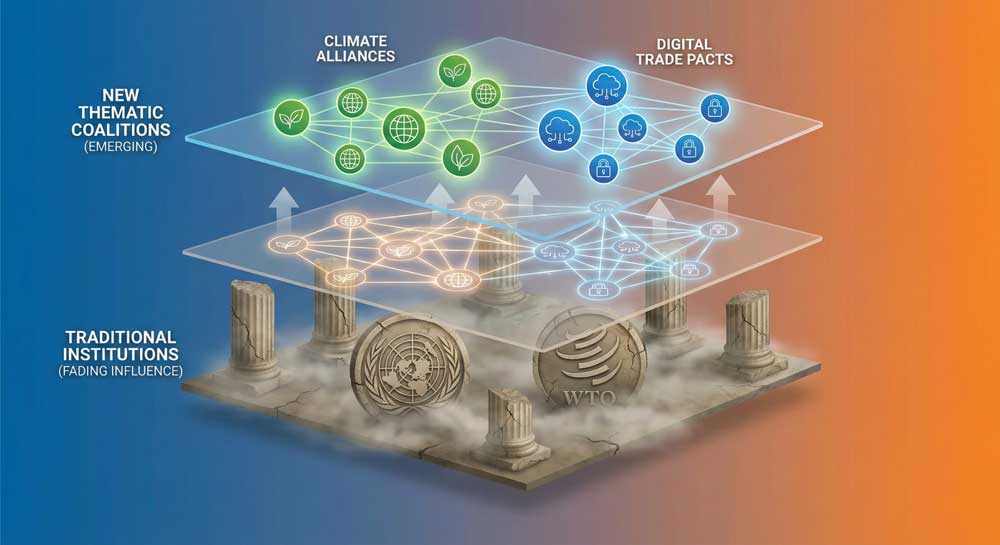
The speech came at a time when global institutions such as the WTO and UN are struggling to fulfill their mandates. Carney echoed widespread calls for reform — suggesting that if major powers abandon even the appearance of respecting shared rules, global trade and security cooperation could rapidly erode.
He argued that restoring trust in multilateral systems requires mid‑level states to set examples rather than wait for superpowers to agree. Regional frameworks, transparent trade agreements, and cross‑border innovation on green energy and AI governance may offer starting points.
But these institutional fixes are being attempted against the backdrop of a global economy that spent 2025 chasing growth in a fractured system — with diverging inflation paths, currency shifts, and an AI‑driven equity boom masking underlying fragilities. For a structured walkthrough of that year’s macro landscape, see “2025 Global Economy: A Fractured World Chasing Growth.”
The Message to Middle Powers: “Be at the Table”
Carney’s most quoted line — “If we are not at the table, we will be on the menu” — encapsulated his message to mid‑sized nations facing a volatile world. The call is not for confrontation, but for collective initiative: building domestic economic strength, enhancing diplomatic coordination, and investing in multilateral problem‑solving.
Analysts view this as consistent with Canada’s broader ambition to act as a “connector nation,” balancing its Western alliances with engagement across the Global South.
References
- WEF Official Transcript: Full special address by PM Mark Carney. Key quotes on “rupture, not transition” and middle powers. https://www.weforum.org/stories/2026/01/davos-2026-special-address-by-mark-carney-prime-minister-of-canada/[weforum]
- YouTube: Carney’s Key Remarks: Clip on middle powers (“not at the table, on the menu”). https://www.youtube.com/watch?v=7JgxGDccWk8[youtube]
- CBC Power & Politics Analysis: Experts call it “most consequential” Canadian speech in decades. https://www.youtube.com/watch?v=kusFKeMq3SA[youtube]
- BBC: “Old Order Not Coming Back”: Carney’s unity call amid U.S. pressures. https://www.bbc.com/news/articles/cly3d28p4p8o[bbc]
- Carnegie Endowment: Tools for middle powers vs. U.S./China coercion. https://carnegieendowment.org/emissary/2026/01/carney-middle-powers-davos-speech?lang=en[carnegieendowment]