BHP vs. CBA: Australia’s Market Duel and the Global Currency Reset in Motion
Introduction: A Shift Beneath the Surface
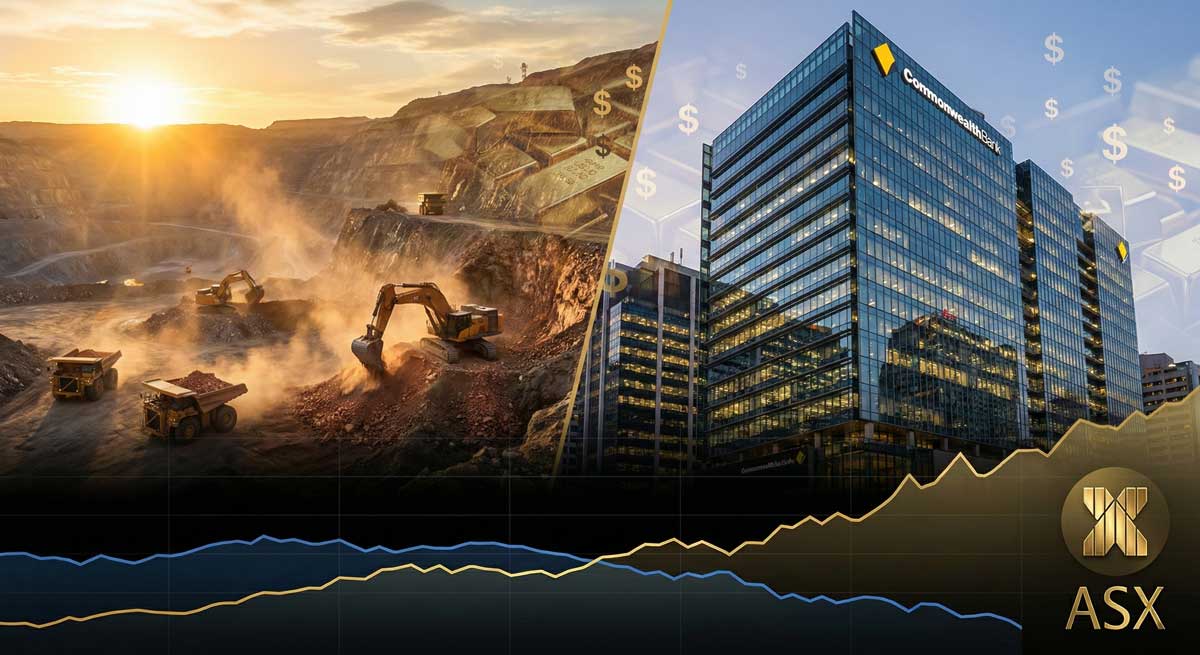
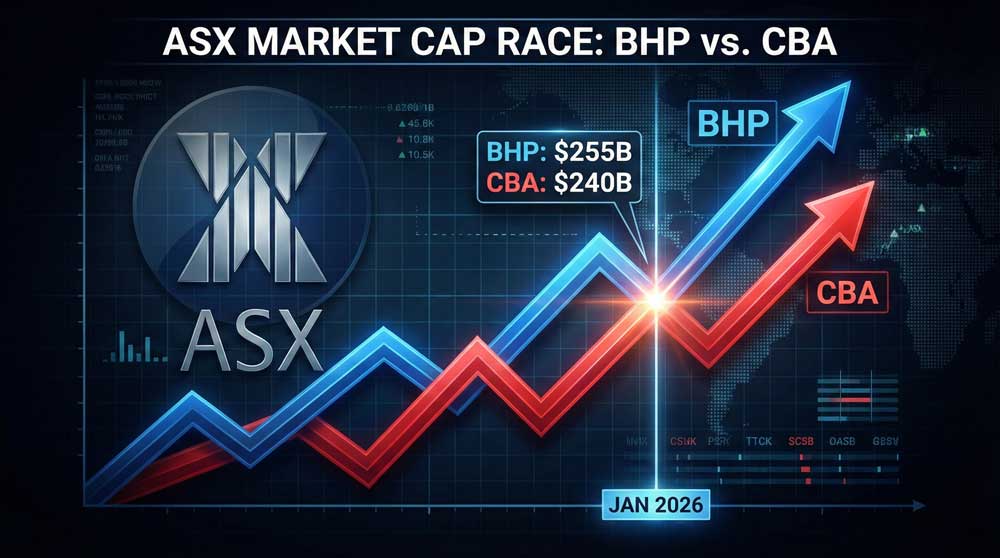
Sydney, 2026 — The rivalry between BHP Group and the Commonwealth Bank of Australia (CBA) for the crown of Australia’s most valuable company is more than a local headline. It mirrors the world’s quiet transition from a credit‑driven economy to one rediscovering the enduring weight of tangible assets.
As gold regains credibility and global fiat currencies face systemic doubt, the “BHP vs. CBA” narrative becomes a window into a deeper transformation — the potential rewriting of global money itself.
1. The Return of Gold as the Hidden Benchmark
For half a century, commodities have lived under a simple rule: priced in U.S. dollars, settled through a dollar‑centric system. That axiom is now breaking down under three structural pressures:
| Structural Pressure | Description | Consequence |
|---|---|---|
| Monetary expansion | Post‑pandemic liquidity injections and fiscal stimulus | Dollar oversupply & reduced trust |
| Debt super‑cycle | U.S. debt surpassing sustainable thresholds | Interest‑rate suppression & inflation |
| Financial weaponization | Sanctions, SWIFT exclusions, and politicized finance | Incentive for alternatives (gold, yuan, crypto) |
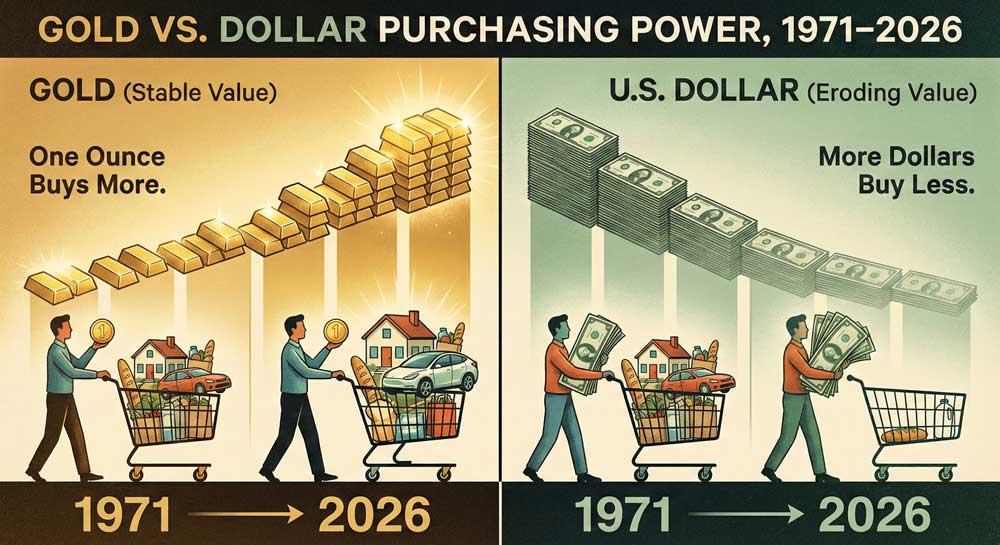
In this atmosphere, gold is quietly reclaiming its role as the monetary base of trust. Unlike fiat money, it cannot be digitally created, defaulted upon, or sanctioned. Gold’s rise is less about “price speculation” and more about re-pricing the denominator — the dollar itself.
2. Two Pricing Systems: The Dual Reality
The modern commodity market now operates under two coexisting valuation logics:
- Industrial Logic — determined by physical supply, demand, and technological shifts (e.g., EV metals).
- Monetary Logic — determined by the changing value of money versus real assets.
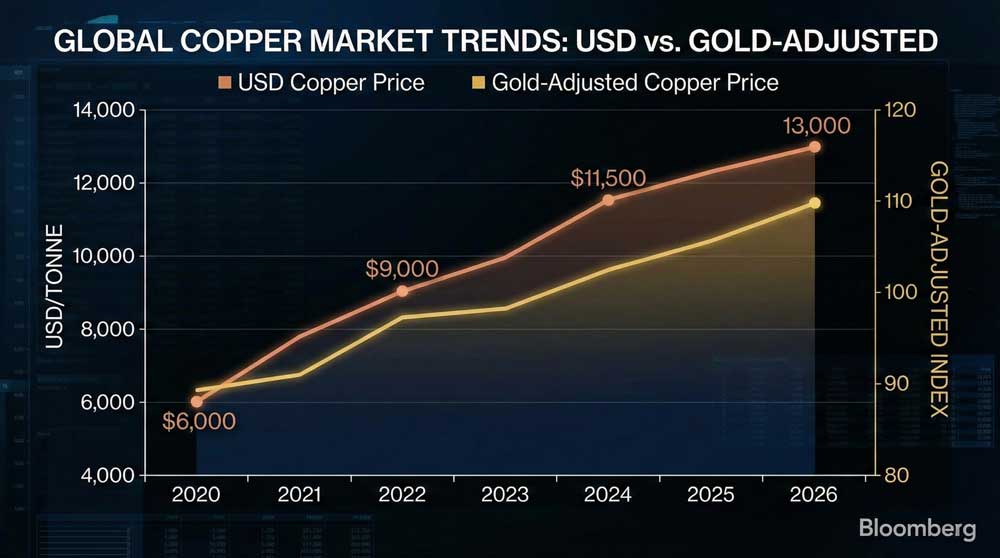
When these two systems diverge, deeper truths appear. Take Copper: in 2025 it broke past $13,000 per tonne, a record high in dollar terms — but even in gold‑adjusted prices, the uptrend persisted.
That alignment means the rally is not just cyclical — it’s monetary. Hard assets are being repriced as stores of value, not just raw materials.
| Characteristic | Financial Assets (Banks) | Hard Assets (Miners) | Implication |
|---|---|---|---|
| Core value | Credit claims | Physical reserves | Tangible scarcity gains value |
| Inflation impact | Negative (real yield loss) | Positive (pricing power) | Inflation hedge |
| Expansion capacity | Infinite (credit creation) | Finite (geological scarcity) | Adds premium |
| Geopolitical role | Policy‑driven | Strategic & physical | Security of supply > liquidity |
This is why mining giants such as BHP no longer trade solely on industrial demand; they serve simultaneously as industrial engines and monetary vaults.
3. Lessons from the 1970s — History Speeds Up
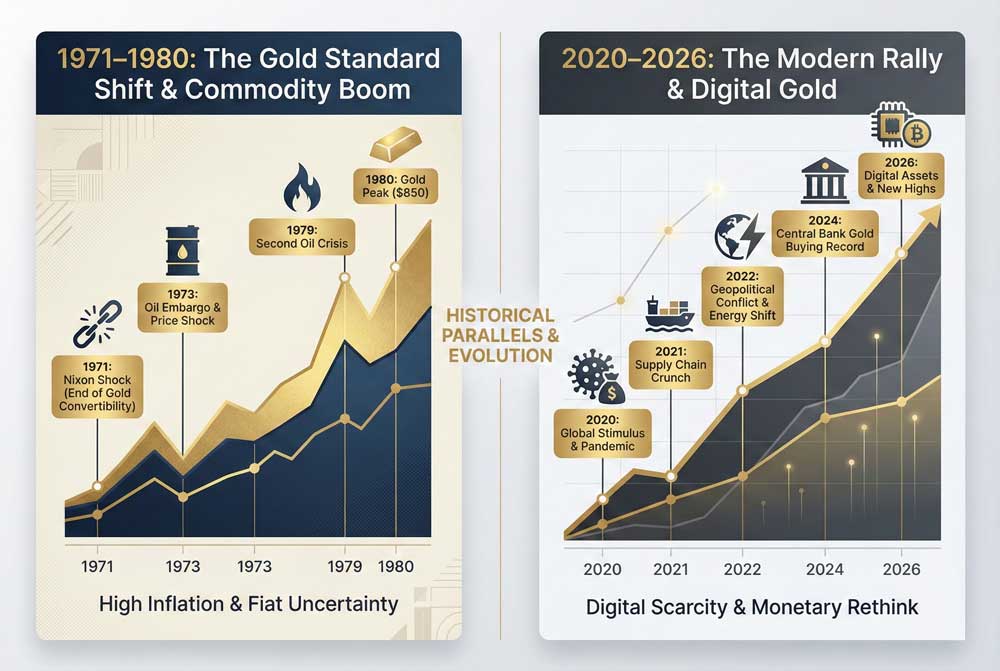
The 1970s commodity boom followed the collapse of the Bretton Woods gold peg. When the U.S. dollar was freed from gold, markets recalibrated rapidly, sending oil, metals, and gold to new highs.
Today’s echoes are unmistakable — but the tempo is faster.
| 1970s Catalyst | 2020s Equivalent | Acceleration Factor |
|---|---|---|
| Oil shocks & inflation | Energy transition + supply deficits | Green shift creates structural shortage |
| Cold War blocs | West–East fragmentation | Trade security over optimization |
| Monetary debasement | Infinite digital liquidity | Instant capital mobility speeds contagion |
Australia, positioned as a top exporter of iron ore, copper, coal, and lithium, is again in the right place at the right time. Global capital flows are already showing preference for atoms over algorithms — the tangible over the virtual.
4. BHP’s Transformation: From Miner to Monetary Custodian
In this new environment, BHP’s valuation logic evolves from cyclical to structural.
Its underground reserves act as non‑inflatable collateral. Whether measured in tonnes or ounces, these resources cannot be conjured into existence by central banks. Investors increasingly view them as natural vaults in an age of monetary overreach.
| Attribute | Past View | Emerging View | Strategic Meaning |
|---|---|---|---|
| Business model | Cyclical producer | Monetary custodian | Dual return stream |
| Earnings sensitivity | Commodity prices | Global liquidity flows | Hedge vs. fiat |
| Asset nature | Industrial input | Inflation‑proof storage | Security substitute |
As this perception spreads, mining equities may command valuation premiums that once belonged to financials and tech platforms.
5. CBA and the Fragility of the Financial Architecture
By contrast, CBA — a model of banking stability — faces a different structural question: What is the fair value of credit in a world losing faith in fiat?
Its main asset base consists of debt claims — mortgages and business loans. In an inflationary or currency-erosion regime, the real value of those claims erodes. Meanwhile, capital regulations and macro prudence limit expansion while miners benefit from inflation uplift.
| Metric | BHP Group | Commonwealth Bank |
|---|---|---|
| Core Assets | Iron ore, copper, coal reserves | Loans, deposits, bonds |
| Inflation Exposure | Positive (asset revaluation) | Negative (yield compression) |
| Global Role | Supplies real commodities | Processes fiat liquidity |
| Risk Type | Geological/operational | Systemic/monetary |
The market’s gradual rotation from Financials → Resources is, therefore, not transient. It reflects a lasting shift in perceived safety — from promises of payment to proof of possession.
6. The Road Ahead: Volatility and Multipolar Money
Still, the global monetary transition won’t be linear. The U.S. dollar’s dominance is sustained by deep capital markets, global debt linkages, and inertia. Change will unfold gradually yet irreversibly.
The likely destination is not a return to the gold standard, but a multipolar reserve ecosystem—like the 2025 global economy as a fractured world chasing growth—including:
| Asset Class | Example | Function |
|---|---|---|
| Fiat Currencies | USD, EUR, CNY | Liquidity & trade settlement |
| Precious Metals | Gold, Silver | Trust baseline |
| Digital Assets | CBDCs, Bitcoin | Technological layer |
| Commodities | Oil, Copper | Collateralized backing |
Gold’s role becomes more referential than transactional, serving as the silent denominator that disciplines monetary excess.

7. The Real Meaning of the BHP–CBA Battle
The return of BHP to the top of ASX valuations — if and when it occurs — will be symbolic. It will represent the moment markets formally recognized the ascendancy of productive capital over credit capital.
More broadly, this marks a reconstruction of the global balance sheet — where real assets are rediscovered as forms of monetary integrity.
In this sense, BHP is not merely a miner, but a proxy for value’s evolution itself.
Conclusion: The New Guardians of Value
The convergence of a commodity bull cycle and gold’s resurgence signals more than a financial rotation — it announces a changing philosophy of wealth.
The global economy, once built on leverage and paper promises, is steering back toward substance, scarcity, and sovereignty. In that story, Australia’s own market rivalry embodies a world choosing between mined reality and printed illusion.
References & Further Reading
- World Gold Council: Central Bank Gold Reserves Trends
- Reserve Bank of Australia (RBA): Commodity Price Index & Monetary Policy
- IMF Economic Outlook: Inflation and the Future of Money
- ASX Market Data: Top Companies by Market Capitalization