AI Token Economy: 7 Brutal Truths That Will Redefine Who Gets Wealthy in the Next Decade
The AI Token Economy is here — and it is quietly dismantling everything we thought we knew about hard work, productivity, and wealth creation.
In 1866, the SS Great Eastern crossed the Atlantic to lay a telegraph cable connecting London and New York. With transoceanic telegraphs, the British Empire instantly controlled commodity prices, war updates, and climate intelligence. Through faster communication, wealth concentrated rapidly in the hands of those with the highest cognitive access.
From the telegraph to mobile internet, every wave of communication technology accelerated that same dynamic: wealth flowed toward those who controlled information channels. But that era is ending.
A new liberation is arriving — nearly silent, yet overwhelming. It is liberating the efficiency of value generation itself. This is the AI Token Economy.
Table of Contents
Truth #1: A Token Is Not Just a Character
To understand this shift, we must fundamentally redefine what a “token” actually means.
Technically, a token is the smallest computational unit an AI Large Language Model (LLM) processes — roughly four English letters or one to two Chinese characters. But as NVIDIA CEO Jensen Huang declared at GTC 2026, tokens are now “the basic unit of AI that turns data into knowledge” — repositioning the entire concept as an economic phenomenon, not merely a technical one.
The working definition gaining authority in 2026: a token is the smallest quantifiable unit of value created by human civilization in the intelligence age — the settlement unit bridging technical supply and commercial demand.
This is a profound reframe. For the first time in history, “wisdom” can be measured, priced, and traded at scale — like coal or oil in the industrial age, but infinitely more reproducible.
Truth #2: The AI Token Economy Makes Invisible Value Visible
In the traditional world, value is often vague, subjective, and impossible to disaggregate.
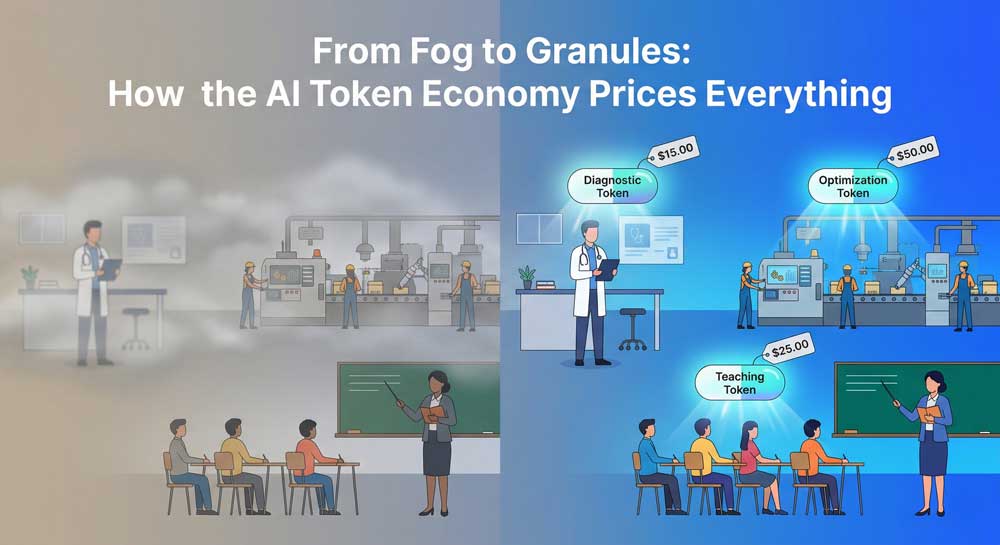
A physician charges $500 for a five-minute consultation. How much was each sentence worth? How much is the lifetime of diagnostic experience behind it worth? No one can say.
Under the AI Token Economy lens, that same consultation becomes legible:
- Observing the patient’s complexion → “Diagnostic Experience Token”
- Asking about sleep quality → “Inquiry Logic Token”
- Writing the prescription → “Treatment Plan Token”
The same applies to a lean manufacturing expert who cuts production costs by 1%. Which decision drove which saving? Previously unknowable. In token terms: an “Optimization Token,” a “Quality Control Token,” a “Lean Strategy Token” — each with a calculable market value.
| Traditional Economy | AI Token Economy | Impact on Wealth |
|---|---|---|
| Generalized hourly rate | Priced per specific action or insight | High-value insights rewarded instantly |
| Inseparable tacit experience | Extractable “Experience Tokens” | Expertise digitized and scaled globally |
| Subjective, negotiated pricing | Data-driven token pricing | Wealth flows to the most efficient token creators |
| Value visible but untouchable — “fog” | Every token carries its own price tag — “granular” | Precision pricing replaces guesswork |
Previously, value was like a fog — visible but untouchable. In the AI Token Economy, value becomes granular. Every token carries its own price tag.
Truth #3: This Is the Third Great Liberation in Human History
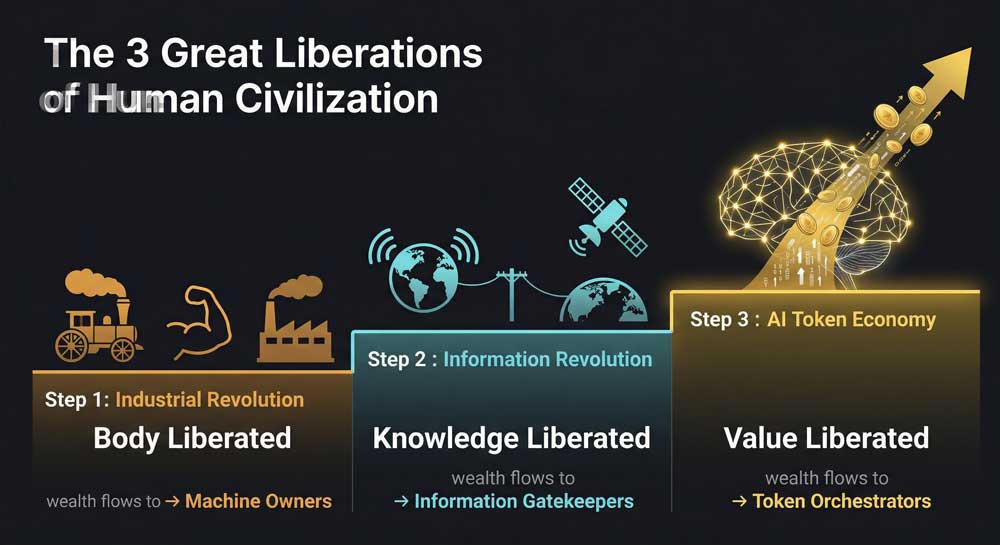
Stretch the timeline far enough, and human progress reduces to a pattern of three liberations:
1st Liberation — Industrial Revolution: Human output was capped by physical stamina. One person could plow one acre or move a few hundred bricks per day. Machines shattered that ceiling — and wealth flowed to machine owners.
2nd Liberation — Information Revolution: Knowledge transmission was bound by time and space. Letters took months; books reached few. Telecommunications demolished those barriers — and wealth flowed to those controlling information networks.
3rd Liberation — The AI Token Economy: This one targets the output directly — value itself.
Even Einstein had linear value output. A top surgeon can see 40 patients a day — and that is a hard biological ceiling. AI operates 24/7, processes information at billions of times human speed, and generates value-laden tokens nonstop.
Value production is shifting from handmade craftsmanship to industrialized mass production — and the factory floor is every industry simultaneously.
The IMF’s April 2025 working paper projects that widespread AI adoption could raise the global wealth Gini coefficient by 7.18 percentage points — the largest single-factor inequality shift in modern economic history.
Truth #4: The AI Token Economy Is Brutally Restructuring 5 Industries
Financial Markets — From Human Instinct to Token Execution
Traditional stock trading — however algorithmic — still relied fundamentally on human friction: analysts reading reports, fund managers visiting companies, retail investors chasing headlines.
In the AI Token Economy, when news breaks, a quantitative fund’s LLM scrapes and decomposes it into “Event Tokens,” “Sentiment Tokens,” and “Trading Strategy Tokens” — executing orders before most human analysts finish reading the headline.
Wealth no longer flows to the most diligent researcher. It flows to whoever commands the most powerful token-generation infrastructure. This is asymmetric warfare, and the asymmetry is growing.
Content Creation — The Death of Mediocre
AI can generate hundreds of articles and dozens of video scripts per hour at near-zero marginal cost. The “decent but generic” middle ground is being obliterated. Only two content categories survive:
- Personality Tokens — deeply human, emotionally resonant, irreplaceable personal perspective. A rural memoir’s value is not its vocabulary; it is the emotional authenticity AI cannot replicate.
- Logic & Data Tokens — hyper-precise, algorithmically structured output. A financial AI that instantly decomposes a 1,000-page earnings report into “Risk Tokens,” “Growth Tokens,” and “Correlation Tokens” — auto-customized for 10 investor profiles simultaneously.
Content in the middle — no unique emotion, no precision data — sees its token value collapse to zero. AI produces it faster and cheaper than any human.
Healthcare — Infinite Replication of Scarce Expertise
The deepest pain of global healthcare has always been elite expertise is scarce and geography-bound. The best specialists can only see dozens of patients a day — a hard physical law.
The AI Token Economy breaks this law. A top physician’s lifetime of diagnostic reasoning can be trained into a high-precision model. A young doctor in a remote clinic, facing a complex case, can call upon that expert’s “Experience Tokens” — receiving a diagnostic suggestion matching world-class standards in real time.
This is the infinite replication of scarce wisdom at near-zero marginal cost. The tokenized healthcare asset market alone is projected to reach $2–4 trillion by 2030.
Industrial Manufacturing & Logistics
AI fused with robotics and sensors is enabling autonomous complex task execution. Every factory action generates operational tokens that feed back into continuous optimization loops — compressing the improvement cycle from years to weeks.
Drug Discovery & Biotech
AI compresses drug development timelines from a decade to years by tokenizing molecular interaction data, clinical outcomes, and protein-folding patterns — running thousands of virtual experiments simultaneously that would have taken entire research divisions a generation.
Truth #5: Society Will Split Into the 1% and Everyone Else
The World Economic Forum estimates 92 million jobs will be eliminated by 2030 — while 170 million new roles are simultaneously created. The net figure looks positive. The distribution does not.
BCG’s March 2026 analysis found that 50–55% of US jobs will be substantially reshaped by AI within two to three years. The question is not whether change is coming. The question is which side of it you land on.
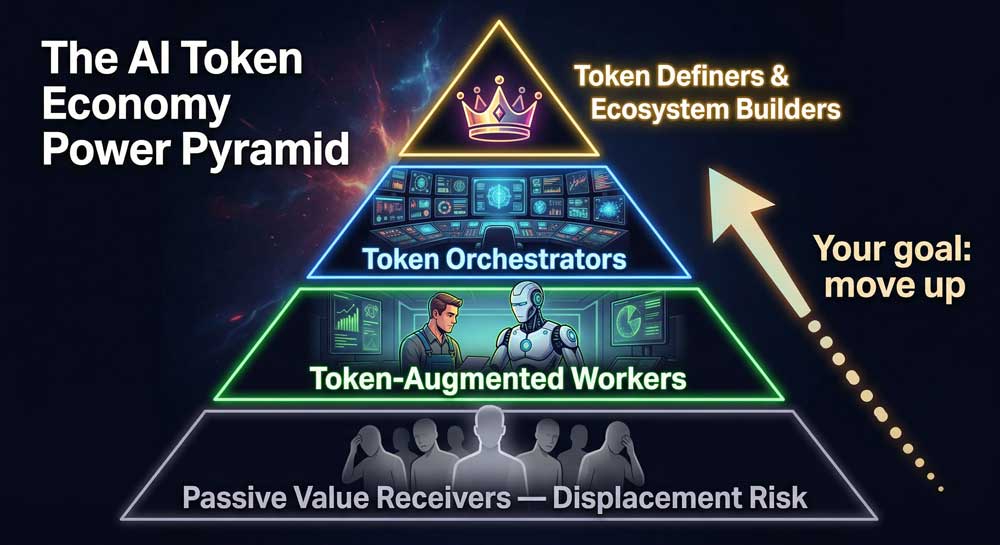
| Group | Role in the AI Token Economy | Wealth Trajectory |
|---|---|---|
| Token Definers | Set what constitutes valuable tokens — e.g., medical diagnosis standards, educational scoring | Exponential growth |
| Token Orchestrators | Direct AI compute and data pipelines to generate high-value tokens at scale | Exponential growth |
| Ecosystem Builders | Build platforms enabling token producers and consumers to transact | Exponential growth |
| Token-Augmented Workers | Use AI tools to amplify existing domain expertise | Moderate growth |
| Passive Value Receivers | Perform standardized, repetitive tasks without AI leverage | Displacement risk |
Those in the bottom tier are not at risk because they are lazy. They are at risk because standardized tasks are precisely what AI executes better, faster, and cheaper — a relentless and improving competitor with no salary requirements.
Truth #6: The 3 Core Powers That Determine Your Position
Entry into the core group of the AI Token Economy hinges on mastering three distinct capabilities:
- Token Definition Power — the ability to articulate what constitutes valuable AI output in your domain. Like the rule-setters of the industrial age, these individuals control the definition of value itself. Who defines what makes a “good” diagnostic token in oncology? That person is irreplaceable.
- Token Orchestration Power — the ability to direct AI compute, data pipelines, and model selection to generate high-value tokens efficiently. These are the modern infrastructure operators — not building the factory, but running it at full capacity.
- Token Ecosystem Power — the ability to build or anchor platforms where token producers and consumers transact freely. Gartner predicts 40% of enterprise applications will integrate task-specific AI agents by end of 2026; those governing those agent ecosystems become structural monopolists.
These three powers do not require a PhD in computer science. They require domain depth + AI fluency + strategic positioning. The combination is rarer than it sounds — and more valuable than almost any traditional credential.
Truth #7: Effort Still Matters — But It Must Be Redirected
The classic belief that hard work determines destiny worked when value creation was linear: more hours meant more output. The AI Token Economy breaks that equation permanently.
AI operates 24/7. Its per-token production costs have been falling sharply even as enterprise AI spending surged 36% in 2025. The productivity gap between someone who strategically leverages AI token generation and someone who does not is not 2x or 10x — it is potentially 1,000x or more.
This does not make effort worthless. It makes misdirected effort catastrophic. Effort must shift:
- From doing → to directing
- From creating → to defining
- From executing → to orchestrating
Your 3-Step AI Token Economy Action Plan
- Audit your value — identify which parts of your current role are token-replicable (standardized, pattern-based) vs. token-irreplaceable (judgment, ethics, relationships, original taste)
- Build domain-specific AI fluency — not generic chatbot use, but deep integration of AI tools built for your industry’s specific token ecosystem
- Shift toward definition and orchestration — seek projects where you set quality standards for AI outputs, not projects where you compete against them
The Bottom Line
The telegraph cable of 1866 created its first millionaires within months of going live. The token infrastructure being built right now — in NVIDIA’s AI factories, in enterprise LLM deployments, in healthcare AI platforms — is that cable.
“When the wave comes, those still rowing with old oars will be swept away. Only those who learn to build surfboards — and eventually shape the waves themselves — will reach shores that have never been seen before.”
The AI Token Economy is not a prediction. It is already the present. The only question left is which side of it you are building toward.
Authoritative Resources
- 📊 IMF Working Paper: AI Adoption and Inequality — April 2025
- 🏭 Forbes: Industrializing Intelligence — NVIDIA’s GTC 2026 and the New AI Economy
- 💼 BCG: AI Will Reshape More Jobs Than It Replaces — March 2026
- 🌐 WEF: The AI-Driven Workforce Is Here — February 2026
- 💡 LinkedIn: When Labor Becomes Tokens — AI and the Economics of Running a Business
- 🔬 AIQuinta: Tokens — The New Currency of AI Economics
- 🏥 RWA.io: How Tokenization Is Shaping the Future of Healthcare Assets
- 📈 AEI: Algorithms, Compute, and the Rise of Tokenomics — February 2026
- 💰 McKinsey: The Economic Potential of Generative AI
- 📉 Introl: Inference Unit Economics — The True Cost Per Million Tokens
- 📊 The Claude Code Leak: 1 Catastrophic Mistake That Could Supercharge Every AI Tool 100x
- 🏭 Chinese AI Models: 7 Powerful Ways They’re Dominating the Global Developer Market in 2026
- 💼 US Space Force Combat Deployment: 5 Powerful Realities Reshaping the Space Warfare Era