
US Space Force Combat Deployment: 5 Powerful Realities Reshaping the Space Warfare Era
The US Space Force combat deployment in recent operations against Iran is not simply a military footnote — it is a civilizational inflection point. For the first time in history, a dedicated space military branch has participated as a frontline, full-spectrum warfighting force rather than a passive support unit. This milestone officially transitions human conflict from a three-dimensional battlefield (land, sea, air) into a four-dimensional arena — and it permanently rewrites the economics of the global commercial aerospace industry.
Whether you are an investor, a defense analyst, or a technology strategist, the market logic you operated under before this deployment is now obsolete.
Table of Contents
What the US Space Force Combat Deployment Actually Did
Established in December 2019 as America’s sixth military branch, the US Space Force reached active combat deployment in under seven years — a pace that signals the Pentagon’s urgency around space dominance. Operations including Operation Midnight Hammer (June 2025) and Operation Absolute Resolve (January 2026) already demonstrated early integration, but the current Operation Epic Fury against Iran represents the most comprehensive and openly acknowledged space force combat role to date.
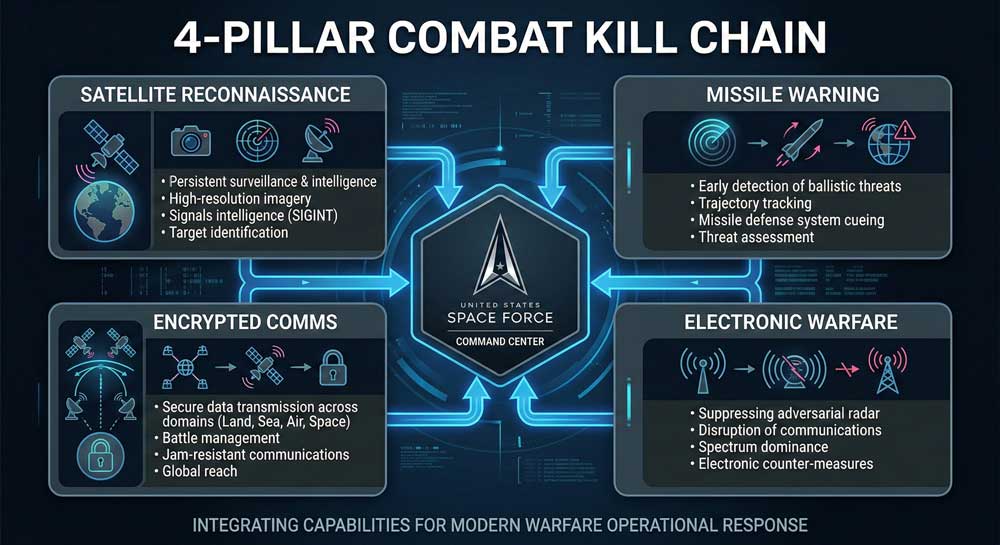
Based on unclassified reports and tactical analyses, the deployment executed four core operational pillars:
| Mission Pillar | Capability Deployed | Strategic Outcome |
|---|---|---|
| Continuous Satellite Reconnaissance | Real-time LEO imaging & tracking | 24/7 lock on Iranian military infrastructure |
| Space-Based Missile Warning | Infrared sensor satellites (SDA constellation) | Early detection & interception guidance for ballistic missiles |
| Omni-Domain Encrypted Communications | Starshield military terminals | Unbreakable relay for ground, naval & air assets |
| Electronic Suppression & EW | Directed jamming payloads | Blind adversarial radars and satellite uplinks |
Unlike past conflicts where space assets merely provided passive GPS or weather data, this deployment embedded space capabilities into every link of the kill chain — from target acquisition through strike guidance to defensive interception.
The Military-Commercial Nexus: SpaceX Is the Engine
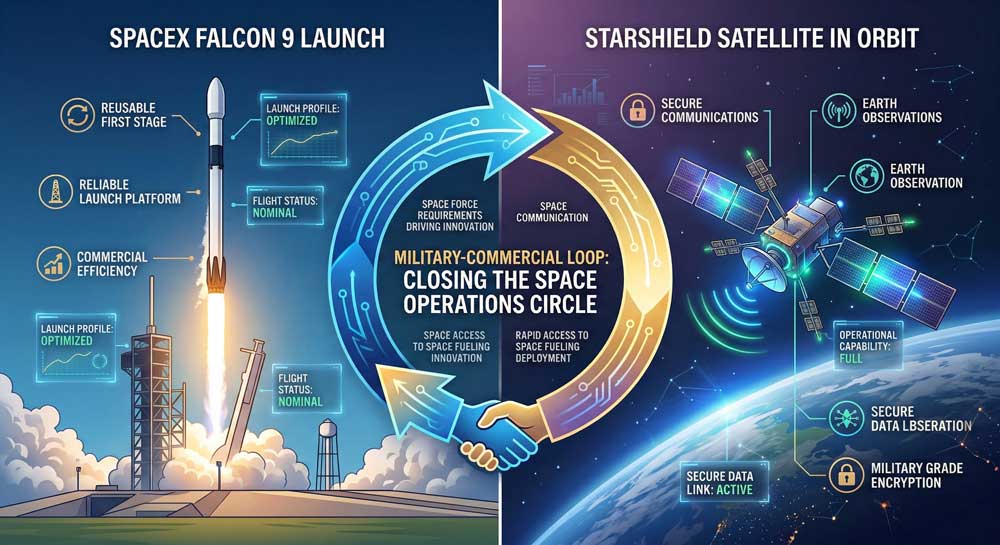
No analysis of the US Space Force combat deployment is complete without confronting the SpaceX relationship. The two entities have formed a closed-loop military-commercial ecosystem that is unprecedented in modern defense history.
SpaceX holds the dominant position in US national security space launches, with the Falcon 9 certified for all NSSL (National Security Space Launch) mission types. While traditional expendable rockets cost $300–500M per mission, Falcon 9 cuts that to $60–70M with reusable boosters — and crucially, offers rapid constellation replenishment. If adversaries destroy US military satellites, SpaceX can restore orbital coverage within days, not years.
Starshield: Not Starlink With a Flag
The key technology in active operations is Starshield — SpaceX’s classified, military-grade satellite network, managed through a contract with the National Reconnaissance Office. It is architecturally related to Starlink but operationally distinct:
- 480+ dedicated MILNET satellites currently under deployment, with initial operating capability projected for mid-2026
- Terminals with stronger encryption than any commercial Starlink product
- Payloads engineered for Earth observation, ballistic and hypersonic missile tracking (via advanced infrared sensors), electronic interference, and counter-space operations
- A $1.8 billion classified contract confirmed in 2023, with satellites operational from May 2024
The alignment creates a perfect strategic loop: the US Space Force provides capital, policy protection, and R&D backing; SpaceX delivers low-cost, high-tempo warfighting capability at scale.
| SpaceX Program | Public Narrative | Military Reality |
|---|---|---|
| Falcon 9 | Affordable commercial launch | Primary USSF satellite delivery vehicle, 95+ NSSL missions completed |
| Starlink | Global consumer internet | Battlefield communications backbone (proven in Ukraine) |
| Starshield | Limited public disclosure | Classified comms, missile tracking, EW payloads, NRO-managed |
| MILNET Constellation | Not publicly acknowledged | 480-satellite encrypted military network, ops from 2026 |
Market Impact: The Trillion-Dollar Ceiling Opens
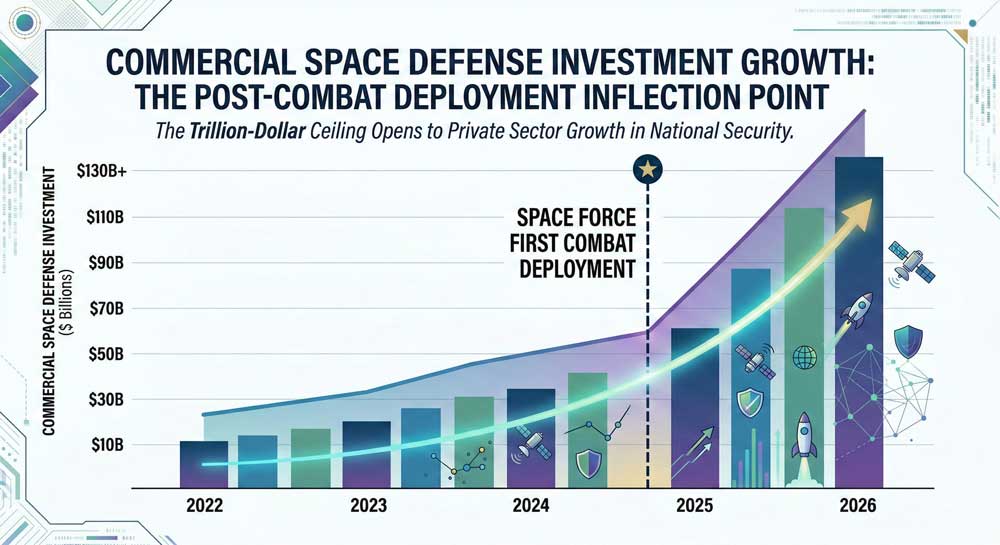
The US Space Force combat deployment doesn’t just validate existing space companies — it reprices the sector’s entire growth ceiling.
The US aerospace and defense market currently stands at $463 billion in 2026, projected to reach $610 billion by 2031 at a 5.67% CAGR. Space platforms are the fastest-growing segment within that, leading at a 7.12% CAGR driven by LEO constellation proliferation and cheaper launch economics. And that trajectory was calculated before the full geopolitical acceleration of 2026.
Commercial space attracted $5.8 billion in investment in Q3 2025 alone, with defense spending emerging as the primary driver as NASA faces budget constraints. The US Space Force is projected to receive $40 billion in FY2026 — a 40% year-over-year increase.
Three structural market shifts are now locked in:
1. Defense budgets flood the sector at scale. Military contracts are no longer a supplement to commercial space revenue — they are the primary underwriter of technology iteration and manufacturing scale. Every major space power will replicate this model domestically.
2. The “civilian neutrality” myth collapses permanently. Foreign governments can no longer treat American commercial space firms as neutral technology providers. Starshield terminals are weapons systems. Satellite imaging feeds military targeting. This accelerates sovereign space investment globally.
3. Technology cycles compress dramatically. Battlefield requirements force iteration that peacetime product cycles never would. Reusable launch vehicles, LEO mega-constellations, inter-satellite laser links, quantum-encrypted communications, and hypersonic missile tracking sensors will all see accelerated development timelines.
The Global Race to Build a Domestic SpaceX
The military-commercial binding model demonstrated by the US Space Force combat deployment will be aggressively replicated worldwide. The 2026 defense industry outlook confirms that commercial manufacturers are actively repositioning themselves as viable defense contractors, while defense primes are commercializing their manufacturing capabilities.
| Country/Region | National Champion Strategy | Current Status |
|---|---|---|
| China | LandSpace, CAS Space + PLA dual-use integration | Actively accelerating |
| European Union | Arianespace + ESA defense pivot + ArianeGroup | Strategic transition underway |
| India | ISRO privatization + new commercial launch licenses | Early-stage expansion |
| South Korea | KARI + commercial sector licensing framework | Developing |
| Japan | MHI + ispace + JAXA commercial partnerships | Active investment phase |
Each of these national trajectories received a significant acceleration signal from the Iran operation. The message is unambiguous: nations without sovereign, rapid-launch commercial space capacity are strategically exposed.
What Investors Should Watch
The US Space Force combat deployment reshapes the valuation framework for the entire sector. The era of concept-driven space investing is closing. Military procurement now rewards demonstrated launch cadence, verified on-orbit performance, and satellite manufacturing throughput — not roadmap promises.
Segments positioned for re-rating:
- Rocket manufacturers with reusable, high-cadence launch capability and NSSL certification
- Satellite constellation operators with military-grade encryption and hardened payloads
- Synthetic aperture radar (SAR) and hyperspectral imaging companies
- Ground station network operators and space situational awareness (SSA) firms
- Inter-satellite laser link and quantum communications payload developers
What the market will increasingly penalize:
- Pure civilian-contract operators with no dual-use pathway
- Single-launch providers without rapid reconstitution capability
- Foreign-component-dependent supply chains in propulsion, electronics, and solar arrays
The Strategic Reality
The US Space Force combat deployment in Iran operations has done something no policy paper or defense white paper could achieve: it delivered irrefutable operational proof that space is now a primary warfighting domain, not a support layer. The commercial aerospace companies powering this shift are not civilian tech companies wearing military contracts as side income. They are defense infrastructure providers with civilian-facing products.
Nations that build their own version of the SpaceX-USSF model fastest will hold asymmetric advantages in every future conflict. The race, formally, has begun — and it will be won or lost in low Earth orbit.
Reference Links
- DefenseScoop: Space Force’s role in Iran & Venezuela raids fueling push for more resources
- Breaking Defense: Space Force contracting with SpaceX for secretive MILNET satcom network
- SatNews: US Space Force and SpaceX partner to develop 480-satellite MILNET constellation
- Mordor Intelligence: US Aerospace & Defense Market Size & Forecast to 2031
- Space Capital via ExTerra: Defense drives surge in space investments, Q3 2025
- Asia Pacific Defence Reporter: 2026 Defence Industry Outlook
- Wikipedia: SpaceX Starshield — military satellite architecture
- El País: Operation Epic Fury — US unleashes military might against Iran
- Iran Oil Crisis Impact: 5 Proven Reasons It Won’t Trigger a 1970s-Style Disaster
- Must Read: The 2028 Global Intelligence Crisis and the “Ghost GDP”
- 5 Critical Reasons Why OpenAI’s $750B IPO Could Reshape AI Economics by 2027