The Claude Code Leak: 1 Catastrophic Mistake That Could Supercharge Every AI Tool 100x
The Claude Code leak is the most consequential accidental disclosure in AI history — not because it exposed user data, but because it handed every competitor on Earth Anthropic’s entire engineering playbook for free.
Next month, next week, or perhaps even tomorrow, the AI tools you rely on could experience a massive, unprecedented performance upgrade. The trigger wasn’t a dramatic new model announcement. It was a single overlooked configuration file.
Table of Contents
What Is the Claude Code Leak?
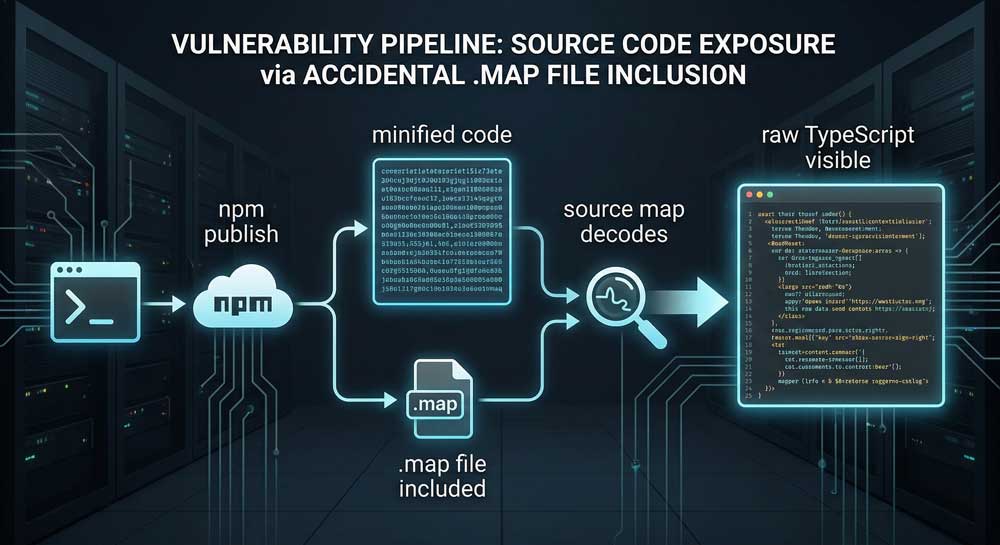
On March 31, 2026, security researcher Chaofan Shou discovered that Anthropic’s npm package @anthropic-ai/claude-code version 2.1.88 had shipped with a 59.8 MB .map file accidentally bundled inside. Source map files are debugging tools designed to reverse-engineer compressed, minified code back into its original, human-readable form. Including one in a public production release is the software equivalent of publishing your diary alongside your business report.
What followed was immediate and irreversible. Within hours, the file pointed developers to an R2 storage bucket containing Anthropic’s full, unobfuscated TypeScript source code. The reconstructed codebase spanned 1,906 files and over 512,000 lines of code. Developers worldwide began archiving, forking, and dissecting it at a speed no legal team could match.
Critically, this was not the first time. An almost identical source map leak had occurred in February 2025 — making this Anthropic’s second such incident in just over a year, and raising serious questions about their release pipeline discipline.
What Is Claude Code — and Why Does This Matter?
For those outside the developer world, Claude Code is Anthropic’s flagship agentic command-line coding tool. It’s not a simple chatbot. It’s a fully autonomous AI developer that can read your codebase, write and edit files, run tests, catch its own errors, self-reflect, and keep iterating until the job is done — all from your terminal.
The reason developers consider it the gold standard is a combination of two factors:
| Factor | Why It Matters |
|---|---|
| Model capability | Claude models dominate coding-specific AI benchmarks, holding multiple top-5 positions on the LMSYS Chatbot Arena leaderboard |
| Engineering architecture | Anthropic designed proprietary workflows that feed the model code in manageable chunks, route errors back for self-correction, and maintain reliable context across massive projects |
Competitors like Cursor CLI, OpenCode, Kimi Code, and OpenAI Codex CLI all operate in the same space, but developers have consistently ranked Claude Code above them for real-world reliability. That edge came almost entirely from the second factor — the engineering architecture — which was Anthropic’s most closely guarded intellectual property. Until now.
Inside the Leak: 44 Hidden Features Anthropic Never Meant to Ship
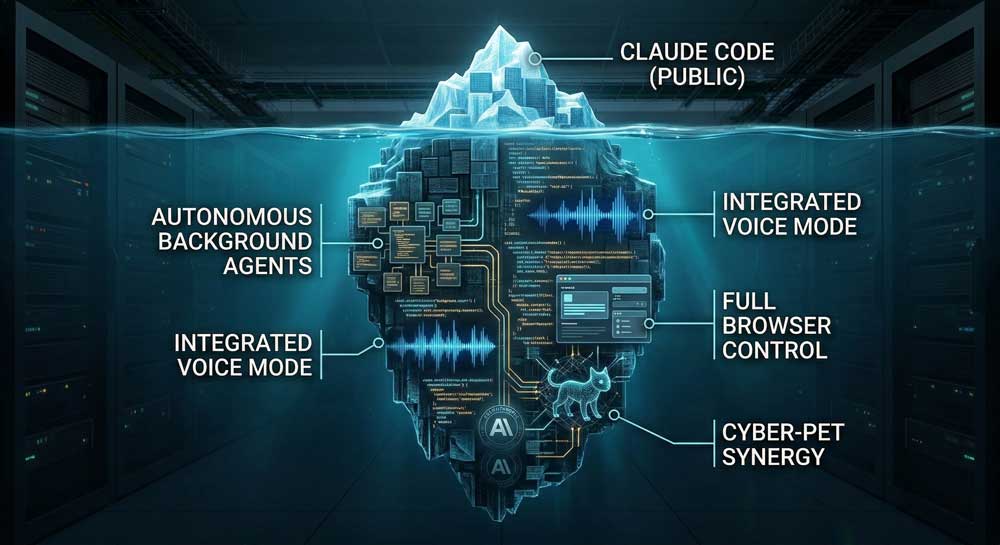
The most electrifying discovery wasn’t what Claude Code currently does — it was what Anthropic has already built but not yet released. Buried inside the source were 44 feature flags covering fully compiled, functional features that are simply switched off in external builds. These aren’t vague roadmap items. They are production-ready code sitting behind a boolean.
| Hidden Feature | What It Does |
|---|---|
| Background agents (24/7) | Autonomous agents running continuously with GitHub webhooks and push notifications — no user present required |
| Multi-agent orchestration | One “boss” Claude directing multiple worker Claudes, each with a restricted toolset for their specific task |
| Cron scheduling | Create, delete, and list scheduled agent jobs with external webhook triggers |
| Voice command mode | Full voice-controlled CLI interface with its own dedicated entry point |
| Playwright browser control | Real browser automation — not just web fetching, but full interactive browser control |
| Self-resuming agents | Agents that can pause, sleep, and restart themselves without user prompting |
| Persistent cross-session memory | Memory that survives session restarts without any external storage dependency |
Beyond unshipped features, developers also uncovered several existing but undisclosed behaviors:
- Undercover Mode: Claude Code is explicitly instructed to hide its AI identity when making Git commits to public repositories, so no one can tell the code was written by an AI. Ironically, the source code revealing this was reportedly generated with Claude’s own help
- Anti-distillation traps: The system secretly injects false or “polluted” records into conversations to prevent competitors from training their own models on Claude’s outputs
- Emotion tracking: The tool quietly logs how often a user expresses frustration or “yells” at the AI
- Cyber-pet companion (“Buddy”): A gamified hidden feature that generates a unique virtual pet for each user based on their account ID, complete with rarity tiers — a Tamagotchi for developers
The DMCA Counterattack and the Open-Source Rebellion
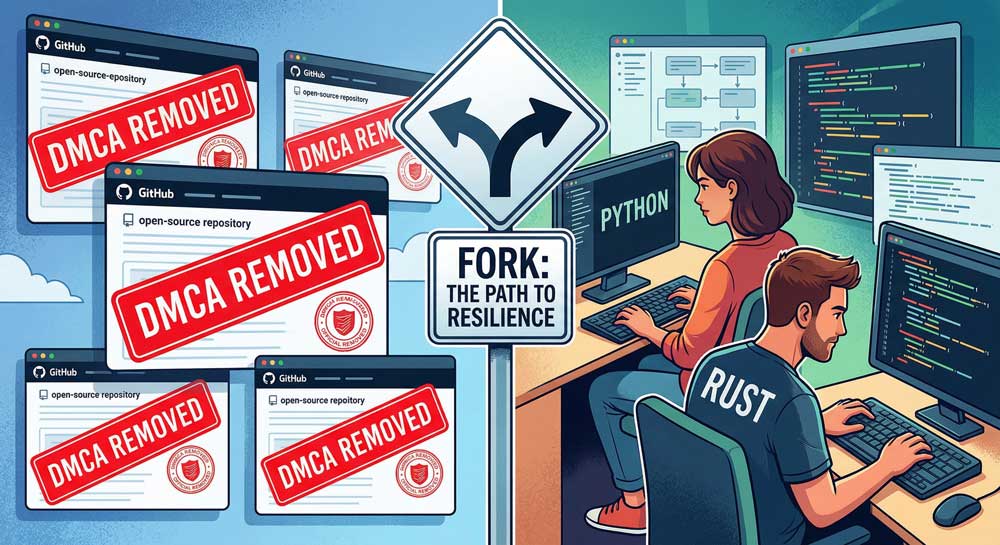
Anthropic moved fast. The company filed aggressive DMCA (Digital Millennium Copyright Act) takedown notices with GitHub, ultimately forcing the removal of 8,100 repositories that had forked or archived the leaked code. The repositories vanished overnight.
But the developer community is not easily contained, and copyright law has a well-known limitation: it protects the specific expression of code, not the underlying ideas or architectural logic.
Developers immediately began reimplementing Claude Code’s core architecture from scratch in different programming languages:
| Rewrite Language | Status |
|---|---|
| Python | Multiple open-source reimplementations appeared within 48 hours |
| Rust | Early implementations shared across developer forums |
| Go | Community contributions in progress |
You cannot copyright an idea. Once a workflow pattern is understood and documented in thousands of developers’ minds and notes, the DMCA becomes largely symbolic. The playbook is out.
This Was Also Part of a Catastrophic Week for Anthropic
The Claude Code leak did not happen in isolation. Just five days earlier, on March 26, Anthropic had suffered a separate incident where approximately 3,000 internal documents were exposed due to a CMS configuration error. That leak reportedly included details of an unreleased model codenamed “Claude Mythos.”
Two major accidental disclosures in less than a week — both attributed to human error — prompted public scrutiny about whether a company that builds tools to assist with software development and code review is applying those same standards internally.
Anthropic confirmed that the Claude Code leak did not expose customer data, credentials, model weights, or core reasoning infrastructure. The Claude models themselves were unaffected. But the technical blueprint for building a competing product? That barrier has been dramatically lowered.
Why the Claude Code Leak Will Upgrade Every AI Tool You Use
The practical impact of this leak extends far beyond the developer community. The core question that every AI product team has been wrestling with — how do you make an AI agent reliably useful on complex, real-world tasks? — has now been answered publicly by the industry leader.
The architectural lessons now available to every competitor include:
- How to write system prompts that keep an AI reliably on-task across a multi-hour, multi-file coding session
- How to structure self-healing memory so the AI doesn’t lose context or confuse itself mid-project
- How to design auto-debugging loops where the model reads its own error logs, reflects, and retries
- How to prevent model distillation so competitors can’t silently scrape your AI’s outputs to train their own
The community’s reaction reflects the complicated relationship many developers have with Anthropic. The company is simultaneously admired for pioneering MCP (Model Context Protocol), Constitutional AI training methodology, and agentic tool frameworks — and resented for aggressive account suspension policies and usage restrictions. That tension makes the leak feel, to many, like a satisfying cosmic correction.
The performance gap between Claude Code and its rivals was never purely about which underlying model was smarter. It was largely an engineering gap. That gap just closed significantly — for every AI tool on the planet.
As one Reddit commenter summarized the mood: “The general sentiment is that it’s both amusing and beneficial.”
Key Facts at a Glance
| Detail | Fact |
|---|---|
| Date discovered | March 31, 2026 |
| Discoverer | Security researcher Chaofan Shou (@shoucccc) |
| Package affected | @anthropic-ai/claude-code v2.1.88 on npm |
| File responsible | cli.js.map — 59.8 MB source map |
| Code exposed | 1,906 files, 512,000+ lines of TypeScript |
| GitHub repos taken down | 8,100 via DMCA |
| Previous similar incident | February 2025 |
| Unshipped features revealed | 44 feature flags, 20+ fully built |
Authoritative Sources
- Ars Technica: Entire Claude Code CLI source code leaks thanks to exposed map file
- BleepingComputer: Claude Code source code accidentally leaked in NPM package
- Claude Code’s Entire Source Code Was Just Leaked via npm Source Maps — Here’s What’s Inside
- Gate.com: Claude Code Source Code Leaked — Anthropic DMCA Takedown of 8,100 GitHub Repos
- innfactory.ai: How Does Claude Code Work? A Source Map Leak Shows It in Detail
- Penligent AI: Claude Code Source Map Leak — What Was Exposed and What It Means
- Mozilla Developer Network: How to use a source map
- Anthropic: Model Context Protocol announcement
- Nvidia H200 Chips China Sales Hit Zero: 7 Shocking Reasons Trump’s Strategy Backfired
- Chinese AI Models: 7 Powerful Ways They’re Dominating the Global Developer Market in 2026
- 7 Harsh Realities of AI Job Displacement: Why 4,000+ Tech Layoffs Are Just the Beginning