Claude Mythos & AI Job Disruption: 5 Brutal Truths Every Professional Needs to Know
Claude Mythos has arrived with record-breaking benchmarks — and so has a fresh wave of AI job disruption warnings. But before you update your résumé in a panic, it is worth asking: is this a genuine technological reckoning, or the most sophisticated investor pitch Silicon Valley has ever staged?
When technology mythology, compute constraints, and capital ambition collide, the real story is far more complex — and far more consequential — than any single headline suggests.
Table of Contents
What Claude Mythos Actually Does
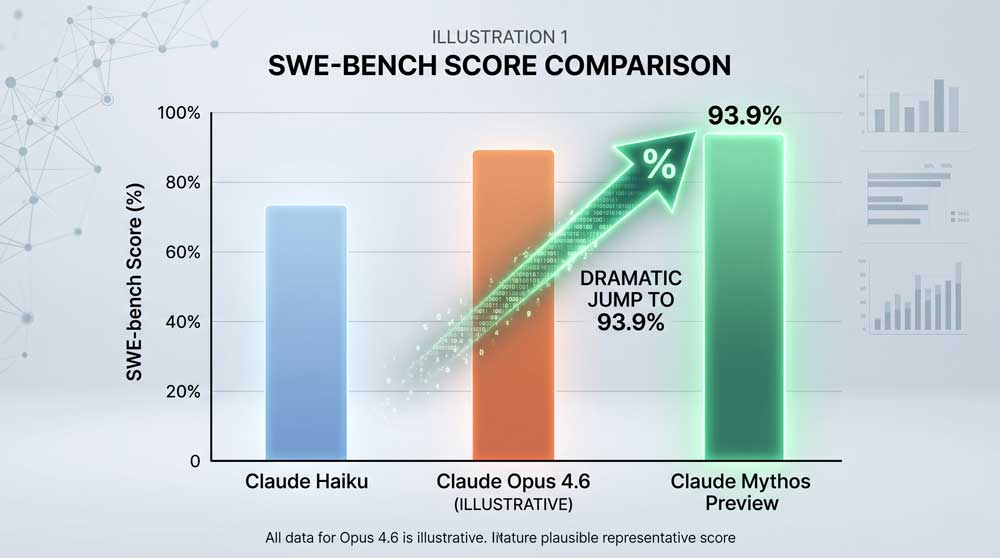
On April 7, 2026, Anthropic released the Claude Mythos Preview system card, and the benchmark numbers were genuinely staggering. The model achieved a 93.9% score on SWE-bench Verified — a 13.1 percentage point improvement over its predecessor, Opus 4.6 — placing it at the frontier of software engineering capability. It also scored 97.6% on USAMO mathematics problems and 86.9% on BrowseComp web navigation tasks, doing so with 4.9 times fewer tokens than the previous model.
In cybersecurity testing, Anthropic’s red team found Mythos capable of identifying decades-old zero-day vulnerabilities — the kind of latent bugs that had evaded human detection for up to 27 years. This is not an incremental update. In my view, it represents a qualitative shift in what AI systems can accomplish in real-world professional environments.
| Benchmark | Claude Opus 4.6 | Claude Mythos Preview | Improvement |
|---|---|---|---|
| SWE-bench Verified | ~80.8% | 93.9% | +13.1% |
| USAMO (Mathematics) | ~42.3% | 97.6% | +55.3% |
| Terminal-Bench | N/A | 82% | — |
| BrowseComp | Baseline | 86.9% | 4.9× fewer tokens |
The 6–12 Month Lead: How Fragile Is It?
I think the honest answer is: very fragile. Dario Amodei himself has acknowledged that Anthropic’s technological lead over its closest competitors may amount to just six to twelve months. In a race driven by national-level investment and geopolitical competition, no technical moat is permanent. The real competitive resource is not a breakthrough algorithm — it is compute infrastructure: data centres, power grids, and cooling systems.
This is precisely why Anthropic recently signed agreements with Google and Broadcom worth hundreds of billions of dollars in chip and cloud commitments, in a bid to secure the compute required to stay ahead. The race for frontier AI is, at its core, a race for physical infrastructure — and that is a reality no amount of research elegance can change.
The Safety Narrative vs. The Compute Reality
Anthropic has publicly stated that Claude Mythos is being rolled out in a deliberately limited fashion — citing safety and misuse concerns as the primary reasons. On the surface, this sounds deeply responsible. I believe the company’s safety commitments are genuine in part. But the full picture is more complicated.

According to reporting from the Financial Times, data centre delays and infrastructure bottlenecks are threatening to choke AI expansion across the entire industry, with nearly 40% of projects facing slowdowns. Insiders familiar with Anthropic’s operations have suggested that server instability and capacity constraints have been a significant factor in limiting Mythos’s broader deployment — running alongside, not separate from, safety considerations.
In my view, wrapping an infrastructure constraint inside a safety narrative is not unique to Anthropic — it is standard practice across the tech industry. The problem is that conflating the two erodes trust. When moral responsibility and resource scarcity point in the same direction, the ethical framing becomes harder to take at face value.
The White-Collar Apocalypse Claim: Alarm or Pitch Deck?
In May 2025, Amodei told Axios that AI could eliminate roughly 50% of all entry-level white-collar jobs — in technology, law, consulting, and finance — within one to five years, potentially driving unemployment to between 10% and 20%. The statement sent shockwaves across social media and ignited genuine career anxiety among millions of professionals.
I think the fear it triggers is real. The disruption will be real. But I also believe the timing and framing of these warnings deserve scrutiny. Anthropic is preparing for what is shaping up to be one of the most significant IPOs of the decade, with its valuation having climbed toward $800 billion. A company that credibly claims it will replace half of all white-collar labour is not merely a productivity tool — it becomes a candidate for the most important infrastructure investment of the 21st century.
The difference in narrative value is enormous. A “better coding assistant” might justify a valuation in the tens of billions. An AI system positioned as the replacement for entire professional labour markets — the new backbone of the global economy — justifies an entirely different order of magnitude. In my assessment, these warnings function simultaneously as genuine concern and as the most compelling institutional investor pitch imaginable.
Yann LeCun, Turing Award winner and former Chief AI Scientist at Meta, has been direct in his pushback: he argues that predictions of this kind misrepresent how technological change actually propagates through labour markets, and urges the public to consult economists rather than AI executives making forecasts that conveniently align with their fundraising cycles.
| Narrative Frame | Who It Targets | What It Achieves |
|---|---|---|
| “AI will destroy 50% of white-collar jobs” | General public, media | Drives urgency, fear, FOMO |
| “Anthropic is building the new labour infrastructure” | Institutional investors, sovereign funds | Justifies trillion-dollar valuation ambitions |
| “We are the responsible safety-focused AI lab” | Regulators, governments | Builds political goodwill and regulatory buffer |
The Contradictions at the Heart of Anthropic
Amodei is a genuinely contradictory figure, and I mean that as an analytical observation rather than a criticism. He declined to provide AI capabilities for domestic mass-surveillance applications — a decision that earned him public rebuke from political figures who labelled him a radical — demonstrating that his safety convictions carry real costs. He founded Anthropic as a public benefit corporation, with pledges to donate the majority of future wealth, and frames his work as a counterweight to unchecked Silicon Valley power concentration.
Yet the structural reality of his position runs in tension with those values. Every doomsday forecast he makes for the labour market adds fuel to the venture capital engine that is propelling Anthropic’s valuation skyward. The uncomfortable truth — one I think is worth sitting with — is that the final shape of AGI may be determined less by carefully crafted safety alignment protocols and more by the compounding pressure of investor growth expectations and competitive survival instincts.

What This Means for You: 3 Practical Responses
The AI acceleration is real. The disruption to professional work is real. But the anxiety being manufactured around it is not an accident. Here is how I think about navigating this environment:
- Separate the signal from the pitch. When an AI CEO makes dramatic labour market predictions, check the company’s funding calendar. That context does not invalidate the claim — but it is essential information for calibrating how much weight to give it.
- Focus on demonstrated capability, not projections. Claude Mythos’s 93.9% SWE-bench score and its cybersecurity performance are documented and verifiable. That is the baseline to reason from — not hypothetical unemployment figures from a fundraising narrative.
- The cost curve is the real story. As frontier AI capability is replicated by a growing number of competitors, the cost of deploying powerful AI tools will fall dramatically. For professionals who invest time now in learning how to use these systems effectively, that cost collapse represents genuine leverage — not a threat.
The storm is already here. The question is whether you are reading the weather or being sold an umbrella.
🔗 Reference URLs
- Financial Times — Data centre delays threaten to choke AI expansion
- Axios — AI jobs danger: Sleepwalking into a white-collar bloodbath
- Fortune — Anthropic CEO warns AI could eliminate half of all entry-level white-collar jobs
- NxCode — Claude Mythos Benchmarks: 93.9% SWE-bench & Every Record Broken
- MindStudio — Claude Mythos Benchmark Results: SWE-Bench 93.9% and What It Means
- Forbes — Dario Amodei Doubled Down On His AI Jobs Warning. Here’s What’s Different Now
- The Next Web — Claude Opus 4.7 leads on SWE-bench and agentic reasoning
- Financial Times — Anthropic in chips deals with Google and Broadcom worth hundreds of billions
- ElevenLab — 7 Harsh Realities of AI Job Displacement: Why 4,000+ Tech Layoffs Are Just the Beginning
- ElevenLab — Blackstone AI Investment Australia: $15 Billion Bet on Infrastructure vs. Reality of Productivity Crisis
- ElevenLab — Big Tech AI Spending Reaches $670B in 2026: Infrastructure Giants vs. Apple’s Strategic Pivot