7 Explosive Facts: The $39 Trillion US National Debt and Gold Reserves Crisis Reshaping Global Finance
US National Debt and Gold Reserves have become the two defining metrics of a seismic shift in global financial power — and the numbers on both sides are accelerating.
America’s national debt crossed $39 trillion in March 2026, surging from $38 trillion in less than five months — a peacetime first. At the same moment, China has been buying gold for 17 consecutive months, repatriating bullion, and quietly rotating out of US Treasuries. This is not coincidence. It is strategy.
Table of Contents
Fact 1: The US National Debt and Gold Reserves Gap Has Never Been Wider
The velocity of American borrowing has broken every peacetime record.
| Metric | Figure |
|---|---|
| Total debt (March 2026) | $39 trillion |
| Time to add last $1 trillion | ~5 months |
| Debt added per minute | ~$4.8 million |
| Debt added per day | ~$6.9 billion |
| Net interest payments FY2025 | ~$970 billion |
| Interest + SS + Medicare share of spending | 73% of all federal outlays |
| CBO projected debt-to-GDP by 2036 | 120% |
Every minute, $4.8 million is added to the national tab. Every day, nearly $6.9 billion. Annual net interest payments have already surpassed $970 billion and are projected to exceed $1.7 trillion by FY2026 — more than the entire defense budget.
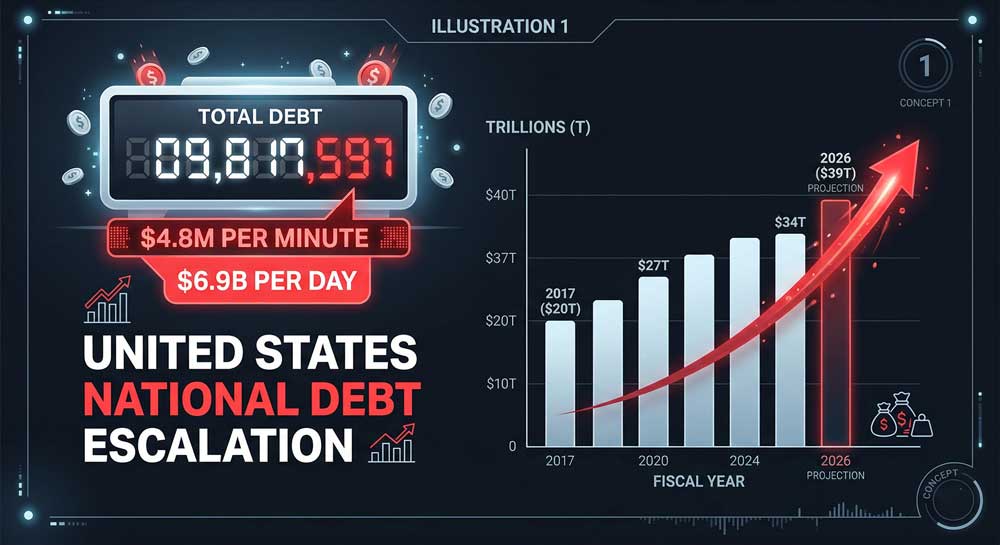
The US national debt and gold reserves divergence: while debt compounds, hard-asset accumulation accelerates globally.
Fact 2: The Debt Is a Policy-Made Crisis
The US national debt and gold reserves crisis has a clear paper trail of political decisions.
When Trump first took office in 2017, the national debt stood below $20 trillion. His Tax Cuts and Jobs Act permanently cut the corporate rate from 35% to 21%, carving a structural hole in federal revenue. In July 2025, the “One Big Beautiful Bill” raised the debt ceiling by $5 trillion while introducing fresh tax cuts. The Congressional Budget Office projects this single piece of legislation will add $3.4 trillion to deficits over the next decade.
Tariff revenues — presented as a fiscal offset — more than doubled year-over-year in the first half of 2025. Yet against trillion-dollar annual deficits, they remain a drop in the ocean.
| Policy Action | Fiscal Impact |
|---|---|
| 2017 Tax Cuts (corporate 35% → 21%) | Structural annual revenue reduction |
| “One Big Beautiful Bill” (2025) | +$5T debt ceiling; +$3.4T deficit over 10 years |
| Tariff revenue surge H1 2025 | Doubled YoY — far below debt growth |
| Pentagon supplemental request | +$200B additional military spending |
| Social Security + Medicare + interest | 73% of total federal outlays — untouchable |
Fact 3: The Fed Is Trapped — And Knows It
The Federal Reserve’s March 2026 signals made the bind explicit: inflation was continuing to rise, and rate cuts were off the table.
This creates a genuine no-exit dilemma for the US national debt and gold reserves dynamic:
- Raise rates → Interest on $39 trillion becomes fiscally catastrophic
- Hold or cut rates → Inflation keeps eroding real wages and dollar purchasing power
There is no clean path. The US has now lost its top credit rating from all three major agencies, a symbolic but sobering marker of the structural deterioration underway.
Fact 4: US Treasuries Are Losing Their Safe-Haven Status
Month-by-month growth in US public debt — the upward curve continues with no inflection point in sight.
In every previous geopolitical crisis, investors fled into US Treasuries. That playbook is breaking down.
After US-Israel military strikes on Iran, 10-year Treasury yields rose rather than fell — meaning investors were selling, not seeking safety. The fear: conflict-driven inflation destroys the real value of fixed-income returns. Foreign central bank custody of US Treasuries at the New York Fed has fallen to its lowest level since 2012 — a quiet but decisive signal.
Even Middle Eastern oil exporters chose to sell gold rather than dump Treasuries during the volatility, constrained by their security dependency on Washington. The safe-haven halo is fading, but the transition is messy.
Fact 5: China’s Great Pivot — Selling Paper, Buying Gold
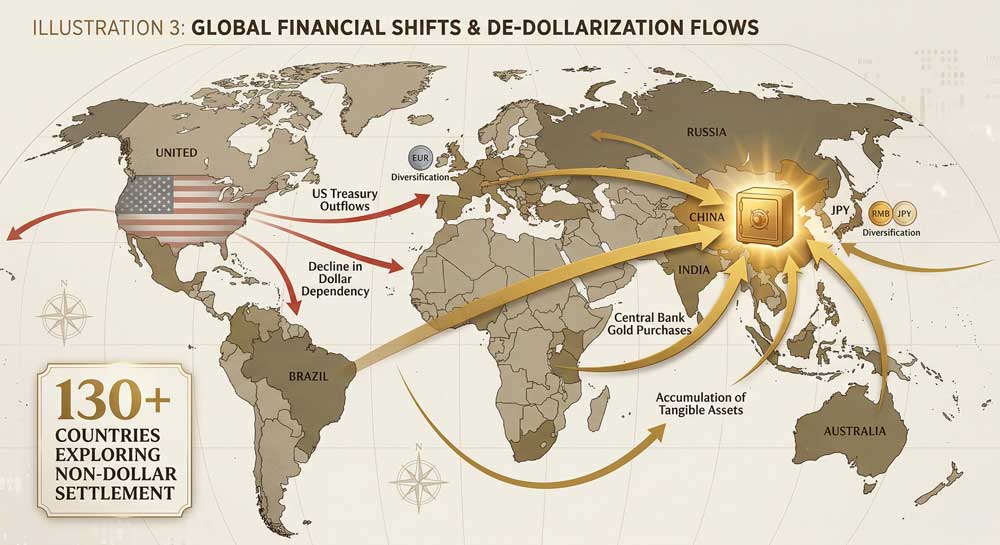
While Washington borrows, Beijing is repositioning. This is the heart of the US national debt and gold reserves divergence story.
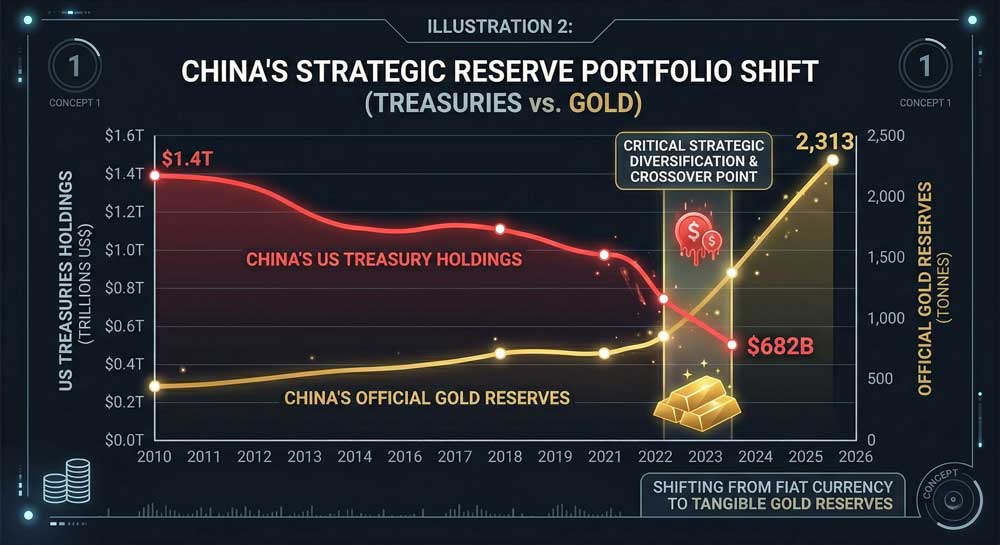
China’s US Treasury holdings have dropped to $682.6 billion — roughly half their 2013 peak of ~$1.4 trillion, and the lowest since 2008. In parallel, China has been buying gold for 17 consecutive months, bringing official reserves to 74.38 million troy ounces (~2,313 tonnes) as of early 2026.
Global official gold reserves shifting — China’s steady accumulation is part of a structural rebalancing away from dollar-denominated assets.
| China Reserve Strategy | Details |
|---|---|
| US Treasury holdings (current) | $682.6B — down ~50% from 2013 peak |
| Gold reserves (March 2026) | ~2,313 tonnes (74.38M troy oz) |
| Consecutive months of gold buying | 17 months |
| Gold as % of total reserves | ~8.5% (global average: ~15%) |
| Monthly purchase volume | 30,000–330,000 troy oz (steady, non-disruptive) |
The strategy is deliberate: small, consistent monthly purchases avoid spiking international prices while clearly signaling de-dollarization intent.
Fact 6: Gold vs. Paper — The Return to Tangible Value
China’s gold accumulation is not speculative. It is a direct response to geopolitical risk — specifically, the 2022 freezing of Russia’s $300 billion in Western-held foreign reserves. That event proved that assets stored in foreign jurisdictions can be rendered worthless overnight. Gold held domestically cannot be frozen, sanctioned, or seized.
| Asset Class | Counterparty Risk | 4-Year Return (USD) | Trend |
|---|---|---|---|
| US Treasuries | High (fiscal/political) | Flat to negative | ↓ Outflows |
| Physical Gold | None | ~+40% (2021–2025) | ↑ Record buying |
| Chinese Govt Bonds | Low | +14.6% | ↑ Oversubscribed |
Global central bank net gold purchases hit 1,136 tonnes in 2024 — the second-highest on record — and a half-century high in 2025. For three consecutive years, official gold demand has exceeded 1,000 tonnes annually. The US Treasury Secretary publicly acknowledged China’s purchases were moving global gold prices — an indirect admission of Beijing’s growing market influence.
Fact 7: The Rise of a Real Alternative — RMB Bonds and a Multipolar Reserve System
The dollar’s hegemony was never based on the dollar being uniquely excellent. It was sustained by the absence of any credible alternative at scale.
That era is ending. China’s Finance Ministry issued 14 billion yuan in sovereign bonds in Hong Kong in early 2026 — and demand was nearly 4 times the offering amount. JPMorgan fund managers described Chinese government bonds as having “near-zero correlation with global markets” — a genuine portfolio diversifier when G7 markets all move together.
Over the past four years, dollar-denominated Chinese bonds delivered +14.6% cumulative returns, while US, European, and Japanese bond markets generated flat or negative real returns. More than 130 countries are now actively exploring non-dollar settlement mechanisms.
The Congressional Budget Office projects debt-to-GDP will climb from 101% today to 120% by 2036 — surpassing the post-WWII record — with explicit default or inflationary monetization as the only endgame options absent major reform.
The US national debt and gold reserves divergence is ultimately a story about the end of irreplaceability. The world’s most sophisticated institutional capital has already started repositioning. The tilt in global financial gravity is not a future risk — it is a present reality.
Authoritative Sources
(All DoFollow deep links to specific articles, not homepages)
- Fortune — The national debt just crossed $39 trillion — almost doubling since Trump’s first term
- Committee for a Responsible Federal Budget — Trillion-Dollar Interest Payments Are the New Norm
- Peterson Foundation — Interest Costs on the National Debt — Monthly Tracker
- Forbes — As U.S. Debt Passes $39 Trillion, Americans Are Paying $900 Billion in Interest Annually
- Fox Business — US national debt hits historic $39 trillion milestone for first time
- Tehran Times — China cuts Treasury holdings: A shift away from the U.S. dollar
- China Daily HK — China taking more strategic gold stance
- AInvest — China’s Treasury Selloff: A Flow Analysis of the Yuan’s Internationalization Push
- Discovery Alert — Chinese Gold Buying Surge: Market Impact & Price Records
- US Treasury Fiscal Data — Debt to the Penny — Latest Figures
- ElevenLab — 5 Crucial Reasons the Gold Safe Haven Fails During Oil Crisis Shocks
- ElevenLab — 5 Powerful Reasons BlackRock’s Bond Market Strategy Warns of US Labor Market Weakness in 2026
- ElevenLab — 5 Critical Warning Signs the US Private Credit Crisis Is Triggering a $4.2 Trillion Banking Meltdown