Alarming Pattern: Gold Price Crash in January Revealed (3 Historical Lessons)
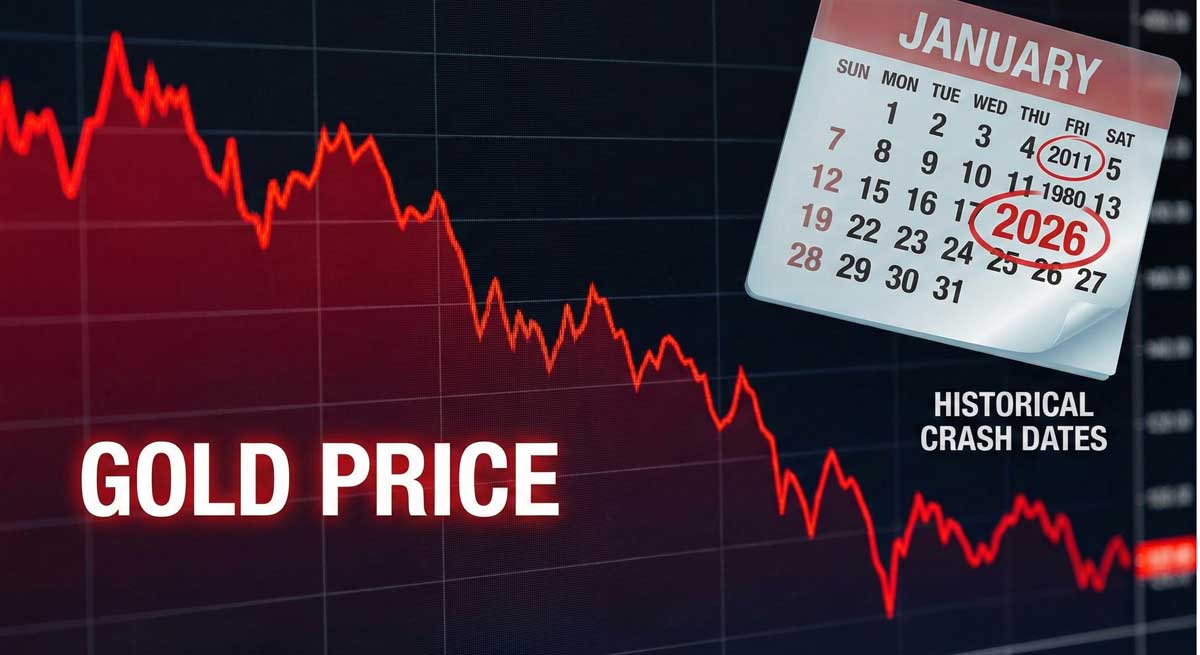
On January 31, 2026, spot gold crashed 9.45% in a single day—the steepest plunge in nearly 40 years. For investors celebrating 2025’s stellar returns, this felt like financial whiplash. But seasoned traders recognized something eerily familiar: another Gold Price Crash in January.
This isn’t coincidence. January 2011 saw gold tumble over $100 within weeks. January 1980 witnessed a catastrophic 20% collapse in seven days. The pattern raises urgent questions: Is January genuinely cursed for precious metals? More importantly, does 2026 signal a temporary correction or the beginning of a generational bear market?
This analysis dissects three historical crashes, reveals the structural forces behind January’s vulnerability, and provides actionable insights for navigating today’s unprecedented market conditions.
Why Gold Price Crashes in January: The Structural Setup
Gold doesn’t crash exclusively in January—October 2008 saw prices plummet from $931 to $682 during the financial crisis. However, January possesses unique characteristics that create perfect storm conditions for volatility.
Critical January vulnerabilities:
- Institutional rebalancing pressure: Global fund managers reset annual asset allocations at year’s start, often selling overperforming assets like gold after strong previous-year gains
- Federal Reserve policy uncertainty: The Fed’s first meeting typically occurs in January, setting the tone for annual monetary policy when markets are hypersensitive to guidance
- Post-holiday liquidity gaps: Lower trading volumes amplify price movements as large sell orders encounter thinner order books
- Profit-taking psychology: Investors lock in gains from previous year’s performance, creating concentrated selling pressure
- Tax optimization timing: Some investors realize capital gains or losses strategically at fiscal year beginnings
According to market analysis, gold’s seasonal patterns show January historically delivers positive returns 65% of the time, making crashes statistically rare but structurally possible when conditions align.
Case Study 1: January 2011 – The Correction That Became an Opportunity
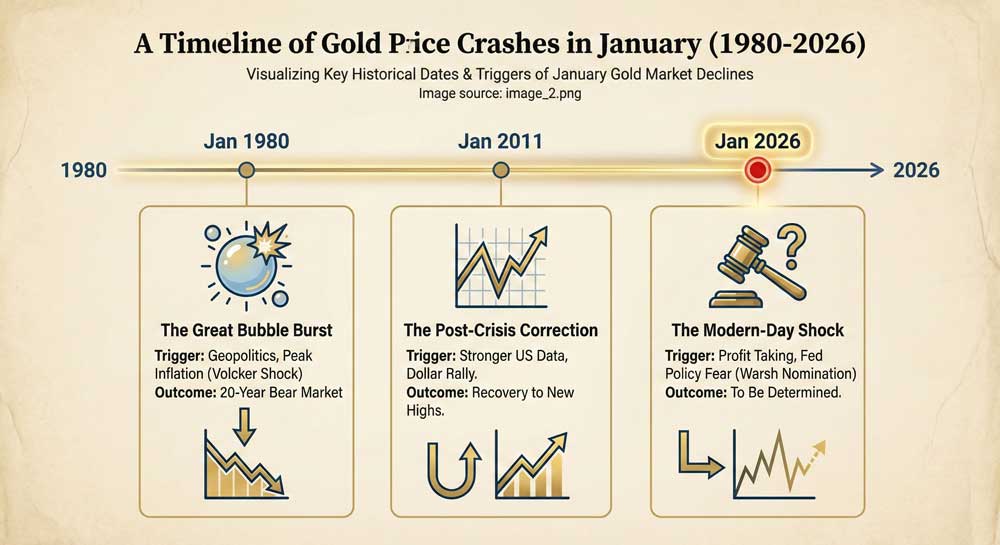
The Gold Price Crash in January 2011 mirrors 2026’s scenario with remarkable precision, offering crucial lessons about distinguishing corrections from reversals.
The buildup: Gold surged nearly 30% during 2010, leaving investors holding substantial unrealized gains heading into 2011. Portfolio managers faced pressure to rebalance overweight positions.
The catalyst: Unexpectedly strong US economic data in early January sparked speculation that the Federal Reserve would tighten monetary policy faster than anticipated. The dollar rallied sharply, triggering coordinated selling across precious metals.
The damage: Spot gold peaked at $1,422.85/oz on January 3rd before cratering to $1,307.45/oz by month’s end—a $115 decline that shook trader confidence.
The recovery: This proved temporary. Gold resumed its uptrend by March 2011, ultimately reaching $1,920.80/oz in September. Multiple catalysts reignited safe-haven demand:
- European sovereign debt crisis escalation
- Japan’s Fukushima nuclear disaster
- US debt ceiling standoff
- Persistent inflation concerns despite Fed optimism
Key insight: The 2011 crash represented a correction within a bull market, not a trend reversal. Strong underlying fundamentals—debt accumulation, geopolitical instability, monetary expansion—remained intact.
Case Study 2: January 1980 – When the Bull Became a Bear
![Vintage photo of 1980s trading floor showing panicked selling activity. Alt text: Traders reacting to the Gold Price Crash in January 1980 bear market beginning]
The Gold Price Crash in January 1980 tells a fundamentally different story—not correction, but capitulation. Understanding this distinction is critical for 2026 positioning.
The euphoric peak: 1979 delivered a staggering 126% gold return, capping a decade-long super-cycle following the Bretton Woods collapse. Rampant inflation, dollar debasement fears, and the Soviet invasion of Afghanistan drove gold to $852/oz in January 1980 —a record that would stand for decades.
The reversal: Federal Reserve Chairman Paul Volcker’s aggressive interest rate hikes reaching over 20% broke inflation’s back but also crushed gold’s rally. Higher real yields made non-yielding assets like gold unattractive.
The devastation: Gold plunged below $300/oz by June 1982, entering a brutal 20-year bear market lasting until 1999. This bear phase coincided with the “Great Moderation”—declining inflation, economic stability, and diminished geopolitical tensions following the Cold War’s end.
Key insight: The 1980 crash marked a secular trend reversal because underlying fundamentals shifted permanently. Inflation was defeated, monetary policy normalized, and geopolitical risk premiums evaporated.
Historical Comparison Table: Three January Crashes Analyzed
| Factor | January 1980 | January 2011 | January 2026 |
|---|---|---|---|
| Previous year gain | +126% (bubble territory) | +30% (strong bull) | Significant gains (exact % varies) |
| Market phase | Super-cycle peak | Mid-bull correction | Uncertain |
| Primary trigger | Volcker rate shock + geopolitics | Improved US data + tightening fears | Hawkish Fed chair nomination |
| Peak price | $852/oz | $1,422/oz | Pre-crash 2026 highs |
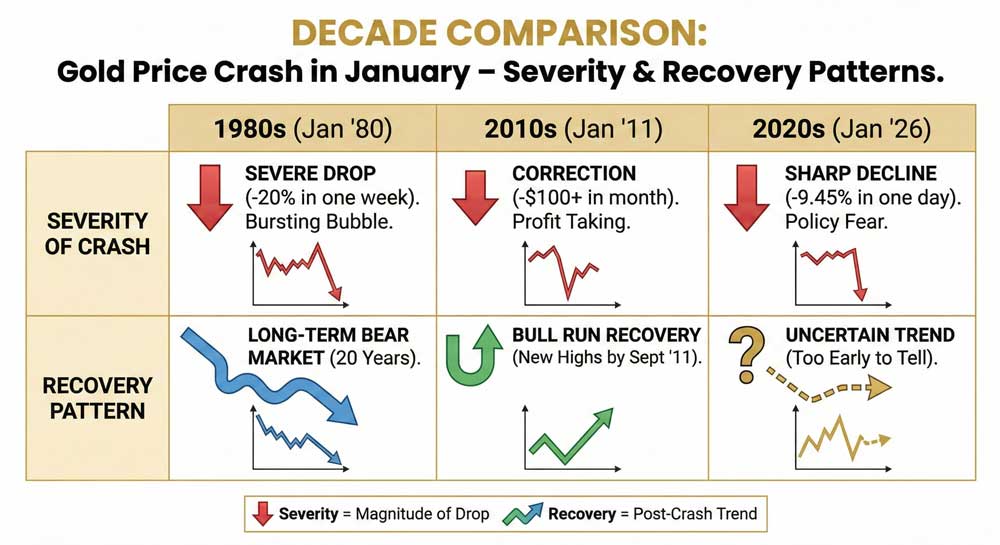
| Decline severity | 20% in one week | $115+ over month | 9.45% single day |
| Liquidity conditions | Panic selling | Orderly profit-taking | Flash-crash dynamics |
| Subsequent trend | 20-year bear market | Resumed rally to $1,920 | To be determined |
| Real interest rates | Turned sharply positive | Remained negative | Moving toward positive |
| Central bank actions | Aggressive tightening | Continued accommodation | Policy uncertainty |
2026: Which Historical Parallel Fits?
The January 2026 crash shares elements of both predecessors while introducing entirely new variables that complicate direct comparison.
Similarities to 2011 (correction scenario):
- Strong prior-year performance creating profit-taking pressure
- Federal Reserve policy uncertainty as primary catalyst
- Geopolitical tensions (different regions but comparable intensity)
- Central banks remaining net gold buyers unlike 1990s selling
Similarities to 1980 (reversal scenario):
- Potential shift toward restrictive monetary policy
- Real interest rates trending positive
- Peak speculation indicators in precious metals
- Dollar strengthening against major currencies
Critical 2026 differences requiring new frameworks:
Today’s gold market operates under unprecedented structural conditions:
- De-dollarization momentum: Central banks accumulated record gold reserves, with 1,044.6 tonnes officially added in 2024—fundamentally different from 1990s divestment
- Digital asset competition: Cryptocurrency emergence as alternative inflation hedge creates new portfolio dynamics
- AI economic disruption: Technological revolution introducing unpredictable productivity and employment shifts
- Geopolitical fragmentation: Multipolar world order replacing Cold War and post-Cold War structures
- Climate transition costs: Green economy transformation requiring massive capital reallocation
- Debt sustainability concerns: Government debt-to-GDP ratios far exceeding historical precedents
Investment Implications: Navigating Post-Crash Uncertainty
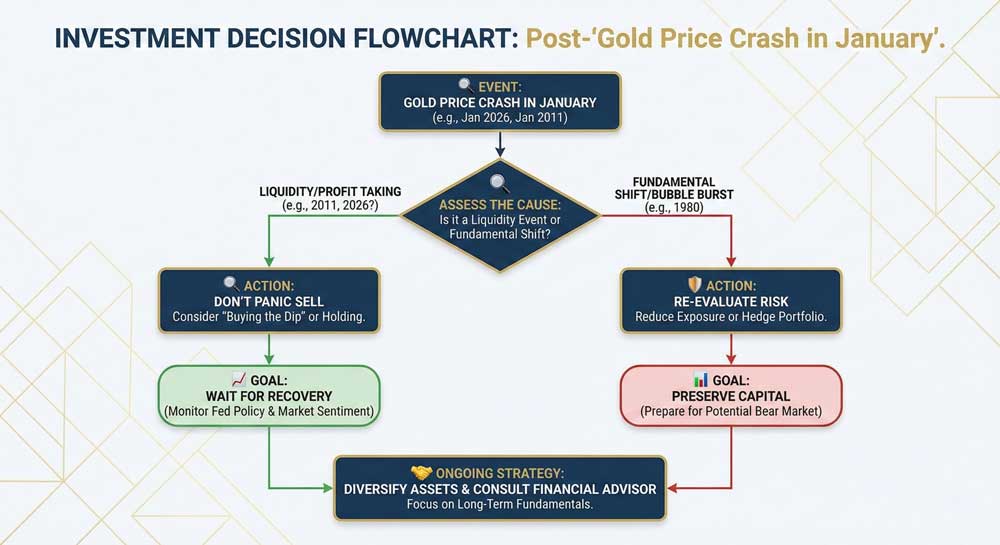
Immediate tactical considerations:
- Avoid panic liquidation: If fundamental drivers (debt accumulation, geopolitical tensions, monetary uncertainty) remain intact, January crashes historically represent liquidity events rather than value destruction
- Monitor Fed policy execution: Kevin Warsh’s actual decisions as Fed Chair will prove more determinative than nomination rhetoric
- Assess technical support levels: Gold breaking below key support around $4,360 could signal trend change; holding support suggests consolidation
- Watch dollar strength: Sustained dollar rally pressure versus temporary rebalancing move
Strategic portfolio positioning:
Understanding gold’s seasonal liquidity patterns emphasizes diversification remains paramount regardless of short-term directional bets:
- Maintain appropriate precious metals allocation (typically 5-10% for conservative portfolios)
- Consider dollar-cost averaging during volatility rather than timing bottoms
- Hedge with negatively correlated assets (quality bonds, defensive equities)
- Evaluate miners versus physical gold based on risk tolerance
Scenario planning framework:
| If 2026 follows… | 2011 pattern (correction) | 1980 pattern (reversal) |
|---|---|---|
| Signal to watch | Gold reclaims previous highs within 3-6 months | Gold breaks below $4,000 decisively |
| Key driver | Fed pivots dovish or crisis emerges | Real yields stay elevated, inflation normalizes |
| Portfolio action | Accumulate on weakness | Reduce exposure, rotate to yielding assets |
| Timeline | Recovery by late 2026 | Multi-year bear market |
Conclusion: History as Guide, Not Gospel
The Gold Price Crash in January isn’t mystical curse but rational outcome of institutional behavior, policy timing, and market psychology converging. Understanding 2011 and 1980 provides essential context, but 2026 operates under genuinely novel conditions requiring adaptive rather than formulaic responses.
Current technical analysis suggests gold futures may remain under pressure until April 2026, with key support at the 9 EMA around $3,959. Smart investors use historical patterns to manage risk objectively while remaining alert to paradigm shifts that could rewrite established rules.
Whether January 2026 proves another buying opportunity like 2011 or marks a generational top like 1980 depends on how new variables—de-dollarization, AI disruption, geopolitical realignment—interact with traditional monetary policy cycles.
The bottom line: Don’t fear January’s history; respect it. Position defensively while maintaining exposure to assets that protect against the genuine structural risks that made gold valuable in the first place.
Disclaimer: This analysis is for educational purposes only and does not constitute financial advice. Consult qualified financial advisors before making investment decisions.
Related Resources:
- Federal Reserve Rate Cuts Impact on Gold Markets
- Seasonal Trading Strategies for Gold (XAUUSD)
- Understanding Gold Market Liquidity Variations
- Central Bank Gold Buying Trends Analysis
Other Readings:
- 2025 Global Economy: A Fractured World Chasing Growth
- The Great Capital Migration: Why Global Investors Are Fleeing Australian Assets in 2026
- Davos 2026: Carney Warns of a Fractured Global Order and Calls for Middle-Power Unity
- 7 Reasons Why Silicon Valley Pivots to Natural Gas Investment for AI Power