AI IPO 2026: 3 Trillion-Dollar Giants That Could Reshape Markets
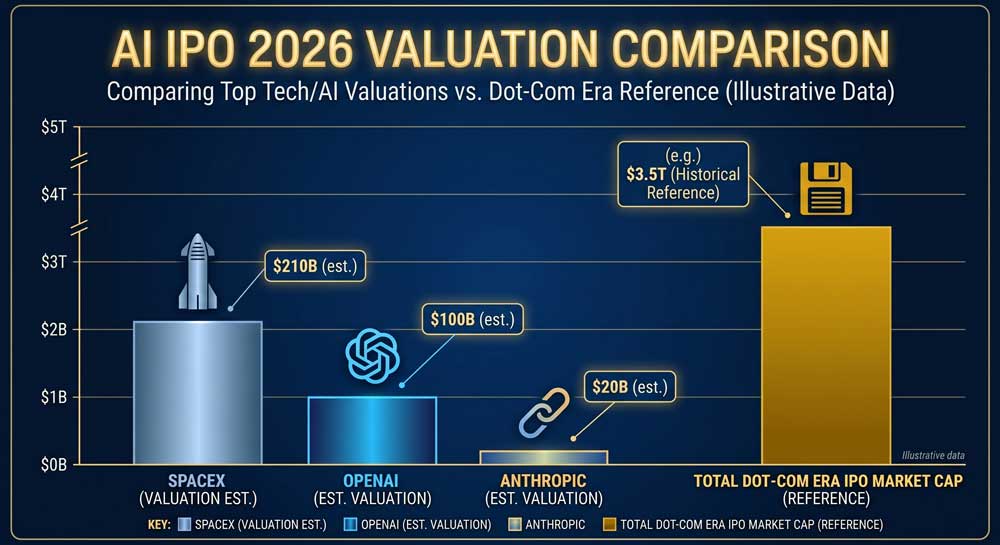
The AI IPO 2026 landscape is shaping up to be unlike anything capital markets have witnessed before. Three companies — SpaceX, OpenAI, and Anthropic — are all racing toward public listings in the same year, collectively targeting combined valuations that approach $4 trillion. To put that in perspective, it exceeds the total IPO market capitalisation of all 2,600 companies that went public during the peak of the dot-com boom in 2000.
This is not just a story about big numbers. It is a stress test for the entire global capital allocation system.
Table of Contents
The Three Contenders: By the Numbers
SpaceX filed its prospectus with the SEC and is targeting a listing on Nasdaq under the ticker SPCX, with a share price set at $135 and a target raise of approximately $74.4 billion — which would make it the largest IPO in history. At that price, SpaceX’s valuation lands above $1.75 trillion. OpenAI, meanwhile, has been laying the groundwork for a public offering targeting a $1 trillion valuation, with a filing potentially as early as the second half of 2026. Anthropic completed a $65 billion funding round at a post-money valuation of approximately $965 billion, making it the last major private AI fundraise before what looks like an imminent IPO.
| Company | Latest Valuation | IPO Target Valuation | Fundraise / IPO Raise |
|---|---|---|---|
| SpaceX | $1.77T (IPO price) | $1.75T+ | ~$74.4B |
| OpenAI | ~$852B | Up to $1T | $60B+ |
| Anthropic | ~$965B | ~$1T | $65B |
Together, these three companies are targeting a combined public market value of roughly $3.6 trillion to $4 trillion. That is an extraordinary concentration of capital demand landing in a single year.
What This Means for Market Liquidity
The liquidity math here is genuinely alarming if you look at it carefully. At normal IPO float ratios of 15–25%, these three listings alone would need to absorb somewhere between $400 billion and $500 billion from public markets. For context, the entire US IPO market raised roughly $469 billion across the full decade from 2016 to 2025. A single quarter could effectively match ten years of supply.
In practice, I expect all three will debut with minimal floats — likely in the 3–8% range — to manage the demand shock. But even so, the overlap in their listing windows from mid-2026 through year-end creates a sustained liquidity drain that markets have never navigated at this scale. The concern among institutional investors is not just the volume of capital required, but the compressing timeline in which that capital must be committed.
The US Stock Market’s Structural Reality
Before assessing the impact of these listings, it is worth understanding the market they are entering. US equities have crossed $75 trillion in total market capitalisation — a first in history. But that headline figure hides a deeply uneven internal structure.
The so-called “Magnificent Seven” — Apple, Microsoft, Alphabet, Amazon, Meta, Nvidia, and Tesla — now account for close to 40% of the S&P 500’s total weight. In 2025, approximately 45% of the S&P 500’s full-year gain came from just those seven stocks. Strip them out, and the remaining 493 companies essentially went nowhere.
The US equity market has effectively become a single-thesis trade: AI. Every dollar of excess return, every rerating, every incremental institutional allocation has been justified by some version of the AI growth narrative. That makes the arrival of three more trillion-dollar AI entrants both an amplification of that thesis and its most direct test yet.
The Bull and Bear Case: Wall Street’s Split Verdict
The divide among major institutions on where this goes next is as wide as I have seen in any market cycle.
The bull case rests on the idea that the capital being deployed today will eventually generate proportionate returns. The bear case — and I think Goldman frames it most cleanly — is that this rally is not built on the floor of low expectations and cheap valuations. It is built on the ceiling: the assumption that earnings must deliver, on schedule, at scale. The moment that delivery slips, the valuation floor disappears.
The Financial Reality Behind the Headlines
Turning to the actual financials of these three companies, the picture is more complex than the headline valuations suggest.
SpaceX’s prospectus reveals that its 2025 combined net loss was $4.94 billion, a dramatic reversal from a standalone profit of $791 million in 2024. Almost the entire swing came from xAI, which burned through roughly $14 billion in cash while generating only $3.2 billion in revenue. Starlink remains the only consistently profitable unit within the group. OpenAI reported approximately $5.7 billion in Q1 2026 revenue, but its adjusted operating margin was negative 122% — a structure where revenue growth accelerates losses rather than offsetting them. Most analysts do not expect OpenAI to generate positive cash flow before 2029 at the earliest.
Anthropic is the strongest of the three on near-term financials. The company is reportedly on track for its first profitable quarter, with revenue approaching $11 billion on an annualised basis. However, that “profitability” sits alongside a commitment to over 10GW of new compute capacity signed in recent weeks alone, which means any margin is immediately being reinvested at a rate that makes sustained profitability structurally distant.
What the AI Supply Chain Is Actually Earning
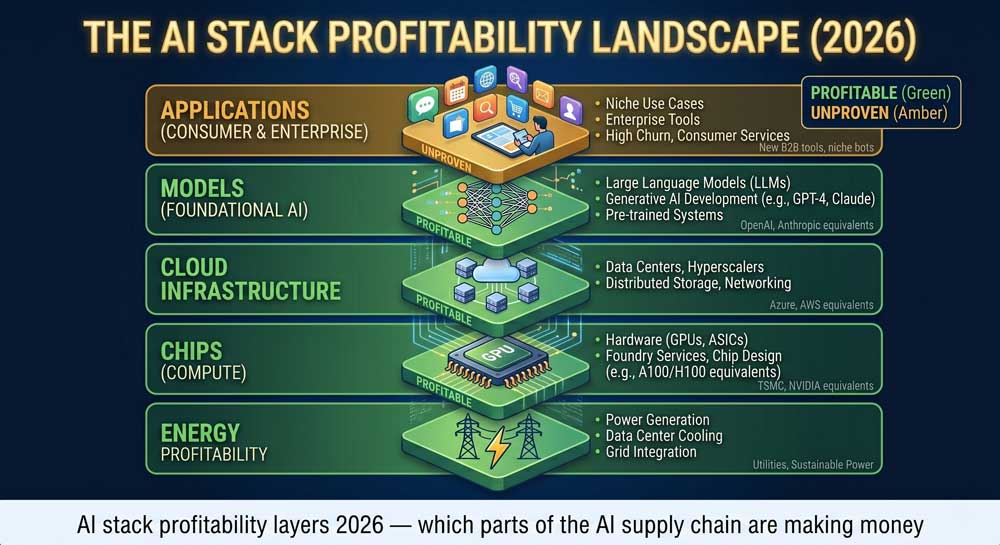
There is an important distinction to make here, and it is one I think gets lost in the IPO excitement. The AI ecosystem is already generating enormous real cash flows — just not at the application layer where these three companies primarily operate.
Nvidia’s latest quarterly operating profit reached $53.5 billion — possibly the highest single-quarter operating profit in commercial history. Dell reported $43.8 billion in quarterly revenue, up 88% year-on-year, with AI server revenue of $16.1 billion — a 757% increase — and a backlog of $51.3 billion in AI orders. Micron crossed $1 trillion in market capitalisation driven by AI-server demand for high-bandwidth memory. Microsoft, Google, Amazon, and Oracle have collectively accumulated over $2 trillion in compute order commitments.
This is what I would describe as “picks and shovels” profitability: the infrastructure layer of AI is generating verifiable, audited, cash-in-hand returns. The investment thesis for that layer is not a narrative — it is a P&L.
The challenge is that SpaceX’s xAI, OpenAI, and Anthropic are operating one layer higher, at the model and application level. That layer has not yet demonstrated the same closed-loop financial validation. AI-assisted coding is the one application that has genuinely scaled — and it has done so precisely because code is verifiable, testable, and correctable in real time. Most other enterprise AI applications do not yet have that property.
The China Parallel: Same Question, Different Language
Looking at the Chinese technology sector, I see a mirror image of the same structural dynamic — just expressed in different market vocabulary.
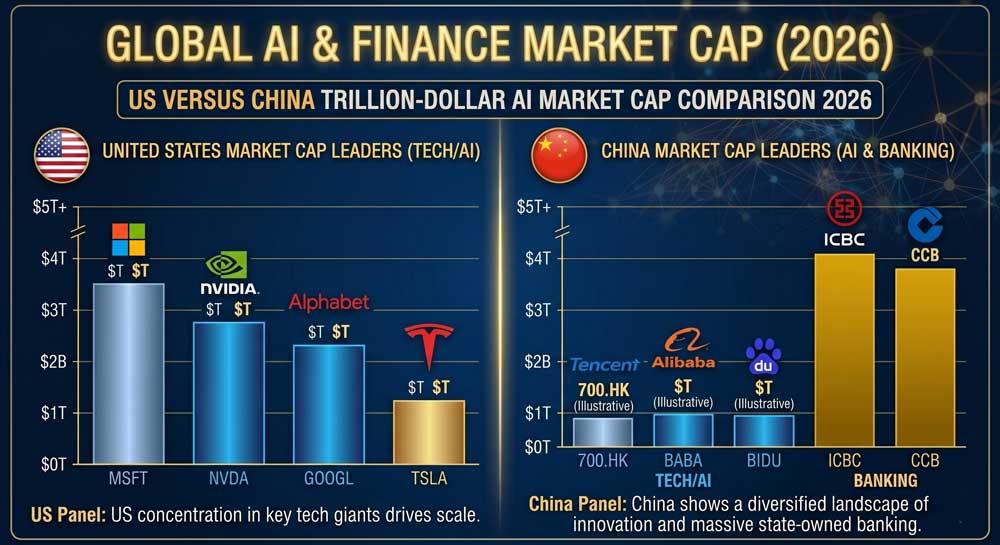
China has no listed company above $1 trillion in US dollar terms. Tencent, at close to $500 billion, is the closest. The top tier of Chinese market capitalisers is anchored not by AI growth stories, but by state-owned banks like ICBC and Agricultural Bank of China, whose stock appreciation in 2025 was driven by high dividend yields and low valuations — a “bond proxy” thesis that attracted patient institutional capital. Agricultural Bank of China’s A-shares rose over 50% in 2025 on that basis alone.
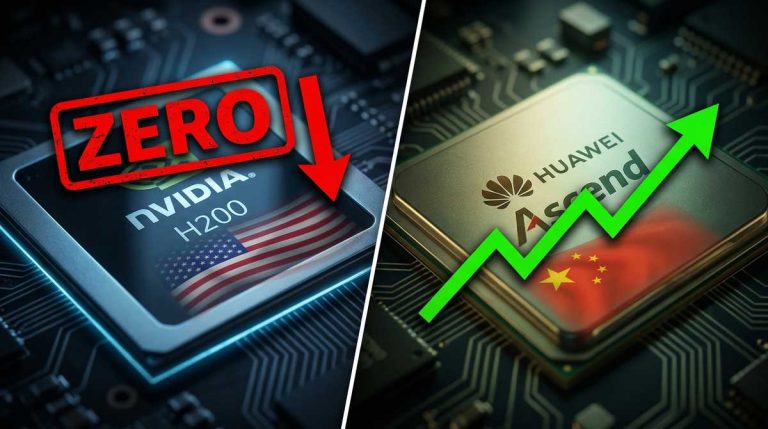
Chinese AI infrastructure companies like Cambricon, Moore Threads, and Muxi have a combined market capitalisation of roughly 1.2 trillion yuan — about 4% of Nvidia’s equivalent value. Yet Cambricon trades above 70x earnings, while Nvidia trades at roughly 40x. The premium is justified entirely by a domestic substitution narrative: the expectation that US chip export restrictions will force Chinese hyperscalers to source locally at scale. Alibaba, Tencent, Baidu, and ByteDance collectively increased capex by 48–132% in 2025, and ByteDance alone has reportedly committed 160 billion yuan to infrastructure in 2026, with nearly half allocated to domestic chips.
The structural parallel is striking: in both markets, upstream infrastructure spending is real and growing; in both markets, the application layer that would justify that spending has not yet delivered at scale. The difference is only the story being told to justify the premium — “AI dominance” in the US, “national self-sufficiency” in China.
The Core Risk Nobody Is Pricing Cleanly
The deepest risk in this entire landscape is not company-specific — it is timing. AI’s economic logic is sound at a first-principles level: greater intelligence, applied at scale, should produce higher marginal returns. The problem is that right now, marginal costs are running well ahead of marginal returns.
Historically, when capital concentrates this heavily around a single narrative, the system’s stability depends entirely on demand growth continuously exceeding expectation. The internet era’s lasting value came not from making existing tasks cheaper, but from creating entirely new markets — social media, mobile apps, e-commerce, cloud computing — that represented genuine net additions to GDP. AI has not yet produced that equivalent. The most honest question any investor or operator can ask in mid-2026 is: will AI create new demand at the scale and speed needed to justify the capital already committed?
That question does not yet have an answer. But the IPO calendar is forcing a verdict before the evidence is complete.
Three Principles for Navigating This Moment
For any business leader or investor watching this unfold, I would offer three grounding principles.
First, distinguish between technology leadership and valuation leadership. Dell’s free cash flow is technology leadership — it reflects real economic activity. SpaceX’s $1.77 trillion IPO valuation is valuation leadership — it reflects a bet on future states. Both are real, but they carry fundamentally different risk profiles.
Second, protect your cash flow. When global capital concentrates this intensely in AI, non-AI sectors will face tighter financing conditions. The companies that survive cycle turns are consistently the ones with strong balance sheets and stable operating cash generation. High-dividend, low-valuation assets have outperformed in exactly these conditions, and they will again.
Third, return to first principles on AI adoption. The right question is not “can I use AI?” It is “can AI help me create a category of demand that did not previously exist?” Substituting labour for AI tools is a defensive move. Opening new markets with AI is the offensive one. The internet era’s greatest winners were not the fastest coders — they were the people who used code to build markets that had never existed. The AI era will almost certainly follow the same pattern.
The listing of these three companies will be the loudest starting gun this market cycle has fired. Whether what follows is a gold rush or a reckoning depends on one thing: whether the fifth layer of the AI stack — real, paying, scalable demand — finally shows up.
Reference URLs
- Reuters — SpaceX Plans to Raise $75 Billion IPO at $135 Per Share
- The New York Times — SpaceX IPO to Be Largest Ever at $135 Share Price
- TechCrunch — Anthropic Raises $65 Billion, Nears $1T Valuation Ahead of IPO
- Reuters — OpenAI Lays Groundwork for Juggernaut IPO at Up to $1 Trillion Valuation
- Forbes — 4 Things To Know As OpenAI Eyes IPO
- Anthropic — Anthropic Raises $30 Billion in Series G Funding at $380 Billion Post-Money Valuation
- Zacks — SpaceX IPO 2026 Guide: Everything You Need to Know and Consider
- ElevenLab — Musk Anthropic SpaceX GPU Deal: 5 Powerful Reasons This Threatens OpenAI
- ElevenLab — 5 Critical Reasons Why OpenAI’s $750B IPO Could Reshape AI Economics by 2027
- ElevenLab — AI Military Technology: 8 Tech Giants Just Joined the Pentagon’s Most Ambitious — and Dangerous — Project