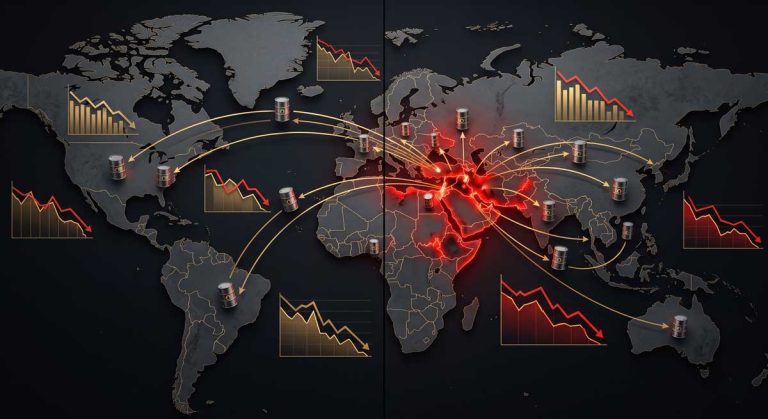
The Great Capital Migration: Why Global Investors Are Fleeing Australian Assets in 2026
Executive Summary: As the global economy pivots toward AI-driven growth and post-inflationary stabilization, Australia is finding itself on the wrong side of the capital flow. From lackluster corporate earnings to a hawkish central bank, we analyze the structural forces driving the exodus of global funds from the ASX, and what—if anything—can bring them back.
Introduction: The Silent Exodus
In the high-stakes game of global asset allocation, money has no passport—it only has a mandate for returns. As we settle into 2026, a distinctive and somewhat alarming trend has emerged in the Southern Hemisphere: a significant capital migration away from Australian assets.
For decades, Australia was the “Lucky Country,” riding the coattails of China’s rise and a booming resources sector. But today, for investors anticipating a domestic recovery, the dashboard is flashing red. Australian equities are underperforming, corporate earnings are fatigued, and the Reserve Bank of Australia (RBA) remains stubbornly hawkish while the rest of the world cuts rates.
This is not a momentary dip in sentiment; it is a structural reassessment of Australia’s place in a diversified global portfolio. From major institutional players like MLC Asset Management to global heavyweights like J.P. Morgan, a consensus is forming: the risk-to-reward ratio in Australia no longer justifies the allocation.
The “Underweight” Consensus: Why 5% Isn’t Enough
“We are underweight Australian equities because it is difficult to see them outperforming in 2026.”
This blunt assessment from Patrick Nichols, head of asset allocation at MLC, encapsulates the current mood of the institutional market. But what drives this sentiment? It comes down to the opportunity cost of capital.
According to data compiled by Bloomberg, the projected upside for the Australian stock market over the next 12 months is meager—potentially less than 5%. In isolation, a positive return seems acceptable. However, in a relative world, it is disastrous. This projected growth is roughly one-third of the expected gains for the MSCI All Country World Index (ACWI).
Global capital flows like water to the path of least resistance and highest growth.
- The United States is riding a secular bull market driven by the Artificial Intelligence revolution.
- Japan has broken free from its “lost decades,” with the Nikkei reclaiming historic highs and corporate governance reforms unlocking value.
- India offers a demographic dividend and a growth story that rivals China’s boom in the early 2000s.
Table 1: 2026 Global Market Growth Projections (Forecast)
| Market Index | Projected Growth (12M) | Key Driver | Investor Sentiment |
|---|---|---|---|
| S&P 500 (US) | High (>12%) | AI & Tech Dominance | 🟢 Overweight |
| Nikkei 225 (Japan) | Moderate (~8-10%) | Corporate Reforms | 🟢 Overweight |
| Nifty 50 (India) | High (>10%) | Demographic Growth | 🟢 Overweight |
| MSCI ACWI (Global) | Moderate (~8%) | Diversified Growth | 🟡 Neutral |
| ASX 200 (Australia) | Low (<5%) | Banking & Mining | 🔴 Underweight |
Comparative analysis of projected market returns showing the divergence between Australia and global peers.
Against this backdrop, Australia’s modest single-digit growth forecast renders it invisible to growth-hungry capital.
The Structural Flaw: An Old Economy in a New World
The underperformance of the S&P/ASX 200 is not merely cyclical; it is structural. The Australian index is a relic of the 20th century, dominated heavily by two sectors: Financials and Materials.
Table 2: The Structural Gap: ASX 200 vs. S&P 500 Composition
| Sector | ASX 200 Weight | S&P 500 Weight | The Implication |
|---|---|---|---|
| Financials (Banks) | ~30% | ~13% | High exposure to local debt cycles warakirri |
| Materials (Mining) | ~25% | ~2% | Commodity price dependency ibisworld |
| Technology (AI/Cloud) | <3% | ~30% | Missed AI boom entirely northcape |
| Healthcare | ~10% | ~12% | CSL struggling vs stable US peers warakirri |
The sector breakdown highlights Australia’s lack of exposure to the high-growth technology sector.
The Missing AI Narrative
In 2025 and 2026, the primary driver of global wealth creation has been the Generative AI stack—semiconductors, cloud infrastructure, and software applications. The US market has the “Magnificent Seven”; Europe has ASML and SAP; even Taiwan and South Korea are critical nodes in the tech supply chain.
Australia, by contrast, lacks a scalable technology sector. It has no NVIDIA, no Microsoft, and no TSMC.
- While the ASX offers a generous dividend yield of approximately 3.2% (nearly double the global average), this “yield trap” is no longer attractive.
- In an era where capital appreciation is driven by technological disruption, a high-yield, low-growth market is viewed as a “bond proxy” rather than an equity play.
Without exposure to the AI productivity boom, Australia is effectively sidelined from the most significant investment theme of the decade.

Corporate Earnings: The Engines Are Stalling
Capital flight is ultimately driven by fundamentals, and the fundamentals of Australia’s corporate giants are deteriorating.
The Banks: Squeezed Margins
The “Big Four” banks, particularly the Commonwealth Bank (CBA), have long been the bedrock of Australian portfolios, accounting for a massive share of the index. However, the golden era of banking profits is facing headwinds. Following recent updates, it is clear that net interest margins (NIM) are under compression. Competition for deposits is fierce, and loan growth is slowing due to the RBA’s restrictive policy. Valuation concerns are now paramount—investors are asking why they should pay premium multiples for banks with shrinking margins in a low-growth economy.
Healthcare: The Fallen Crown Jewel
CSL Limited, historically seen as Australia’s global growth proxy and “crown jewel,” has suffered a crisis of confidence. Facing disappointing earnings updates and a softening vaccine market in the United States, CSL recently concluded its worst trading year in two decades. This is a significant psychological blow to the market. When the “defensive growth” stocks fail to deliver growth, international investors lose their last reason to stay.
As the head of equities at UniSuper noted, future earnings growth in Australia is now almost entirely dependent on a cyclical recovery in metals and mining. The industrial and consumer discretionary sectors—tied to the struggling domestic economy—offer little upside.
The RBA’s Dilemma: The Hawk That Can’t Land
If the equity market is disappointing, the bond market is downright hostile.
The Reserve Bank of Australia finds itself in a unique and unenviable position compared to the Federal Reserve or the ECB. While global inflation cools, Australian service inflation remains sticky. This has forced the RBA to maintain a hawkish stance that is out of step with the global easing cycle.
- The Rate Disconnect: Traders are pricing in potential rate hikes well into mid-2026, while the US is cutting.
- Bond Market Pain: These hawkish bets have pushed Australia’s benchmark 10-year yield to some of the highest levels in the developed world.

Bloomberg data highlights a stark divergence: returns on Australian sovereign debt are projected to be around 2.3% through 2026, compared to a global peer average of 6.8%.
This creates a flattening of the yield curve. The spread between 3-year and 10-year yields has narrowed significantly. For global fixed-income managers, the math is simple: Why hold Australian debt with lower capital appreciation potential and higher policy risk when US Treasuries offer a clearer path to profit?
The Currency Double-Edged Sword
The Australian Dollar (AUD) adds another layer of complexity to the capital flight thesis.
Typically, high interest rates would support a currency. However, the AUD is often treated as a proxy for global risk and Chinese demand. With China’s growth stabilizing at a lower level, the AUD lacks its traditional tailwind.
For a US-based investor, a depreciating AUD is a portfolio killer. Even if an Australian stock stays flat, a 5% drop in the AUD/USD exchange rate translates to a 5% loss in the investor’s home currency. This currency risk exacerbates the outflow, creating a feedback loop: capital leaves, the currency weakens, and the weaker currency prompts further capital flight.
The Contrarian View: Is There Hope in the Dirt?
Despite the gloom, Australia is not entirely without merit. The very reliance on mining that makes the index “old fashioned” could be its salvation if the macro cycle turns.
There is a valid contrarian argument—one that I find personally compelling—that 2026 could be the year of Commodities.
- The Supercycle: If the global economy avoids a hard landing and re-accelerates, demand for copper, iron ore, and lithium will rebound.
- Energy Transition: Australia remains a critical supplier for the global green energy transition.
- Sector Rotation: If the AI trade becomes a bubble that bursts, capital will rotate violently back into “real assets.”

In this scenario, Australia’s miners would lead a sharp earnings recovery. However, this is a binary bet on external factors (Chinese stimulus and global industrial demand) rather than a bet on Australian innovation.
Conclusion: A Wake-Up Call for Policy Makers
The exodus of capital from Australia is a rational response to market incentives. In a borderless financial world, capital owes no loyalty to geography—it seeks only growth and yield.
Australia’s current predicament—high household debt, sticky inflation, and a lack of technological diversification—has exposed the fragility of its economic model. The “dig it up and ship it out” strategy is struggling to compete in a world obsessed with silicon chips and neural networks.
For the global investor, the message is clear: untill the RBA pivots or a new commodities supercycle ignites, Australia remains a “hold” or “sell,” but certainly not a “buy.” The market is waiting for a reset where value and price find a new equilibrium. Until then, the capital migration is likely to continue.