Middle East Ground Invasion Strategy: 7 Crucial Tactics & Shocking Deceptions Behind the Iran Ceasefire
The two-week US-Iran ceasefire announced on April 7–8, 2026, looks like diplomacy on the surface — but a closer reading of the Middle East ground invasion strategy signals, military logistics, and Pentagon personnel shakeups tells a more complicated story. Is this pause genuine de-escalation, or a calculated staging window for the next phase of Operation Epic Fury?
Table of Contents
The Ceasefire Timeline Doesn’t Add Up
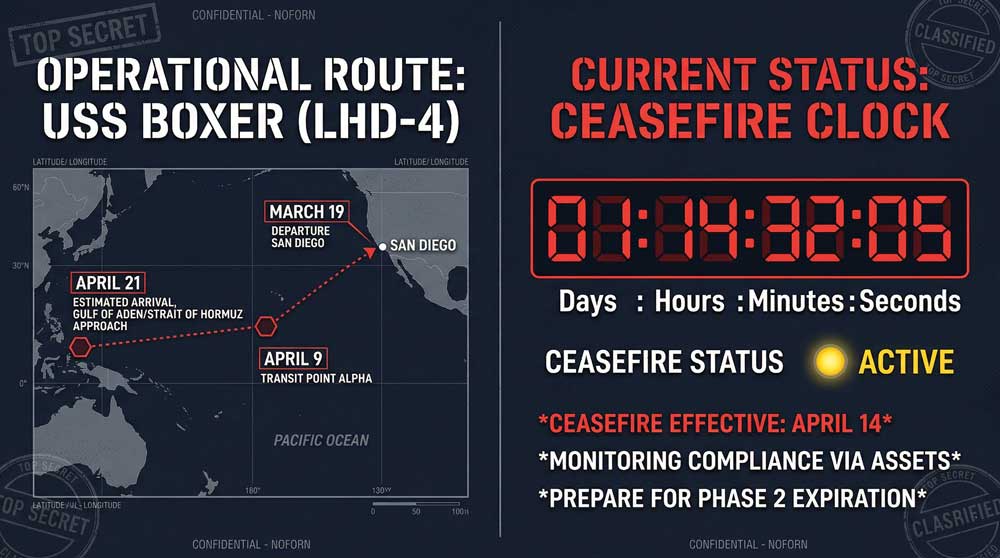
On April 7, 2026, President Trump announced a two-week suspension of bombing operations against Iran, contingent on Iran’s “complete, immediate, and safe reopening of the Strait of Hormuz”. The duration — exactly two weeks — is suspiciously precise.
The USS Boxer Amphibious Ready Group departed San Diego on March 19–20, 2026, carrying approximately 2,500–4,500 Marines of the 11th Marine Expeditionary Unit, along with F-35B jets, Ospreys, and attack helicopters. Transit time from the US West Coast to the Persian Gulf is approximately three weeks — meaning the Boxer would arrive in theater right as the ceasefire window expires.
| Asset | Departure | Est. Arrival in Gulf | Ceasefire Ends |
|---|---|---|---|
| USS Boxer ARG + 11th MEU | March 19–20, 2026 | ~April 9–12, 2026 | ~April 21–22, 2026 |
| USS Tripoli ARG + 31st MEU | Earlier, March 2026 | Already in eastern Indian Ocean | Already staged |
| Strategic Airlift (C-17 etc.) | On-demand | 24–48 hours | N/A |
Trump had also publicly forecast the conflict would end in “2–3 weeks” — a window that neatly maps onto fleet arrival, not negotiation timelines. The ceasefire may be less a peace signal and more a loading dock timer.
Pentagon Shakeup: Who Gets Fired Before a Ground War?
Since the start of hostilities, the US military has undergone a rapid and dramatic leadership overhaul. Multiple senior generals with extensive Iraq and Afghanistan combat experience have been reassigned or forced to retire.
Most significantly, on April 2, 2026, Defense Secretary Pete Hegseth asked Army Chief of Staff General Randy George — the 41st holder of that role — to “step down and take immediate retirement”. The Pentagon issued a brief statement thanking him for his service and said nothing further.
This raises a critical strategic question: senior generals don’t resist air campaigns. Air strike packages don’t require Army Chief of Staff sign-off. The only category of operation that demands — and apparently cannot get — Army leadership consensus is a high-risk, large-scale ground combat operation. The firings suggest someone at the top of the US command structure is pushing exactly that, and the Army’s most experienced warfighters are refusing to endorse it.
3 Lessons from Military History: The Art of the Feint
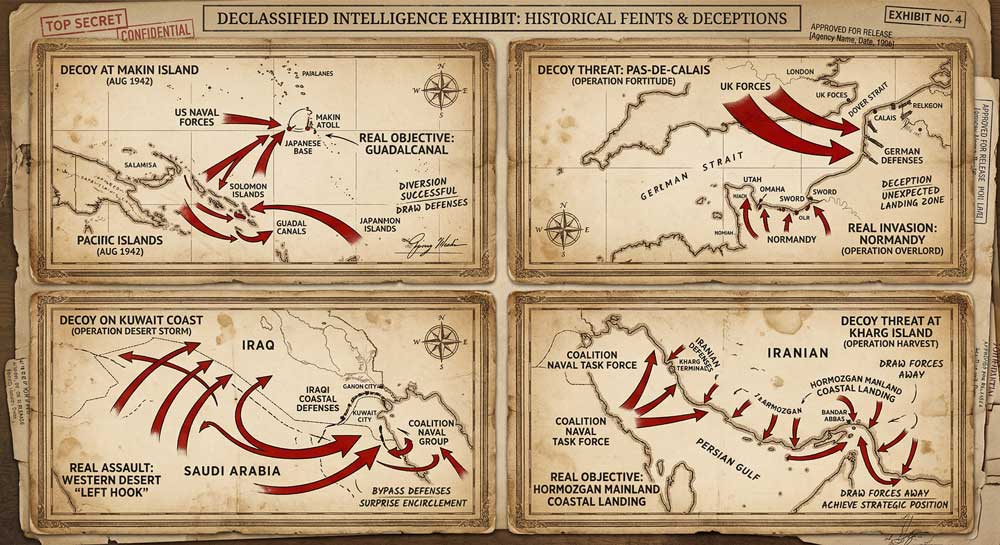
Any credible Middle East ground invasion strategy begins with misdirection. This is not speculation — it is standard US military doctrine, validated across generations of warfare:
| Conflict | The Feint | The Real Objective |
|---|---|---|
| WWII Pacific (1942) | Makin Island raid | Guadalcanal |
| WWII Europe (1944) | Operation Fortitude / Pas-de-Calais | Normandy |
| Gulf War (1991) | Amphibious feint off Kuwait coast | Left-hook through western desert |
| Current scenario | Kharg Island media saturation | Likely eastern Hormozgan coastline |
Media coverage has been intensely focused on Kharg Island, which handles approximately 90% of Iran’s crude oil exports. Iran has been responding in kind — laying mines along shorelines, adding MANPADs, and repositioning air defense systems there in recent weeks. But practically, holding Kharg Island is a logistical trap: it sits just 25 km from the Iranian mainland, within easy range of artillery, ballistic missiles, and drone swarms. The US struck roughly 90 military targets there on March 13, 2026, but deliberately left oil infrastructure intact — an admission that some targets are too valuable to destroy and too costly to hold.
The loudest target in a US military operation is rarely the real one.
Target Analysis: Why Bandar Abbas Is the Real Prize
If the strategic goals are to control global oil prices, dominate the Strait of Hormuz, and establish a sustainable logistics pipeline for follow-on forces, then one location stands above all others: Bandar Abbas.
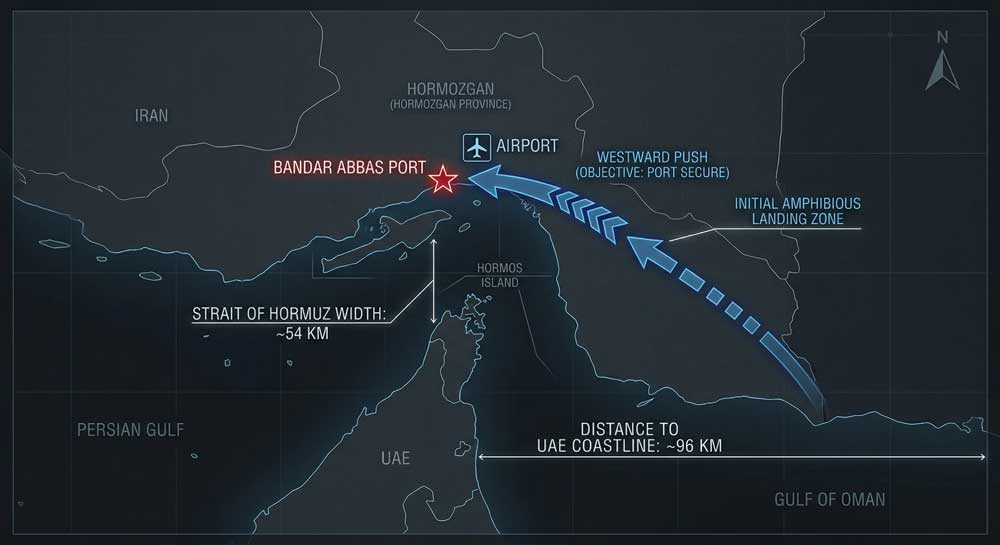
Bandar Abbas is Iran’s largest dual-use civilian-military port, handling 85% of Iran’s containerized trade and sitting directly on the Strait of Hormuz — the chokepoint through which 21% of global petroleum flows daily.
Critically, reporting confirms that during preliminary US strikes, airport runways in the Bandar Abbas area were notably spared — a tactical signal that planners intend to use them.
The Likely Beachhead: East of Bandar Abbas
A direct amphibious assault on Bandar Abbas port itself would be high-risk: it is a known high-value target that Iran can reinforce rapidly. Military planners would more likely exploit the long, thinly defended coastline of Hormozgan Province to the east.
This approach offers several compounding advantages:
- Safer beachhead — landing forces are initially further from concentrated Iranian defenses
- Population dynamics — southeastern Iran has significant Baloch and ethnic minority populations with longstanding grievances against Tehran, creating an environment of ambiguity that complicates defensive planning
- Positional ambiguity — a 300+ km coastline is impossible to uniformly defend; Iran cannot be certain where a landing will occur
- Westward push — once ashore, forces advance toward Bandar Abbas from the landward side, the port’s most vulnerable approach
The separatist dimension is real: Iranian Baloch communities in Sistan and Baluchestan — bordering Hormozgan — have experienced decades of state neglect, economic marginalization, and violent crackdowns including the 2022 “Bloody Friday” in which security forces killed approximately 100 demonstrators. This creates both operational opportunity and ethical complexity for any invading force.
Iran’s Optimal Counter: Trade Space, Bleed Time
How does a defending force counter an amphibious assault from the world’s most capable expeditionary military? The answer from asymmetric warfare doctrine is counterintuitive: don’t fight the beach landing at all.
Contesting a beachhead against USS Boxer’s embarked F-35Bs, naval gunfire, and 4,500 Marines is a losing proposition. The smarter doctrine involves:
- Concede the initial landing — let the invading force advance and let political leaders claim early wins
- Concentrate on Bandar Abbas — the port is the only objective that gives the operation strategic meaning; if it isn’t captured, the landing is tactically irrelevant
- Force a siege dynamic — stall the advance at Bandar Abbas’s outskirts, transforming a mobile campaign into static urban attrition
- Exploit cost asymmetry — a bogged-down expeditionary force dependent on a 10,000 km supply chain costs exponentially more to sustain than a defending force on home soil
Once US forces are committed and stalled, withdrawal becomes politically impossible. A static front then becomes ideal terrain for Iran’s missile and drone arsenal — the weapons systems where it holds genuine capability advantages. The 2026 war has already demonstrated that Iranian defenses can inflict serious damage on US air operations, which is precisely why the ground option is being pushed from Washington despite internal military resistance.
The 5 Signals to Watch
The Middle East ground invasion strategy will telegraph itself through observable indicators before any announcement. Monitor:
- USS Boxer/Tripoli ARG position updates — arrival in the Gulf of Oman is the key logistical trigger
- Further senior military firings — particularly Marine Corps Commandant or CENTCOM leadership changes
- Ceasefire extension vs. resumption — watch whether the April 21–22 window produces an extension or a rapid escalation
- Kharg Island rhetoric intensification — increased media focus on Kharg as a target is a potential deception indicator
- Diplomatic outreach to UAE and Oman — both countries would be essential for staging rights and logistics corridors
Authoritative Sources
- The War Zone — USS Boxer: Second Amphibious Assault Ship Heading to Middle East
- Task & Purpose — US Orders More Warships, Thousands of Marines to the Middle East
- The New York Times — Hegseth Fires Army Chief Amid Battle With Its Leaders
- CNN — Iran Building Up Defenses of Kharg Island Against Potential US Ground Attack
- Wikipedia — 2026 Iran War Ceasefire
- LinkedIn/Shah — The Kharg Island Paradox: Leverage, Vulnerability, and the Limits of American Power
- Foundation for Defense of Democracies — Iranian Baluch Separatist Factions Establish Popular Fighters Front
- Ballast Markets — Bandar Abbas Port: Sanctions Evasion & Strait of Hormuz Analysis
- ABC Australia — What We Know About the US-Iran Two-Week Ceasefire Deal
- The Diplomat — How the Iran War Will Reconfigure Militancy in Balochistan
- Strait of Hormuz Shipping Volume Hits an Incredible 7-Day High
- Cyrus the Great: 7 Timeless Leadership Lessons Iran Urgently Needs Today
- 3 Secret Motives Behind the Dangerous UAE Strategy Against Iran in 2026