
Investment Bonds Australia: 5 Proven Reasons the Wealthy Are Rethinking Super in 2026
Investment bonds Australia were the dominant wealth-building tool before compulsory superannuation arrived in the 1990s. After three decades in the shadows, they are back — and the trigger is one of the most consequential superannuation tax changes in Australian history.
With Division 296 now legislated and set to take effect on 1 July 2026, high-net-worth Australians are urgently restructuring their assets. Industry insiders predict that between $80 billion and $240 billion could flow out of super over the next two years — and investment bonds are the primary beneficiary.
The investment bond market currently sits at just $15 billion but is widely projected to swell toward $80 billion within a few years. If you have a large super balance, high income, or intergenerational wealth goals, this is one of the most important financial structures you can understand right now.
Table of Contents
What Are Investment Bonds Australia?
The name is genuinely misleading. Investment bonds — also called insurance bonds — are neither traditional fixed-income bonds nor standard life insurance policies. They are best understood as a tax-paid investment wrapper: a life-insurance-classified structure that holds a diversified portfolio (shares, managed funds, fixed income) inside a single, tax-compliant vehicle.
Think of it as a privately controlled mini-super fund — with no government-mandated preservation age, no contribution caps tied to super rules, and a unique internal tax mechanism that becomes more powerful the longer you hold it.
Before compulsory super arrived, investment bonds were the retail wealth tool in Australia. Super’s 15% tax rate made everything else look expensive, and bonds faded from mainstream advice. Now, as legislation aggressively targets large super balances, the structural advantages of investment bonds are pulling them firmly back into the spotlight.
The Division 296 Super Tax: What’s Actually Changed
This is not speculation — Division 296 is now law. Here is exactly what takes effect from 1 July 2026:
| Super Balance Threshold | Tax on Earnings | Key Change vs. Prior Rules |
|---|---|---|
| Under $3 million | 15% | Unchanged |
| $3M – $10M | 30% (existing 15% + 15% Division 296 levy) | New — applies to proportional earnings above $3M |
| Above $10M | 40% (existing 15% + 25% Division 296 levy) | New — two-tier structure introduced Oct 2025 |
Critically, the revised legislation removes the controversial tax on unrealised gains — a major concern in earlier drafts. However, thresholds are now measured as the higher of opening or closing TSB for the year, closing off the strategy of large mid-year withdrawals to duck under $3M.
Both thresholds are indexed to inflation in $150,000 and $500,000 increments respectively, but for those already near the limits today, the clock is ticking.
1. A Legitimate Overflow Vehicle When Super Gets Too Expensive
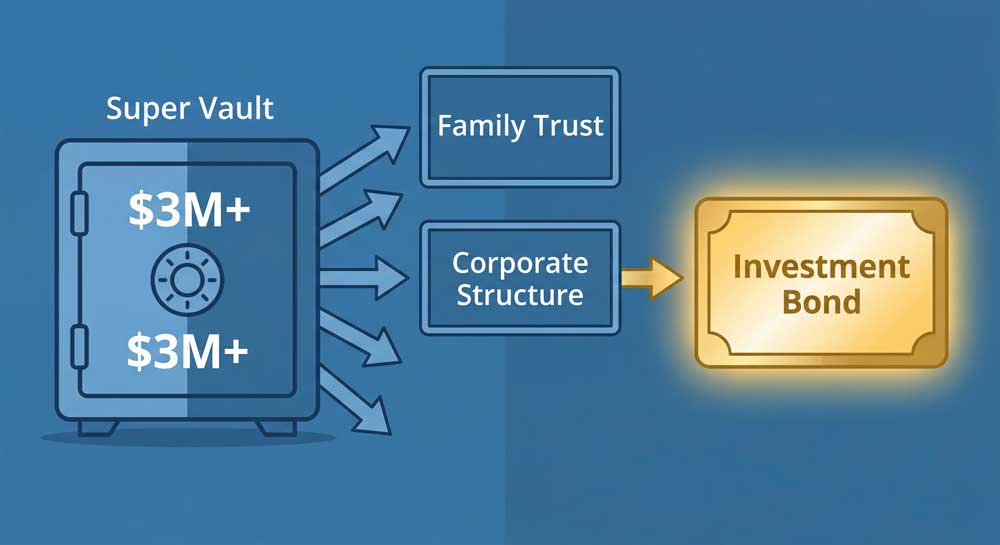
Once your super balance exceeds $3 million, every dollar of earnings on the excess is taxed at 30% inside super — the same internal rate as an investment bond, but without any of the bond’s structural advantages.
For balances over $10 million, super earnings are now taxed at 40% — making investment bonds genuinely cheaper by a full 10 percentage points.
This is the core arbitrage opportunity. Investment bonds are not trying to beat super at its own game for balances under $3M — super still wins clearly in that zone. But as an overflow and diversification structure for capital that can no longer sit efficiently in super, bonds are the leading alternative to family trusts and corporate structures.
2. The 30% Internal Tax Rate — and the Capital Loss Superpower
Investment bonds are classified as life insurance products under Australian law, which means the fund manager pays tax internally at the 30% corporate rate. You have no obligation to declare bond earnings on your personal tax return while funds remain inside the structure.
But the genuinely unique feature is how investment bonds handle capital losses — something neither super nor personal investing can match:
| Structure | Can Capital Losses Offset Internal Income? |
|---|---|
| Personal name | ❌ Losses carry forward; income taxed separately at up to 47% |
| Superannuation | ❌ Losses remain within the fund, no income offset |
| Investment Bond | ✅ Manager offsets losses directly against taxable income internally |
In practice: if the bond’s portfolio loses $100,000 in a volatile year but earns $100,000 in income, the net internal tax bill can be reduced to zero — and the full capital base rolls into the next year to compound untouched. In markets as turbulent as 2025–2026 have been, this internal netting mechanism provides a meaningful compounding edge that accumulates significantly over time.
3. The 10-Year Tax-Free Rule and the 125% Contribution Mechanism
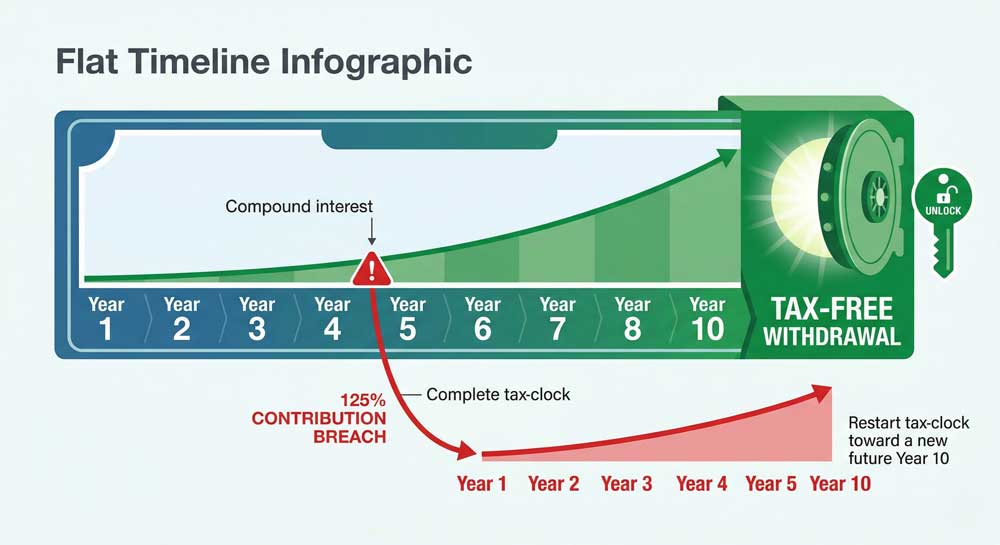
The headline benefit of investment bonds is the 10-year rule: hold the bond continuously for a full decade, and every dollar you withdraw — original capital plus all accumulated earnings — is completely tax-free. No CGT. No income tax. Nothing.
To keep adding money without resetting the clock, the 125% Rule applies:
| Year | Prior Year Contribution | Maximum Allowable Contribution |
|---|---|---|
| Year 1 | $100,000 (initial) | — |
| Year 2 | $100,000 | $125,000 |
| Year 3 | $125,000 | $156,250 |
| Year 4 | $156,250 | $195,313 |
| Year 5 | $195,313 | $244,141 |
⚠️ If you exceed the 125% limit in any year, the 10-year clock resets to zero. If you withdraw before 10 years, earnings are assessed at your marginal rate — but you receive a 30% tax offset for the tax already paid internally inside the bond.
For a top-rate (47%) earner investing for 10+ years, the after-tax outcome of an investment bond substantially outperforms holding the same assets personally. Super under $3M still leads — but bonds are a clear second place for high-income Australians.
4. Estate Planning: The Benefit Most Advisers Rate Highest
![Investment bonds Australia estate planning wealth transfer strategy alt text: Investment bonds Australia estate planning wealth transfer strategy]
For many financial planners, the tax efficiency of investment bonds is actually their secondary advantage. The primary case is wealth transfer.
Bypassing probate and will disputes:
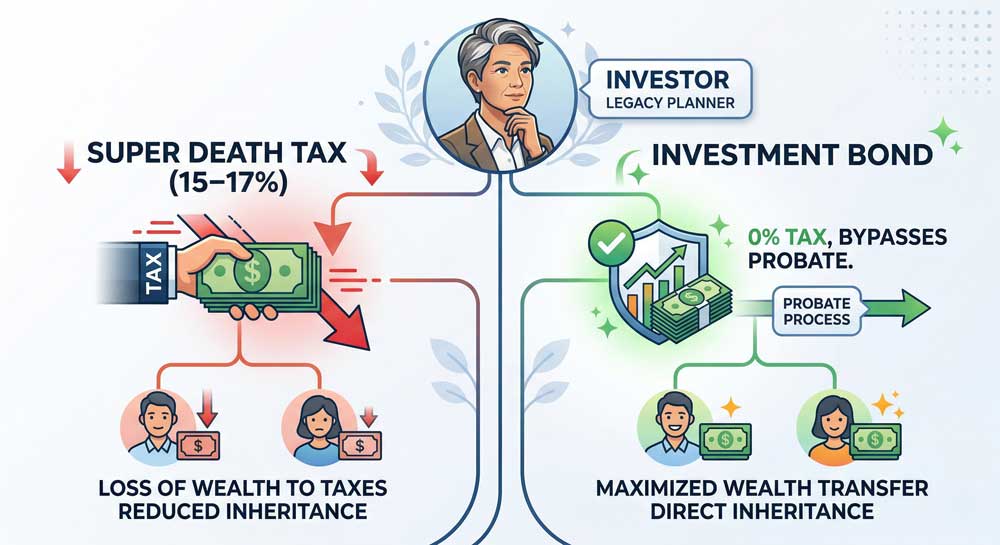
An investment bond does not form part of your legal estate. You nominate a beneficiary directly on the policy. On death, funds transfer immediately to the nominated person — bypassing probate entirely, and essentially unchallengeable in a will dispute — regardless of what the will says or who contests it.
Eliminating the super “death tax”:
Super paid to adult non-dependent children (e.g., grown-up kids not financially reliant on you) typically attracts a 15–17% tax on the taxable component. If you instead transfer surplus super into an investment bond while alive, your death automatically triggers an exemption from the 10-year rule — your beneficiaries receive the full balance tax-free, regardless of how long the bond has been held.
| Asset Transferred to Adult Children on Death | Tax Payable |
|---|---|
| Superannuation (taxable component) | 15–17% |
| Investment Bond (10yr+ held) | 0% |
| Investment Bond (triggered by death, any duration) | 0% |
| Personal shares via estate | CGT event applies; rate varies |
For grandparents wanting to establish a tax-free, dispute-proof education fund or home deposit for grandchildren, this structure has no meaningful equal in the Australian financial toolkit.
5. Who Should Consider Investment Bonds — and Who Should Wait
Investment bonds are powerful, but they are not universal. The key limitation is that they lack the 50% CGT discount available to individuals who hold assets personally for more than 12 months. For portfolios composed primarily of zero-dividend, high-growth equities (pure capital growth strategies), holding in personal name may still outperform over very long horizons.
Strong candidates for investment bonds:
- High-net-worth individuals with super approaching or exceeding $3M, needing a tax-efficient home for overflow capital before 1 July 2026
- High-income earners on the 47% marginal rate with surplus cash they can genuinely lock away for 10+ years
- Grandparents and legacy planners who want to fund a grandchild’s future and ensure clean, tax-free, dispute-proof transfer
- Investors in volatile markets who want to use internal capital loss offsetting to enhance compounding
Better served by other structures:
- Investors whose primary strategy is long-term capital growth with minimal income (personal name + CGT discount wins)
- Those who may need liquidity within 3–5 years (early withdrawal tax implications reduce the advantage)
- Anyone whose super balance is well under $3M and still has room to contribute (super is still the gold standard)
Your Planning Window Is Closing
Division 296 takes effect 1 July 2026. The transition year (2026–27) includes a special rule allowing some flexibility in TSB calculations — but that window is narrow. For anyone approaching the $3M threshold, the most valuable thing you can do right now is review your asset structure with a registered financial planner before the law kicks in.
Investment bonds are not a loophole — they are a fully legislated, ATO-recognised structure that has existed in Australian law for decades. What’s changed is that the super tax environment has finally made them genuinely competitive again.
This article is general in nature and does not constitute personal financial advice. Always consult a licensed financial adviser or registered tax accountant before making structural changes to your wealth management strategy.
Authoritative Sources
- Pitcher Partners — $3M Super Balance Tax Legislation Enacted (March 2026)
- Grant Thornton — Latest Update on Division 296 Tax 2026
- William Buck — What the Division 296 tax actually means for you
- Hudson Financial Planning — Investment Bonds vs Superannuation Australia
- Bentleys — Seven Reasons Investment Bonds Could Be an Alternative to Super
- ASFA — Division 296 Legislation Introduced to Parliament
- Australian Parliament — Treasury Laws Amendment (Building a Stronger and Fairer Super System) Bill 2026
- ElevenLab — How to Invest 20,000 Euros Smartly: 7 Proven Strategies for 2026
- ElevenLab — Alternative Asset ETFs: 5 Shocking Truths Behind the 72% Youth Investment Exodus from Traditional Stocks
- ElevenLab — The Financial System Explained: 5 Stages from Basic Lending to Global Markets