AI Customer Service Has Fixed What the Internet Broke — Here’s the Proof
AI customer service is no longer a cost-cutting experiment. It is quietly becoming one of the most important conversion levers in modern ecommerce, and the numbers are starting to demand attention.
There is a story from Amazon’s early days that has always stuck with me. Jeff Bezos famously kept an empty chair at executive meetings — a symbol of the absent customer, supposedly the most important person in the room. He required senior leaders to complete two days of customer service training annually and made “customer obsession” a founding principle. Then one day, after a VP reported that call wait times were under a minute, Bezos picked up the phone and dialled Amazon’s support line himself. He waited four minutes. He said, “Just checking,” and hung up. That VP left within the year.
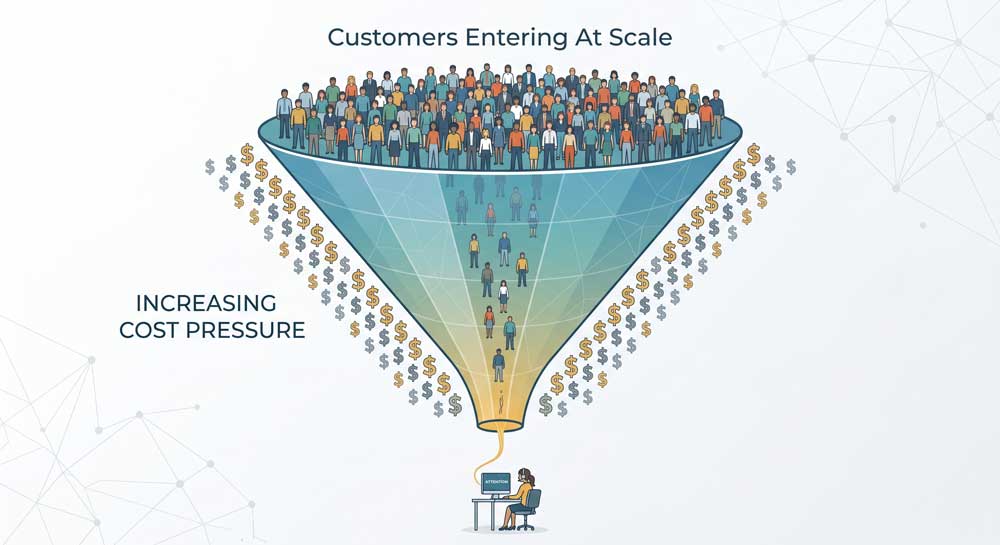
The problem was never a management failure. It was structural. The internet enabled businesses to scale to hundreds of millions of users, but genuine customer attention could only grow linearly — proportional to headcount. The bigger a company got, the thinner the care spread.
Table of Contents
How the Internet Turned Customer Service Into a Cost Centre
Before the internet, good customer service was straightforward. A small shop owner knew their regulars, remembered preferences, and solved problems immediately. That was a relationship.
The internet shattered that model. Logistics could scale exponentially, but attentive human service could not. Customer support became a cost centre — a necessary overhead to be minimised, not a competitive advantage to be invested in. What followed was a bifurcation of the entire consumer market.
| Service Model | Who It Serves | Experience Quality | Cost Structure |
|---|---|---|---|
| Scale model (Amazon, major platforms) | Hundreds of millions | Thin, transactional | Low per-user cost |
| Concierge model (luxury brands, private banking) | A privileged few | Deep, personalised | Extremely high |
| Offshore outsourcing (1990s–2010s fix) | Mass market | Inconsistent | Low, but quality degraded |
The dominant solution for over two decades was offshore outsourcing. Large English-speaking workforces in India and the Philippines offered labour at roughly one-tenth of Western rates, with time zones that conveniently covered overnight hours. Oxford’s dictionary even coined a term for it: Bangalored — work shipped offshore. But this approach never resolved the core tension. Outsourced agents often lacked deep product knowledge and had little incentive to deliver exceptional service. During high-growth periods, nobody cared. In a saturated, competitive market, weak service became a genuine liability.
Then AI arrived and started pulling the whole structure apart.
The Market Signal Is Unmistakable
The investment flowing into AI customer service reflects a clear conviction. According to MarketsandMarkets, the global AI customer service market was valued at approximately $12 billion in 2024 and is projected to reach $47.8 billion by 2030. In May this year, Silicon Valley AI customer service company Sierra closed a $950 million funding round at a $3 billion valuation. Its founder, Bret Taylor, is the former CTO of Facebook and former Co-CEO of Salesforce — not someone who backs trends lightly.
The underlying bet across all of this capital is the same: AI is the first technology capable of giving scale-model businesses something close to a concierge-level experience — always available, aware of each user’s history, infinitely concurrent, and at a fraction of human labour cost.
AI Has Learned to Sell, Not Just Answer
For two decades, ecommerce AI was built almost entirely on behavioural data — clicks, browsing history, purchase records. Recommendation engines and search ranking algorithms are sophisticated, but they work with indirect signals. When a user clicks on a red dress, the algorithm cannot know whether they are shopping for a wedding, browsing out of boredom, or buying a gift. Intent is inferred, never stated.
Customer service conversations are the first ecommerce context where users state their intent directly. “I’m hiking Mount Huangshan, I need something breathable, I have darker skin, and my budget is under 500 yuan.” That single sentence contains more actionable signal than a year’s worth of click data from the same user. Critically, conversation supports real-time correction — “not that one, I need something looser” — which gives AI systems something recommendation engines rarely get: labelled, real-time feedback on their own outputs.
This is where modern AI customer service becomes genuinely powerful. Consider a real example from a flagship electronics retailer using Alibaba’s AI Dian Xiaomi (AI Store Assistant). A user sent a photo — no text, no model number, just an image — asking “what phone is this?” Within six seconds, the AI identified the flagship model, asked about use cases, and returned a recommendation link bundled with subsidy eligibility and redemption instructions. The conversation ended in a completed transaction.
Multimodal image recognition is now a baseline capability in the latest generation of these systems. Users send screenshots or short videos; the AI reads them directly and surfaces solutions from catalogues containing tens of thousands of SKUs, with reported accuracy rates above 95%.
Apparel presents a subtler challenge. Size recommendations are the single most common customer query in fashion ecommerce, and also the leading driver of returns. Earlier AI systems cross-referenced size charts. Current systems synthesise product page data, community Q&A, verified reviews, and a shopper’s personal purchase history to make a contextual recommendation. For ambiguous requests — “I run hot, I need something that breathes,” “I have a deeper complexion, what reads as lighter?” — the AI interprets intent and returns curated outfit combinations, not just individual SKUs, and can factor in weather forecasts for a travel destination when making suggestions.

What the Data Actually Shows
The performance numbers from large-scale deployments are worth examining carefully.
| Metric | Result | Source |
|---|---|---|
| Average conversion rate lift (post-AI integration) | +10% or more | Alibaba AI Dian Xiaomi launch data |
| Reduction in escalation to human agents | -45% to -55% | Xiaomi and Xtep flagship store data |
| Return/refund recovery success rate | Over 20% | Alibaba internal |
| AI-assisted vs. unaided human agent conversion uplift | +2 percentage points | A/B test, Alibaba |
| Fraud/false claim interception | Active, via AI image verification | Alibaba |
The A/B test result deserves particular attention. When traffic was split — 1% routed directly to human agents, 99% handled first by AI with human escalation available — the AI-plus-human combination outperformed pure human service on conversion, across all hours of the day, not just overnight. The practical implication for merchants who deploy AI only during off-hours to cut costs is stark: keeping AI off the daytime shift means voluntarily surrendering conversion on the highest-value traffic of the day.
The Human Role Gets More Valuable, Not Obsolete
The most counterintuitive finding in this space comes from a 2025 Gartner survey of 321 customer service executives: following AI integration, 55% of organisations handled higher contact volumes with the same or fewer staff, and 80% planned to transition a portion of their customer service workforce into more complex roles — not eliminate them.
This result is not actually paradoxical once you examine the mechanics.
First, better service stimulates more demand. When AI lowers the friction of getting help, more users ask questions. This is a direct example of the Jevons Paradox from economics — efficiency gains in a resource increase its consumption rather than reducing it. Total contact volume rises, which partially absorbs any labour savings.
Second, customer service work is fundamentally a collection of exception-handling. AI absorbs the standardised 80% efficiently. The remaining 20% — complex disputes, emotionally distressed users, edge cases requiring genuine judgement — is precisely where human involvement matters most, and where the work becomes more meaningful rather than less.
Third, AI systems require human oversight and strategy. Experienced merchants have long employed roles informally called “service trainers” — people responsible for quality, scripts, and escalation logic. In an AI environment, the trainee has changed. The trainer has not.
The day-to-day mechanics of human-AI collaboration have also improved considerably. When AI determines a conversation exceeds its handling capability and escalates to a human agent, the handoff no longer arrives as a blank screen. Agents receive a real-time summary card: user emotional state assessment, estimated conversion potential, and suggested next steps. Human agents pick up exactly where the AI’s analysis left off, not from zero. Seats with AI assistance show a 2-percentage-point conversion advantage over unaided seats.
| Scenario | AI Handles | Human Handles |
|---|---|---|
| Product queries, size guidance, shipping status | Yes | Rarely needed |
| Complex returns, disputes, fraud suspicion | Partially | Yes, with AI summary |
| High-value order, emotional customer | Flags and escalates | Yes, with full context |
| Overnight and off-peak hours | Yes, autonomously | Minimal |
| Strategy, tone policy, escalation rules | No | Yes |

The Economics Are Transparent
In most digital marketing contexts, attribution is messy. An AI-driven ad impression might contribute to a purchase that happens three sessions later; the ROI calculation involves assumptions and models.
Customer service conversations have no such ambiguity. A conversation either ends in a transaction or it does not. That clarity makes the ROI calculation unusually direct.
Using tiered pricing as an illustration: at a rate of 0.5 yuan per conversation for the advanced tier, a merchant handling 10,000 monthly conversations pays 5,000 yuan. If average order value is 200 yuan and AI lifts conversion by 3 percentage points — a conservative figure given the published benchmarks — that represents 300 additional transactions and 60,000 yuan in incremental revenue. The cost-to-return ratio is approximately 1:12.
The advanced tier consumes more than five times the compute resources of the standard tier, reflecting deeper sales guidance and return-recovery logic. For high-volume merchants, platforms have made the standard tier available at no cost to smaller sellers while subsidising infrastructure at scale.
The structural argument is simple. The internet gave businesses the ability to serve users at a scale that no human attention budget could match, and in doing so, it turned customer service into a weak point — a conversion funnel with a persistent leak at the bottom. AI customer service does not fix this by replacing people. It fixes it by making high-quality, contextually aware attention replicable at scale, applied consistently to every interaction, at a cost that makes the economics work.
With major retail events approaching, that proposition is being tested at a scale that will produce a great deal of evidence, quickly.
Reference URLs
- Goldman Sachs — Tracking Trillions: The Assumptions Shaping the Scale of the AI Build-Out
- McKinsey & Company — The State of AI in 2024: Generative AI Adoption and Customer Experience
- Gartner — Gartner Predicts 2025: Customer Service and Support
- Harvard Business Review — The Value of Customer Experience, Quantified
- MarketsandMarkets — Conversational AI Market — Global Forecast to 2030
- MIT Technology Review — How AI Is Remaking the Call Centre
- Forrester Research — Predictions 2026: AI Gets Real For Customer Service
- ElevenLab — Personal Superintelligence Revealed: Inside Meta’s Unbelievable 5-Year Plan for Billions
- ElevenLab — 7 Secrets Why Hermes Agent Crushed OpenClaw: An Explosive 2026 Review
- ElevenLab — The Claude Code Leak: 1 Catastrophic Mistake That Could Supercharge Every AI Tool 100x