Canada’s Alarming Bankruptcy Rate 2026: 17 Canadians File Every Hour
Canada bankruptcy rate 2026 has reached its most alarming level since the 2008 global financial crisis — and the data tells a story that goes well beyond the headline number.
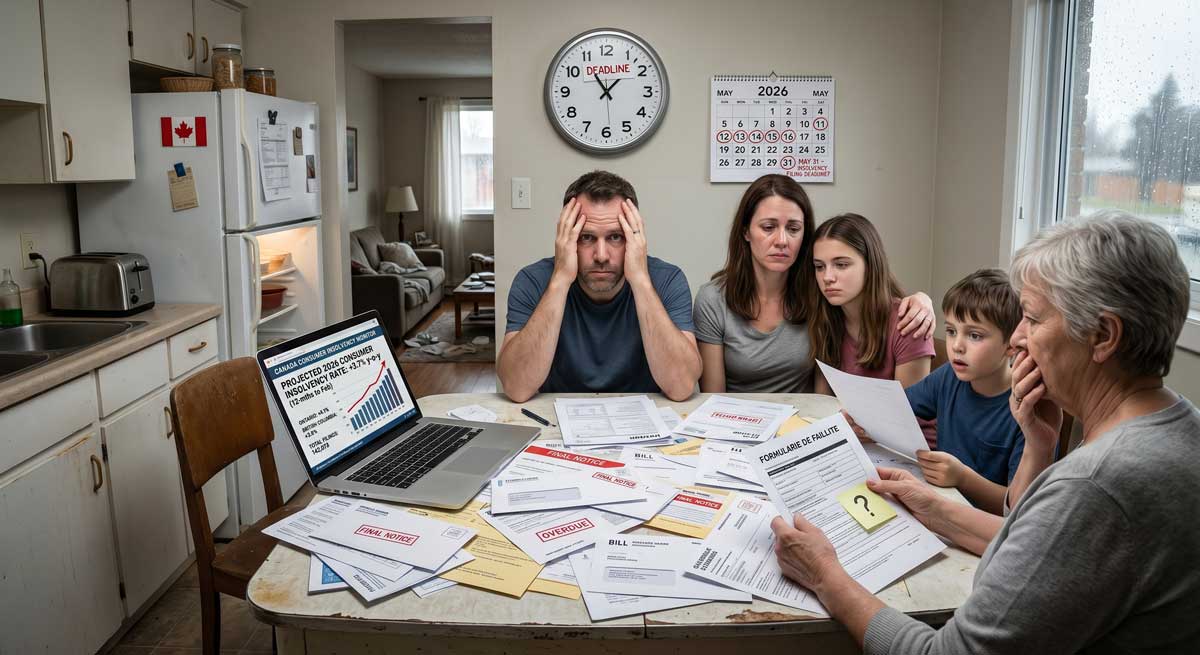
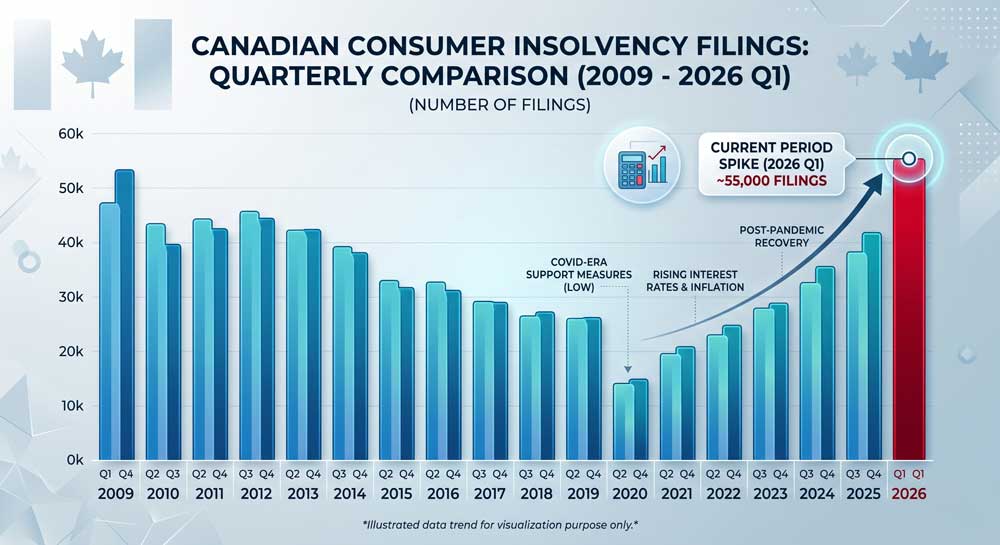
In the first quarter of 2026, 37,121 Canadians filed for consumer insolvency, according to Canada’s Office of the Superintendent of Bankruptcy (OSB). That translates to roughly 17 people every single hour — a pace that matches the darkest quarter of the Great Recession in early 2009. Year-over-year, filings are up 8.5%, and up 6.5% from Q4 2025.
What makes this moment distinctly unsettling is its context: the Canadian economy is not technically in recession. Interest rates have eased from their peak. And yet the insolvency numbers keep climbing.
Table of Contents
Canada Bankruptcy Rate 2026: The Raw Data
March 2026 alone recorded 13,406 individual filings — a 10.6% year-over-year jump that puts it just 1.64% below the all-time single-month record set in March 2009. Over the trailing 12 months, cumulative filings reached 143,353, the second-highest 12-month rolling total ever recorded in Canada, sitting only 4.5% below the 2009 peak.
| Metric | Q1 2026 | Change |
|---|---|---|
| Consumer insolvency filings | 37,121 | +8.5% YoY / +6.5% QoQ |
| March single-month filings | 13,406 | +10.6% YoY |
| 12-month rolling total | 143,353 | 2nd highest on record |
| Business insolvency filings | 1,232 | -7.5% YoY / +9.8% QoQ |
| Filings per hour | ~17 | Matches Q1 2009 level |
Business filings tell a divergent story — down year-over-year but accelerating quarter-over-quarter, suggesting corporate stress is building momentum even from a lower base.
A $2.6 Trillion Household Debt Problem
Canadian household debt reached $2.6 trillion across all credit products in Q4 2025, according to TransUnion. That figure spans mortgages, credit cards, auto loans, lines of credit, and personal loans — and it forms the essential backdrop for understanding why Canada’s bankruptcy rate in 2026 has surged to this level.
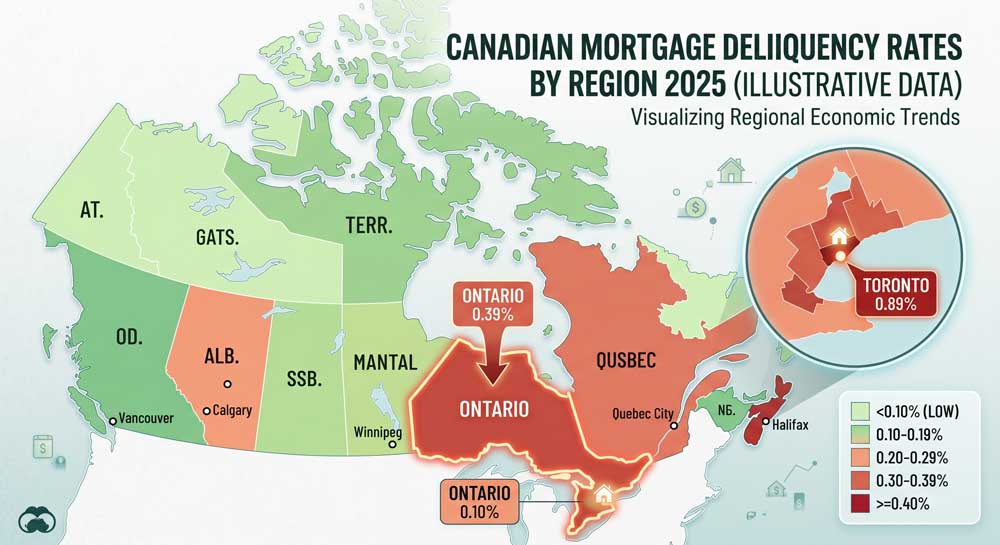
The mortgage market is showing its own warning signs. CMHC data shows mortgage delinquency rates in Toronto rose 60% year-over-year in Q2 2025, reaching 0.24% — the highest level since 2012. Ontario’s delinquency rate surpassed the national average for the first time in over a decade.
| Region | Mortgage Delinquency Rate (Q2 2025) | YoY Change |
|---|---|---|
| National | 0.22% | Slight decrease |
| Ontario | 0.23% | Above national average |
| Toronto | 0.24% | +60% YoY |
| British Columbia | 0.19% | Increased |
These rates remain low in absolute terms. But the speed and direction of movement — particularly in Canada’s highest-cost housing markets — is what makes them concerning.
How Canadians Reach the Breaking Point
The path to bankruptcy is rarely sudden. Insolvency professionals consistently describe a pattern where people grind against their debt for years before filing — restructuring balances, missing payments, cycling credit card debt into home equity lines.
Wesley Cowan, Vice-President of CAIRP (the Canadian Association of Insolvency and Restructuring Professionals) and a licensed insolvency trustee, has described how a single triggering event — job loss, a rent increase, an unexpected bill, or even a relationship breakdown — pushes someone past the threshold of self-recovery. In practice, this means the stress embedded in today’s filings didn’t begin in 2026. It began accumulating in 2023 and 2024, and is only now crystallising into official data.
Bankruptcy statistics are a lagging indicator. By the time someone files, the underlying financial pressure has typically been building for one to three years. The Q1 2026 spike is, in significant part, a delayed reflection of the high-rate environment of 2023–2024 and the sustained cost-of-living squeeze that compounded it.
The Hidden Debt Stress Behind Canada’s Bankruptcy Rate in 2026
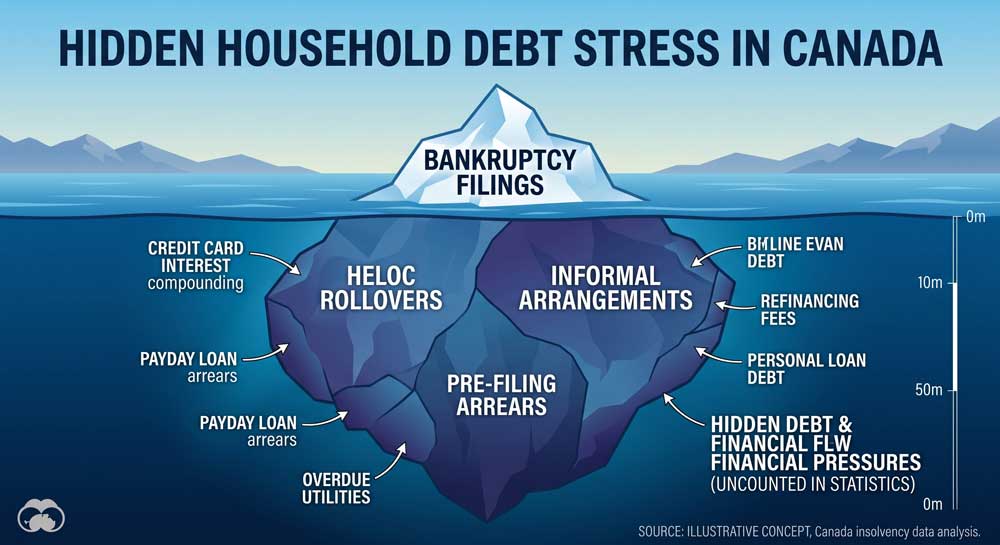
The insolvency figures only capture a fraction of true household financial strain. A large, unmeasured share of debt distress never appears in bankruptcy filings. Instead, people absorb consumer debt into their mortgages or HELOCs, pushing the obligation into a longer repayment timeline rather than resolving it.
| Debt Stress Category | Visible in Bankruptcy Data? | Notes |
|---|---|---|
| Consumer insolvency filings | Yes | Tracked by OSB and CAIRP |
| Mortgage arrears 90+ days | Partially | Tracked by CMHC |
| Debt rolled into HELOC/mortgage | No | Not captured in insolvency stats |
| Informal payment arrangements | No | Not publicly tracked |
| Pre-filing payment pressure | No | Precedes official filing by years |
These loans may appear performing on a bank’s balance sheet, but they represent deferred stress — debt restructured to delay, not resolve, the underlying vulnerability.
What the Trajectory Tells Us
No one can say with certainty whether Q1 2026 marks a peak or a midpoint. The 2009 surge subsided once the acute shock of the global financial crisis passed. Today’s drivers are different — not a single external jolt, but a slow convergence of high housing costs, elevated consumer debt, softening labour markets, and unresolved global trade pressures.
CAIRP has stated publicly that many Canadian households are entering this period of uncertainty already carrying unsustainable debt loads. If unemployment rises or mortgage renewal stress intensifies, the insolvency pipeline is likely to keep expanding. The data does not yet suggest we have reached the worst of it.
Reference URLs
- Global News — Consumer insolvencies highest since 2009 as Canadians struggle with debt
- CAIRP — Q4 2025 Canadian Insolvency Statistics Media Release
- TransUnion Canada — Canadian Household Debt Reaches $2.6 Trillion
- CMHC — National Delinquency Rate Drops but Continues to Rise in Ontario and BC
- Office of the Superintendent of Bankruptcy — Insolvency and CCAA Statistics in Canada
- MyClearDebt — Canadian Debt Report Q1 2026 — Insolvency Statistics and Trends
- Hoyes Michalos — 2024 Consumer Insolvency and Bankruptcy Study
- ElevenLab — Davos 2026: Carney Warns of a Fractured Global Order and Calls for Middle-Power Unity
- ElevenLab — Operation Epic Fury & the Middle East Geopolitical Crisis: 8,000 Airstrikes, 3 Market Warnings, and 1 Economic Tipping Point
- ElevenLab — How the US-Israel-Iran Conflict Is Crushing the Global Economy — 7 Critical Facts