High Bandwidth Memory HBM: Why South Korea Is Winning the AI Race in 2026
High bandwidth memory HBM has quietly become the most strategically important component in artificial intelligence infrastructure — and South Korea’s SK Hynix holds an iron grip on it. Understanding how that happened, and what it means for the global AI race, requires looking far beyond GPU specs and model benchmarks.
Table of Contents
The Numbers That Shocked the Market
When South Korea’s KOSPI 200 futures surged 5% at the open and triggered circuit breakers — pausing automated trading for five minutes — the catalyst was a single earnings report. SK Hynix posted Q1 2026 revenue of 52.6 trillion Korean won (approximately USD 38 billion), with an operating profit margin of 72%. That is not a typo.
To put that in perspective: Huawei’s entire global revenue for 2025 was roughly 880 billion Chinese yuan. SK Hynix — a single memory chip maker — is on a trajectory to surpass that in profit alone. Projections from KB Securities, UBS, and Bank of Communications International suggest annual revenue will exceed 300 trillion won in 2026, with net profit clearing one trillion Chinese yuan.
Reports circulating on Korean social media claim average employee bonuses could reach the equivalent of USD 850,000. Whether that precise figure is confirmed or not, the underlying story is real: a company once dismissed as a commodity cyclical business has rewritten the ceiling for semiconductor profitability.
What Is High Bandwidth Memory — And Why Does It Matter?
To understand why HBM commands such extraordinary economics, it helps to understand the “memory wall” problem that defines modern AI computing.
GPU chips are designed for massively parallel workloads — think tens of thousands of simultaneous simple operations. This makes them ideal for AI training and inference, which are essentially enormous matrix multiplications repeated billions of times. The problem is that GPUs have become so fast at computation that the memory feeding them can no longer keep up. Estimates suggest GPUs spend up to 70% of their time idle, simply waiting for data to arrive.
Conventional memory solutions — DDR5, GDDR7 — try to solve this by increasing clock speeds. But that approach hits hard physical limits: power consumption rises, heat becomes unmanageable, and signal integrity degrades. High bandwidth memory HBM takes an entirely different approach. Rather than making the data highway faster, it makes the highway dramatically wider.
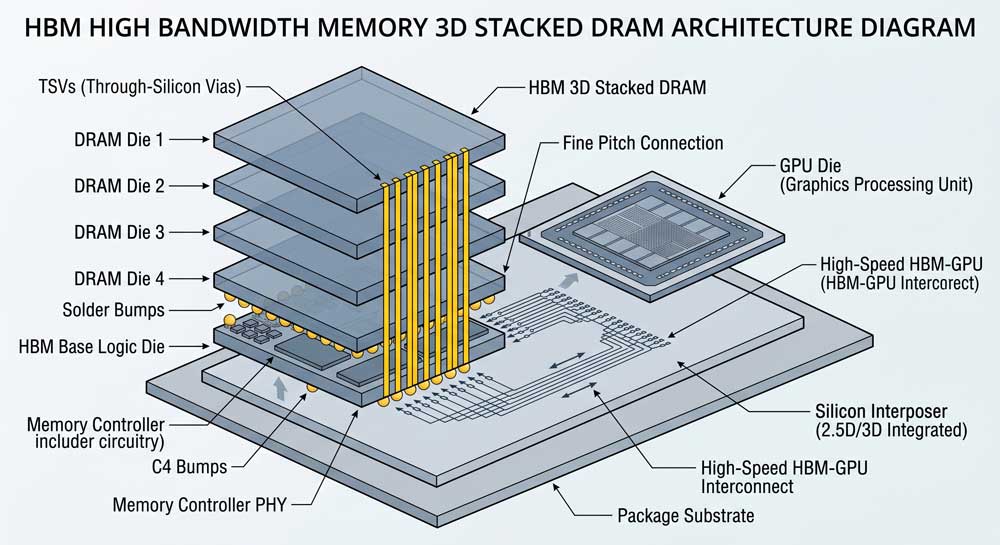
HBM stacks multiple DRAM dies vertically — like floors in a building — connected through thousands of microscopic through-silicon vias (TSVs). This stack is then placed directly beside the GPU die on a shared silicon interposer using advanced 2.5D packaging. The result is an enormous number of data lanes operating over a very short physical distance, delivering bandwidth that no conventional memory architecture can match.
| Memory Type | Peak Bandwidth | Interface Width | Typical Use Case |
|---|---|---|---|
| DDR5 | ~89 GB/s | 64-bit | Consumer PCs, servers |
| GDDR7 | ~1,792 GB/s | 192-bit | Gaming GPUs |
| HBM3E | ~1,230 GB/s per stack | 1,024-bit | AI accelerators, HPC |
| HBM4 (projected) | ~2,000+ GB/s per stack | 2,048-bit | Next-gen AI training |
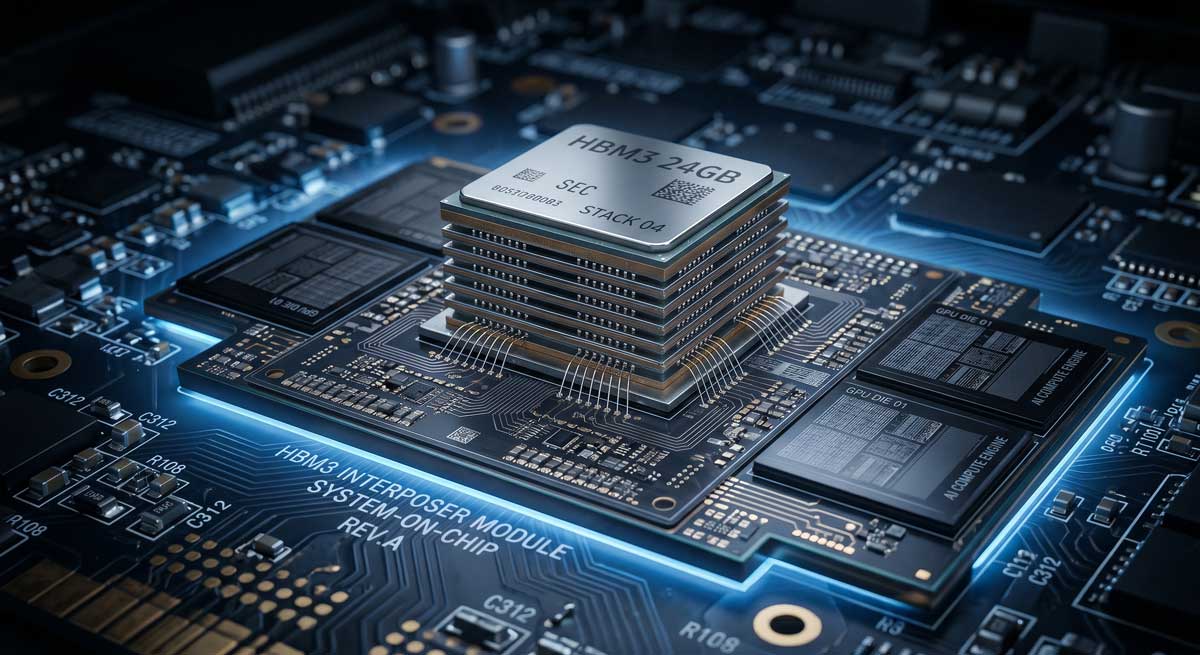
SK Hynix’s latest HBM4 stacks 12 to 16 DRAM dies in a single package. Multiple such stacks surround a single GPU die. On Nvidia’s B200, cost analysis from Epoch AI estimates total production cost between USD 5,700 and USD 7,300 per unit — with memory and advanced packaging together accounting for roughly two-thirds of that figure.
The implication is stark: Nvidia’s business model, its GPU delivery schedule, and its customer commitments are all meaningfully constrained by how much HBM SK Hynix can produce.
SK Hynix’s Market Position
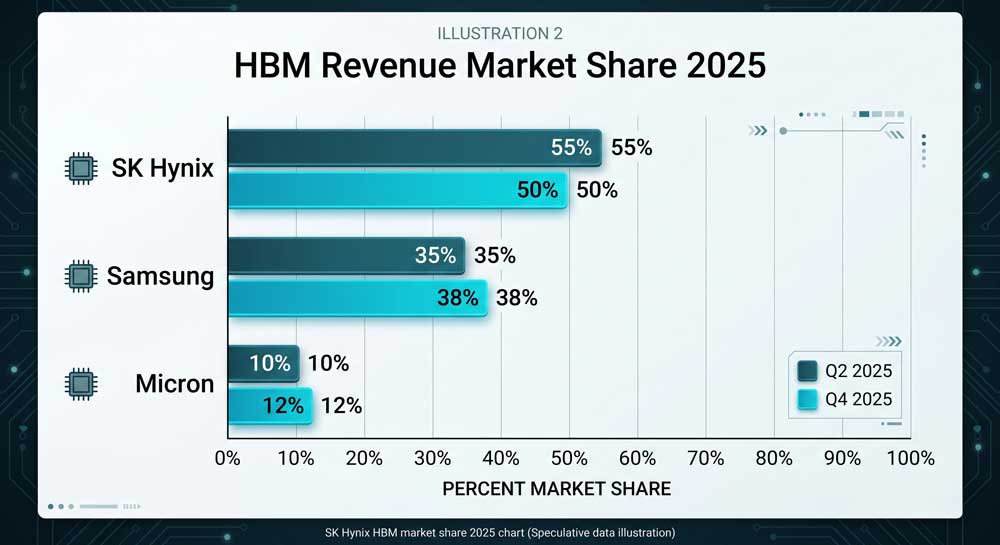
SK Hynix does not merely lead the HBM market — it dominates it at a level that is structurally difficult to challenge in the short term.
| Supplier | HBM Revenue Share (Q4 2025) | HBM Revenue Share (Q2 2025) |
|---|---|---|
| SK Hynix | ~57% (Counterpoint) | ~62% (Chosun Biz) |
| Micron | ~21% | ~21% |
| Samsung | ~22% | ~17% |
SK Hynix’s head of HBM sales stated on an earnings call that customer demand for HBM over the next three years already far exceeds the company’s total production capacity. That is an unusual situation in any industry: the supplier selects which customers to serve, not the other way around. Even Nvidia, the most powerful company in AI infrastructure, must queue.
SK Hynix plans capital expenditure of 70 trillion won in 2026, with 70% directed toward HBM production capacity, including the M15X production line and EUV-equipped facilities in the Yongin semiconductor cluster.
Decades of Painful Preparation
South Korea did not stumble into this position. The HBM advantage is the product of decisions made decades ago, sustained through multiple cycles of brutal industry losses.
The origins of Korean memory are, frankly, unglamorous. Samsung’s semiconductor programme began in 1983 with a USD 3 million technology licence for 64K DRAM from Micron, combined with reverse engineering of Toshiba chips and the recruitment of hundreds of Japanese engineers. The early Hynix lineage — then Hyundai Electronics — licensed 256K DRAM from Toshiba in 1984, survived a forced government-mandated merger with LG Semiconductor in 1999, and was not acquired by SK Group until 2012.
What transformed these companies was not technological genius alone. It was a willingness — backed by government credit and conglomerate capital — to invest counter-cyclically at a scale that Western and Japanese competitors could not match.
| Downturn | SK Hynix / Samsung Response | Competitor Outcome |
|---|---|---|
| 1997 Asian Financial Crisis | Samsung cut staff by 33%, maintained R&D, expanded production 30% | Many Western DRAM makers exited |
| 2008 Global Financial Crisis | Samsung expanded capacity as DRAM prices fell 90% | Germany’s Qimonda went bankrupt |
| 2012 consolidation | Samsung acquired Japan’s Elpida | Japan exited DRAM entirely |
| 2022–23 Memory Downturn | SK Hynix lost USD 4B+ per quarter; doubled HBM capacity anyway | Competitors reduced investment |
The 2021 and 2025 acquisitions of Intel’s NAND business for USD 9 billion gave SK Hynix 3D NAND technology and manufacturing assets in Dalian, China, transforming it from a NAND minor player into a direct Samsung rival.
Between 2016 and 2025, Samsung and SK Hynix spent a combined USD 500 billion on capital expenditure in memory semiconductors — 2.3 times the combined total of Micron, Kioxia, and Western Digital over the same period.
The Export Control Dimension
In December 2024, the US Department of Commerce’s Bureau of Industry and Security (BIS) explicitly added HBM to its export control framework covering China. The BIS designation described HBM as “critical to large-scale AI training and inference” and a “key component of advanced computing integrated circuits” — making it subject to the Foreign Direct Product rule.
This means China cannot legally import leading-edge HBM from SK Hynix or Samsung for use in advanced AI systems. China does have a domestic DRAM producer — CXMT (ChangXin Memory Technologies) — which has made genuine progress in conventional DRAM. But HBM is a fundamentally different challenge.
Producing competitive HBM requires the simultaneous mastery of advanced DRAM die design, TSV drilling at scale, thermal management across stacked dies, co-design with the GPU customer’s architecture, advanced packaging yield, and a sustained supply chain for materials and EDA tools. Each of these is a multi-year capability to build; all of them must work together.
China’s Architectural Workaround
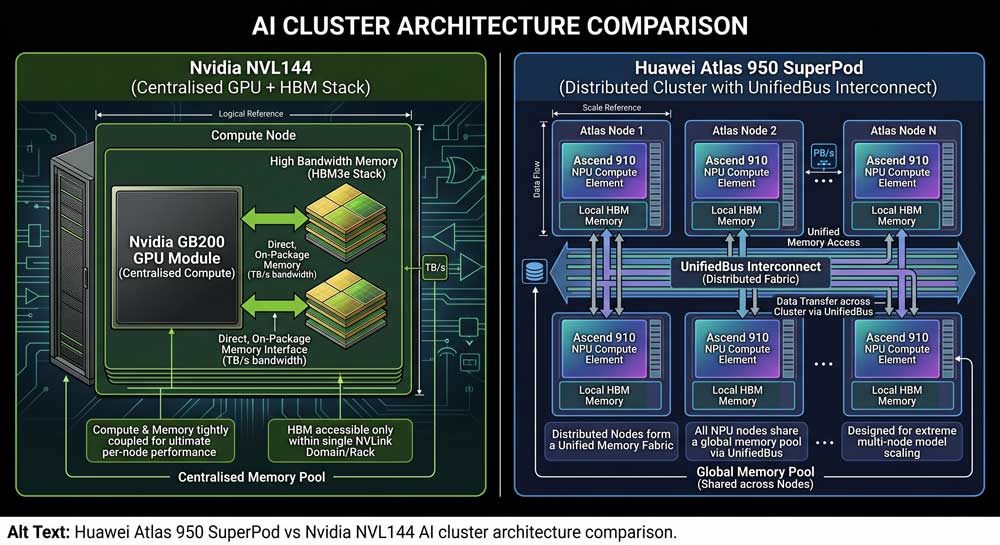
The challenge China faces is real, but the response is more sophisticated than simply trying to copy HBM. At Huawei’s 2025 Connect conference, rotating chairman Eric Xu revealed that Huawei has developed two proprietary HBM variants: HiBL 1.0 (used in the Ascend 950PR, providing 128 GB at 1.6 TB/s bandwidth) and HiZQ 2.0 (used in the Ascend 950DT, providing 144 GB at 4 TB/s).
These specifications trail HBM3E in raw bandwidth but represent a meaningful step toward memory independence. More importantly, Huawei is not just solving the chip problem — it is rethinking the system architecture.
The Atlas 950 SuperPod, planned for Q4 2026, will reportedly pack 8,192 Ascend 950DT chips across 160 cabinets. Huawei claims the system will deliver 6.7 times the compute and 15 times the memory capacity of Nvidia’s NVL144 system, which is also scheduled for 2026. Eric Xu’s stated rationale is architectural: where a single chip cannot match the world’s best, a well-engineered cluster can compensate through high-bandwidth, low-latency interconnects — Huawei’s proprietary UnifiedBus / LingQu protocol.
The strategy is essentially to substitute system-level engineering for component-level parity. Instead of a single chip with the world’s best HBM, deploy many chips connected by a fabric designed from the ground up to minimise data movement latency. This is not the path of least resistance, but it is a coherent engineering response to real constraints.
The Broader Supply Chain Picture
AI infrastructure is not a single product — it is a stack of interdependent capabilities, each of which can become a chokepoint.
| Layer | Current Leader | China Status |
|---|---|---|
| GPU compute | Nvidia (TSMC-fabricated) | Huawei Ascend (domestic) |
| High Bandwidth Memory | SK Hynix, Samsung | Huawei HiBL/HiZQ (early stage) |
| Advanced Packaging (CoWoS) | TSMC | SMIC, JCET (catching up) |
| EUV Lithography | ASML (Dutch, export-restricted) | No domestic equivalent |
| Memory DRAM (commodity) | Samsung, SK Hynix, Micron | CXMT (lagging 2–3 nodes) |
| AI Software / Frameworks | CUDA (Nvidia) | CANN (Huawei), PaddlePaddle |
The US export control regime is calibrated to apply pressure at multiple points in this stack simultaneously — not just GPUs, but HBM, EUV tools, EDA software, and advanced packaging materials. Each new frontier of capability creates a new potential chokepoint. When one gap is closed, another opens further up the technology curve.
What the South Korean story demonstrates is that closing these gaps takes not months but decades of sustained capital allocation, engineering accumulation, and a willingness to absorb catastrophic losses in the interim. Samsung lost USD 3 billion in the 1997 crisis and kept its semiconductor R&D budget intact. SK Hynix lost more than USD 4 billion in a single quarter during the 2022–23 downturn and doubled its HBM capacity anyway.
What the HBM Bottleneck Reveals About AI Power
The deeper lesson of the HBM story is about where power actually resides in the AI supply chain. The public narrative about AI focuses on model parameters, benchmark scores, and the charisma of foundation model companies. But none of those matter if the hardware cannot be built.
Every hyperscaler queues for GPU allocations. Every GPU allocation depends on HBM availability. HBM availability depends on a handful of fabs in South Korea and the United States — and right now, predominantly one company in Icheon, South Korea.
SK Hynix is effectively collecting a bandwidth tax on the entire AI industry. The more ambitious the AI model, the more HBM it requires, and the more revenue flows to Suwon and Icheon. This is not a temporary dislocation — it reflects a decade and a half of technical investment that cannot be replicated quickly.
The AI race, stripped of its narrative glamour, is an industrial competition: who has the fabs, the packaging lines, the HBM capacity, the power infrastructure, and the engineering organisation to run hundreds of thousands of accelerators at scale. South Korea answered that question with forty years of painful, counter-cyclical capital allocation. The result is a 72% operating margin in a quarter that shocked global markets.
The path for challengers is long, and the discipline required is extraordinary. But as the Korean example shows, the rewards — when they finally arrive — are historic.
Reference Links
- Goldman Sachs — Will the Corporate Investment in AI Pay Off?
- Counterpoint Research — Global DRAM and HBM Market Share: Quarterly Tracker
- Reuters — Key Products in Huawei’s AI Chips and Computing Power Roadmap
- BIS / US Commerce Department — Commerce Strengthens Export Controls to Restrict China’s Capability to Produce Advanced Semiconductors for Military Applications
- CNBC — SK Hynix Overtakes Samsung in Annual Profits for the First Time
- PatsSnap — HBM Technology Landscape 2026: Market Trends and AI Demand
- Wired — The US Just Made It Way Harder for China to Build Its Own Chips
- ElevenLab — Blackstone AI Investment Australia: $15 Billion Bet on Infrastructure vs. Reality of Productivity Crisis
- ElevenLab — Storage Chip Prices Are Exploding: 3 Shocking Reasons Your Next SSD Will Cost More
- ElevenLab — AI Token Economy: 7 Brutal Truths That Will Redefine Who Gets Wealthy in the Next Decade