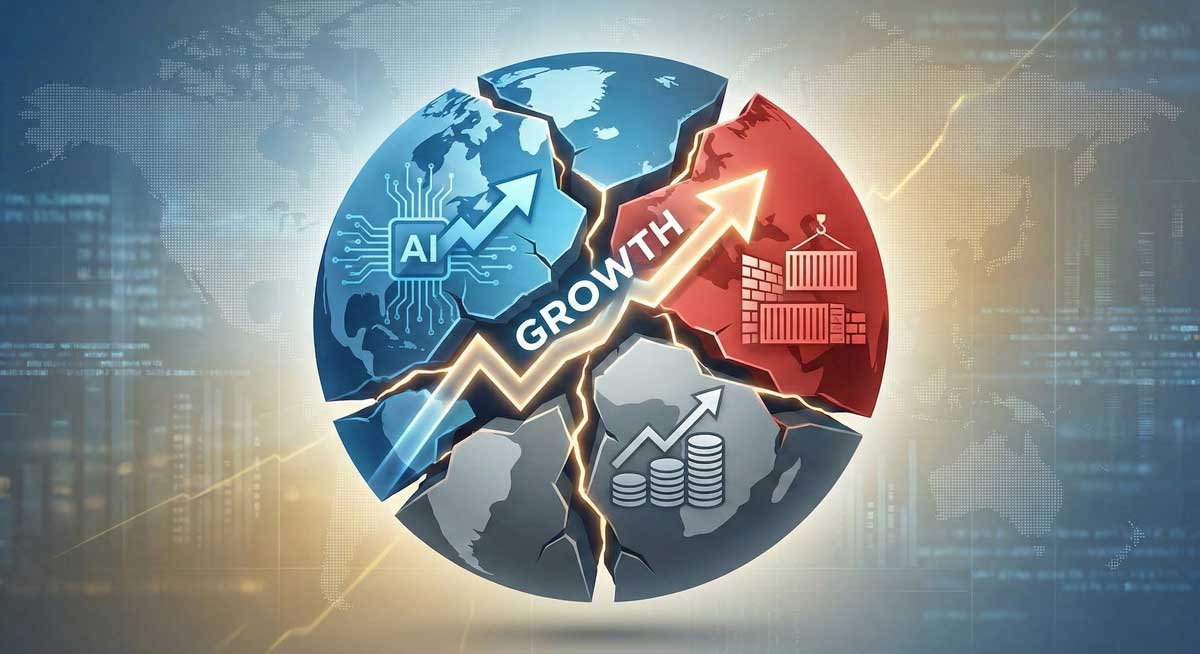
2025 Global Economy: A Fractured World Chasing Growth
The 2025 Global Economy 2025 landscape did not deliver a classic recession, but it did redraw the map of globalization. Growth held up better than many feared, even as the United States launched the most aggressive tariff experiment in decades and governments everywhere shifted from “printing to spend” to borrowing to spend.[sparkco]
From “Where It’s Cheap” to “Where It’s Safe”
For half a century, world trade was built around one simple logic: produce wherever costs were lowest.
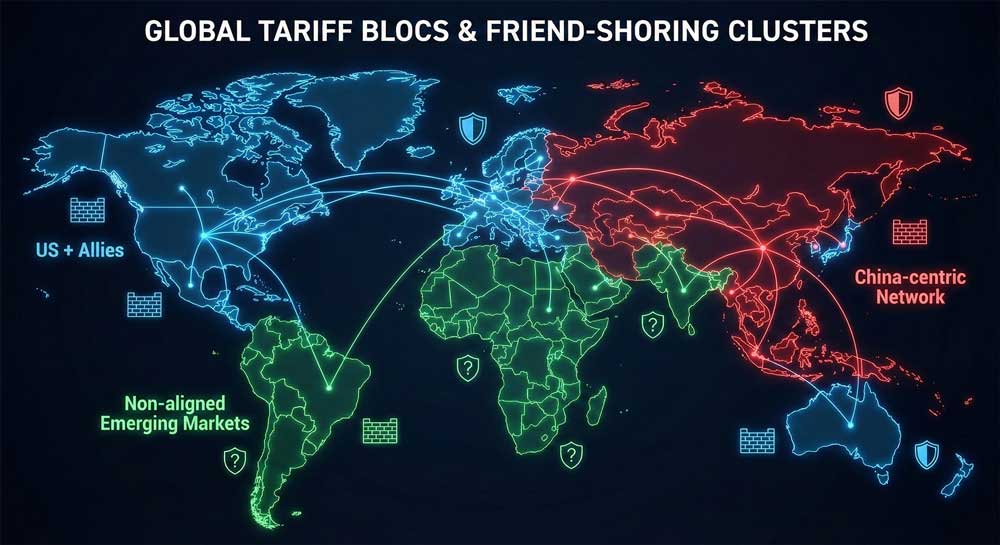
The 2025 tariff shock, triggered by President Trump’s “Liberation Day” executive order and the 10% baseline tariff plus steep “reciprocal” surcharges on key partners, has pushed the system toward a new logic: produce where it is geopolitically safe.[en.wikipedia]
The IMF now projects global growth around 3.2% in 2025 and 3.1% in 2026: numerically “ordinary”, but surprisingly resilient given the scale of trade disruption.[imf]
Governments and firms reacted tactically: front‑loading shipments before tariffs, negotiating partial exemptions, and absorbing margins to slow the pass‑through to consumers.[reuters]
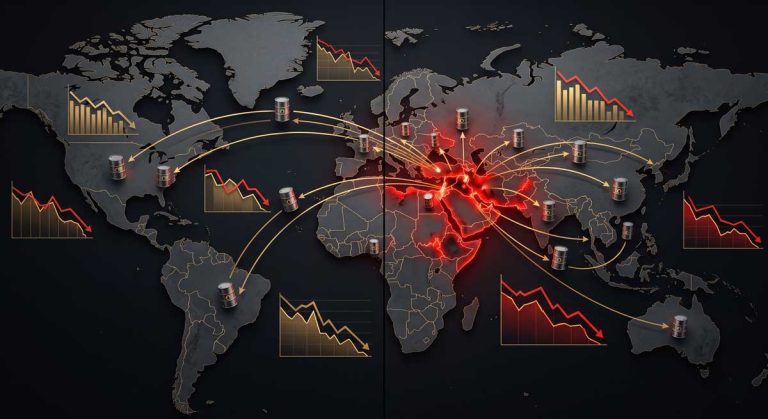
The deeper shift is structural: value chains are being re‑wired around security, alliances, and political leverage rather than purely cost efficiency, fragmenting trade into rival blocs.[tradingeconomics]
Tariffs as Power Politics, Not Economics
The 2025 tariff wave is often sold domestically as a way to “fix” trade deficits or fund the budget.
In reality, both economic justifications are weak; tariffs function more as a bargaining chip and a geopolitical instrument than as a macro policy tool.[news.uq.edu]
Even with broad coverage, projected US tariff revenue (on the order of a few hundred billion dollars annually) is small relative to federal receipts and comes at the cost of alienating nearly every trading partner at once.[pwc.com]
Economists point out that trade deficits are primarily driven by macro balances in savings, investment, and capital flows, not by tariff schedules; reshuffling bilateral balances does little to shrink the overall gap.[sparkco]
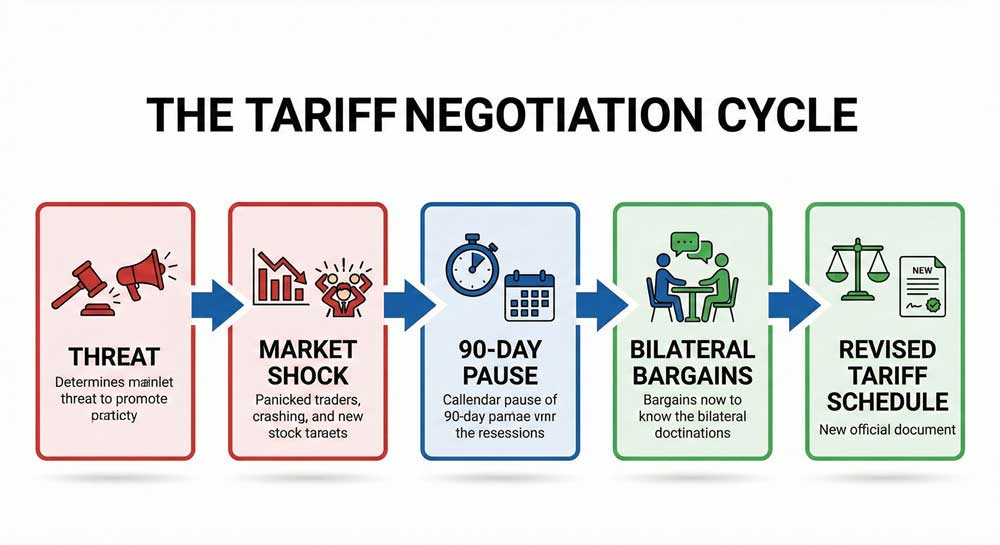
Where tariffs do “work” is in extracting concessions: lower partner tariffs, investment pledges, energy‑purchase commitments, or strategic access in exchange for lower US rates.[sbs.com]
The result is a world in which tariff policy is negotiated deal‑by‑deal, country‑by‑country; “most‑favoured nation” has been replaced by something closer to “most‑useful partner”.[tradingeconomics]
AI: Capital Boom, Labor Chill
If tariffs are the political story of 2025, artificial intelligence is the financial one.
Capital expenditure on AI infrastructure—hyperscale data centers, specialized chips, and cloud platforms—has become one of the few genuine global growth engines.[sparkco]
Major US tech groups alone are estimated to be committing hundreds of billions of dollars to AI‑related capex, a magnitude comparable to or exceeding annual US tariff revenues.[sparkco]
This wave of investment has lifted equity markets and household wealth at the top, turning AI leaders into systemic institutions: “too central to fail” in the narrative, even if not legally in the banking sense.[sparkco]
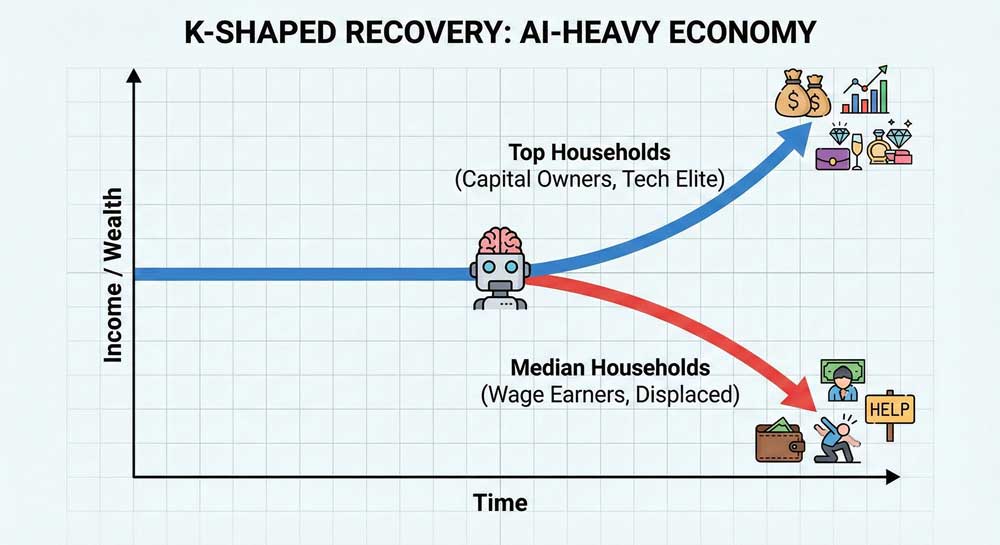
Yet the labor side tells a different story: automation and AI‑enabled tools are suppressing hiring in some white‑collar segments, while layoffs in non‑AI tech and traditional sectors keep pressure on middle‑ and lower‑income groups.[sparkco]
In macro terms, AI is amplifying a K‑shaped recovery: asset owners and high‑skill workers ride the AI boom, while those without capital or adaptable skills face stagnant wages, rising job insecurity, and higher cost‑of‑living in many economies.[sparkco]
For analysis of the deeper AI race and ecosystem battles driving this boom:
Debt, Deficits, and the New Fiscal Regime
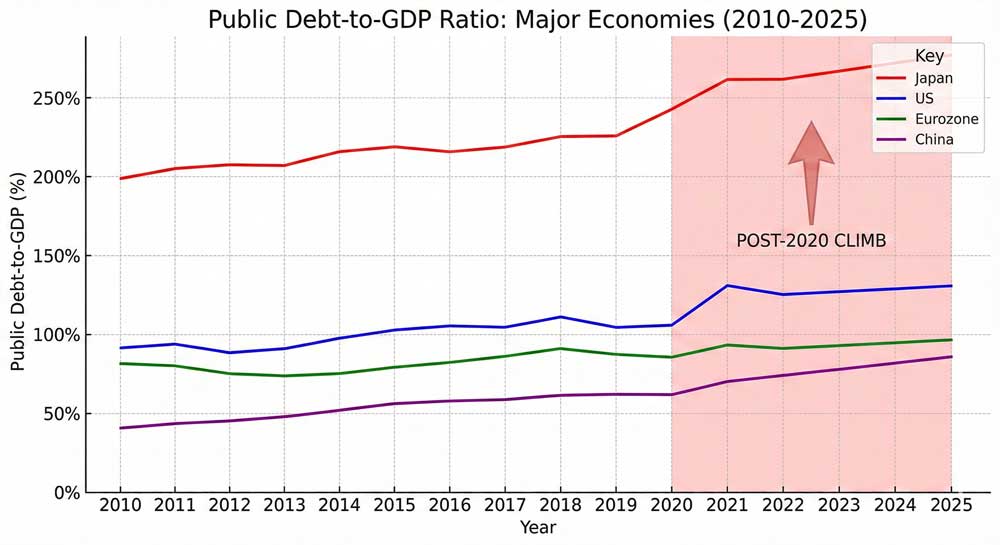
Under the surface of 2025’s “OK” growth lies a common pattern: governments are leaning much harder on fiscal policy.
The post‑pandemic era of extraordinary money printing has given way to a more politically palatable model—large, persistent deficits funded by heavy public borrowing.[mourant]
The IMF’s latest outlook highlights that many major economies are simultaneously loosening fiscal policy while inflation drifts back toward targets, especially outside the US.[imf]
In the United States, expanded spending programs and structural deficits keep public debt on an upward path, reinforcing political pressure on the Federal Reserve to ease in order to contain borrowing costs and support markets.[reuters]
Europe, Japan, and China are also pivoting—through infrastructure programs, defense build‑ups, or targeted consumption subsidies—to offset weak private demand or trade headwinds.[mourant]
What is new is not that governments spend in downturns, but that “emergency‑level” fiscal activism is quietly becoming the default, drifting the global policy mix toward permanent stimulus backed by rising debt ratios.[mourant]
Winners, Stragglers, and the Geography of Growth
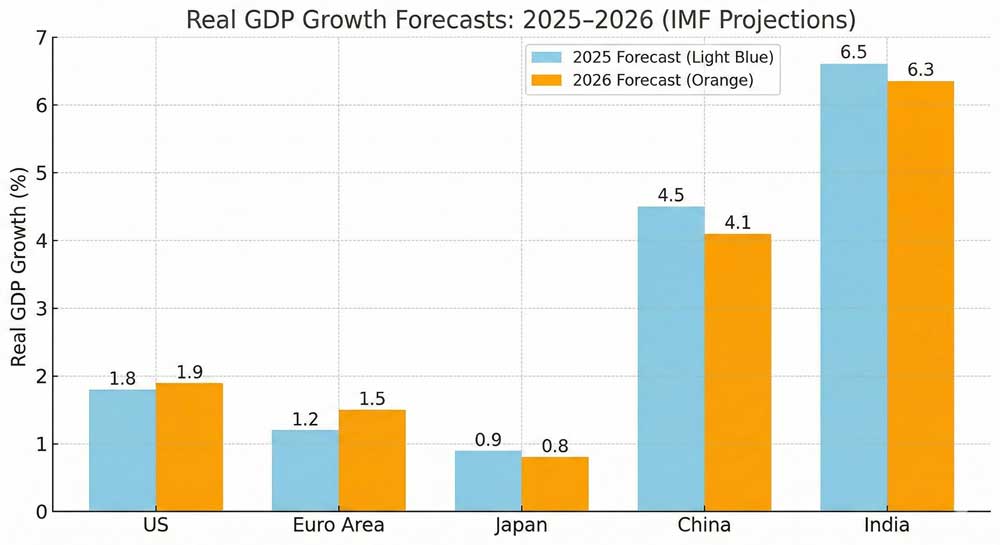
Beneath the global 3% headline, the distribution of growth is extremely uneven.
A few large emerging markets are doing the heavy lifting, while some advanced economies barely grow at all.[tradingeconomics]
Growth Profiles by Economy Type
| Economy type | 2025 growth narrative (IMF / public data) | Macro takeaway |
|---|---|---|
| India & peers | India projected around 6.4–6.6% growth, remaining the fastest‑growing major economy despite US tariffs.[newsonair.gov] | Strong domestic demand, demographics, and “China+1” supply‑chain shifts make South Asia a key global growth engine.[newsonair.gov] |
| China | Growth revised up toward the high‑4% range amid resilient exports and targeted fiscal support, but domestic demand and property remain headwinds.[tradingeconomics] | External resilience masks structural issues at home: weak confidence, property adjustment, and persistent deflationary pressures in producer prices.[sparkco] |
| United States | Growth around 2% with falling inflation, but rising debt and tariff uncertainty; AI‑driven capex and strong markets offset trade frictions.[tradingeconomics] | A narrow path: “soft‑landing” data, but high dependence on financial conditions and tech valuations.[sparkco] |
| Euro area & UK | Growth close to 1–1.2%, inflation near 2%; Germany among the weakest after energy shocks and tight fiscal rules.[tradingeconomics] | “Boring but stable”: low trend growth, improving inflation, and ongoing debates over how loose fiscal policy should become.[sparkco] |
| Japan | Modest growth below 1% with inflation finally above zero, but rising concerns about debt sustainability, yen weakness, and political turnover.[tradingeconomics] | From deflation problem to inflation problem: policy trade‑offs have become more acute.[sparkco] |
The consequence is a more multipolar growth map.
The US still anchors global finance and technology, but incremental demand is increasingly supplied by India and a handful of emerging markets able to leverage demographics, commodity positions, or new supply‑chain roles.[newsonair.gov]
2026: A “Spend First, Worry Later” World
Looking ahead, 2026 is shaping up as a year where governments test how far they can push fiscal and industrial policy before markets push back.
The IMF baseline still shows global growth just above 3%, supported by easier financial conditions and delayed tariff impacts, but risks are clearly skewed to the downside.[imf]
Key global risks to watch:
- Policy‑driven inflation comeback
Simultaneous fiscal expansion and, in some cases, tariff pass‑through could re‑ignite inflation, especially where central banks face intense political pressure to cut rates.[tradingeconomics] - AI narrative fatigue
If AI investment fails to translate into broad productivity gains, stretched valuations and “too‑central‑to‑fail” tech names could become a vulnerability instead of a buffer.[sparkco] - Fragmentation and “hidden” trade shocks
Firms can route around tariffs in the short run, but a more fragmented system tends to be less efficient, more inflation‑prone, and more exposed to geopolitical accidents.[reuters] - Middle‑class squeeze
In many countries, the combination of high asset prices, AI‑linked job risk, and fiscal choices skewed toward capital‑intensive sectors deepens inequality and political volatility.[sparkco]
In other words, the 2025 global economy proved it could survive a dramatic policy shock without crashing 2026 will test whether it can live with a world where fragmentation, permanent deficits, and AI‑driven polarization are the new normal.[sparkco]
References
- International Monetary Fund, World Economic Outlook, October 2025.[imf]
- International Monetary Fund, World Economic Outlook Update, July 2025.[tradingeconomics]
- Reuters, “IMF lifts growth outlook on more benign tariffs as revived US‑China trade war looms,” October 2025.[reuters]
- NDTV / IMF commentary on India’s growth outlook, 2025–2026.[newsonair.gov]
- Wikipedia, “Liberation Day tariffs,” updated 2025.[en.wikipedia]
- University of Queensland, “Trump’s tariffs explained,” 2025.[news.uq.edu]
- PwC and related trade advisories on the implementation and temporary pause of Liberation Day tariffs.[pwc.com]