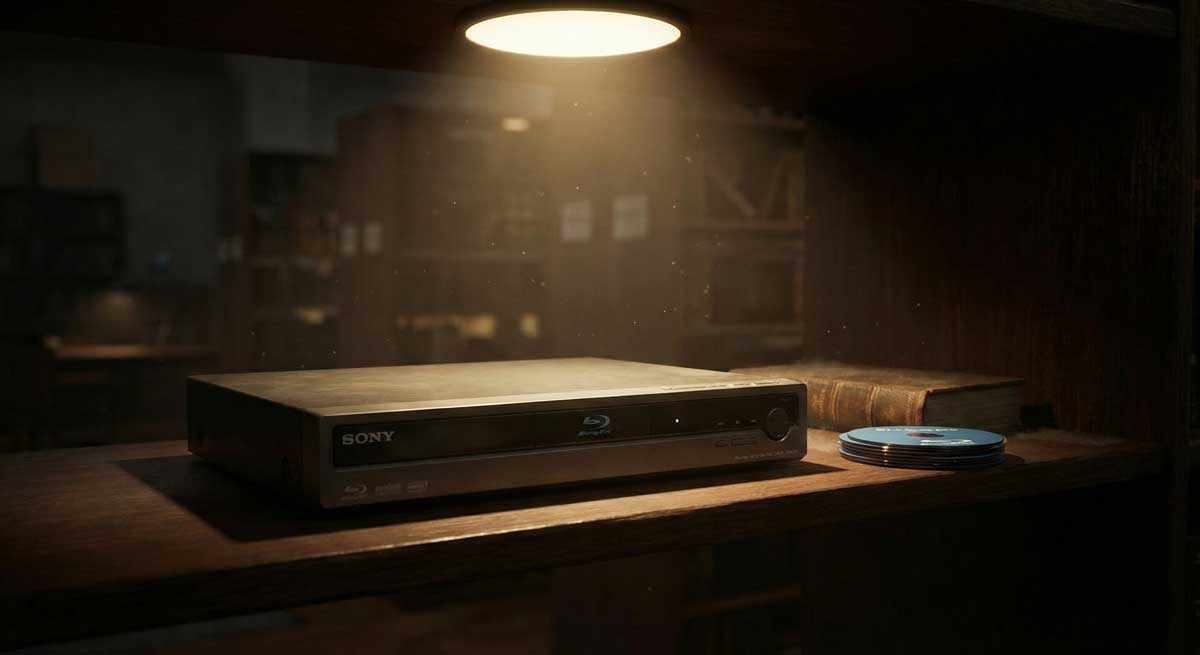
Sony Discontinues Blu-ray Recorders: The Final Death of Physical Media Recording in 2026
Sony discontinues Blu-ray recorders effective February 2026, officially terminating a 23-year journey that began with the format’s birth in 2003. The company—which pioneered the Blu-ray Disc standard and championed it through a bitter format war—announced on its Japanese website that all recorder shipments will cease with no successor models planned. This definitive exit marks the end of consumer-controlled broadcast archiving, leaving audiophiles and home theater enthusiasts mourning the loss of the last high-quality physical recording ecosystem.
What Exactly Sony Discontinues in Blu-ray Recorders
Sony discontinues Blu-ray recorders specifically—devices capable of recording television broadcasts and burning content to optical media. The terminated lineup includes flagship models released within the past two years:
- BDZ-ZW1900 (2024 release)
- BDZ-FBT4200 (2023 release)
- BDZ-FBT2200 (2023 release)
- BDZ-FBW2200 (2023 release)
All remaining recorder inventory will be phased out through early 2026.
Critical Distinction: Recorders vs. Players
| Device Type | Status | Functionality |
|---|---|---|
| Blu-ray Recorders | Discontinued permanently | Record TV broadcasts, burn discs, playback |
| Blu-ray Players | Still in production | Playback only—no recording capability |
| 4K Ultra HD Players | Still in production | Premium playback with HDR support |
Consumers who simply want to watch pre-purchased movie discs retain hardware options. However, the ability to archive broadcast television to physical media is effectively extinct.
Collector Alert: If you own libraries of recorded BD-R discs, secure backup hardware immediately. Replacement units will become scarce as inventory depletes throughout 2026.
The Brutal Format War: How Blu-ray Defeated HD DVD
Understanding why Sony discontinues Blu-ray recorders today requires revisiting the fierce technological battle that established Blu-ray dominance—a conflict so intense it’s remembered as one of technology’s most expensive corporate wars.
The Blue Laser Revolution
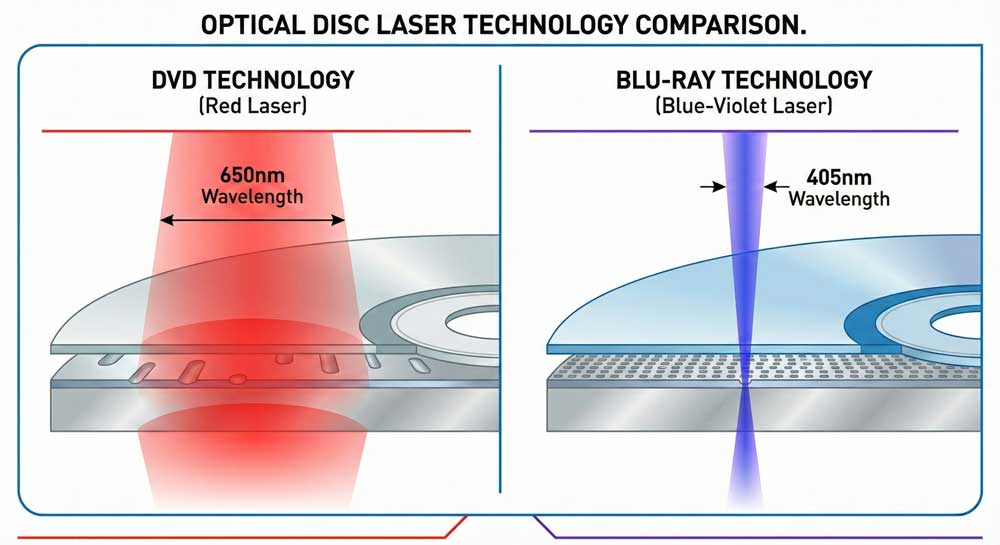
On February 19, 2002, Sony partnered with Philips and Panasonic to unveil the Blu-ray Disc specification. The innovation centered on a blue-violet laser with wavelength λ=405 nm —significantly shorter than DVD’s red laser at 650 nm. This wavelength reduction enabled tighter data pit spacing, achieving 25GB per layer versus DVD’s 4.7GB.
Technical Specifications:
| Parameter | Blu-ray Disc | DVD (Comparison) |
|---|---|---|
| Laser Wavelength | 405 nm | 650 nm |
| Numerical Aperture (NA) | 0.85 | 0.60 |
| Track Pitch | 0.32 μm | 0.74 μm |
| Single-Layer Capacity | 25 GB | 4.7 GB |
| Dual-Layer Capacity | 50 GB | 8.5 GB |
| Data Transfer Rate (1x) | 36 Mbps | 11 Mbps |
In 2003, Sony launched the world’s first consumer Blu-ray recorder: the BDZ-S77, priced at ¥450,000 ($3,000-4,000 USD). The astronomical cost limited adoption to wealthy early adopters, but it demonstrated commercial viability.
The HD Format War Timeline (2006-2008)
| Date | Event | Strategic Impact |
|---|---|---|
| Feb 2002 | Sony/Philips/Panasonic announce Blu-ray standard | 25GB capacity targets HD video storage |
| 2003 | Toshiba unveils competing HD DVD format | Uses 405nm laser but different disc structure; cheaper manufacturing |
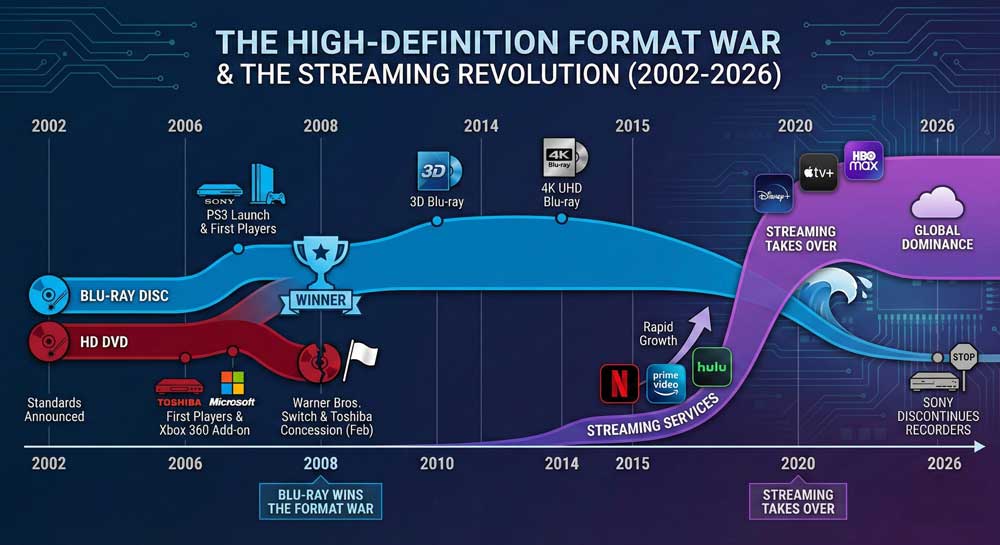
| Nov 2006 | PlayStation 3 launches with Blu-ray drive | Mass-market penetration strategy—millions of drives enter homes |
| 2006-2007 | Studios split between formats | Warner Bros., Paramount support both; Universal exclusive to HD DVD |
| Jan 2008 | Warner Bros. announces Blu-ray exclusivity | Tipping point—major studio support shifts decisively |
| Feb 2008 | Walmart, Best Buy back Blu-ray exclusively | Retail infrastructure abandons HD DVD |
| Feb 19, 2008 | Toshiba surrenders, halts HD DVD production | Format war ends after 7 years—Blu-ray wins |
The PlayStation 3 Gambit: Sony’s decision to embed Blu-ray drives in PS3 consoles proved strategically decisive. While Toshiba focused on standalone player affordability, Sony flooded the market with millions of Blu-ray-capable devices disguised as gaming hardware. When Warner Brothers—the largest neutral studio—committed to Blu-ray exclusivity in January 2008, the war effectively ended. Toshiba officially conceded on February 19, 2008, exactly 18 years before Sony discontinues Blu-ray recorders in 2026.
Why Sony Discontinues Blu-ray Recorders Now: The Streaming Apocalypse
Blu-ray won the format war but lost the convenience revolution. The same technological advances that made Blu-ray recording possible—increasing storage density, faster data processing—also enabled cloud streaming that rendered physical recording obsolete.
The Five Forces That Killed Blu-ray Recorders
- Streaming ubiquity: Netflix, Disney+, YouTube, and regional platforms offer instant access without hardware management
- Generational shift: Users under 30 never developed physical media collection habits
- Catch-up services: TVer, NHK Plus, and network apps eliminate the need to record scheduled broadcasts
- Content abundance: More content available on-demand than consumers can realistically watch
- Blank media death: Panasonic stopped producing recordable Blu-ray discs in 2023
Sony’s official statement explicitly cites “the proliferation of video streaming services and increased availability of on-demand content, resulting in significantly reduced demand for recorder-based archiving”.
The Industry Mass Exodus
| Manufacturer | Exit Date | Details |
|---|---|---|
| Panasonic | 2023 | Ceased blank recordable Blu-ray disc production |
| LG | 2024 | Exited all Blu-ray player markets globally |
| TVS REGZA | January 2026 | Stopped recorder production one month before Sony |
| Sharp | 2026 | No new in-house designs; effective market exit |
| Sony | February 2026 | Ends all recorder shipments; no successor models |
| Panasonic (DIGA line) | Still Active | Only remaining manufacturer developing new recorders |
Panasonic’s DIGA product line represents the sole remaining Japanese manufacturer actively investing in Blu-ray recorder development. The market has effectively collapsed into a single-brand category.
The Technical Truth: Why Blu-ray Still Crushes Streaming Quality
Despite market irrelevance, the technology Sony discontinues in Blu-ray recorders remains technically superior to streaming for one critical metric: uncompressed data bandwidth.
Bitrate: The Quality Bottleneck Streaming Can’t Overcome
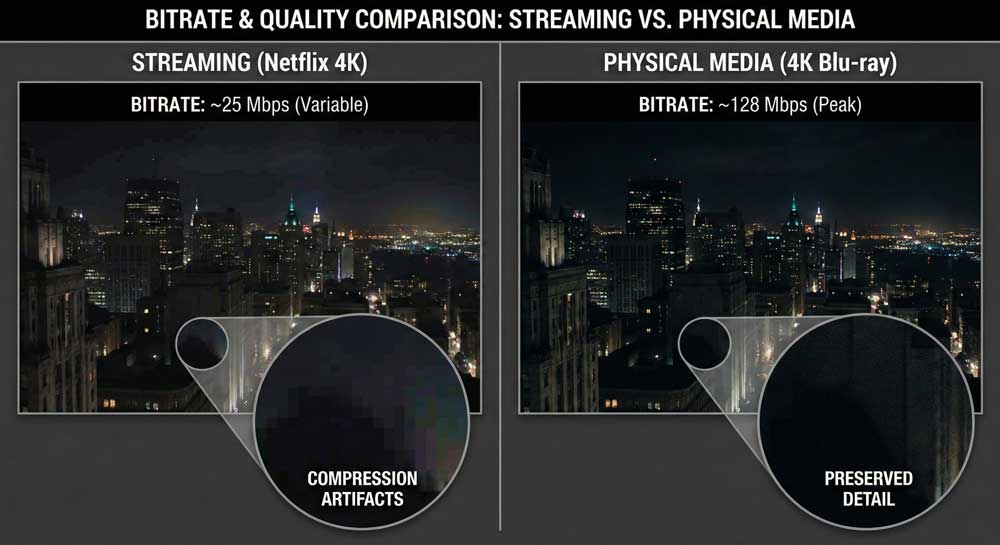
Bitrate measures data transferred per second—higher bitrates preserve detail, eliminate compression artifacts, and maintain shadow/highlight gradation. Streaming services compress video aggressively to fit internet bandwidth constraints; physical media doesn’t.
| Format | Average Bitrate | Maximum Bitrate | Video Compression | Audio Format |
|---|---|---|---|---|
| 4K Ultra HD Blu-ray | 82 Mbps | 128-144 Mbps | Minimal | Dolby Atmos/DTS:X lossless |
| Standard Blu-ray (1080p) | 48-75 Mbps | 92 Mbps | Light compression | TrueHD/DTS-HD MA |
| Sony Pictures Core | ~70 Mbps | 80 Mbps | HEVC compression | Lossy Atmos |
| Apple TV+ | ~35 Mbps | 40 Mbps | HEVC compression | Compressed Atmos |
| Netflix/Prime 4K | 15-25 Mbps | 25 Mbps | Heavy HEVC compression | Compressed surround |
| YouTube 4K | 8-15 Mbps | 45 Mbps | VP9 compression | AAC stereo/5.1 |
Technical Reality: A 4K Blu-ray disc averaging 82 Mbps delivers 3-5× more visual data per second than Netflix or Amazon Prime. This difference manifests as visible macroblocking in dark scenes, color banding in gradients, and detail loss in complex textures—all absent from Blu-ray playback.
The Dolby Vision Secret Only Physical Media Delivers
Professional videophiles guard a technical advantage streaming platforms cannot replicate: dual-layer Dolby Vision (Profile 7). This premium HDR implementation appears exclusively on physical 4K Blu-ray discs and uncompressed disc image files.
Dolby Vision Technical Breakdown:
| Implementation | Availability | Dynamic Metadata | Tonemapping Precision |
|---|---|---|---|
| Dual-Layer (Profile 7) | 4K Blu-ray discs only | Frame-by-frame + enhancement layer | Maximum fidelity |
| Single-Layer (Profile 5/8) | Netflix, Disney+, streaming services | Frame-by-frame only | Compressed dynamic range |
Most streaming platforms—including Netflix, Disney+, HBO Max, and regional services—deliver only single-layer Dolby Vision, a compressed variant that sacrifices peak luminance precision and shadow detail. For collectors pursuing absolute visual fidelity on high-end OLED displays, physical discs remain the exclusive path to maximum HDR specifications.
This technical superiority explains why hardcore enthusiasts continue hoarding Blu-ray recorder libraries despite streaming convenience. On properly calibrated reference monitors, the difference between 128 Mbps Blu-ray and 25 Mbps streaming becomes unmistakable—particularly in film grain preservation, shadow detail, and highlight roll-off.
What Happens After Sony Discontinues Blu-ray Recorders
The Blu-ray recorder market faces terminal decline, but the broader Blu-ray ecosystem retains viability in specific niches:
Surviving Blu-ray Sectors:
- Playback-only hardware: Players for pre-recorded discs remain in production
- Gaming console integration: PlayStation 5 and Xbox Series X maintain Blu-ray drives
- Boutique film releases: Criterion Collection, Arrow Video, and specialty distributors sustain collector markets
- Archival applications: Institutions use Blu-ray for long-term data preservation beyond consumer electronics
Extinct Categories:
- Consumer broadcast recording to optical discs
- Blank recordable Blu-ray disc production
- Mass-market recorder hardware development
Sony discontinues Blu-ray recorders not because the technology failed, but because the use case evaporated. Modern consumers rent streaming access rather than own permanent copies—a fundamental behavioral shift from the ownership culture that sustained physical media for decades.
The Archivist’s Lament: Permanence vs. Convenience
For the diminishing community that refuses to compromise on quality, Sony discontinues Blu-ray recorders represents an existential threat. Physical media offered something streaming platforms fundamentally cannot guarantee:
- Ownership without licensing restrictions: Content remains accessible regardless of platform business decisions
- No internet dependency: Playback survives network outages and bandwidth constraints
- Preservation of original masters: Bitrate and dynamic range match theatrical distribution specifications
- Freedom from subscription churn: One-time purchase vs. perpetual monthly fees
The irony: streaming conquered the market through convenience, but Blu-ray recording technology achieved something platforms still struggle to match—absolute user control over media libraries.
Deep-Dive Sources
Industry News:
- Sony to End Blu-ray Disc Recorder Shipments – Nippon.com
- Sony Blu-ray Recorder Production Ending by 2026 – TechNet Books
- Japan’s Blu-ray Recorder Market Collapses as Sony Exits – Tokyoscope
Technical Specifications & Format Details:
- Blu-ray Disc Format Specifications – Blu-ray Disc Association
- Blu-ray Physical Format White Paper – BD Association Technical Documentation
- Blu-ray Recordable Specifications – BD-R Technical Standards
Quality Comparisons & Consumer Analysis:
- Are 4K Blu-ray Discs Better Quality Than Streaming? – What Hi-Fi
- Why I’m Still Buying 4K Blu-rays in 2025 – Tom’s Guide
- Ultra HD Blu-ray vs. Streaming: The Ultimate Showdown – Wolfcrow
Format War History:
- High-Definition Optical Disc Format War – Wikipedia
- Sony Pulls the Plug on Recordable Blu-ray Discs – Home Theater Review
From Us: