4 Mortgage Repayment Strategies That Could Save You $318,000 in Interest
Table of Contents
Mortgage repayment strategies can save Australian homeowners over $318,000 in interest, especially critical as Commonwealth Bank economists now forecast a potential RBA rate increase as early as February 2026. For Australia’s average mortgage of $693,801, each 0.25% rate hike adds approximately $106 to monthly repayments. But while borrowers can’t control central bank policy, they can dramatically reduce total interest costs through strategic loan management.
Financial educator Lacey Filipich from Money School recently modeled a revealing scenario: a borrower with an $800,000 mortgage at 5.5% over 30 years making minimum repayments of $4,542 monthly will pay a staggering $835,232 in total interest. However, strategic deployment of a $100,000 windfall—increasingly common with generational wealth transfers—can slash that figure by over $318,000 while cutting nearly eight years off the loan term.
The Four Mortgage Repayment Strategies Compared
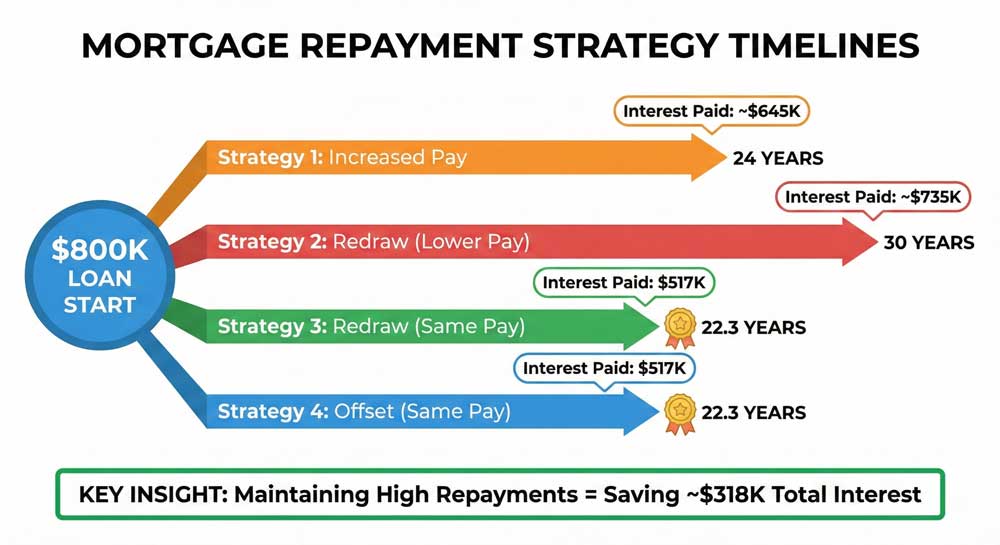
Strategy 1: Increase Monthly Repayments
Method: Boost monthly payments from $4,542 to $5,000, gradually deploying the $100,000 windfall.
Results: Saves approximately $190,000 in interest and cuts 6 years off the loan term.
Critical limitation: Filipich warns this isn’t optimal when mortgage rates (5.5%) exceed savings rates (typically 5.1%), as keeping money in savings costs 0.4% annually.
Pro tip: Switch to fortnightly repayments—paying half the monthly amount every two weeks results in 26 annual payments instead of 12 monthly ones, effectively adding an extra month’s repayment each year.
Strategy 2: Deposit Into Redraw, Reduce Payments
Method: Deposit $100,000 into a redraw facility and accept the bank’s recalculated lower minimum payment of $3,974.
Results: Saves approximately $100,000 in interest but still requires 30 years to repay.
The trap: This “comfort strategy” provides immediate cash flow relief but sacrifices hundreds of thousands in potential long-term savings.
Strategy 3: Deposit Into Redraw, Maintain Original Payments
Method: Deposit $100,000 into redraw but continue paying the original $4,542 monthly.
Results: Loan term drops to 22 years and 4 months, with total interest of only $517,085—saving $318,147 compared to minimum repayments.
The advantage: By maintaining high payment discipline against a reduced balance, you aggressively attack principal while the deposited funds continuously reduce interest charges.
Strategy 4: Deposit Into Offset, Maintain Original Payments
Method: Place $100,000 in a 100% offset account while maintaining $4,542 monthly repayments.
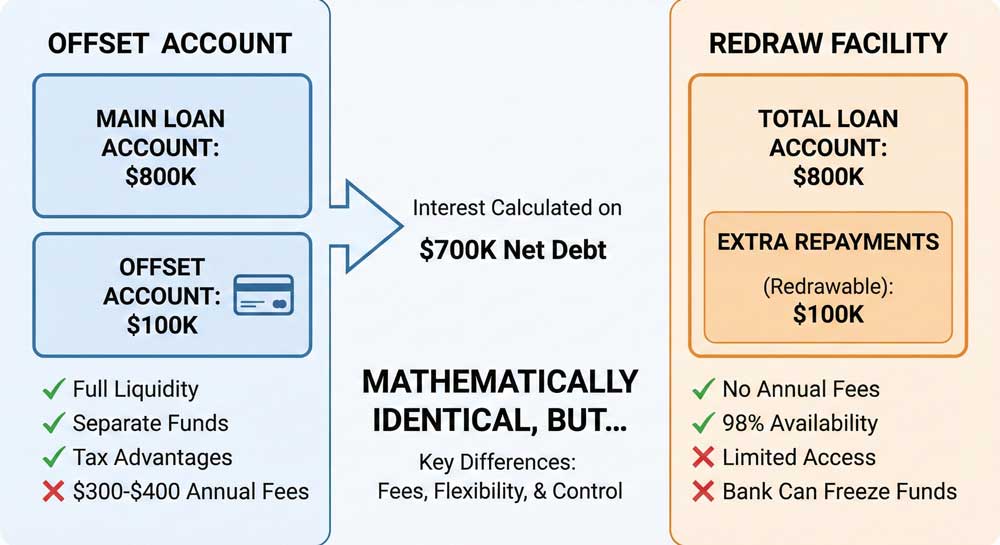
Results: Mathematically identical to Strategy 3—$318,147 in interest savings and a 22-year, 4-month loan term.
The distinction: Josh Scipione from First Financial confirms offset and redraw produce identical interest savings when balances remain constant, as the bank calculates interest on the same “net debt” either way.
Strategy Comparison Table
| Strategy | Monthly Payment | Loan Term | Total Interest | Savings vs Minimum |
|---|---|---|---|---|
| Minimum repayments only | $4,542 | 30 years | $835,232 | $0 (baseline) |
| 1. Increased payments | $5,000 | ~24 years | ~$645,000 | ~$190,000 |
| 2. Redraw with reduced payments | $3,974 | 30 years | ~$735,000 | ~$100,000 |
| 3. Redraw maintaining payments | $4,542 | 22.3 years | $517,085 | $318,147 |
| 4. Offset maintaining payments | $4,542 | 22.3 years | $517,085 | $318,147 |
The Critical Success Factor: Payment Discipline
The data reveals one crucial insight: the account type matters far less than your behavior. Strategies 3 and 4 save over $318,000 because they prevent “lifestyle creep” when mandatory payments decrease.
The mistake most borrowers make is accepting lower minimum payments when their balance drops. This provides short-term relief but extends the loan back to 30 years, forfeiting hundreds of thousands in potential savings.
Golden rule: When you receive a windfall or rates drop, continue paying as if nothing changed. This “payment lock” strategy transforms temporary advantages into permanent debt reduction.
Offset vs Redraw: When Does Each Make Sense?
While mathematically equivalent for interest savings, offset accounts and redraw facilities differ significantly in cost, flexibility, and control.
Cost Considerations
Offset accounts typically carry $300-$400 annual fees or add approximately 0.2% to your interest rate. Bank Australia charges $199 annually for offset access, while some banks bundle it in “package” fees of $395.reddit+2
Break-even calculation: If you only maintain $2,000 in an offset account, the interest saved (approximately $110 at 5.5%) won’t cover a $395 annual fee. Currently, 98% of Australian loans include redraw facilities, while only 45% offer offset accounts.
Choose Offset Accounts When:
- You need liquidity: Offset funds function like regular transaction accounts with instant access via cards and transfers
- You’re a high-income earner: Interest saved is tax-free, while savings account interest is fully taxable
- You plan investment property conversion: Offset preserves high loan balances for maximum future tax deductions when converting to rental properties
- You prioritize control: Offset balances remain legally separate from loans, unlike redraw funds which banks can restrict during financial stress
Choose Redraw Facilities When:
- You want lower costs: Most redraw facilities have no ongoing fees
- You need spending discipline: Slight access friction helps prevent impulsive withdrawals
- You have smaller balances: Lower balances make offset fees harder to justify
Implementation Checklist
To maximize your mortgage repayment strategies:
✓ Calculate your break-even point: Use online calculators to determine if offset fees are justified by your likely balance
✓ Lock in high payments: Never reduce your direct debit amount when rates drop or balances decrease
✓ Verify offset functionality: Following ASIC investigations, confirm your offset account properly reduces interest calculations
✓ Plan for tax implications: If future investment property conversion is possible, offset accounts preserve better tax positioning
✓ Monitor the $250,000 threshold: Financial Claims Scheme protection caps at $250,000 per institution—consider moving excess into loan principal via redraw
Conclusion
With the RBA signaling potential rate increases rather than cuts for 2026, strategic mortgage management has never been more critical. The $318,000 difference between passive minimum repayments and disciplined optimization strategies represents a life-changing amount for most Australian families.
Whether you choose offset or redraw, the principle remains constant: deploy available funds to reduce interest-bearing balances while maintaining aggressive repayment schedules. In today’s higher-rate environment, these mortgage repayment strategies can mean the difference between 30 years of debt and financial freedom in your early 50s.
Sources and Further Reading
- ASIC MoneySmart Mortgage Calculator
- CommBank RBA Rate Rise Forecast February 2026
- NAB Redraw vs Offset Account Comparison
- Money.com.au Average Mortgage Statistics 2026
- Bank Australia Offset Home Loan Features
- 2025 Global Economy: A Fractured World Chasing Growth
- 7 Reasons Why Silicon Valley Pivots to Natural Gas Investment for AI Power
- Alternative Asset ETFs: 5 Shocking Truths Behind the 72% Youth Investment Exodus from Traditional Stocks