Japan Economic Decline: 7 Brutal Reasons the Yen Is Collapsing Fast
Japan’s economic decline is no longer a distant warning — it’s a present reality. While the ruble has quietly recovered to pre-war levels, the yen has lost nearly 40% of its value against the dollar over the same period. That contrast alone should make every investor and economist stop and ask: what went wrong?
Table of Contents
The Ruble Recovered. The Yen Didn’t.
When Russia launched its invasion of Ukraine, Western nations rushed to impose sweeping financial sanctions, ejecting Russia from the SWIFT international payments network. The consensus at the time was near-universal: the ruble was finished. For a moment, that prediction held — the ruble plunged nearly 50%, reaching 135 to the dollar at its worst point.
Japan was among the most aggressive sanctioners, banning around 800 categories of Russian exports including high-performance semiconductors, chip manufacturing equipment, precision instruments, carbon fibre, robots, and quantum computing components. By 2025, Japan had taken its Russian energy imports to effectively zero — no oil, negligible natural gas or coal. Even European nations, far closer to the front lines of the conflict and far more dependent on Russian gas, couldn’t match that level of economic self-denial. Europe still sources roughly 10% of its natural gas from Russia today, compared to 40% before the war.
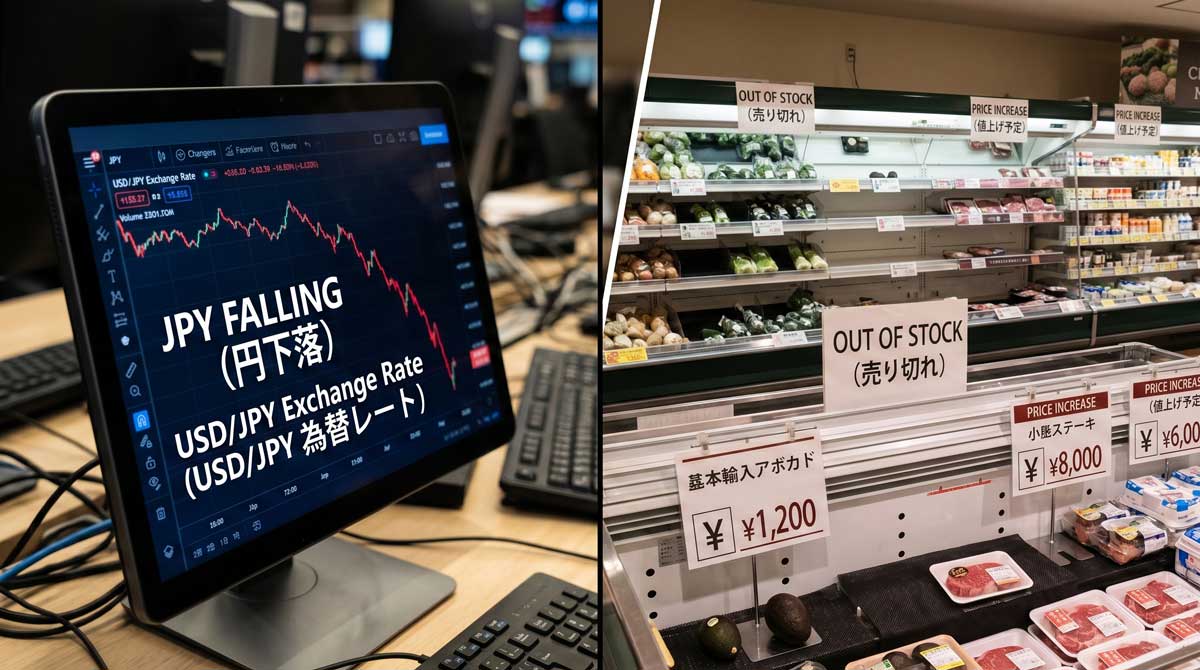
Yet, the outcome defied expectations. The ruble recovered all the way back to 77 against the dollar — essentially its pre-war level. The yen, meanwhile, has slid to around 159 to the dollar, a 38% depreciation over the same window. Japan sanctioned an energy superpower, cut itself off from cheap resources, and ended up worse off for it.
Japan’s Living Standards Are Quietly Unravelling
The numbers coming out of Japan’s own government surveys paint a stark picture of Japan economic decline at the household level. According to Japan’s Ministry of Internal Affairs’ 2025 Household Survey (家計調査), average disposable income for working households reached 2.256 million yen — a nominal increase of 11.8% since 2020. Non-working (retired) households earned an average of 1.214 million yen, virtually unchanged.
The problem? Japan’s Consumer Price Index (CPI) rose 11.9% over the same period. In real terms, both types of households saw their purchasing power fall by approximately 3%.
When you convert those figures into comparative terms, the picture worsens dramatically:
| Year | Japanese Working Household Income (¥) | Estimated CNY Equivalent | Monthly Average (CNY) |
|---|---|---|---|
| 2020 | ~2,020,000 ¥ | ~129,200 CNY | ~10,767 |
| 2025 | ~2,256,000 ¥ | ~108,300 CNY | ~9,025 |
| 2026 (est.) | ~2,256,000 ¥ | ~96,900 CNY | ~8,073 |
The erosion comes not from falling nominal wages, but from the yen’s purchasing power collapse. Rice prices in Japan rose 90% in a single year. A 5kg bag costs the equivalent of roughly ¥3,200. Eggs rose 50% over three years. A cabbage now costs close to ¥1,000. Japan’s Engel coefficient — the share of household spending going to food — has risen to 29.4%, its highest level in 45 years.
In the early 2000s, Japanese household income was roughly 35 times higher than Chinese urban household income. Today that gap has narrowed to about 1.8 times. In China’s tier-one cities, average incomes have effectively caught up with Japan.
The Resource Trap Nobody Warned Japan About
I think the core of Japan’s vulnerability is something most mainstream commentary glosses over: Japan is a resource-barren nation that has spent the last four years provoking the very countries that hold its energy lifeline.
Japan imports 99% of its crude oil, with 95% of that sourced from the Middle East. Some 73.7% passes through the Strait of Hormuz. When escalating conflict in the Middle East led Iran to restrict shipping through the strait, Japan’s energy costs spiked viciously. Electricity prices in Japan surged 34% in a single week during the conflict’s most intense phase. A bowl of ramen with a single egg at a standard restaurant climbed to ¥1,100 — roughly the equivalent of AU$11.
The darkest irony in all of this: Japan had deliberately cut off Russian oil, which could have served as an alternative. Meanwhile, the United States — under a very different political calculus — quietly eased its own restrictions on Russian crude. Japan was left with no affordable fallback.
To understand why resource shocks hit some nations harder than others, it helps to consider how energy markets actually work in times of geopolitical stress. In a stable, peaceful global order, resource-exporting nations compete aggressively with each other. OPEC’s 13 member states — including Saudi Arabia, Iraq, Iran, Kuwait, the UAE, and Venezuela — coordinate production levels to manage prices, but even within that cartel, discipline breaks down under pressure. In 2015, as oil prices fell, Kuwait and Iraq undercut Saudi Arabia with lower export prices. In 2020, OPEC+ nearly fractured over whether to increase production during the pandemic.
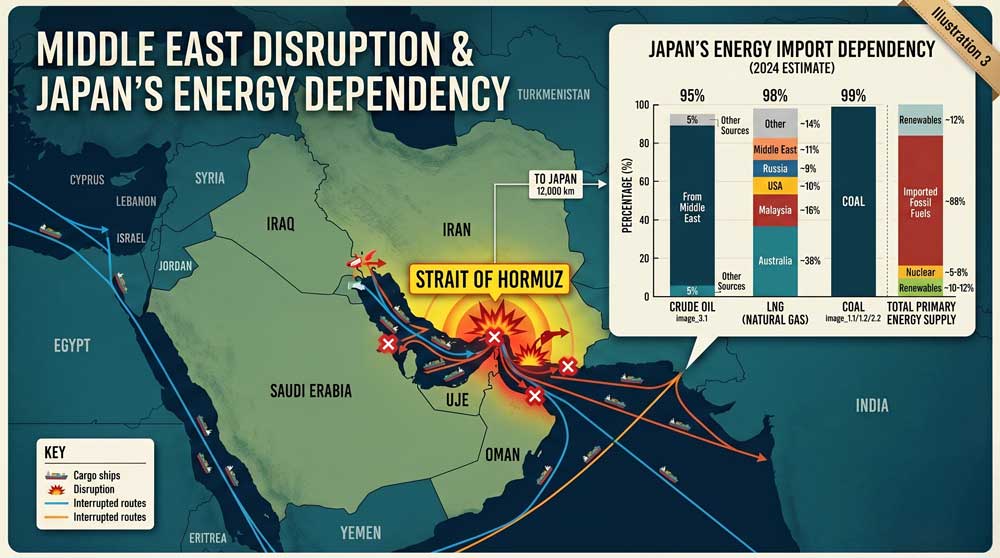
Global Energy Dynamics: Stability vs. Disruption
| Condition | Effect on Resource Nations | Effect on Import-Dependent Nations Like Japan |
|---|---|---|
| Peaceful, stable global order | Lower commodity prices, competitive pressure among exporters | Cheap energy imports, manageable trade balance |
| Geopolitical conflict, supply disruption | Higher commodity prices, stronger resource-nation currencies | Energy costs spike, trade deficit widens, currency weakens |
| Sanctions on energy exporters | Short-term ruble weakness, long-term recovery as energy demand persists | Japan loses cheap energy alternatives, inflation accelerates |
Russia, as one of the world’s most powerful resource exporters, benefits structurally from global instability. The ruble’s recovery isn’t an accident — it reflects the hard reality that energy is inelastic demand. Countries need it regardless of politics.
Japan’s Industrial Collapse in Numbers
Japan’s economic identity was built on manufacturing excellence. That identity is now in serious jeopardy — and the data is unambiguous.
In 1980, Japan held approximately 50% of the global semiconductor industry. By 2025, that share had collapsed to roughly 5%. Japan now imports 64% of the semiconductors it uses. In LCD panels, Japan once held a monopoly. Today, mainland China commands 64% of global output, Taiwan 21%, South Korea 5% — Japan has been entirely marginalised.
In mobile internet, smartphones, 5G infrastructure, and AI, Japan is effectively absent. The global telecom equipment market is now dominated by Huawei (31%), Ericsson (24%), Nokia (20%), and ZTE (14%) — Japan doesn’t register.
Even in automotive — Japan’s last great industrial pillar — the dominance has evaporated. China surpassed Japan in vehicle production in 2009, in vehicle exports in 2023, and in total global sales by 2025, with Chinese automakers moving approximately 27 million vehicles globally compared to Japan’s 25 million. In electric vehicles specifically, China accounts for over 75% of global production and sales. Japan is not a meaningful competitor in that segment.
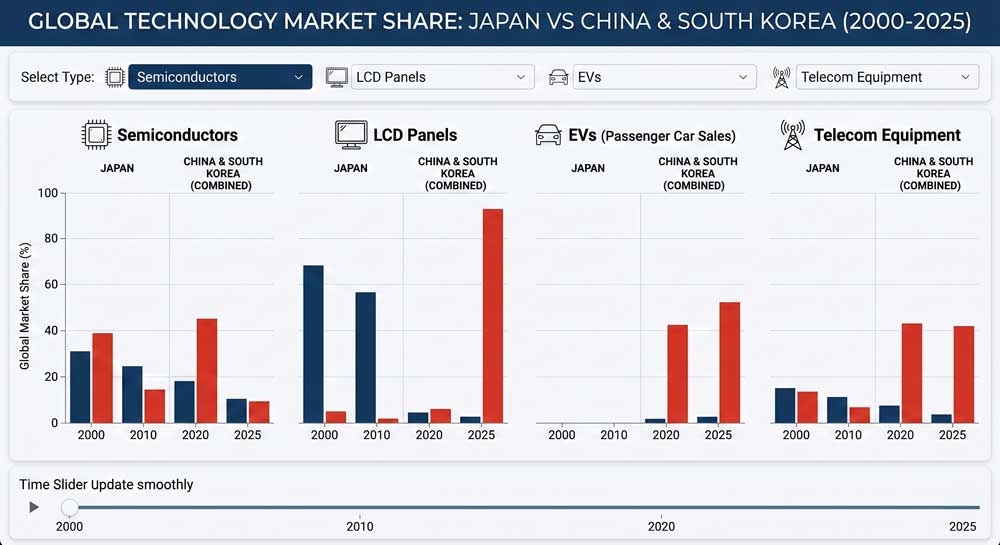
Japan vs. Competitors: Key Industry Market Share (2025 est.)
| Industry | Japan Peak Share | Japan 2025 Share | Current Leader |
|---|---|---|---|
| Semiconductors | ~50% (1980) | ~5% | USA / South Korea / Taiwan |
| LCD Panels | ~100% (early 1990s) | <2% | China (64%) |
| Electric Vehicles | N/A | <1% | China (75%+) |
| Telecom Equipment | Significant | Negligible | Huawei / Ericsson |
| Consumer Electronics (TV) | Top 3 globally | Outside top 5 | Samsung / Chinese brands |
Japan retains meaningful positions in upstream manufacturing — specialised equipment, precision components, semiconductor materials — but these niches are increasingly under pressure as China continues to invest heavily in domestic supply chain development.
The Yen’s Vanishing Safe-Haven Status
For decades, the yen occupied a unique position in global finance: it was considered one of the world’s premier “safe-haven currencies.” In my view, that status rested on three distinct foundations — and all three are now eroding simultaneously.
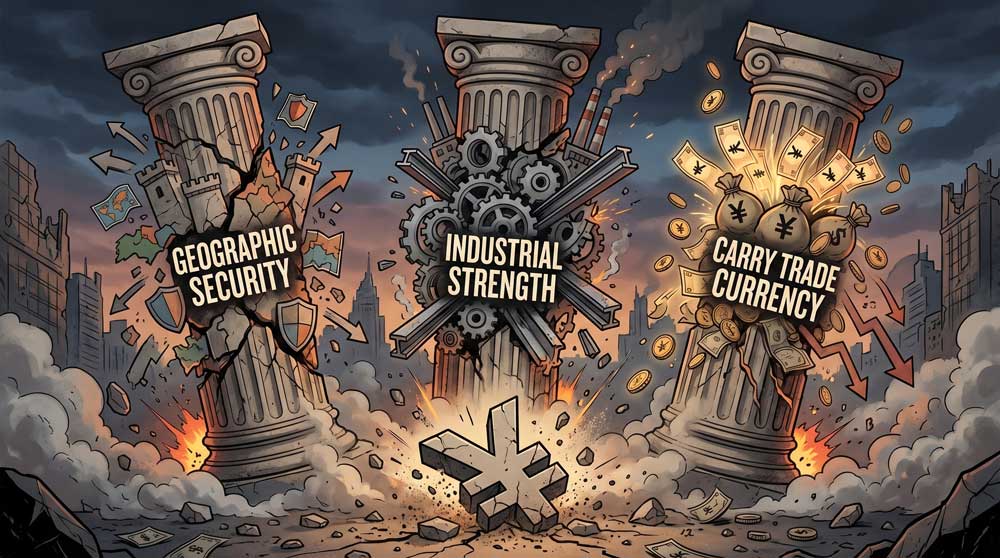
Geographic security. Japan’s island geography historically protected it from continental wars. Like Britain before it, Japan could watch Eurasian conflicts from a distance. This insulation attracted capital during periods of global stress. But Japan’s right-wing political shift — particularly the Sanae Takaichi administration’s declarations that “a Taiwan Strait incident is a Japan incident” and its aggressive push to revise the pacifist constitution — has turned Japan from a geopolitical sanctuary into a potential flashpoint. The destruction of Dubai’s financial standing during just 50 days of Middle East conflict — 40% stock market decline, 97% drop in real estate transactions, mass capital flight to Singapore and Hong Kong — demonstrates how quickly geopolitical exposure can shatter a financial centre’s credibility.
Industrial credibility. The yen’s strength was historically underpinned by Japan’s formidable export machine. When Japanese manufacturing was synonymous with quality and global market leadership, the yen had intrinsic credibility. That foundation has been hollowed out, as the industry comparison table above shows. Japan’s export value actually fell from $757.5 billion in 2021 to $738.3 billion in 2025, with its share of global exports dropping from 8% to 3%. Japan has run a trade deficit every year since 2021. Currency depreciation was supposed to boost exports — in Japan’s case, it demonstrably hasn’t worked.
Carry trade engine. Perhaps the most fragile of the three foundations is Japan’s role as the world’s primary carry trade funding currency. For years, Japan’s near-zero and negative interest rate policy — a response to its prolonged deflationary “lost decades” — made the yen the cheapest currency to borrow on earth. Investors borrowed yen at 0.1% annually and deployed the capital into US Treasuries (yielding 4.5% in 2023), US equities, and cryptocurrency. JPMorgan estimated carry trade positions at around $4 trillion, with 60–70% allocated to US stocks and bonds. Some analysts, accounting for leverage, put the true exposure above $10 trillion.
When Japan’s central bank raised its policy rate from 0.1% to 0.25% on July 31, 2024 — its first meaningful rate hike in 17 years — the consequences were immediate: Bitcoin dropped 26%, Ethereum 31%, the Nikkei fell 12% (its worst single-day drop in 48 years), and the Nasdaq fell 6%. That was just 0.15 percentage points. With Japanese inflation now entrenched, further rate hikes are inevitable — and markets have begun treating Japan’s rate normalisation as one of the biggest macro risk events of 2026–2027.
A Three-Way Squeeze With No Easy Exit
What makes Japan’s situation genuinely serious — rather than merely cyclical — is the convergence of three simultaneous pressures I’d call a “triple kill”:
- Currency depreciation makes all imports more expensive, including the energy and raw materials Japan cannot produce domestically
- Industrial erosion means Japan cannot compensate through higher export volumes or higher-value-added products
- Carry trade unwinding threatens to destabilise global capital markets and reduce the one financial service — cheap funding — that Japan could still offer the world
Economists sometimes describe the “resource curse” or “Dutch Disease” — the phenomenon where resource-rich nations neglect industrial development and suffer when commodity prices shift. Japan has developed an inverse pathology: a resource-poor nation that has alienated its most accessible energy suppliers while simultaneously failing to build the next generation of competitive industries.
Japan’s trade trajectory in recent years underscores this bind:
| Year | Japan Trade Balance (USD billion) | Context |
|---|---|---|
| 2021 | -$0.68B (near balance) | Pre-energy crisis baseline |
| 2022 | -$153.4B | Russia-Ukraine conflict, energy price shock |
| 2024 | -$58.0B (improving) | Partial energy cost stabilisation |
| 2025 | -$38.9B | Improved but still structurally negative |
Even in the best recent year, Japan ran a substantial trade deficit — in a country whose entire postwar economic model was built on the opposite.
What the Yen Crisis Reveals About Japan’s Political Direction
In my assessment, Japan’s economic difficulties cannot be separated from its political trajectory. There is a well-worn pattern in democratic decline where political leaders spend more time on ideological positioning than economic management — the result being that the real-world consequences land on ordinary households.
The near-dispatch of Japan Self-Defense Forces to escort tankers through the Strait of Hormuz in March 2026 — reportedly overruled at the last moment by senior political figures — illustrates how close Japan has come to dramatically worsening its geopolitical exposure. Had that deployment proceeded, Japan would have risked direct confrontation with Iran, the nation that controls the very waterway through which 73.7% of Japan’s oil supply passes.
Japan’s political discourse also suffers from a structural insularity problem. In contrast to Western media, which — whatever its biases — has largely acknowledged China’s rapid development in technology, infrastructure, and living standards, large portions of Japan’s public discourse appear to operate on a frozen image of China from 20 to 30 years ago. Meanwhile, China has opened 30-day visa-free access to 50 countries, generating a wave of international visitors whose firsthand accounts have reshaped global perceptions. Japan’s information environment, shaped by strong conformist social norms — what folklorist Kunio Yanagita described as Japan’s tendency toward collective conformity and insular thinking — has made it slower to update its strategic assumptions.
This is not a minor cultural curiosity. Strategic miscalculation driven by outdated perception has real economic consequences: misallocated diplomatic capital, missed partnership opportunities, and continued alienation from the neighbours who hold Japan’s energy and trade future in their hands.
The Road Ahead for Japan and the Yen
Japan is not without assets. Its upstream manufacturing capabilities in precision equipment and specialised materials remain globally relevant. Its financial system is deep and liquid. Its people are educated, productive, and resilient. The “lost decades” themselves are evidence that Japan can absorb economic pain without social collapse — a remarkable feat.
But the structural headwinds are severe, and they are compounding. A currency that can no longer reliably attract safe-haven capital, an industrial base that has ceded leadership in nearly every high-growth sector, an energy dependency that political decisions have made more acute rather than less — these are not problems that resolve themselves through monetary policy tweaks.
For global investors, the Japan economic decline story is ultimately a cautionary tale about the cost of standing still. Japan was once the nation that terrified American manufacturers, dominated global electronics, and set the pace for industrial innovation. The question now is whether it can find a new engine of growth before the structural decay becomes irreversible.
🔗 Reference URLs
- IMF — Escaping from the Resource Curse
- Brookings Institution — What to know about China’s economic ambitions and its Five-Year Plan
- Japan Research Institute — Restoring Japan’s Economic Competitiveness
- RIETI — Toward the Revival of Japan’s Industrial Competitiveness
- Eurostat — Natural Gas Statistics: EU Import Dependency
- Pew Research Center — Hostile Neighbors: China vs. Japan — Public Opinion Survey
- ThinkChina — Japan’s Perception of China Continues to Deteriorate
- StudyCorgi — Japan’s Lost Decades: Economic Stagnation, Demographics, and Societal Impacts
- ElevenLab — Trump Tariffs European Inflation: 5 Shocking Ways US Trade Barriers Are Crushing Eurozone Prices
- ElevenLab — Strait of Hormuz Semiconductor Crisis: 5 Devastating Threats to the Global Tech Supply Chain
- ElevenLab — US-Iran Conflict Oil Prices: 3 Alarming Ways Russia Secured a $6.5B Windfall