
Spain Immigration Amnesty 2026: 500,000 Migrants Legalized in a Shocking Policy Shift
Spain has made international headlines with a sweeping Spain immigration amnesty that grants legal status to an estimated 500,000 undocumented migrants — a bold move that puts it directly at odds with the rest of Europe. Prime Minister Pedro Sánchez called the measure “an act of justice” and an economic necessity, describing the half-million recipients as people “already part of our daily lives.”
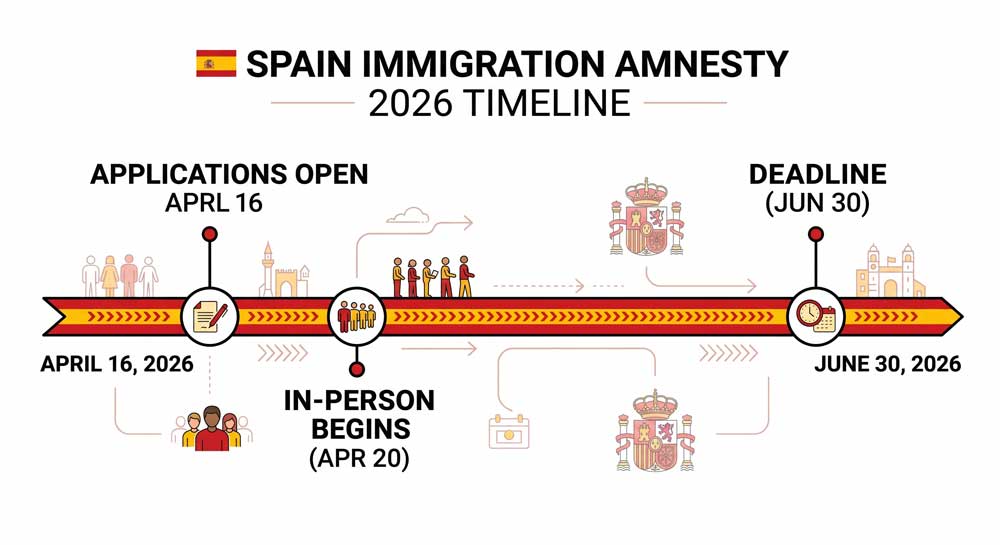
This policy shift runs from April 16 to June 30, 2026, enacted through a Royal Decree — bypassing parliamentary approval entirely. It is the largest regularization program Spain has launched since a near-identical amnesty in 2005, and arrives at a moment when the EU is pushing in the exact opposite direction.
Table of Contents
Who Qualifies for the Spain Immigration Amnesty?
The eligibility requirements are intentionally accessible. Unlike standard European visa procedures, the amnesty targets people already embedded in Spanish society, not new arrivals.
To qualify, applicants must meet all three criteria:
| Eligibility Criteria | Detail |
|---|---|
| Residency cutoff | Entered Spain before December 31, 2025 |
| Minimum continuous stay | At least 5 months (reduced from the usual 2-year requirement) |
| Criminal record | No major convictions in Spain or country of origin |
Accepted applicants receive the following:
| Benefit | Detail |
|---|---|
| Residency permit | 1-year temporary permit, renewable |
| Work rights | Full authorization — all sectors, all regions within Spain |
| Healthcare | Access to Spain’s national public health system |
| EU mobility | Restricted — no long-term residency rights in other EU states |
Critically, proof of residency requirements are minimal. A municipal registration (empadronamiento), a utility bill, or a rental agreement is sufficient. This low barrier is by design — and one of the policy’s most contested features.
Why the Spain Immigration Amnesty Defies European Trends
To grasp the scale of this political statement, consider what Spain’s neighbors are doing.
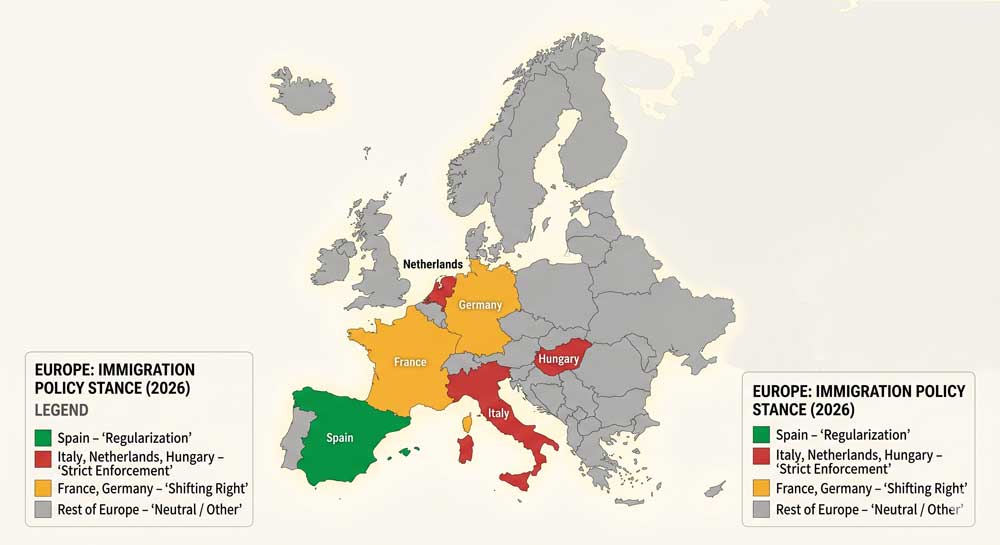
In late 2024, the EU passed its landmark Pact on Migration and Asylum, explicitly designed to strengthen external borders, speed up migrant screening, and fast-track deportations. EU officials have already voiced concern over Spain’s amnesty, warning it could undermine the pact’s framework. Yet Spain pushed ahead anyway.
| Region | Immigration Policy Stance | Key Action |
|---|---|---|
| Spain | Progressive, integration-focused | 2026 amnesty for 500,000 migrants |
| EU-wide | Restrictive, deportation-focused | 2024 Migration & Asylum Pact |
| Italy | Right-wing, strict border control | Increased deportations, naval operations |
| Netherlands | Right-wing, strict border control | Wilders’ PVV leading governing coalition |
| France / Germany | Shifting rightward | Record far-right electoral gains in 2025 |
Spain’s stance is especially striking because, unlike Italy or Greece, it has actually reduced irregular migration. In 2025, irregular entries to Spain fell 42% to approximately 36,000 — compared to Italy’s roughly 66,000 with little change. Spain is arguing it can be simultaneously open and controlled.
The Economic Case: Labour Shortages and an Ageing Nation
The government’s most defensible argument is demographic and fiscal. By 2025, people aged 65 and over accounted for 20.7% of Spain’s population, crossing the threshold for a “super-aged society.” Spain’s birth rate is one of the lowest in Europe, and its native workforce is shrinking.
Many of the estimated 840,000 undocumented migrants in Spain — per the Funcas think tank — are already working informally in agriculture, tourism, hospitality, and elder care. Regularization converts them from off-the-books workers into taxable, social-security-contributing employees — a direct fiscal benefit that goes beyond humanitarian optics.
“This will generate more revenue for the Spanish government and provide employers with a larger pool of legally available workers.” — a Barcelona-based worker quoted by BBC
However, the economic picture is not uncomplicated.
| Year | Spain Unemployment Rate | EU Average |
|---|---|---|
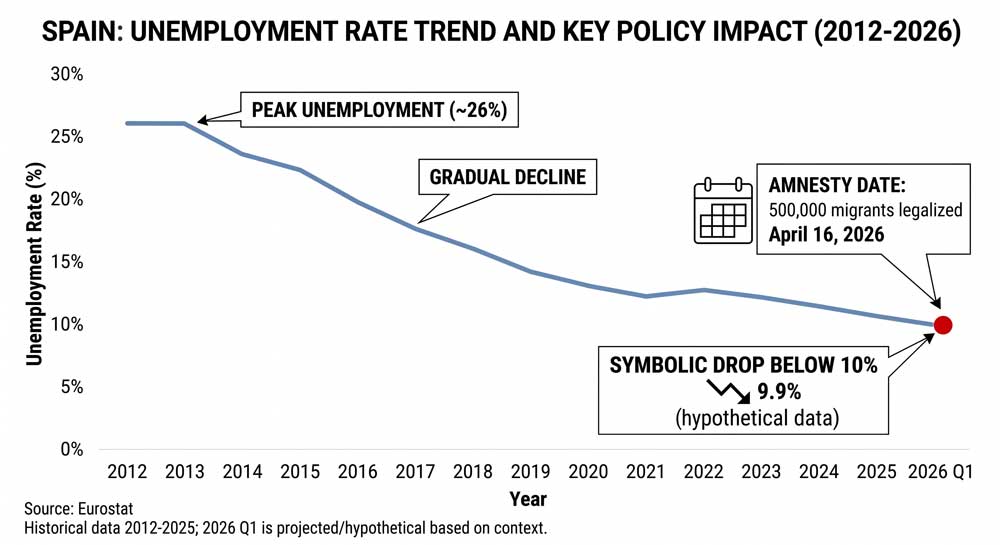
| 2012 (peak) | ~26% | ~10.5% |
| 2019 (pre-COVID) | ~14% | ~6.7% |
| 2025 | ~10.3% | ~6.0% |
| Q1 2026 | Just below 10% | ~5.8% |
Falling below 10% in early 2026 was Spain’s best unemployment figure since 2008 — a symbolic milestone. But at nearly double the EU average, Spain’s labour market remains fragile, and critics argue legalizing 500,000 additional workers could increase pressure on low-wage job seekers.
Is This About Politics or Principles?
Some critics have accused Sánchez of mimicking US Democratic Party tactics — cultivating an immigrant voter base. That theory doesn’t hold up. Temporary residence permits do not grant citizenship or voting rights, and Spain’s naturalization process typically requires 10 years of legal residency. None of these 500,000 individuals will vote in any near-term election.
Instead, the amnesty fits a consistent ideological pattern from a government that has positioned Spain as a progressive outlier on the global stage:
- March 2026: Publicly opposed US military strikes on Iran-aligned forces
- 2024: Joined South Africa’s ICJ genocide case against Israel — one of very few EU states to do so
- 2024: Signed Ukraine’s largest-ever bilateral military aid deal — €1.129 billion
- 2026: Launched the largest Spain immigration amnesty since 2005, while EU peers push deportation
Whether this is principled leadership or strategic brand-building, Spain is carving a distinctive role in a continent shifting sharply to the right.
Backlash: Domestic Opposition and EU Pressure
The amnesty faces significant pushback from multiple directions.
At home: Polling suggests roughly 60% of Spanish citizens oppose the measure, with concerns about crime and a “pull factor” effect that could attract further illegal crossings — particularly via the Canary Islands route, which has seen record arrivals from West Africa in recent years. The conservative People’s Party (PP) has vowed to oppose the legalization, arguing it “rewards illegal migration.”
Administratively: Immigration officers have warned that the government may lack the resources to process hundreds of thousands of applications before the June 30 deadline — raising questions about implementation.
At the EU level: Because the Schengen Area enables free movement, EU officials worry that newly legalized migrants in Spain could eventually relocate across EU borders, complicating enforcement of the new Migration and Asylum Pact.
Spain’s Calculated Gamble
The Spain immigration amnesty 2026 is simultaneously a demographic fix, a fiscal strategy, a labour market intervention, and a geopolitical statement. It may prove pragmatic, idealistic, or reckless — depending on your lens.
What’s beyond dispute: Spain has placed itself at the centre of Europe’s most contentious debate, and its outcomes will shape how policymakers across the continent think about undocumented migration for years to come.
Authoritative Sources
- AP News: Spain offers hundreds of thousands of immigrants a way to stay legally
- AP News: Spain granting legal status to potentially 500,000 people
- BBC: Spain approves plan to give 500,000 undocumented migrants legal status
- Al Jazeera: Spanish government approves amnesty programme
- DW: Spain finalizes amnesty plan for undocumented migrants
- New York Times: How Spain Is Carving a Different Path on Immigration
- Reuters: Spain opposes EU plan for external asylum centres
- European Commission: Official Pact on Migration and Asylum
- Mixed Migration Centre: Spain’s divergent path in a right-wing EU
- LA Times: Spain finalizes amnesty for potentially hundreds of thousands
- 7 Shocking Truths: How Peter Thiel & Palantir Influence Is Reshaping Global Power
- Davos 2026: Carney Warns of a Fractured Global Order and Calls for Middle-Power Unity
- Europe’s Cinema Renaissance: Is Hollywood Losing Its Edge?