HALO Investing: 7 Proven Reasons Heavy Assets Dominate the AI Era
HALO investing — the strategy of prioritising companies with Heavy Assets and Low Obsolescence — has emerged as one of the most consequential investment frameworks of the current market cycle. The logic is both simple and powerful: artificial intelligence can replace a programmer, a financial analyst, or an entire SaaS platform. It cannot replace a copper mine, a power transmission grid, or a semiconductor fabrication plant.
I have been tracking this theme closely, and I believe it represents more than a tactical rotation. It reflects a structural re-rating of what competitive advantage actually means in the age of AI.
Table of Contents
What HALO Investing Really Means
At its core, HALO investing is about identifying companies whose moats are physical, not informational. An economic moat built on code can be eroded by a model update. A moat built on 40 years of infrastructure, geological positioning, or fabrication expertise cannot.
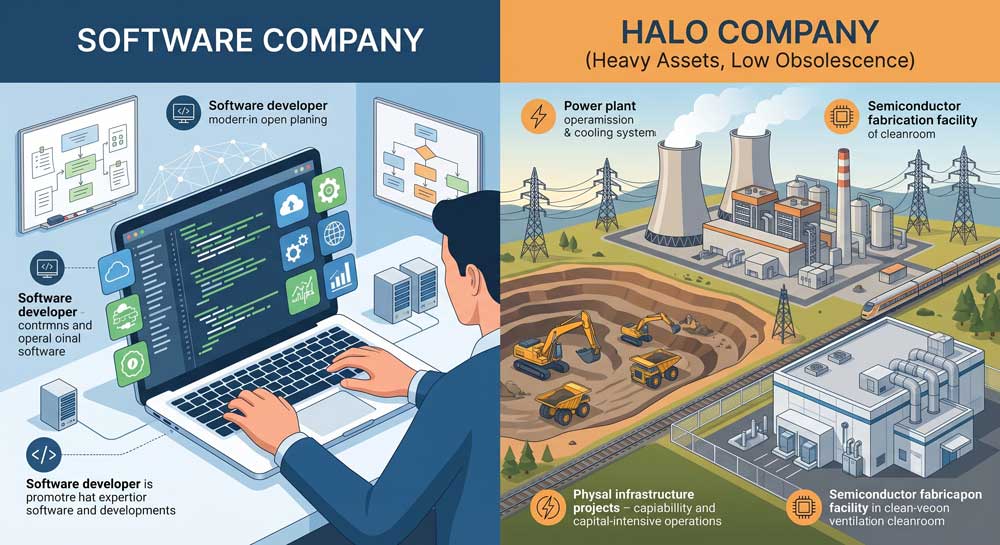
When evaluating a company through the HALO lens, I focus on three quantitative measures: the ratio of fixed assets to total assets, tangible assets per employee, and capital expenditure relative to sales revenue. A company scoring highly across all three is genuinely difficult to displace — regardless of what AI can do.
The contrast with “non-HALO” companies is stark. SaaS platforms, property listing portals, and financial advice services all share a common vulnerability: their core value proposition is informational, and information is precisely what large language models commoditise fastest. Several of these categories have already seen meaningful valuation compression as markets begin to price in this structural risk.
| Asset Type | Moat Source | Obsolescence Risk | Primary Vulnerability |
|---|---|---|---|
| Heavy Physical Infrastructure | Tangible, irreplaceable assets | Very Low | Capital cost, regulatory change |
| SaaS / Digital Software | Proprietary code or data | Very High | Generative AI replication |
| Professional Advisory Services | Human knowledge and judgement | High | Agentic AI automation |
| Semiconductor Fabs (e.g. TSMC) | Physical manufacturing scale | Low | Geopolitical concentration risk |
7 Reasons HALO Investing Has Durable Staying Power
1. Physical assets cannot be trained away.
No matter how capable the next generation of AI becomes, it cannot produce electricity, extract lithium, or fabricate a chip. The physical world remains beyond the reach of software disruption.
2. The valuation gap has already closed — and earnings are taking over.
European HALO stocks traded at a roughly 35% price-to-earnings discount relative to light-asset peers just one year ago. That discount has largely disappeared. But I do not interpret this as a reason to exit — I see it as a signal that the market has moved from re-rating to earnings-driven momentum. HALO companies delivered strong results in the most recent reporting season, and forward guidance revisions are trending upward.
3. Capital intensity creates self-reinforcing barriers.
Top-tier semiconductor foundries have sustained annual capital expenditure well above $30 billion in recent years. That is not just a competitive advantage — it is a barrier that accumulates every year a competitor fails to match it. The same logic applies to power grids, LNG terminals, and desalination plants.
4. Heavy-asset sectors are already outperforming.
Utilities, mining, and energy have outperformed broader MSCI Global indices year-to-date in 2026 — and this outperformance predates recent geopolitical disruptions. Industrial engineering firms focused on critical infrastructure have posted some of the strongest equity returns in the market this year. This is not a forward-looking hypothesis. It is already happening.
5. The real economy is underrepresented in major indices.
Corporate investment spending as a share of cash flow in the US has fallen from approximately 65–70% in the early 1990s to below 40% today. Buying a broad US index fund now means buying less exposure to tangible productive assets than at any point in recent history. HALO investing is, in part, a corrective to this structural drift.
6. Geopolitical fragmentation is a structural tailwind.
Nations are now prioritising energy security, domestic supply chains, and strategic defence capabilities. Every one of these priorities requires hard assets — grids, fabs, refineries, mines. This is not a cycle. It is a decade-long policy shift that will continue channelling capital into exactly the companies that HALO identifies.
7. Agentic AI may compress demand for digital services — not physical ones.
The rapid expansion of autonomous AI agents — systems that independently execute searches, purchases, and logistical decisions — introduces a structural risk to consumer-facing digital businesses. As agentic AI mediates more economic activity, discretionary digital spending could compress significantly. Physical infrastructure, by contrast, benefits from every unit of AI compute that is trained, deployed, and run — because all of it requires electricity, cooling, and chips.
The Bear Case — and Why I Still Lean Constructive
I think it is worth addressing the sceptical view directly, rather than dismissing it. A credible critique of HALO investing at this stage runs as follows: the trade has worked, the discount is gone, and the marginal buyer is now paying fair value rather than acquiring a cheap asset. On pure risk-adjusted terms, some of the easy gains are behind us.
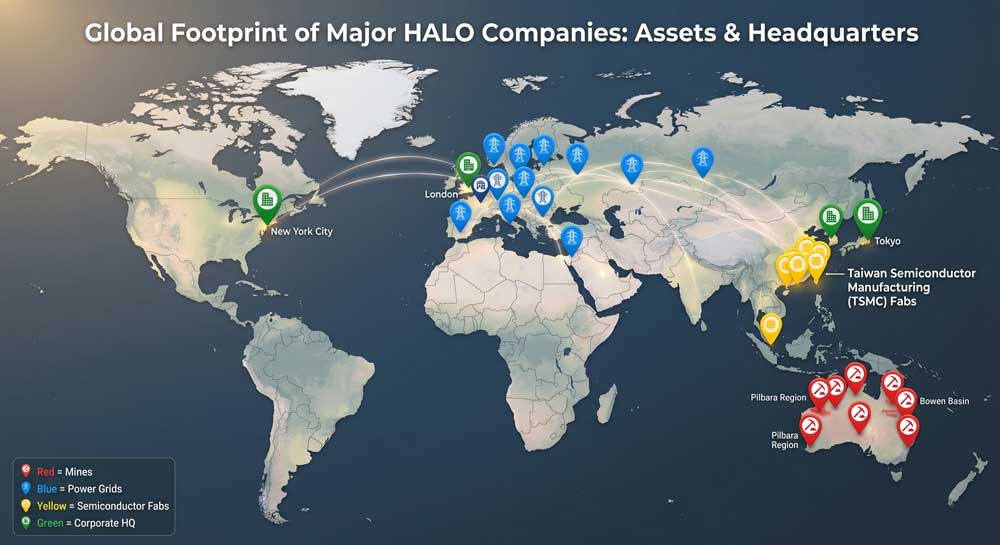
I find this argument partially correct and worth taking seriously. HALO as a blanket rotation trade is largely priced in. But HALO as an earnings screen — finding companies within the theme where growth continues to surprise to the upside — remains highly actionable. The distinction matters.
| Consideration | Bull Case | Bear Case |
|---|---|---|
| Valuation | Earnings growth justifies current multiples | P/E discount fully closed; limited re-rating upside |
| Earnings momentum | Strong recent results; guidance trending up | Commodity price volatility can compress margins |
| Macro backdrop | Energy transition, reshoring drive long-term capex | Rising interest rates increase cost of heavy capital |
| AI disruption pressure | Continues to weigh on light-asset competitors | Could slow if AI adoption plateaus |
| Geopolitical tailwind | Structural, multi-year policy shift | Regulatory and political risk in infrastructure |
HALO vs. the 1990s “Old Economy” Debate
The most common pushback I encounter is that this is simply the late-1990s “new economy versus old economy” reversal — that value investors are celebrating a temporary mean reversion that will fade once AI enthusiasm returns.
I think this misreads what is actually happening, for two reasons.
First, the 1990s rotation was almost entirely valuation-driven. Growth stocks were priced for implausible futures; value stocks were merely cheap. The eventual correction was mechanical, not structural. What we are seeing now is a divergence in actual earnings trajectories — HALO companies are growing profits faster, not merely trading at lower multiples.
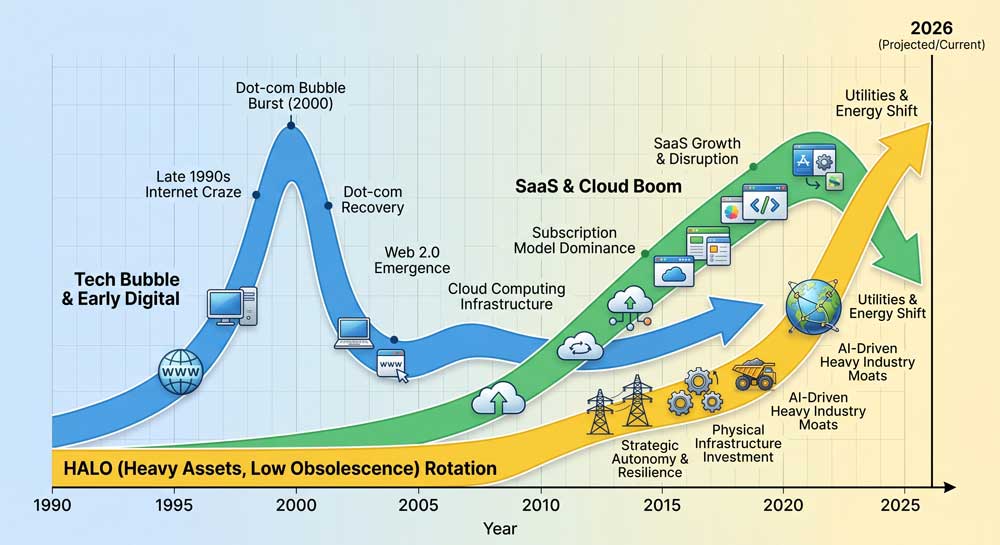
Second, and more importantly, HALO is not anti-technology. Semiconductor foundries — some of the most technologically sophisticated enterprises on earth — are among the highest-scoring HALO companies by every metric. The framework does not reward backwardness. It rewards irreplicability.
| Dimension | 1990s Value vs. Growth | 2026 HALO Investing |
|---|---|---|
| Primary driver | Valuation mean-reversion | Structural earnings divergence |
| Tech included? | No — tech was the opposition | Yes — fabs and chip infrastructure qualify |
| Geographic scope | Mostly US-domestic | Global, especially Europe and Asia |
| Catalyst | Bubble deflation | Permanent AI-driven moat reassessment |
| Duration | Cyclical | Structural / secular |
The Active Management Opportunity
One implication of HALO investing that I find genuinely exciting is what it means for active management. For much of the past decade, passive index funds outperformed because the market was dominated by a narrow group of mega-cap tech winners. Picking stocks was largely an exercise in tracking or missing those names.
The current environment is fundamentally different. Sector and geographic dispersion is widening. The gap between HALO leaders and non-HALO laggards is growing. Company-level earnings differentiation is accelerating. These are exactly the conditions in which disciplined, research-driven stock selection adds the most value. Broad indices increasingly fail to capture where the real earnings growth is happening.
For investors constructing long-term equity portfolios, I believe the HALO lens should now be a standard part of due diligence — not a niche thematic overlay. Before committing capital to any business, the question I now ask first is simple: what happens to this company’s competitive position when AI gets ten times more capable? If the answer is “not much,” that is a HALO business.
🔗 Reference URLs
- JM Finn — What is the HALO investment theme?
- Global X ETFs — The HALO Trade: When Heavy Assets Matter Again
- Tema ETFs — Investors Are Looking to Put a HALO Around Their Portfolio
- VanEck Australia — Investing Evolved: HALO Strategy and Equal Weighting
- STAR Capital — HALO and the Repricing of Resilience: Why AI Favours Strategic Assets
- Investopedia — How an Economic Moat Provides a Competitive Advantage
- Morgan Stanley — AI Boom Drives Thematic Investment Megatrends 2026
- ElevenLab — 7 Reasons Why Silicon Valley Pivots to Natural Gas Investment for AI Power
- ElevenLab — Must Read: The 2028 Global Intelligence Crisis and the “Ghost GDP”
- ElevenLab — The Physical Truth Behind the US-China AI Race: Electrons, Not Just Silicon