DeepSeek V4: 5 Explosive Reasons This $10B Fundraise Will Break Nvidia’s Grip
DeepSeek V4 is coming — and it may be the single most consequential AI model release of 2026. Not just because of its trillion-parameter scale, but because of what surrounds it: a historic first fundraise, a deliberate break from Nvidia hardware, and a direct challenge to Western AI dominance.
Table of Contents
DeepSeek’s First-Ever Fundraise
For years, DeepSeek operated as a pure research lab, fully bankrolled by its parent company, High Flyer Capital Management — one of China’s most prominent quantitative hedge funds. It rejected overtures from China’s top venture capital firms and technology giants after its R1 model sent shockwaves through Silicon Valley in early 2025. That posture of financial independence was deliberate: the lab’s leadership prioritised research autonomy over growth-at-all-costs.
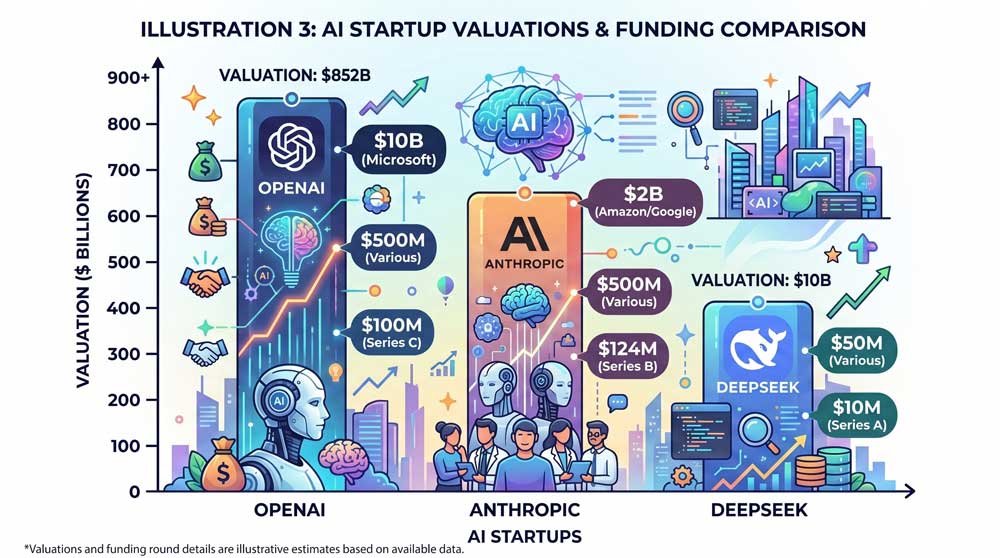
That has now changed. DeepSeek is in active discussions to raise at least $300 million at a valuation of no less than $10 billion — marking the company’s first-ever external funding round. The move signals a strategic pivot from academic lab to serious frontier AI competitor.
| Metric | DeepSeek (2026) | OpenAI (2026) |
|---|---|---|
| Fundraise Amount | $300M (seeking) | $40B (completed) |
| Valuation | ~$10B | ~$852B |
| External Funding History | First round ever | Multiple rounds |
| Primary Backer to Date | High Flyer Capital | SoftBank, Microsoft, others |
In context, this is still a modest raise: OpenAI closed a $40 billion round at a valuation approaching $852 billion just weeks ago. But for DeepSeek, $300 million represents something more significant than the dollar figure suggests — it is the moment the lab acknowledged that frontier AI cannot be built on a shoestring budget indefinitely.
Why DeepSeek V4 Needed Fresh Capital
I think the financial logic here is straightforward. The performance gap between the best US and Chinese AI models has narrowed to just 2.7 percentage points, according to Stanford University’s 2026 AI Index. When you’re that close to the frontier, every incremental improvement becomes exponentially more expensive. Training runs at the trillion-parameter scale demand not just more chips, but more engineers, more infrastructure, and more reliability engineering to support production deployments.
Beyond compute costs, there is a talent war. ByteDance, Baidu, Alibaba, and Tencent are all competing aggressively for the same pool of top-tier AI researchers. Without competitive compensation, DeepSeek risks losing the engineers who built its reputation for efficiency.
There is also a deployment story emerging. DeepSeek recently posted job listings in Ulanqab, Inner Mongolia — specifically for server operations engineers and delivery managers. These are not research roles. They are infrastructure roles. DeepSeek V4 is no longer a lab project. It is preparing for large-scale deployment.
DeepSeek V4: Architecture Breakdown
DeepSeek V4 is a qualitative leap over everything DeepSeek has shipped before. Here is what is technically confirmed or credibly reported:
| Feature | DeepSeek V3 | DeepSeek V4 |
|---|---|---|
| Total Parameters | ~671B | ~1 Trillion |
| Active Parameters per Token | ~37B | ~37B |
| Context Window | 128K tokens | 1M tokens |
| Architecture | MoE | MoE + Engram Memory |
| Multimodal | No | Yes (text, image, video) |
| Primary Chip Platform | Nvidia | Huawei Ascend 950 PR |
| Open Source Licence | MIT | Apache 2.0 |
| SWE-bench Score (reported) | ~65% | 80%+ |
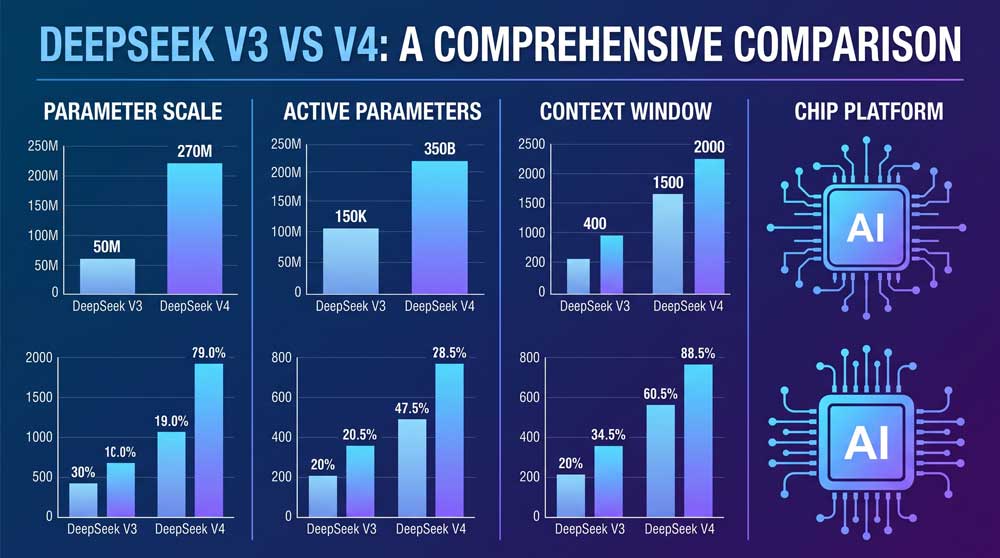
The architecture uses a Mixture-of-Experts (MoE) design, meaning that while the total model contains approximately one trillion parameters, only around 37 billion are activated for any given inference. This is the same efficiency-first design philosophy that made V3 competitive at a fraction of the cost of GPT-4 — now applied at twice the scale.
The Engram conditional memory architecture is the most novel element. It enables constant-time retrieval over one-million-token contexts, with internal tests reportedly showing a 97% information recall rate at that length — compared to far lower performance from V3 at 128K. For developers building tools over large codebases or long documents, this is a step-change capability.
On code specifically, I believe V4 could genuinely shift the competitive landscape. Internal benchmarks place it above 80% on SWE-bench and 90% on HumanEval. The claim that it can handle repository-level bug fixes — not just isolated function completions — is the kind of capability that enterprise software teams will take seriously.
Breaking Free from Nvidia
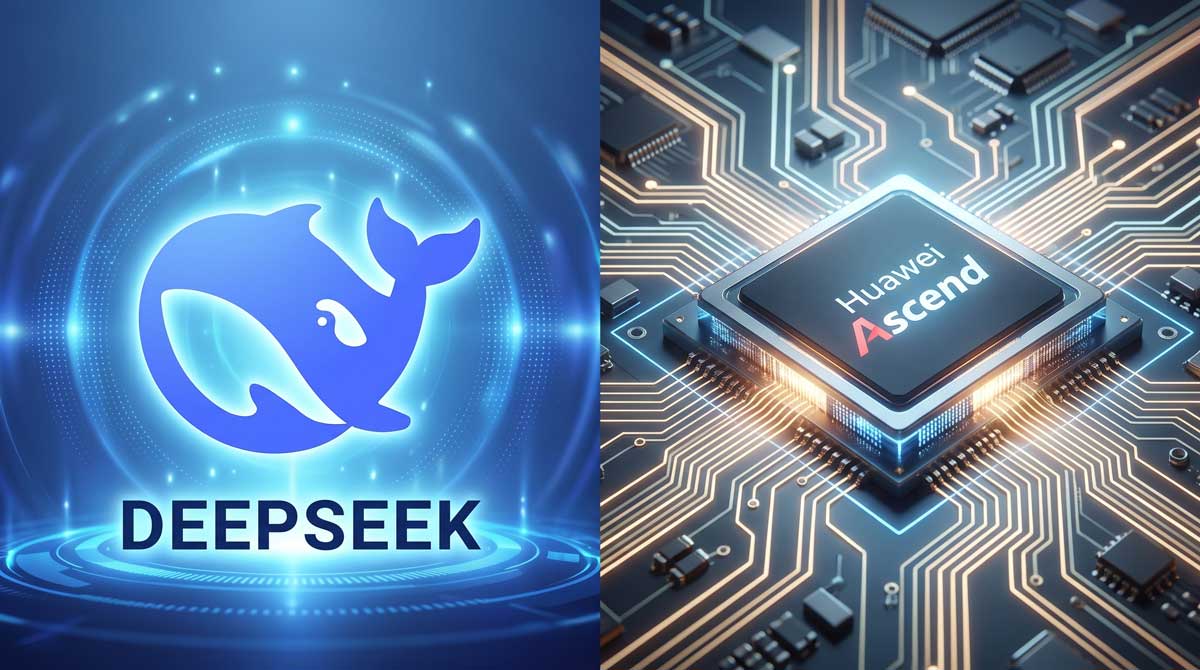
This is the part of the DeepSeek V4 story that has the widest geopolitical and market implications. Every prior DeepSeek model was trained on Nvidia hardware. V4 is being built to run on Huawei’s Ascend 950 PR chip — and DeepSeek reportedly gave Huawei exclusive early access for optimisation, deliberately excluding Nvidia and AMD.
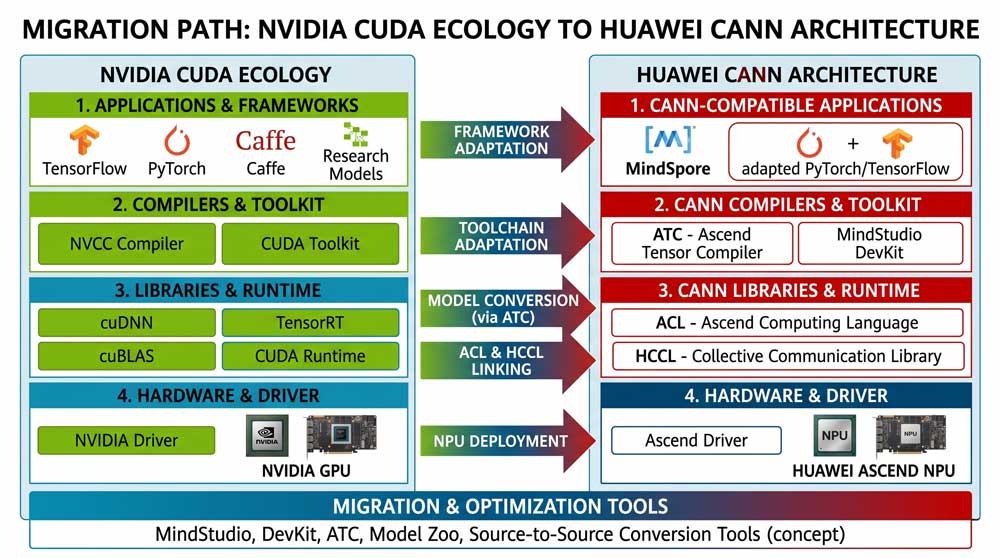
The technical migration is significant. DeepSeek’s engineers have had to rewrite core infrastructure components, moving from Nvidia’s CUDA ecosystem to Huawei’s CANN (Compute Architecture for Neural Networks) framework. This is not a simple port — it involves rewriting compilers, communication libraries, and distributed training systems from the ground up.
If V4 delivers competitive performance on Ascend chips, it will be the first frontier-scale AI model to run entirely independently of Nvidia hardware. That matters for several reasons:
- Hardware sovereignty: China would have a credible domestic alternative for training and running frontier AI models, reducing exposure to US export controls
- Cost structure: Huawei’s Ascend 950 PR is reportedly 2.8x more performant than Nvidia’s H20 on FP4 tasks, which could dramatically reduce inference costs
- Ecosystem signal: Other Chinese AI labs — ByteDance, Baidu, Moonshot — would have proof of concept that the Huawei stack is viable at scale
Nvidia CEO Jensen Huang has not been subtle about his view of this development. In a recent interview, he stated directly that a DeepSeek model optimised for Huawei chips would be “a horrible outcome for the United States”. The logic is clear: if the best AI models run best on Chinese hardware, the strategic moat that US semiconductor dominance provides begins to erode.
Two Versions, One Bold Bet
Reports suggest V4 will launch in two configurations:
| Version | Parameter Count | Target Use Case | Chip Platform |
|---|---|---|---|
| V4 Full | ~1 Trillion | Advanced reasoning, complex code | Huawei Ascend 950 PR |
| V4 Lite | ~200 Billion | General conversation, API services | Other domestic chips |
A version labelled “V4 Lite” briefly appeared on DeepSeek’s platform in March before being pulled. Developers later found a test endpoint in early April showing a 30% improvement in inference speed and a jump in 128K context recall from 45% to 94% compared to V3. These are not marginal upgrades.
The full release window is expected in late April 2026, per Reuters. Twice already the launch has been delayed — once in February and again in March. In my view, the delays are almost entirely attributable to the Huawei chip migration, not model quality. Getting a trillion-parameter model to run reliably and efficiently on a new hardware stack, at production scale, is an engineering challenge of the highest order.
Both versions are expected to be released under Apache 2.0 open-source licensing, continuing DeepSeek’s policy of open-sourcing model weights. This is a meaningful differentiator from OpenAI and Anthropic, both of which have moved toward closed or restricted model access.
What This Means for the Global AI Race
I think the DeepSeek V4 fundraise and the Huawei chip pivot together tell a coherent strategic story. DeepSeek is no longer content to be the scrappy efficiency lab that built a good model cheaply. It is making a serious bid to be a full-stack frontier AI player — with its own hardware pipeline, its own deployment infrastructure, and now, for the first time, external capital to fund the ambition.
The $300 million raise is modest by US standards, but it is a meaningful commitment to the thesis that frontier AI can be built outside the Nvidia-dominated Western tech stack. That $300 million, in effect, is a bet that V4 on Huawei chips works — and that if it does, the global AI hardware landscape will never look the same.
For investors and technologists watching the AI race, this is the development to track most closely in the coming weeks.
🔗 Reference URLs
- The Information — DeepSeek Is Raising Money for First Time at $10 Billion-Plus Valuation
- SCMP — Nvidia’s Jensen Huang warns Huawei chips for DeepSeek AI models would be ‘horrible’ for US
- TrendForce — Decoding DeepSeek V4: How Huawei’s Ascend 950 PR Is Powering China’s Push to Break CUDA Dependence
- GizChina — DeepSeek V4 Expected to Launch in Late April with Massive Parameter Scale
- Implicator AI — DeepSeek Funding Turns Cheap AI Into Chip Bet
- Introl Blog — DeepSeek V4’s 1-Trillion Parameter Architecture Targets Coding Dominance
- Let’s Data Science — DeepSeek Seeks $300M Raise To Challenge Frontier AI
- ElevenLab — SpaceX xAI Merger: 7 Shocking Facts Behind Elon Musk’s $1.25 Trillion Gamble
- ElevenLab — Big Tech AI Spending Reaches $670B in 2026: Infrastructure Giants vs. Apple’s Strategic Pivot
- ElevenLab — 5 Powerful Reasons BlackRock’s Bond Market Strategy Warns of US Labor Market Weakness in 2026