SpaceX $2 Trillion IPO: 7 Brutal Truths Every Investor Must Know
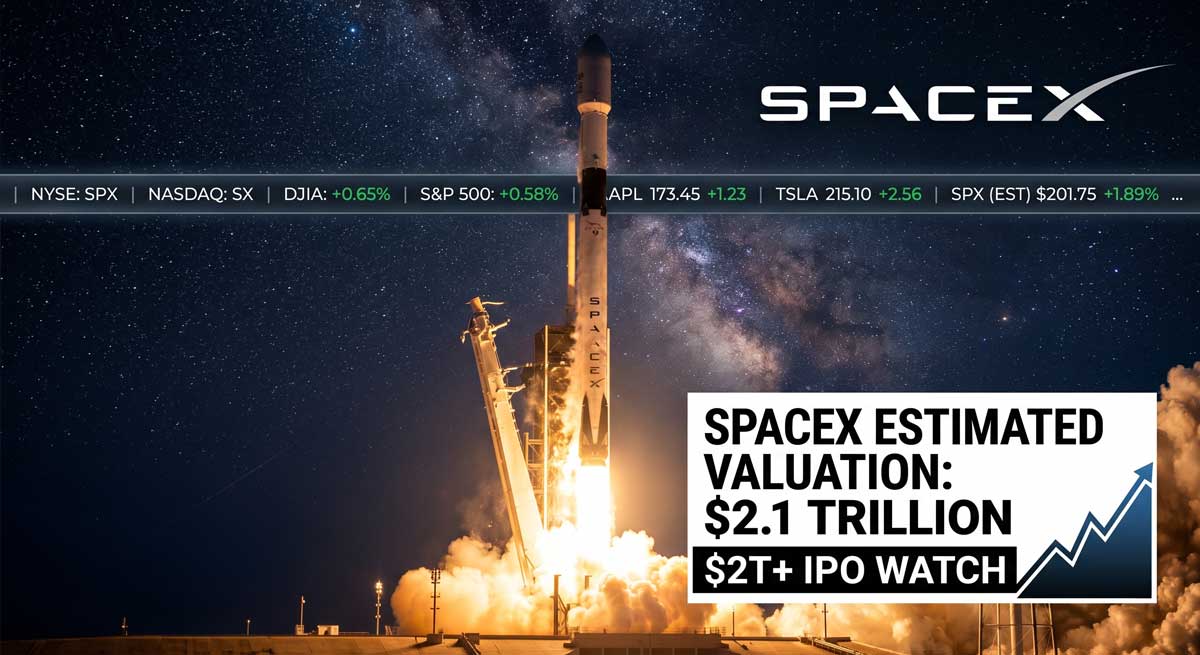
The SpaceX $2 trillion IPO, internally codenamed “Project Apex,” is shaping up to be the most consequential market event of 2026 — and possibly the most polarising. Between $30 billion and $80 billion is expected to be raised when SpaceX goes public in the summer of 2026, which would shatter the record set by Saudi Aramco as the largest IPO in history.
What makes this genuinely fascinating — and genuinely dangerous for investors — is that SpaceX is not simply selling a rocket company. It is selling a deliberately assembled composite: reusable launch vehicles, a global satellite internet network, an AI subsidiary, a social platform, and a vision of off-planet computing infrastructure. Understanding what each of these pieces is actually worth, and what threatens that worth, is the most important financial question of the year.
Table of Contents
The Asset Bundle Behind the $2 Trillion Number
Before going to market, SpaceX executed two of the most structurally unusual corporate mergers in recent memory. In early 2025, xAI — then valued at $80 billion — absorbed X (formerly Twitter) through an all-stock swap, taking on approximately $12 billion in legacy debt in the process. Less than a year later, SpaceX swallowed xAI in another all-stock transaction at a reported $250 billion valuation, anchoring SpaceX’s own valuation at $1 trillion in the process.
The resulting structure is a three-layer vertical: SpaceX as the parent, xAI as a wholly owned subsidiary, and X as a grandchild entity. Within one month of the xAI merger closing, nine of xAI’s twelve original co-founders had departed — a signal of how violently different organisational cultures can collide when speed is prioritised over integration. Rather than pause, SpaceX deployed its own aerospace executives to manage the AI division, a decision that is either a stroke of operational pragmatism or a significant talent risk, depending on how the next twelve months unfold.
The logic driving this consolidation is not hard to follow. Three financial pressures converged simultaneously: private capital markets could no longer fund the capital intensity of Starship development and orbital AI infrastructure at the required scale; longtime employees and early investors needed a genuine liquidity event after years of internal buyback programmes that barely scratched the surface; and a strategic race against OpenAI and Anthropic — both expected to go public by end of 2026 — made timing critical. Whoever lists first gets to set the valuation benchmark for the entire AI era.
Falcon 9 Economics: The Hardest Moat in Aerospace
The financial bedrock of the entire enterprise is a reusable rocket that has quietly dismantled the economics of an entire industry. In 2025, SpaceX conducted 165 orbital launches — representing 85.9% of all US launches and 50.2% of global launch activity. In terms of payload mass, the dominance is even more stark: SpaceX delivered roughly 2,630 tonnes to orbit, accounting for 82.3% of the global total.
This market position rests on an operational capability that no competitor has replicated at scale. One first-stage booster, designation B1067, has completed 34 flights and recoveries. Another, B1088, was relaunched just nine days after its previous landing. When a rocket functions more like a commercial aircraft than a single-use projectile, the entire cost structure is transformed.
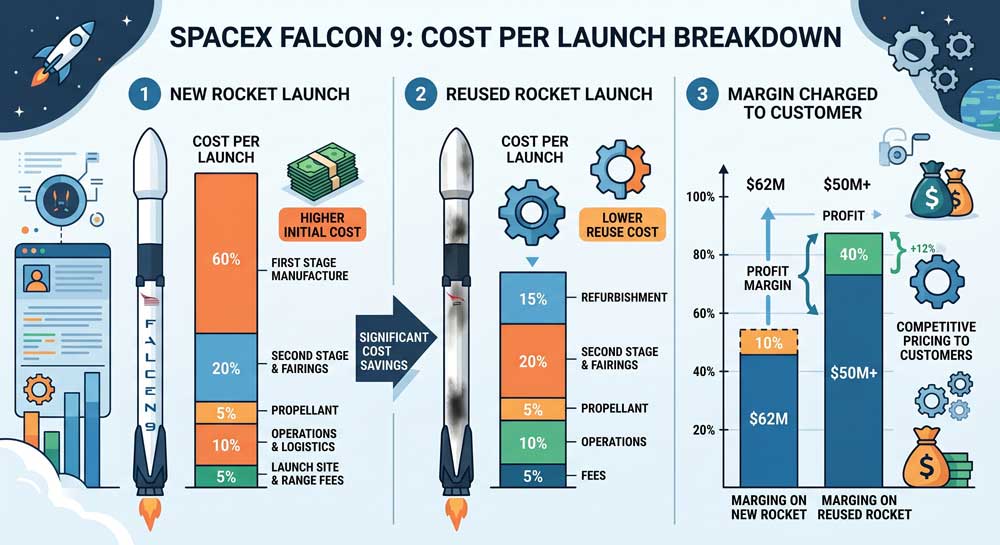
Falcon 9 Cost and Revenue Breakdown
| Cost/Revenue Item | Amount (USD) |
|---|---|
| New Falcon 9 build cost | ~$50 million |
| Marginal cost per launch (at 40 reuses) | ~$15 million |
| — Upper stage (expendable, burned on reentry) | ~$7.5 million |
| — Ground operations and transport | ~$5 million |
| — Fuel, oxidiser, and refurbishment | ~$1.5 million |
| Commercial list price (2026) | ~$74 million |
| Government/military mission pricing | $90M–$100M+ |
| Gross margin per commercial launch | ~70%+ |
At 360–400 launches per year — the trajectory SpaceX is targeting by around 2030 — and an average revenue of $80 million per launch at 75% gross margin, Falcon 9 alone could generate between $14 billion and $24 billion in annual gross profit. For context, 165 launches in 2025 implied approximately $9.9 billion in theoretical gross profit.
There is a second dimension to Falcon 9’s value that rarely gets its due: self-subsidy. Each time SpaceX launches its own Starlink satellites at near-zero marginal cost — using capacity that could otherwise be sold to paying customers — it is making an implicit investment in a recurring-revenue business that eventually dwarfs the launch business itself.
Starlink: From Rocket Factory to Global Telco
Starlink is the transformation that turns SpaceX from a capital-intensive engineering firm into something that resembles a recurring-revenue subscription business. As of Q1 2026, more than 10,000 satellites are operational in low Earth orbit, with physical capacity sufficient to support approximately four million simultaneous users streaming high-definition video. Latency sits at 20–40 milliseconds — effectively comparable to terrestrial broadband, and categorically superior to legacy geostationary satellite services.
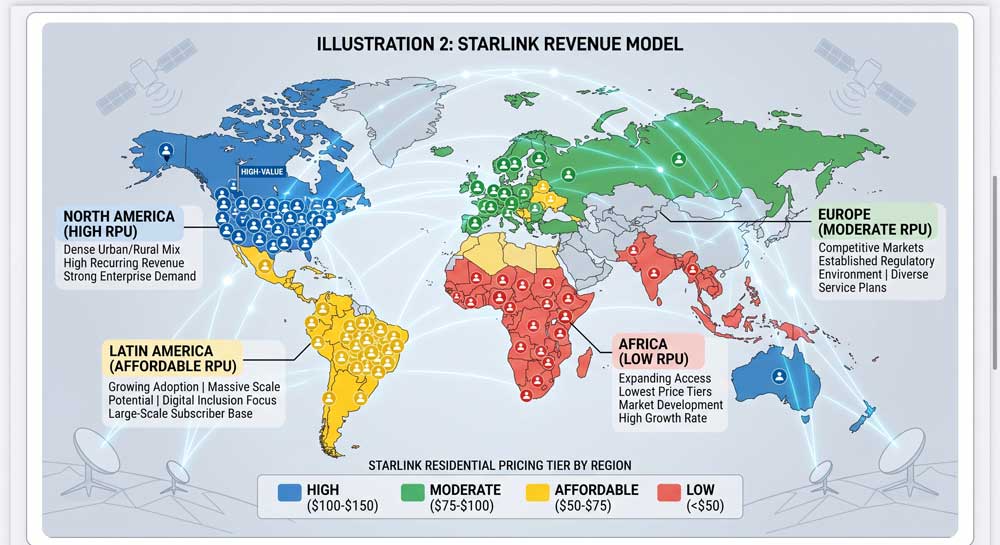
The pricing strategy is deliberately segmented by geography and use case, which is worth examining carefully.
Starlink Pricing by Segment (2025–2026)
| Segment | Monthly Price (USD) | Key Notes |
|---|---|---|
| Residential (North America/Europe) | $90–$120 | Standard home broadband replacement |
| Residential (Latin America/Africa) | $25–$45 | Localised pricing for emerging markets |
| Mobile/RV (Starlink Mini) | $135–$165 | Portable hardware; premium for mobility |
| Maritime (small vessel) | $250 | Consumer-grade marine connectivity |
| Maritime (commercial cargo) | $1,150 | Used by major shipping fleets |
| Maritime (cruise/offshore platforms) | $5,150+ | Captive market; no credible alternative |
| Aviation (per aircraft per month) | ~$25,000 | 1,400 aircraft equipped by end 2025 |
| Direct-to-Cell (D2C, via carriers) | Bundled into carrier plans | 27 carrier partners, including T-Mobile |
The aviation segment deserves particular attention: once an aircraft is certified and retrofitted with Starlink hardware, the switching cost is prohibitively high. Airline operators face complex recertification processes that make mid-contract substitution essentially impractical, which creates what amounts to a captive recurring revenue stream per tail number.
The Direct-to-Cell programme is the longer-term growth story. By deploying 650 satellites with D2C capability, Starlink now enables ordinary smartphones — without any hardware purchase — to send messages, make calls, and access low-speed data over satellite. Rather than building a consumer retail operation, SpaceX acts as a wholesale infrastructure provider to carriers who bundle the coverage into existing plans. This shifts the addressable market from tens of millions of hardware buyers to billions of smartphone users globally.
On the government and defence side, the revenue is substantial and largely non-cyclical. Contracts have included a $180 million engagement with the National Reconnaissance Office for classified satellite deployments, dedicated US Space Force communications infrastructure, and a $2 billion contract for an airborne moving target indication system. These are not supplementary — in 2025, Starlink’s total revenues including government contracts likely exceeded $18 billion, surpassing Falcon 9’s launch revenues for the second consecutive year.
The hardware manufacturing operation at Bastrop, Texas, now produces over 170,000 Starlink terminals per week — roughly 8.5 million units annually. Early-era losses of over $1,000 per terminal have been eliminated through scale, closing what was previously the biggest cash drain in the consumer business.
Starship and Space AI: The Speculative Premium
The valuation gap between what Falcon 9 and Starlink can justify on fundamentals and the $2 trillion target is filled by Starship and the orbital AI infrastructure thesis.
Starship’s core economic promise is straightforward: full first- and second-stage reusability would reduce the marginal cost per launch to roughly $10 million, translating to a per-kilogram delivery cost of under $80. Compared to Falcon 9, this would cut Starlink’s unit bandwidth cost by 70% or more on day one of operational Starship launches, and potentially over 80% at scale. A single Starship can deploy 60 next-generation V3 Starlink satellites per flight, versus a handful of smaller units on Falcon 9.
The orbital data centre concept extends this further. The pitch is that space offers unlimited solar power, a natural thermal environment for server cooling, and freedom from terrestrial land-use bureaucracy. To supply radiation-hardened chips for this infrastructure — and to support Tesla’s autonomous driving compute — SpaceX, xAI, and Intel are co-developing a semiconductor fabrication facility in Texas called Terafab, targeting 1 terawatt of annual AI compute output, with 80% designated for space deployment.
Here is where I think investors need to be most cautious. The physics of orbital data centres present unsolved engineering challenges: vacuum environments cannot dissipate server heat through convection, requiring enormous radiator arrays; high-energy cosmic radiation causes frequent bit-flip errors and hardware degradation; and failed units become unserviceable debris. SpaceX’s own S-1 filing, as reported by Reuters, explicitly warns that these space AI computing concepts involve “unproven technology” that “may never achieve commercial viability.”
The capital cost estimate for Terafab’s production targets ranges from $5 trillion to $13 trillion according to some analyst models — a figure that would consume every dollar of free cash flow Starlink generates for decades.
On the xAI side, Grok has not yet achieved consistent top-tier benchmark performance despite enormous compute investment. The organisational model that made SpaceX exceptional — identifying the critical engineering lever in a long physical chain and compressing timelines through first-principles physics — may not translate directly to AI development, which rewards broad systematic planning and organisational learning at scale. The competitive pressure from OpenAI and Anthropic is real, direct, and increasing.
Space AI vs. Terrestrial AI: Risk Comparison
| Factor | Orbital AI Data Centre | Terrestrial AI Data Centre |
|---|---|---|
| Power source | Solar (unlimited in theory) | Grid + renewable (scalable) |
| Cooling | Radiative only; limited | Air/liquid cooling; well understood |
| Radiation hardening | Required; unproven at scale | Not required |
| Hardware repair | Impossible post-deployment | Routine |
| Regulatory approval | Orbital slot coordination | Land use and grid approvals |
| Capital cost estimate | $5–13 trillion | ~$1–2 trillion for comparable capacity |
| Commercial viability | Unproven | Demonstrated |
The Musk Risk Factor: The Biggest Variable Nobody Can Model
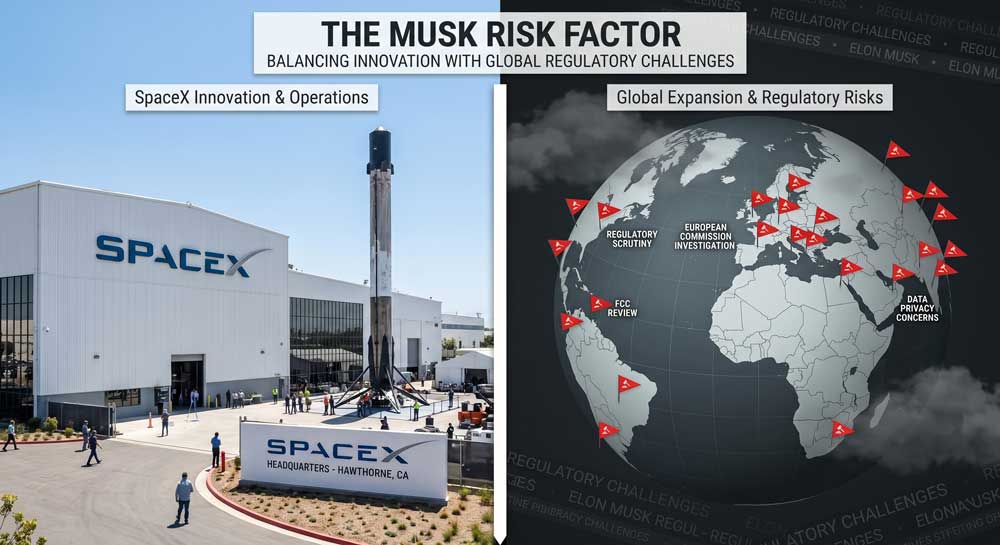
I want to be direct about something that Wall Street tends to price in as abstract risk but which I think deserves concrete treatment: Elon Musk is simultaneously SpaceX’s greatest asset and its most uncontrollable liability.
The $2 trillion valuation is, in substantial part, a premium for Musk’s personal execution history and vision. That is a legitimate basis for a premium in a private market context. It becomes structurally dangerous in a public market where daily share prices respond to individual statements, social media activity, and regulatory confrontations.
Consider the exposure. Musk is managing four major enterprises — Tesla, SpaceX, X, and xAI — with his attention divided across all of them. He has used complex cross-collateralised equity structures to link X’s legacy debt obligations to SpaceX and xAI equity. A personal liquidity crisis, or a stress event in X’s balance sheet, could create contagion pressure on SpaceX shares in the secondary market.
The regulatory dimension is arguably more dangerous for long-term business health. In the US, the FAA-Starlink conflict of interest complaint — filed by the Campaign Legal Center after Starlink was awarded an FAA contract while Musk was simultaneously advising on federal spending cuts — created a direct reputational and legal overhang. In Europe, X’s clashes with the EU’s Digital Services Act have placed the entire Musk-associated brand in adversarial standing with the bloc’s regulatory bodies. In Australia, Starlink has already received formal warnings from the Australian Communications and Media Authority (ACMA) after missing four separate regulatory reporting deadlines.
This matters for a very specific reason: Starlink’s cash flow depends on two things — consumers choosing to subscribe month after month, and governments approving and maintaining operational licences. Both are vulnerable to brand damage. Tesla’s North American brand value fell 26% within a year as Musk’s political activities intensified. If a comparable dynamic reaches Starlink, the subscription churn risk and government contract exposure would cut directly into the recurring revenue foundation that underpins the entire valuation.
The proposed share structure amplifies this risk rather than containing it. Reports indicate that Musk may retain approximately 79% of voting control through a dual-class structure while holding roughly 42% of equity. Additionally, up to 30% of the IPO allocation may go directly to retail investors — compared to the traditional 5% for technology listings — with the standard 180-day lockup period potentially waived entirely.
If accurate, this means that on day one of trading, an enormous volume of retail-held shares will be liquid and responsive to Musk’s own public statements, with no institutional lockup buffer to dampen volatility. The result would be a stock whose price movements are determined less by quarterly earnings and more by the Twitter feed of its controlling shareholder.
What This IPO Actually Means for the Market
The timing is not accidental. By listing in summer 2026 ahead of the anticipated OpenAI and Anthropic IPOs, SpaceX is competing directly for institutional capital allocation. Large funds have finite mandates for technology and growth exposure. A $30–$80 billion capital raise by SpaceX materially reduces the dry powder available for AI-pure-play listings later in the year.
For individual investors, the SpaceX $2 trillion IPO offers genuine exposure to the most operationally proven private aerospace and satellite business in history — but bundled with speculative AI infrastructure bets, unresolved governance concerns, and a controlling shareholder whose public conduct has already demonstrated the capacity to move markets in ways that are disconnected from underlying business fundamentals.
The Falcon 9 and Starlink businesses are real, defensible, and impressive. The question is whether you are paying for those businesses, or for the story wrapped around them.
The SpaceX $2 trillion IPO is the clearest test yet of whether public markets will price a company on what it earns or on who controls it. The Falcon 9 moat is real, the Starlink cash flow is real, and the competitive threats from Amazon’s $11.5 billion Globalstar acquisition — which secured critical spectrum and an existing Apple partnership to compete directly in the direct-to-cell space — are also real. What cannot be priced with any precision is the man holding 79% of the votes.
Reference URLs
- Forbes Australia — Starlink numbers could bring SpaceX’s valuation crashing down
- NPR — Can the Global South trust Starlink?
- Forbes — Elon Musk Conflicts of Interest: FAA-Starlink Deal
- FedScoop — As Trump and Elon feud, government demand for Starlink grows
- Information Age Australia — Elon Musk doesn’t care what the Australian govt says
- ARN Australia — Starlink satellites posing cyber security and regulatory concerns
- ElevenLab — Massive Asian Stock Market Outflows: 3 Devastating Reasons Why $52 Billion Has Fled
- ElevenLab — Must Read: The 2028 Global Intelligence Crisis and the “Ghost GDP”
- ElevenLab — The $5 Trillion AI Investment Bubble: Can the Boom Outrun Reality?